
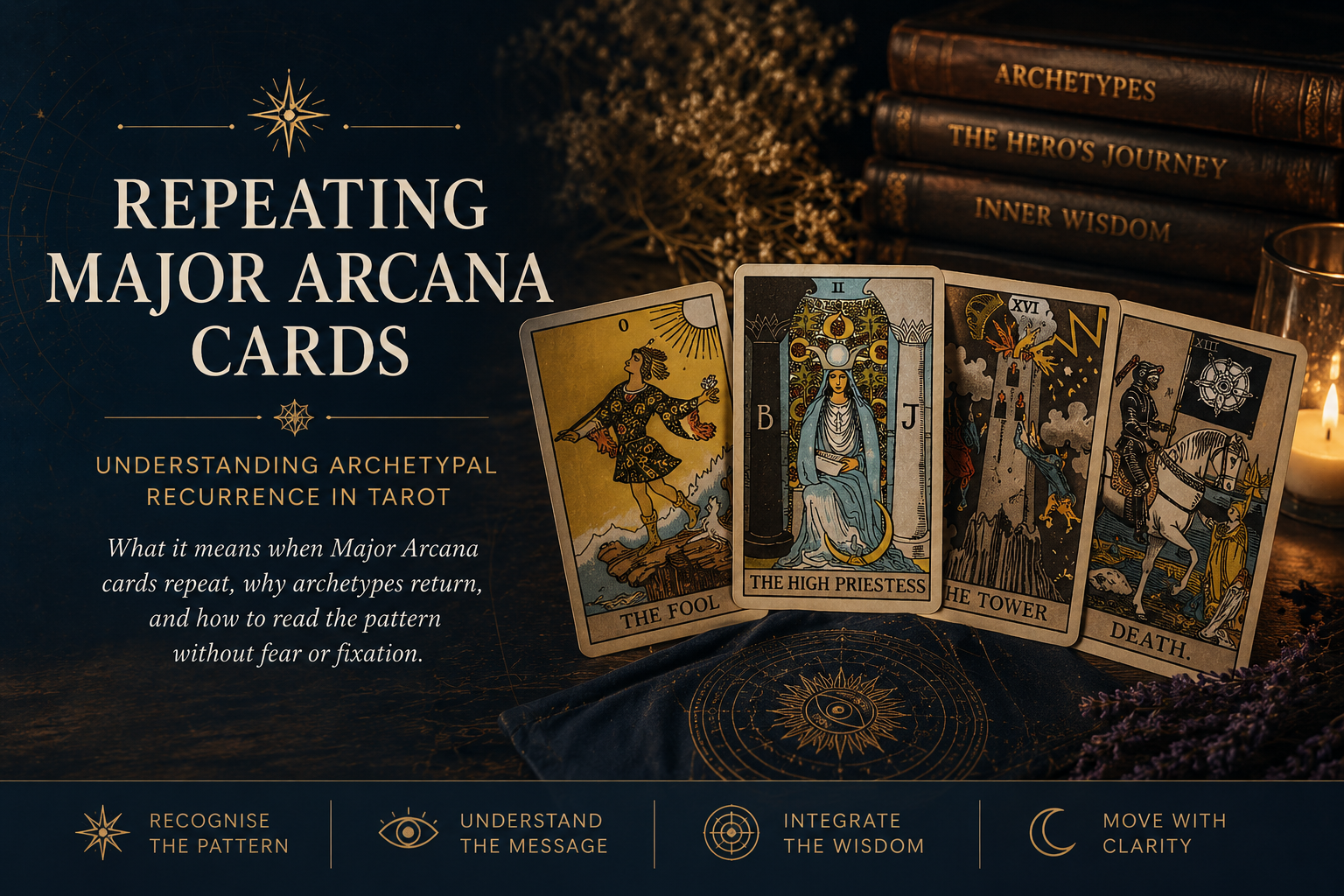
A Minor Arcana card that keeps returning is pointing at a pattern. A Major Arcana card that keeps returning is pointing at a theme. The difference is in the scale of what is being asked to be recognised.
When a Major Arcana card appears repeatedly in your readings, the experience tends to feel weightier than a recurring minor. There is a quality of inevitability to it, a sense that something significant is pressing for attention. That sense is not wrong, but it does require careful reading. Major Arcana repetition is sustained symbolic pressure from the archetypal layer of experience, and understanding what kind of pressure it represents is the difference between interpreting the pattern and being overwhelmed by it.
Why This Matters
The Major Arcana cards represent archetypal forces: the large-scale themes of human experience that do not belong to any single situation but to the recurring patterns of a life. The Tower does not mean only this particular disruption. It names a quality of disruption, the kind that reveals a false foundation, that appears again and again across a life in many different forms. The High Priestess does not mean only this particular moment of uncertainty. She names an entire territory of inner knowing and its relationship to outer action.
When a Major Arcana card repeats, it is almost always pointing toward one of these larger territories rather than a single situational headline. The card names something that is already present in the reader’s life as a sustained pattern, an active theme, a recurring quality of experience that has not yet been fully recognised, understood, or integrated.
This is why Major Arcana repetition tends to feel significant. It is significant, in the specific sense that it is pointing at something of genuine weight. But significance is not the same as doom, and the appropriate response to a repeating major is not anxiety but investigation: what large-scale theme is this card naming in my life right now, and what remains unresolved within it?
How to Interpret the Pattern
A Major Arcana card that recurs is asking to be read at the level of life theme rather than situational message.
The difference between these two levels of reading is practical. Reading at the level of situational message, you ask: what does this card mean for the situation I am currently in? Reading at the level of life theme, you ask: what recurring quality of experience does this card represent, and where is it active in my life across multiple situations, relationships, or time periods?
A repeated major is almost always better served by the second question. The card is not commenting on one situation. It is pointing at something that is running as a background condition through multiple areas of the reader’s life, or across a significant span of time.
When you identify which archetypal territory the repeating major belongs to, the interpretation opens in the right direction. Initiation cards (The Fool, The Magician) point toward an unbegun beginning, an unlaunched capacity, or a threshold that keeps being approached without being crossed. Reckoning cards (Justice, Judgement) point toward something unacknowledged that is pressing toward clarity, or a verdict on one’s own life and choices that is being resisted or avoided. Disruption cards (The Tower, Death) point toward an ending or a revelation that has been delayed, avoided, or imperfectly integrated. Inner knowing cards (The High Priestess, The Hermit) point toward a relationship with interior intelligence that is being strained, ignored, or not yet given the conditions it requires. Integration cards (Temperance, The World) point toward a wholeness or completion that is available but has not yet been fully inhabited.
Reading the repeated major in light of its archetypal category allows the reader to ask not just “what does this card mean?” but “what kind of work is this card pointing toward, and where is that work currently incomplete in my life?”
What Not to Assume
Two assumptions about repeating majors are worth naming and setting aside.
The first is that repetition makes the card’s territory more severe. A reader who draws The Tower three times is not facing three times the disruption of a reader who drew it once. The card is not multiplying the intensity of its meaning. It is persisting in pointing at something that has not yet been adequately engaged. The repetition is a measure of persistence, not of catastrophe.
The second is that a repeating Major Arcana card represents fate in a deterministic sense. The Major Arcana describe archetypal forces, not fixed outcomes. The Tower does not foretell an unavoidable collapse. It names a pattern of building on false foundations, and the card returns as long as that pattern remains active. The reader has genuine agency in how they engage with the territory a repeating major is pointing toward. The card is not a sentence. It is an extended invitation.
A third assumption, subtler than the other two, is that the card’s darkest or most dramatic interpretation is the most accurate. Major Arcana cards carry wide symbolic ranges. When a reader is under emotional pressure, they tend to contract toward the most alarming reading of any card they encounter, and Major Arcana cards, given their archetypal weight, are particularly susceptible to this contraction. The most accurate interpretation of a repeating major is usually not the most frightening one. It is the most honest one, which requires looking clearly at what is actually happening in the reader’s life rather than what the card’s most dramatic symbolism might suggest.
Examples by Archetypal Category
Initiation: The Fool and The Magician
The Fool repeating is almost always pointing at a threshold that keeps being approached without being crossed. The beginning is available. The capacity to step into new territory is present. What remains is the willingness to commit to genuine uncertainty, to release the known arrangement and accept that what comes next cannot be fully planned in advance. The card returns because the step has not yet been taken, not because it is unavailable.
The Magician repeating tends to mark a reader who has the resources, the skills, and the capacity for directed action but is not yet deploying them in their full configuration. Something is being held back, underused, or not yet organised into genuine intentional effort. The card’s return is asking what is preventing the full exercise of the capacity that is already present.
Reckoning: Justice and Judgement
Justice returning repeatedly is pointing at something that requires an honest accounting: a decision that has been made by default rather than by genuine deliberation, a consequence that has been avoided rather than acknowledged, or a standard being applied inconsistently in ways the reader has not fully examined. The card is asking for the kind of clear-eyed assessment that is uncomfortable but necessary.
Judgement repeating marks a reader in the process of being called back to themselves: not toward a better version so much as a truer one. It is a reckoning with the choices, directions, and accumulated compromises that have led away from what the reader actually values and actually knows themselves to be. The card returns when that summons is being heard but not yet fully answered, when a significant reorientation is available but not yet committed to.
Disruption: The Tower and Death
The Tower returning again and again is pointing at something built on a false foundation that has not yet been honestly examined. The repetition is not announcing a series of imminent collapses. It is pointing at the specific pattern of building on unexamined premises, false certainties, or ego investments that keep attracting disruption because the foundation beneath them is not solid. The work is to examine the foundation before the lightning arrives rather than waiting for the disruption to reveal what could have been seen.
Death repeating marks a reader who is in a significant ending that has not yet been fully inhabited or completed inwardly. Something is over, or has been over for longer than it has been acknowledged, and the work of genuine transition, including the grief, the release, the genuine relinquishing of what was, has not yet been done. The card returns because the threshold has been reached but not fully crossed.
Inner Knowing: The High Priestess and The Hermit
The High Priestess returning is pointing at an interior intelligence that is present but not being consulted, trusted, or given the conditions of stillness and quiet it requires. The reader already knows something relevant to the situation at hand. The card’s repetition is not adding new information. It is directing attention back toward the knowing that has been there all along and has been consistently bypassed in favour of external confirmation or rational analysis.
The Hermit repeating marks a reader who is being called toward a more deliberate engagement with solitude, with their own inner light, with the particular quality of knowing that only comes through withdrawal from the noise of external life. This is not isolation as avoidance but solitude as practice: the willingness to be genuinely alone with what one already knows, without the distraction of company or activity.
Integration: Temperance and The World
Temperance returning repeatedly is pointing at an imbalance that has not yet been acknowledged and addressed. Something in the reader’s life, whether an emotional pattern, a relational dynamic, a pace of living, or a relationship to their own needs and limits, is out of proportion, and the card is asking for the kind of patient, deliberate rebalancing that does not happen all at once but through sustained, careful attention over time.
The World repeating is one of the less common patterns and tends to mark a reader who is approaching a significant completion but has not yet fully arrived at it, or who has reached a genuine threshold of integration and wholeness but is hesitating at the doorway. The card’s return is an invitation to inhabit the completion that is available rather than continuing to circle it.
How to Work With the Pattern
When a Major Arcana card keeps returning, the most useful question to bring to it is not “what is going to happen?” but “what is this card’s archetypal territory, and where is that territory active in my life right now across more than one situation?”
Identify which life areas are touched by the card’s symbolic range. A repeating major will almost always be active in more than one area simultaneously. The Tower might be touching a professional structure and a relational belief system at the same time. The High Priestess might be relevant to both a creative project and a relationship decision. Seeing where the card’s territory is present across the reader’s life helps clarify the larger theme the repetition is pointing toward, rather than narrowing the reading to one situation.
It also helps to read the card’s full symbolic range rather than its most prominent meaning. The Tower is not only about sudden disruption. Death is not only about endings. Every major carries a wider interpretive field than its headline image, and the repeating card is often asking the reader to look closely at a dimension of its meaning they have not yet examined.
Give the pattern space rather than pulling more cards to decode it. A repeating Major Arcana card is not asking for more interpretation. It is asking for genuine engagement with what it has already named.
The Repeating Card Meanings Library
Each of the Major Arcana cards has a full interpretive entry in the Repeating Card Meanings library that explores specifically what the card is pointing toward when it repeats. These entries go beyond general card meanings to address why the energy persists, what sustains the pattern, what would allow it to shift, and how to work with what the card is pointing at across every major life area.
Use the interactive repeating card selector when you want to jump straight to one card’s full entry.
The full library covers all 22 Major Arcana and all 56 Minor Arcana cards with the same depth of focus on repetition as a pattern rather than repetition as a series of individual messages.
A Note on The COMPASS Method™
When a repeating Major Arcana card has begun to feel oppressive rather than clarifying, or when the reader’s emotional state is making it difficult to engage with the card’s territory without distortion, The COMPASS Method™ offers a structured way to stabilise interpretation. Major Arcana cards, precisely because they carry significant symbolic weight, are particularly susceptible to being read through the lens of fear or unresolved expectation. The method is designed to interrupt that distortion and return the reading to what the card is actually pointing toward.
For the general framework on any repeating card, start with Why the Same Tarot Card Keeps Appearing. For recurrence versus stalker-card language, see Repeating Cards vs Stalker Cards.