
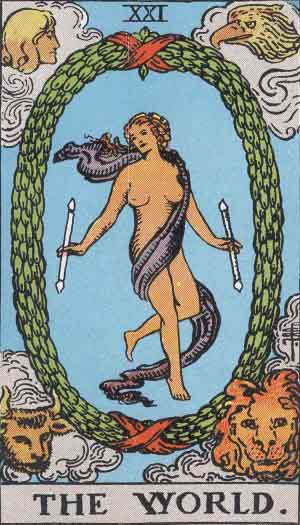
The dancer at the centre of the wreath embodies a completed cycle while remaining in motion. The question is what has truly finished, and what still requires honest attention.
Core Repeating Message
The World is the final card of the Major Arcana, and it arrives as the conclusion of an extraordinary arc: from the Fool’s unguarded leap into experience, through initiation, disruption, surrender and transformation, through the Moon’s dark pool and the Sun’s full warmth and Judgement’s rising, to this: a figure dancing in the centre of a great wreath of victory, one leg raised, a wand in each hand. At the corners are the bull, the lion, the eagle and the human figure, traditionally associated with the four fixed signs of the zodiac and the four evangelists. Read through the four elements, the four directions and the four dimensions of experience, these figures give the image its sense of an encompassing whole.
The wreath is oval, and the figure within it is enclosed and free simultaneously. Enclosed by the completeness of the cycle, free within that completeness to dance. The dancer does not look anxious. She does not look finished, in the sense of having stopped. Her posture suggests the card’s central meaning: she is in movement, and the movement is the completion. The image suggests a cycle whose learning has been lived, integrated and embodied, rather than merely declared complete. That is a way of inhabiting this stage of experience, not a claim that every part of a person is finished.
When The World appears repeatedly, one useful question is: what evidence shows that a cycle is complete, and what would it mean to acknowledge that completion without declaring the whole self finished?
The World’s emphasis is on arrival rather than endless approach. The Fool approaches. The Magician begins. The cards from zero to twenty trace the journey through the arc; The World gives its culmination an image. When it keeps appearing, a useful question is whether an arrival is being overlooked, or whether something still needs to be completed before that recognition would be honest.
Resistance to arrival takes many forms. It can be subtle precisely because a person has already done considerable developmental work. They have done real work. They have navigated real initiations. They may have passed through experiences they once doubted they could manage, yet still find it difficult to trust or acknowledge the result. The World need not be read as a judgement of inadequacy. It can ask why something significant has not been fully inhabited, while leaving room for the possibility that the hesitation concerns unfinished work rather than an inability to arrive.
There are several primary patterns this card marks when it appears repeatedly.
The first is the completion-avoider: the seeker who is skilled at development but uncomfortable with completion, who can begin brilliantly, can sustain through the difficult middle, and who consistently finds ways to avoid the final step that would constitute a completed cycle. The project that is ninety-five percent done and has been ninety-five percent done for six months. The degree that is essentially complete but somehow never officially finished. The relationship in which a mutually wanted choice remains indefinitely under discussion, without either person naming what is needed to decide. The creative work that is ready to be offered but that is always in one more round of revision. These examples invite examination of the seeker’s relationship to completion itself, particularly if the same pattern appears across several domains. The remaining requirements still need to be checked before delay is called avoidance.
The second is the integration-incomplete seeker: the person who has done significant work in the individual domains of their life but who has not yet brought those domains into a workable synthesis. They have developed spiritually, and professionally, and relationally, and creatively, but these different dimensions of their life are not yet integrated: they are still somewhat separate compartments, each with its own development, its own logic, its own relationship to the seeker’s sense of who they are. The dance at the centre of The World gives this missing relationship an image: a person bringing all four corners of experience into the same life.
The third is the completion-sceptic: the seeker who understands intellectually that life is cyclical, that The World’s completion is followed by The Fool’s new beginning, that the end of one cycle is the beginning of the next, and who is using this understanding as a reason not to allow any particular cycle to complete. If completion is always provisional, always followed by a new beginning, why does this particular completion matter? The card’s answer is that a bounded ending still matters: acknowledging what has been done allows its learning to inform what follows. The Fool’s next leap can be read as beginning from that edge, rather than continually circling an unfinished chapter. Life’s cycles can overlap, but their overlap does not make every ending meaningless.
The fourth is the wholeness-doubter: the seeker who has developed enough self-knowledge to be aware that their development is still incomplete in specific ways, and who is using this awareness as a reason to discount or disqualify a completion that is available at the current stage of their life. They are waiting for the version of themselves that is more fully developed before allowing the current version to arrive anywhere. But The World does not depict a perfect figure. It depicts a fully present one, which is different: someone who is completely inhabiting what they are, in this moment, in this stage of the arc, without waiting for a more perfect future version of themselves to show up first.
The fifth is the contribution-threshold seeker: the person who has developed understanding or capacity and is deciding whether, how, and for whom it should be offered. The World can symbolise contribution, but privacy is not hoarding and no gift creates an automatic duty of public service. The question is whether an offering is genuinely wanted, responsibly prepared, and compatible with the seeker’s limits and obligations.
Twenty-one brings the sequence to maturity and can be read as seven multiplied by three. Seven evokes the Chariot’s directed will and the symbolism of completeness; three contributes the creative trinity, the movement of beginning, middle and end, and the triangular synthesis in which two things together produce something new. The wider arc also carries the Hermit’s interior wisdom and the Star’s hope. Within this numerological reading, The World brings will and creative completeness together: developed capacities form a living whole, capable of expression across the four dimensions of human experience.
For the seeker who keeps drawing this card, the work may be to inhabit an arrival: to let developed capacities become part of ordinary life, to give integrated understanding a form of expression that fits, and to allow a cycle that has met its completion criteria to close. The fullness of The World’s dancer is grounded in what has been lived. It need not wait for a flawless self, and it need not become an offering larger than the seeker wishes or is able to make.
This is not a passive state. The dancer is not sitting. She is in motion. The World’s completion is not the end of engagement but the transformation of engagement: from the effortful, initiatory, crisis-navigating quality of the preceding cards towards a mastery in which learned responses become more available and less consuming. The difference between working and dancing is not about the absence of effort; it is about the relationship between the self and the work. The dancer and the dance are not separate. In moments of integration, the seeker can feel less divided from what they are doing and, where they choose to contribute, from what they are offering. The dance still involves attention and care; its freedom lies in a changed relationship to the movement.
When This Card Repeats Weekly
The World appearing multiple times in a single week may draw attention to an immediate completion, transition, or moment of integration. It does not confirm that a cycle is finished. The seeker can compare the symbolic theme with concrete criteria, outstanding duties, and the views of people affected.
A weekly appearance may fit the seeker in the final stages of a significant cycle: a project, a relationship transition, a developmental arc, a creative work, to which they are applying one more round of revision, one more deferral, one more reason why completion is not quite available. Repeated draws can bring the question into focus without answering it. Is the delay improving the work or protecting a necessary condition, or has it become a way to avoid the vulnerability of finishing and, where appropriate, offering the result? Looking at the actual remaining tasks helps separate these possibilities.
A World week may also mark the seeker who is in a full and abundant period: who has multiple dimensions of their life working, alive, in correspondence with what matters to them, and who is not fully inhabiting this quality of whole abundance because it is unfamiliar, or because the habit of attention to what is not working is stronger than the practice of presence in what is already sustaining them.
When This Card Repeats Monthly
A World month can bring a sustained encounter with the possibility of completion: something significant may be nearing its end, or an achievement may already be available to live from more fully. The focus is the seeker’s relationship to that arrival over time, as the first recognition settles into daily choices and the remaining work becomes clearer.
This may be a month of celebratory fullness: where several strands of work and development are paying off in ways that are visible and real, and where the seeker is learning, over the course of the month, to receive and live with the results of growing competence. The card appearing month after month in this context is asking the seeker to be in it: to acknowledge and enjoy what is present rather than immediately moving the attention to what is still incomplete or what comes next.
A monthly World pattern may also accompany work on the specific dimension preventing practical completion. The month becomes a period for testing what remains, distinguishing necessary work from perfectionism, and defining a credible stopping point. The card offers a reflective frame, not confirmation that the chosen work is sufficient.
When This Card Repeats Seasonally
A season of World energy can be a rewarding developmental period: a sustained encounter with completion, integration and arrival at a stage that gathers the work of a significant arc. Over a season, there is time to recognise what has changed and to let the consequences of that arrival become part of ordinary life.
Seasonal World appearances can frame reflection on the culmination of significant developmental chapters: the completion of long-term professional or creative projects that have consumed years of development and are now ready to be offered; the arrival at a stage of personal or psychological development that is different in quality from what preceded it; the integration of a spiritual understanding that has been developing across multiple chapters and is now embodied rather than simply understood; the arrival at a form of whole-life synthesis in which multiple dimensions of experience are in correspondence.
The quality of completion explored in a World season cannot be manufactured by declaring the work done. It develops through the work itself and the recognition of what that work has made possible: a sense of rightness, of presence, of dancing rather than always rehearsing. The earlier stages remain valuable, including what is still difficult to integrate. A seeker may feel the fullness of arriving somewhere real without feeling it continuously or needing that feeling to certify that every obligation has been met.
When This Card Repeats Across Years
The World appearing across years invites a broad, multidimensional inquiry into integration: how the parts of a life come into relation, how completed chapters are acknowledged, and how the seeker learns to live from what those chapters have taught. Wholeness here is an ongoing relationship with experience, rather than an ultimately finished self.
This pattern can speak to seekers engaged in work that spans years or decades: creative work that is ambitious in scope, service work that corresponds to a deep calling, spiritual or psychological development that is comprehensive in its engagement with the full scope of human experience. The World across years does not mean that these seekers have achieved some permanent state of completion; it means that the recurring encounter with the question of arrival and integration is a central and sustained feature of their development, and that each return can invite consideration of a new layer of the same essential invitation.
The long-arc World pattern can belong to a seeker working towards a completion large enough to require sustained development across years: a body of work, a long responsibility, or the integration of extensive experience. Each appearance can prompt a progress review, but the card itself cannot measure advancement or guarantee eventual completion.
A second possibility is the seeker who has been resisting arrival across years: who has maintained a sustained stance of approach without arrival, who has developed significantly but has not yet allowed the recognition of what their development has produced, who is far along in their development and is, year after year, encountering the same essential invitation to inhabit what they have arrived at. The long-arc pattern here is the sustained encounter with resistance to arrival, which is typically rooted in something about the seeker’s relationship to completion itself, to wholeness, or to the vulnerability of full expression.
The growth arc explored through The World across years is from approached to inhabited: from the seeker who is perpetually in the vicinity of completion without quite arriving, to the seeker who has learned to inhabit arrival at each stage of the arc while remaining open to the next Fool’s leap that completion can make possible.
Life Area Interpretations
Love & Relationships
In love and relationships, The World’s repetition can bring attention to the possibility of sustained intimacy and integrated partnership, or to the completion of a relational chapter. The question is what is available between the people involved and whether it is being fully recognised, rather than whether commitment must follow from the card.
One relational World pattern is the seeker who is in a genuinely good relationship that they are not fully inhabiting: who has love, compatibility and shared direction, and who is not quite fully present, not quite fully committed, not quite fully inhabiting the completeness of what the relationship offers. There may be an unresolved dimension, an unexplored territory, a remaining hesitation, that is making it difficult to settle into the relationship. The card appearing repeatedly is asking what would allow fuller presence: what the remaining hesitation concerns, whether it identifies an unmet need or a question of safety or consent, and whether a familiar discomfort with commitment also plays a part.
A second pattern is the seeker who has completed a significant relational chapter and finds it difficult to turn towards what follows. They may still be looking back, carrying grief or trying to understand what the ending means, rather than feeling ready for the next Fool’s leap. This is the space between a completed arc and a new beginning. Acknowledging the ending can matter without requiring immediate release of attachment or the start of another relationship; the new chapter may begin with learning how to live differently within the life already here.
The card can also speak to a time when the seeker has integrated significant relational learning, perhaps across multiple chapters and multiple relationships, and is now carrying a quality of relational wisdom and relational wholeness that is different from what they brought to earlier relationships, and which could support a different kind of partnership when brought into a mutually wanted relationship.
Career & Purpose
In career and purpose, The World’s repeated appearance can mark work nearing a defined completion, the integration of several capacities into one role, or the need to recognise a professional chapter that has already ended. It should not be taken as proof of a singular life’s work or as evidence that hesitation is merely resistance.
One professional World pattern is the seeker whose work appears ready by agreed standards but remains in revision. Another is the person being pressured to launch before legal, ethical, technical, financial, or accessibility requirements are met. The card asks for an explicit definition of done, independent review where relevant, and a distinction between perfectionism and due diligence.
The integration dimension is particularly significant in professional and purpose contexts: The World’s completion can be read as bringing developed capacities into a coherent expression. A seeker may have several streams of skill, several kinds of understanding and several domains of contribution, yet not have found a form in which these can inform one another. The card can help frame that search without proving that synthesis is close. The expression may be one role or body of work, or a relationship among several commitments; coherence does not require every capacity to fit into a single occupation.
Money & Stability
The World’s relationship to money can concern the capacity to receive material sufficiency when it is present: to recognise the security that has been built rather than immediately directing attention elsewhere or minimising its value. Completion does not itself produce abundance. The question is how the seeker relates to the resources they actually have, alongside the commitments those resources still need to support.
One financial World pattern is the seeker who has arrived at a level of material sufficiency, who has the material conditions in place for the life they have been developing, and who is not quite inhabiting the security that this sufficiency could provide. They are still operating in the anticipatory anxiety, the expectation of insufficiency, the vigilance about scarcity, that characterised earlier chapters when material security was less stable. The World can prompt a careful question: if the figures, obligations and foreseeable risks support the sense that conditions have improved, can you begin to experience some of that security? Earlier uncertainty may take time to stop shaping the present.
A second pattern concerns the financial implications of bringing a developed contribution into fuller circulation. The seeker may underprice, delay, or limit its reach, but this does not mean abundance is guaranteed or that income is being unconsciously refused. Market conditions, access, discrimination, care duties, risk tolerance, and business design all belong in the assessment.
Spiritual Growth
Spiritually, The World is the destination of the Major Arcana arc: an image of learning brought into a way of being, of presence across the four dimensions of experience, and of what integrated understanding may offer to the wider whole. It gathers the arc’s lessons into lived expression, whether that expression is public service, care within a small circle, or a private way of meeting daily life.
This is not spiritual enlightenment in the sense of a permanent, unchanging, beyond-ordinary-human-experience state. It is a demanding possibility within ordinary life: inhabiting human wholeness through the integration of shadow and light, depth and surface, individual and collective, sacred and mundane. The dancer does not escape the wreath; she is freely and joyfully present within it.
The World’s spiritual invitation, when the card appears repeatedly, is towards integration rather than escape from ordinary life: towards bringing what has been understood in the spiritual dimension into correspondence with the full scope of the daily, embodied, relational, material life, rather than maintaining the spiritual as a separate and elevated domain above the ordinary life. The spiritual completion that The World represents is specifically the integration of the spiritual and the ordinary into a more coherent way of being in which spiritual understanding can shape ordinary choices.
The spiritual seeker who draws The World repeatedly may have developed significant spiritual depth and significant spiritual understanding, and may now be considering how to bring that depth and understanding into fuller embodiment: to dance with it in the world, letting it shape how they live, relate, work and contribute where they choose. An understanding can remain private while still changing the way a life is lived.
Emotional & Mental Patterns
In the emotional and mental domain, The World’s repeated presence can draw attention to emotional and psychological development that has arrived at something real, something different from where it began, and to the possibility that the seeker is not yet fully inhabiting what that development has produced.
The emotional signature of the World pattern is a particular kind of fullness: a quality of sufficiency, integration and being at home in one’s own experience, different from either the striving of earlier development or the satisfaction of specific achievements. Its emphasis is not excitement but completion, not the peak of intensity but a sense of whole presence. And it may be, for the seeker who has spent significant time in the initiatory phases of the arc, unfamiliar, even uncomfortable after so much striving.
Mentally, The World pattern can speak to the seeker who has developed a sophisticated and integrated understanding of themselves and their life, and who is not yet fully trusting this understanding as a basis for action and commitment. They are still, at some level, looking for the next insight, the next self-understanding, the next layer of analysis, when there may already be enough understanding to support a considered step. Further analysis can deepen that understanding, but it can also become a way of postponing the vulnerability of acting on it.
Family & Generational Dynamics
The World in family and generational contexts can represent a synthesis of family inheritance: engaging with what was given, keeping what has proved valuable, and questioning burdens that are not the seeker’s to carry. Something new can take shape in their own life and, where contact is wanted and safe, in their presence within the family system. The synthesis need not erase the past or resolve every inherited difficulty; it concerns how that history is being lived with now.
This can be significant ancestral work. Repeated World appearances may give the seeker a frame for recognising a synthesis that is developing, or one already influencing the life more than they have acknowledged. Someone who has examined what was transmitted and chosen what to carry forward may have something different to offer within the family or to later generations. That possibility can be recognised without making them responsible for completing everyone else’s work, and without requiring the family to understand or approve the change.
The generational dimension of The World concerns how one person’s integration may change what is passed on. A seeker who has worked with their own development, including their family inheritance, can offer a different quality of presence or understanding to those who follow. Its effects will vary; no one can determine the experience of every later generation. The four figures around the dancer give this reading an image of wider relation: a life is lived among others, and what is learned within it may become available beyond its immediate circle.
Health & Energy
In health and energy readings, The World can symbolise the experience of integrating several strands of care, adapting to a changed body, or recognising progress within an ongoing condition. It does not diagnose wellbeing, predict recovery, or show that wholeness is available if only the seeker will inhabit it.
The most direct form is the seeker coordinating treatment, rehabilitation, nutrition, movement, rest, access needs, or daily routines into a workable whole. Progress can be recognised through evidence and lived function, while setbacks and permanent changes remain possible. The card is not confirmation that an intervention is working and should not replace qualified review.
The integration dimension is significant here because health is lived across physical, emotional, social, practical, and meaning-making contexts. Integration means that care plans, limits, support, and daily life can coexist more coherently, not that every symptom disappears. Persistent, severe, or sudden symptoms require appropriate professional assessment, and urgent symptoms require urgent care.
Advanced Interpretive Sections
The Shadow Expression
The World in shadow describes two distinct and opposite patterns, both of which represent a particular kind of relationship to completion that can obstruct an honest recognition of arrival.
The first shadow is the seeker who has declared completion prematurely: who has decided, often on the basis of significant but not yet fully integrated development, that they have arrived, that they are complete, that the cycle is done, when important learning or practical work remains unfinished. This shadow often accompanies real achievement and insight, which makes it difficult to recognise from the inside, because the seeker is more developed than they were. The shadow is in the premature declaration of completion rather than the ongoing honest engagement with the remaining work.
The second shadow is the opposite: the seeker who has become so invested in the journey that they find it difficult to allow any arrival. They have organised their identity around the process of becoming rather than the state of being, around the continuation of seeking rather than living from what the seeking has produced. This seeker may have done extraordinary developmental work and may struggle to recognise completion when it arrives because their identity is organised around development, not arrival. The World appearing repeatedly is gently and persistently asking them to consider whether some of what they have been developing has arrived, and to inhabit what is there.
The Integrated Expression
The integrated World seeker is the dancer: the person who has brought the learning of an arc into a more coherent way of living and can be present within it with a measure of freedom. What once required constant conscious negotiation may become more familiar and available. Integration still needs care, especially as circumstances change; the dancer’s ease represents a different relationship to effort, rather than exemption from it.
This seeker has a quality that may be felt more readily than described: a quality of whole presence, of being in the room, in the moment and in correspondence with themselves, rather than always monitoring the distance between who they are and who they might become. In such moments, they are not working at presence; they are present. They are not trying to prove their wholeness; they are living it, in the way that the dancer is not achieving the dance but is the dancing.
The integrated World seeker also attends to the four corners of experience. They do not have to develop each domain equally, but they become more willing to notice where comfort in one area has allowed another to be neglected. Physical, emotional, mental and spiritual life can inform one another without losing their differences. This is the completeness suggested by the four evangelist figures at the corners: a person including more of their experience in the dance, rather than presenting a polished account of one part as the whole.
What they have developed may also be finding a form of contribution: something available to others, expressing what matters to them and drawing on what they can responsibly offer. The dancer holds a wand in each hand, and that outward gesture can be read as expression extending into the surrounding world. A contribution may be public or quiet, large or small. It belongs within the seeker’s capacity and relationships rather than proving that their integration is complete.
Why This Energy Has Not Released Yet
The World’s pattern may feel unresolved when the seeker repeatedly approaches an ending without taking the step that would complete it. The vulnerability of finishing, and perhaps letting the result be seen, can make almost-there a familiar place to remain. This is one possible source of unfinishedness to examine, alongside the work, resources or agreements that may still be needed; it is not an explanation established by repeated cards.
This resistance is often driven by a fear of what arrival would mean. If the cycle is complete, what comes next? The Fool’s new leap is unknown, uncertain, a beginning at a new level, and this can be more frightening than the sustained familiar position of the seeker who is almost there and therefore still in the development phase rather than in the vulnerable position of full expression. Naming the feared change can help the seeker distinguish the discomfort of finishing from a concern that still needs practical attention. The final step may matter, but the card alone cannot establish which step is needed or when.
The sense of unfinishedness can also persist when integration is incomplete: when one or more dimensions of the seeker’s experience remain separate from the synthesis that The World represents. The specific dimension may be the shadow dimension they have not yet engaged with, the relational dimension they have avoided while developing other areas, the professional dimension they have been treating as separate from their spiritual development, or another unintegrated corner of the full four-dimensional experience. A particular synthesis may need that material to be addressed. This does not mean every part of life must be resolved before any one chapter can close.
For a seeker who wants to contribute, unfinishedness may concern an offering that remains in preparation long after it has met the necessary standards. Keeping the work private can protect it, but it can also avoid the uncertainty of allowing someone else to encounter it. The distinction is the seeker’s intention and circumstances, not privacy itself. The outward movement suggested by the dancer’s hands can support this inquiry without making public expression a duty or claiming that the image proves an offering is overdue.
What This Card Wants the Seeker to Understand
The World wants the seeker to understand that completion is not the end of aliveness. The dancer is not static. She is in motion, in joyful, living motion within the wreath of completion. Integration does not end the life; it transforms the quality of engagement with it. Some of what was effortful can become freer. What required sustained navigation may become more familiar. A capacity once held mainly as potential can become part of the life being lived.
It also asks the seeker to look for what the arc has actually produced. An arrival may be difficult to recognise from within, particularly when the habit of looking for what is missing has outlasted the circumstances that formed it. The work may have led somewhere real. A capacity, a relationship to oneself, or a way of meeting experience may be different now. Recognising that difference allows it to be lived with more fully, without requiring the seeker to claim an achievement they cannot yet substantiate.
The card invites the seeker to decide whether expression is part of this completion. Some integrated knowledge becomes a public contribution; some becomes a private way of living, a boundary, or care offered within a small circle. Completion does not require exposure, productivity, or service beyond the seeker’s consent and capacity.
Finally, The World wants the seeker to understand that completion includes the new beginning it makes possible. The Fool’s next leap is already implicit in the final image of the World’s arc. Arrival can close one door and open another from a new position: that of someone who carries the learning of a completed arc and can meet the next Fool’s leap with that experience behind them. Readiness need not be immediate, and beginning again does not mean leaving every unfinished responsibility behind.
Signs the Pattern Is Beginning to Resolve
One sign of resolution is that the seeker notices moments of whole presence: moments in which the usual background static of development, of not-yet-complete, of something still outstanding, quiets, and there is the experience of being here, in this life, in this body, in this moment, with a sense of fullness and sufficiency.
Another sign is that the seeker takes the final step, completes the project, makes the offering, or enters the commitment that has been the last remaining step towards completion in the relevant domain. This step may be smaller than anticipated and bring a quality of relief and rightness that is disproportionate to its apparent magnitude, because it is the step that has been outstanding for a long time.
The pattern can also ease when the seeker finds themselves inhabiting the good of their current life without constantly monitoring what remains incomplete. They can acknowledge abundance where it exists, feel more at home in what has been learned, and dance within the particular wreath of conditions their life provides. The remaining difficulties do not have to disappear for something good to be received.
Where contribution is part of the chosen completion, another sign is that the offering has taken a form someone else can encounter. What was developed in private is now shared within the limits the seeker has set, whether through a piece of work, a conversation or quiet care. The dancer’s outward gesture can represent this movement from preparation into expression. It is meaningful because the offering is wanted and responsibly made, not because everyone must contribute in order to arrive.
A further sign is that the seeker stands at the edge of the completed arc and looks towards the next Fool’s leap with readiness, curiosity and delight in the mystery of what the next cycle, beginning from this completion, may offer. This is the World’s final gift: not the end of the journey but the completion of an arc from which another journey can become possible. Curiosity may return gradually; the pause between cycles belongs to the transition too.
Reflective Questions
-
Which significant cycle in your life is closest to completion? What remains before it can honestly be called complete, and what is preventing that work or final step from happening?
-
Is there a domain of your experience, one of the four dimensions of your life, that is less developed than the others and that is making it harder to bring those dimensions into relation? What has kept this domain relatively unintegrated?
-
What would it feel like to inhabit an arrival: to be present with what has been completed and integrated at this stage of your life without the habitual monitoring of what is still outstanding? Can you imagine this? Does imagining it feel appealing, frightening, or unfamiliar?
-
What is your relationship to completion itself as an experience? Do you tend towards premature declarations of completion, sustained approach without arrival, or some other characteristic pattern in your relationship to the experience of completeness?
-
What have you developed across the arc of your life that you might want to offer but have not yet shared? What form could that offering take, for whom would it be useful, and what is preventing or qualifying your willingness to make it?
-
Think about the four dimensions represented in this reading of The World’s image: the spiritual, the emotional, the mental, the physical or material. Of these, which dimension is most developed and most accessible in your current life? Which is least? What would integration of all four look like in your life?
-
If you were experiencing the integrated, whole presence that The World’s dancer embodies, what would your daily life feel like? Not look like from outside, but feel like from inside? Where does this already appear in your daily experience, and what still feels different?
-
What is your relationship to celebration and acknowledgement of arrival? Can you receive the fullness of what completion offers, or do you characteristically move quickly to the next challenge before recognition of achievement has had time to settle?
-
The dancer in The World is free within the wreath, not despite the wreath but within it. What is the wreath of conditions, commitments and context within which your freedom can dance? Can you see both the wreath and the freedom simultaneously?
-
What would the Fool’s next leap look like, beginning from the completion of your current arc? Not the details of the next chapter, which are not yet known, but the quality of the leap: the freshness, openness and readiness to begin again from a new place that completion of the current arc might make possible?
Practical Integration Actions
Complete the incomplete. Identify one item, project, conversation, offering, or commitment that appears close to completion. Write down the definition of done, remaining obligations, risks, and whose approval or consent matters. If those conditions are met, take the final proportionate step; if they are not, schedule the necessary work rather than using the card to override due diligence.
Map the four dimensions. Draw or write an honest assessment of your four dimensions of experience: physical, emotional, mental, and spiritual. For each, describe where development has occurred, where it has become part of daily life, and where integration is still incomplete. Notice whether strength in one domain supports the others or allows them to be overlooked. The most visible gap may suggest a useful place to work, but it need not be the most urgent or accessible one. Choose one manageable action in a relevant domain for the coming month.
Offer the gift. Identify an offering that corresponds to what you have developed and that you want to make available. Consider who it is for, what preparation it needs, and what limits would let you offer it responsibly. If it is ready, take one step beyond rehearsing the possibility: the first paragraph shared, the first session offered, the first conversation had, the first part of something you wish to give. The offering does not need to be perfect. It needs to be genuine. A small, wanted contribution can be enough, and keeping some things private remains a valid choice.
Practise genuine arrival. Once each day for one month, choose one moment in which you are in the middle of something good in your life, and practise simply being in it: not thinking about what comes next, not monitoring what is still outstanding, not comparing it to what it could be or what it once was, but being with the good of this moment. This is a practice of inhabiting arrival, one moment at a time, rather than moving immediately to what is missing. If attention wanders, return gently; the point is to make room for the good, not to maintain a flawless state of presence.
Celebrate genuine completion genuinely. When a cycle completes, consider a ritual of celebration that gives the achievement room to register: a deliberate acknowledgement of what has been accomplished, developed and, where relevant, offered. It may be quiet or shared, shaped by what the ending means rather than by an expectation of display. Celebration is not vanity; it can help embody arrival, the dancer in the dance, the wreath inhabited. If the ending also brings grief, fatigue or uncertainty, those feelings can belong within the recognition. Completion does not become invalid because celebration takes time or is not what you want.
Develop the whole life synthesis. Write a brief description of how the different dimensions of your life, professional, relational, creative, spiritual, physical, relate to one another. Where do they inform each other? Where are they in correspondence? Where are they still in separate compartments that have not yet met? This synthesis inquiry is the beginning of the integration practice that moves the seeker from developed in parts towards a more coherent whole.
Engage the generational offering. Consider what you might want to offer those who come after you: younger people in your family or community, people who will encounter territory you have already navigated, or later generations of your lineage. What quality of presence, integrated understanding or hard-won knowing do you carry, and how might it be useful to someone else? Ask what is wanted as well as what you are able to give. Identifying a possible form of this offering can recognise what has been learned and prepare a contribution, without making the future of the family or community your responsibility alone.
Leap. When a cycle meets its completion criteria, choose one small and preferably reversible step into what follows. Carry forward the learning, limits, relationships, and unfinished responsibilities that still matter. The image of the Fool’s leap can support curiosity, but practical preparation and informed consent remain part of any sound beginning.