
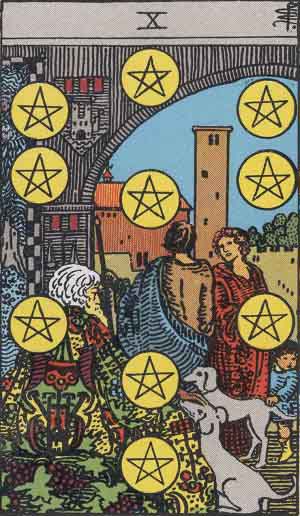
An archway frames three generations: an elder seated at its base, a couple standing within it and a child beside them. Dogs move through the scene, while the ten pentacles form the pattern of the Tree of Life. The image suggests continuity, but it does not tell us whether that continuity is secure, equitable or freely chosen. The question this card keeps returning with is what the seeker has received, what obligations accompany it, what they are consciously building and whose future their material choices will shape.
Core Repeating Message
The Ten of Pentacles shows a multi-generational scene: figures of different ages gathered in and around an archway, with the ten pentacles arranged in the Tree of Life pattern behind them. The image speaks of continuity across time in the material domain, including assets, skills, access, housing, responsibilities, customs and assumptions passed between generations. It is not only a card of wealth. It concerns the institutions and relationships through which material belonging is created, withheld, inherited or rebuilt, and the way one life participates in a story longer than itself.
A single appearance may bring the longer span of material life into view: inheritance, legacy, family systems or the consequences of choices across generations. Repetition suggests that something in this relationship remains unresolved. What has been inherited, what is being built, where the seeker belongs and what will be passed on have not yet been sufficiently examined or consciously lived with.
The most common pattern is unexamined family material: attitudes to money, financial habits, practical beliefs and structural assumptions carried into the present. Some may support the seeker’s life; others operate automatically without having been chosen. The Ten asks where inherited ways of living have been mistaken for the only available ways, and what would be required to distinguish a continuing family pattern from a present commitment made with awareness.
A second pattern concerns the person building or already living with material stability who has not yet addressed what it might mean beyond their own circumstances. The question of legacy presses: what to build for those who follow, for the community or for a future the seeker has some part in shaping. This can be a practical crossroads even when immediate personal needs are met, because the next decision concerns the direction and beneficiaries of what is being created.
A third pattern is the seeker who does not feel embedded in a material lineage, perhaps because the family of origin was fractured, unsafe, displaced or economically insecure, because contact has ended, or because the household never possessed the stability shown in the image. The absence of inherited security is not a personal deficiency, and biological family is not the only source of continuity. The repeating Ten may invite the seeker to recognise chosen family, community knowledge, mutual aid, craft, cultural practice and reliable agreements as valid forms of material lineage, while remaining honest about resources that cannot be recreated through attitude alone.
A fourth pattern belongs to the seeker navigating significant family wealth, property, enterprise or obligation. Material inheritance can confer safety and opportunity while also carrying unequal power, conditions, secrecy, loyalty demands and contested ownership. The Ten does not decide what is legally or morally theirs, nor does it require acceptance or rejection of the family structure. It brings attention to stewardship: what must be verified, what belongs to shared decision, whose labour made the asset possible, and how the seeker can act with integrity rather than continuing arrangements by inertia.
These patterns place one lifetime’s choices inside a longer material story. The unfinished work may be examining an inheritance, building something to pass on or finding a form of rootedness that has not been available before. The Ten asks how the seeker participates in that continuity with awareness, rather than simply allowing it to proceed around and through them.
When This Card Repeats Weekly
A week of Ten of Pentacles repetition draws attention to the longer story within an immediate decision. A family interaction, financial structure, practical choice or domestic arrangement may carry assumptions or consequences that extend beyond the present moment. The card asks the seeker to notice that connection as well as attend to what needs doing now.
Of the practical matters most active this week, what connects to what I inherited and what I am building? What does this choice say about what I value materially, not only now but across time?
When This Card Repeats Monthly
Across a month, inheritance, legacy and belonging may recur in several practical contexts. The longer story is pressing through ordinary choices often enough to become recognisable as a pattern, rather than appearing only in an occasional family event or financial decision. The question is what keeps returning without yet receiving a considered response.
Look across the practical choices of the past several weeks. Taken together, what do they suggest the seeker is building and passing on? How do they continue, adapt or depart from the material inheritance already carried?
When This Card Repeats Seasonally
A season gives time to see how inherited structures shape current development. Which parts of the family material story are useful, and which continue mainly because they have never been assessed? Questions of belonging and legacy become visible in the repeated choices of the season, including the gap between what the seeker says they value and what the existing arrangements sustain.
The central seasonal question is what legacy means in the present. It is not only what will eventually be left behind, but the kind of life being built now: how it expresses the seeker’s values about what material resources are for and what they should make possible.
When This Card Repeats Across Years
When the Ten of Pentacles returns across years, lineage, inheritance and the question of what to build and pass on may be enduring themes. Across different phases of life, material belonging can bring complexity, longing or difficulty. The recurring work is to understand where the seeker stands within that longer story and what kind of participant they want to become.
One possible history is substantial family stability and inheritance whose benefits and expectations require careful judgement. Another is disruption, fracture or absence, leaving the seeker to build forms of belonging elsewhere. Both can make the generational story feel active and unresolved, but neither history can be inferred from the card alone. The relevant facts are those of the seeker’s own family and present circumstances.
The long-cycle Ten can also mark a stage when legacy becomes an immediate practical concern. Age, responsibility or material circumstances may bring questions that once felt distant into daily decisions: what is being built, who it will serve and what may continue beyond the seeker’s direct involvement.
Across years, the growth arc is towards conscious material rootedness. The seeker learns to distinguish inheritance from entitlement, gratitude from compliance, and legacy from the pressure to reproduce a family ideal. They know more clearly what they carry, what they owe, what was denied and what remains uncertain. They build continuity in forms suited to their circumstances, whether through assets, care, knowledge, public contribution, chosen family or dependable practice, without measuring a meaningful life by wealth or biological succession.
Life Area Interpretations
Love & Relationships
In relationships, the Ten of Pentacles concerns building a shared life within longer material histories. What do partners want to create together, what will each bring from their family of origin and what do they intend to leave behind? The practical home and future being made between them carry those decisions, whether or not they have yet been spoken about.
The Ten is especially relevant where partners bring different financial habits, inheritances or experiences of security into a shared life. Those differences may remain implicit until a decision about money, home or responsibility exposes them. The question is what they mean for the arrangement the partners are building, rather than which family story should automatically prevail.
Career & Purpose
In career and purpose, the Ten of Pentacles asks what a working life creates beyond individual achievement. A business, institution, body of practical knowledge or other contribution may continue to serve people after the seeker steps away. The card can also describe an inherited vocational or professional path and the judgement needed to inhabit, continue, transform or depart from it with integrity.
Money & Stability
In financial contexts, the Ten of Pentacles focuses on multigenerational patterns, inherited advantage or disadvantage, shared property, succession and long-term provision. It may be relevant when the seeker is receiving an inheritance, planning for dependants or community, entering a family enterprise, or noticing how earlier household conditions still influence present decisions. Symbolic reflection cannot establish ownership, tax consequences, capacity, fairness or the suitability of an investment. Significant decisions require accurate records, transparent conversation and appropriately qualified legal or financial advice.
The Ten asks the seeker to take a long view without assuming that long-term outcomes are controllable. What is the present structure likely to support, who benefits, who bears risk, and what would happen if circumstances changed? The useful legacy question is not simply how much will remain, but whether the arrangements are understandable, lawful, resilient and aligned with the seeker’s stated responsibilities.
Spiritual Growth
In spiritual growth, the Ten of Pentacles can point towards rootedness in something larger than individual experience: a tradition, lineage, community or continuing practice. Nourishment may come not only from inner development but from belonging to a story that spans time. The question is how that connection can be consciously inhabited, rather than merely inherited, while leaving room for the seeker’s own integrity.
Emotional & Mental Patterns
The Ten of Pentacles in emotional and mental patterns invites enquiry into how family material history may influence the seeker’s expectations of security, obligation and belonging. Repeated exposure to scarcity, secrecy, sudden loss, status pressure or reliable provision can shape habits and emotional associations, but the card cannot determine the cause of a response or establish a psychological condition. Those associations may be felt in the body as well as expressed in conscious beliefs, without establishing a single inherited mechanism. It offers a lens for comparing inherited messages with present facts and noticing where choice is available.
The emotional texture may combine belonging, obligation, inheritance and a sense of being trapped within a story larger than oneself. The task is to distinguish what the seeker now chooses from what continues through a pattern formed before they arrived. A feeling can reveal that a question matters without settling who is responsible or what should change.
Family & Generational Dynamics
In family dynamics, the Ten of Pentacles concerns material inheritance in its broadest sense. Money and property are part of it, alongside practical beliefs, financial habits and assumptions about security and worth. These may be taught directly or absorbed from the atmosphere of family life, and can be examined as learned expectations rather than taken as unquestionable facts.
The Ten asks which inherited patterns are continuing without conscious choice, which are deliberately retained because they still serve the present life, and which have already been transformed. All three deserve recognition. Examining inheritance does not require rejecting everything received, any more than gratitude requires keeping it unchanged.
Health & Energy
In Health & Energy, the Ten of Pentacles concerns the practical systems around care: housing, food access, time, money, family expectations, community support and knowledge about when and how to seek help. A reliable home or community may provide a felt sense of being supported in daily life. Families can transmit routines and attitudes towards rest, disability, ageing, prevention and treatment, but a tarot card cannot identify inherited medical risk or explain symptoms. The useful enquiry is which forms of care, comfort or neglect have been normalised, which resources are available or missing, and what verified family history should be discussed with a qualified health practitioner.
Advanced Interpretive Sections
The Shadow Expression
The Ten of Pentacles in shadow can appear as enclosure within a family material structure, where access to money, housing, work or approval depends on obedience and individual preference has little room to develop. It can also appear as idealisation of lineage, wealth or family unity, obscuring exclusion, unpaid labour, conflict or harm. At the other pole, a necessary separation from family may leave the seeker building with skill and effort but without familiar practical support or a felt sense of continuity. Estrangement is not itself failure or rootlessness. Safety can require distance, and continuity can be built through chosen relationships and institutions.
The Integrated Expression
The integrated Ten of Pentacles seeker has an examined relationship with what they carry from earlier generations, what they are building and what they choose to pass on. They can belong to a material story larger than themselves without surrendering personal integrity. Their life is a contributing chapter, rather than simply another repetition of the family’s existing arrangements; continuity includes choices about what to preserve and what to change.
Why This Energy Has Not Released Yet
The Ten of Pentacles pattern may remain active while inherited arrangements continue without explicit review. Some inherited assumptions work quietly through ordinary decisions until they are noticed. Some patterns are habitual, while others are maintained by contracts, dependency, law, culture, unequal bargaining power or limited alternatives. Awareness is useful but may not be sufficient to change the structure. Resolution can therefore mean clearer understanding, better documentation, safer boundaries or collective planning, even where the material circumstances cannot be altered quickly.
The pattern may also persist while the seeker has not articulated what they want their material life to leave or make possible. Current choices can then drift without reference to a longer intention. The question is whether what is being built day by day is aligned with the contribution the seeker hopes to make across time.
What This Card Wants the Seeker to Understand
Material life takes place within contexts larger than one person: family history, community, institutions and inherited practical values all shape what feels possible or prohibited. The Ten asks the seeker to see those connections clearly. An individual choice may continue a much older arrangement, challenge it or begin a different form of continuity.
Awareness of inheritance need not mean being governed by it. Knowing what is carried and examining what it does makes it easier to choose what to continue and what to transform where choice is available. The aim is a present life that reflects considered values, rather than a largely unexamined continuation of choices made by other people in other circumstances.
Signs the Pattern Is Beginning to Resolve
One sign of resolution is identifying an inherited pattern that has been running automatically and making a considered decision about it. It may be retained because it still serves present values, or changed in a practical way that better fits the life being built. The movement is from unexamined continuation towards a choice the seeker can understand and stand behind.
Another sign is being able to describe, however briefly or imperfectly, what the longer arc of material life is intended to produce. A wish for legacy, community or continuity becomes clear enough to guide current decisions. The intention need not be grand; it needs to be usable as a reference for how the seeker lives now.
Reflective Questions
-
What did you inherit about money, security, material entitlement and the likely prospects of people like you? Which patterns still serve your life, and which continue automatically without having been assessed?
-
Is a family story spanning generations pressing on your practical choices? What is it, and how does it shape what feels possible, permissible or probable?
-
Do you feel part of a material continuity larger than your own life? What form does that belonging take, or what kind of rootedness or community would you like to develop?
-
What are you building that could have meaning beyond your own circumstances? Beyond financial inheritance, what practical contribution might continue after your direct involvement?
-
Have you examined the financial and practical patterns transmitted through your family? Which do you now choose to continue, and which have you changed to better reflect your own values?
-
If your family carries a story of substantial wealth or hardship, how do you relate to it now? Have you engaged with its actual history, rather than only continuing it or reacting against it?
-
What do you want your material life to mean beyond accumulation or achievement? What might it produce for others and continue to make possible after your direct involvement? Have you put that intention into words?
-
Is there a kind of material belonging, community or continuity across generations that you lack and long for? What would developing it require in your actual circumstances?
-
Which inherited attitudes or arrangements are you passing on, deliberately or otherwise, to people affected by your choices? Are they what you want to continue?
-
If the Ten of Pentacles has been appearing for a sustained period, which part of the longer material story remains unexamined or unresolved? What one practical engagement with that story would be useful now?
Practical Integration Actions
Map the material inheritance. Record the financial habits, practical beliefs and assumptions about money, security and worth you absorbed through family life. Include messages felt in the household atmosphere as well as direct teaching. Write what you can honestly identify, rather than what you wish had been transmitted, and leave uncertain origins uncertain. Mark each item as serving, hindering or unexamined. This creates a basis for conscious engagement with the inheritance rather than its automatic continuation.
Articulate the material legacy. Write what you want your life to build, leave and contribute to the people and circumstances shaped by your choices. This is not a manifesto. It is a practical account of a longer intention against which everyday decisions can be assessed. Keep it concrete enough to show whether present actions are moving towards that intention or away from it.
Have one family material conversation. Identify a conversation about inheritance, shared property, care, expectations or family financial history that would be useful and safe. Before initiating it, clarify the purpose, facts, participants, privacy needs and boundaries. Where conflict, coercion, legal rights or large sums are involved, seek independent advice or a suitable facilitator first. If direct contact is unsafe or impossible, document the questions privately instead. Take one safe step towards the discussion or private written exploration you have identified. The exercise is informed engagement, not forced disclosure or reconciliation.
Identify one transformation. Choose an inherited pattern that is hindering your present life and write a plan for one practical change aligned with your values. It need not be large, but it should address the identified pattern rather than remain a general intention. Keep the change within what you can responsibly control; the purpose is to practise conscious agency in relation to the inherited story.
Build something for the long arc. Choose one proportionate action that serves continuity beyond immediate individual return. It might be documenting knowledge, maintaining a shared resource, making an affordable contribution, updating beneficiaries with professional guidance, teaching a practical skill or supporting an institution whose work you understand. Another possibility is a modest shared building project whose benefits would extend beyond your immediate involvement. Check present obligations before committing money or labour, and do not promise resources that others depend on. The exercise is to make legacy concrete through responsible stewardship rather than through grand scale.