
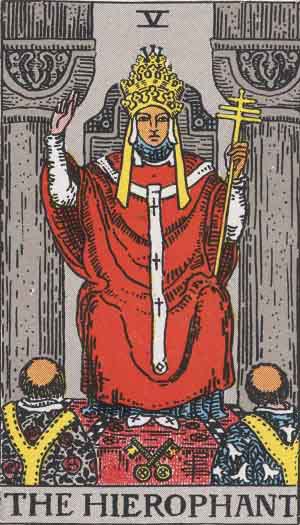
The Hierophant returns not to demand conformity, but to ask what the Seeker actually believes and whether the structures they inhabit support the life they are living.
Core Repeating Message
The Hierophant sits between two pillars, as the High Priestess does, but where she guards the veil between conscious and unconscious knowing, he presides over the transmission of what has already been known, codified and passed down. He wears the robes of authority. He raises one hand in blessing and holds the other around a triple cross. At his feet are the keys. Before him kneel two figures who have come to receive what he holds: the accumulated wisdom of a tradition, a lineage, a way of understanding the sacred that has been tested across time and held in form for those who come after.
He is numbered five, the number that follows the four of the Emperor’s solid foundation and precedes the six of The Lovers’ direct encounter. The Hierophant occupies the space between built structure and relationship. He is the institutional mediator, the keeper of rites and ceremonies that make certain kinds of encounter possible, and the figure whose role is to make the sacred accessible through prescribed form. Without some version of his function, accumulated wisdom does not pass between generations. Without conscious examination of that function, its limitations are transmitted alongside its gifts.
When The Hierophant appears once in a reading, he marks a moment of teaching, tradition, belief or institutional belonging. When he returns repeatedly, the message has deepened into a sustained question about the Seeker’s relationship with received wisdom, the structures of belief or belonging that have shaped them, and what they themselves believe when inherited answers are set aside and their own interior knowledge is consulted.
The Hierophant’s domain is broader than religion, although religion is his most obvious territory. He presides wherever accumulated knowledge is transmitted through institutional form: the medical establishment, the legal profession, academia, therapeutic traditions, family systems, cultural norms and the professional orthodoxies of a field. Any context in which the primary question is not “What do you individually perceive to be true?” but “What does the received tradition hold to be true?” is Hierophant territory. Whenever the Seeker’s relationship with that received wisdom becomes a significant unresolved question, The Hierophant returns.
There are three primary patterns that bring him back repeatedly.
The faithful within a tradition that no longer serves. This Seeker is inside a structure, whether a religious tradition, professional orthodoxy, family belief system or cultural framework, whose received wisdom shaped them deeply and continues to define their belonging, identity and relationships. But something has shifted. What the tradition teaches no longer aligns with what the Seeker is discovering through experience and reflection. The gap between received belief and lived knowledge has widened to the point of real discomfort. They cannot fully inhabit what the tradition prescribes without inner compromise. Yet the cost of departure is also real: the community, family relationships, identity and historical belonging provided by the tradition are not abstract. They are among the most important things in the Seeker’s life. The Hierophant is not telling them to leave. He is asking them to examine the gap honestly and name what is no longer aligned without requiring the whole tradition to be either defended or discarded.
The rebel who has made rebellion the new orthodoxy. This Seeker left a tradition, often a religious or cultural one and often in response to real harm, then built a substantial part of their self-concept around that departure. They are not a believer. They do not participate in the institution. They are free from the prescribed structure that others remain captured by. Yet, examined honestly, that freedom has developed its own rigidity. Received wisdom is dismissed before engagement. Any expression of spiritual or institutional tradition is viewed through the harm present in the system that was left. Any suggestion that the rejected forms may still contain something of value is met with a resistance that has itself become restrictive. The Hierophant points to the inversion: rebellion has become an unexamined structure, rejection has become dogma, and an act of liberation has settled into a new and equally rigid position.
The unexamined inheritor. This Seeker has never seriously asked what they actually believe. They may hold the beliefs of their family, community or culture with complete sincerity, but those beliefs have been received rather than discovered through examination. The Hierophant is not asking them to abandon what they inherited. It is asking them to test each significant belief against doubt, lived experience and credible alternatives, then determine whether it is truly theirs or simply held by default. What survives may look very similar to the original inheritance, but once consciously examined and chosen, it becomes something different: conviction rather than convention.
All three patterns share the same root condition. The Seeker’s relationship with received wisdom, transmitted belief or institutional belonging remains unexamined or unresolved, and that is costing them something. The Hierophant’s persistent return holds the cost in view and asks for the form of examination this particular relationship requires.
There is a fourth dimension to The Hierophant’s repeated presence that becomes relevant for some Seekers: the calling to transmit. The Hierophant does not only receive wisdom. He passes it on. Some Seekers who repeatedly encounter this card are being directed, with increasing urgency, towards the role of teacher, guide, elder or transmitter within a particular domain. They have something worth offering, tested through their own experience and capable of serving people at an earlier stage of the same terrain. Yet claiming the Hierophant’s transmitting role, standing up to say “I have something worth teaching”, is an act of authority. It requires a sufficiently settled relationship with one’s own knowledge. The returning card asks whether that claim is being made and, if not, what prevents it.
What is happening in the life of someone who keeps drawing The Hierophant? They may be living inside a tradition or belief structure whose fit has become uncertain. They may have built an identity around rejecting received wisdom without examining what the rejection is protecting. They may be living by inherited answers to questions they have never asked for themselves. Or they may be called to teach and have not yet entered that role. The Hierophant returns because this territory, whatever form it takes for the Seeker, has not yet been consciously engaged.
When This Card Repeats Weekly
When The Hierophant appears repeatedly within a single week, it is pointing to something immediate in the Seeker’s relationship with received authority, conformity or personal belief. Something happening now is bringing this territory into direct contact with daily life.
The most common short-term expression is an encounter with institutional or received authority that requires a response the Seeker has not yet found. It may arise in a professional setting where the accepted position of the field conflicts with the Seeker’s own assessment, or at a family or community gathering where the group’s beliefs are being expressed while the Seeker’s different position is either suppressed or voiced with more force than the situation warrants.
The choice between conforming to what the structure expects and expressing what the Seeker actually believes has become acute. The Hierophant returning across the week asks them to notice that choice and examine it rather than continue managing it automatically.
Belonging is often central to short-term Hierophant repetition. Something this week may be exposing the social cost of saying what the Seeker really thinks within a particular community or relationship. There may be a truth that would be unwelcome in the group, or a departure from shared belief that the Seeker recognises but has not yet named. The Hierophant is not automatically recommending disclosure.
It is asking the Seeker to become conscious of what they are suppressing, why they are suppressing it, and what sustained self-censorship is costing them.
There is also a teaching dimension to weekly repetition. The Seeker may be encountering an immediate opportunity to offer what they know, to occupy the position of someone with knowledge worth transmitting, and they have declined or deferred that role. The Hierophant returning is drawing attention to the deferral.
When This Card Repeats Monthly
When The Hierophant returns consistently across several weeks, a pattern has become visible in the Seeker’s relationship with the traditions, communities or belief structures shaping daily life.
For the Seeker inside a tradition that is becoming increasingly misaligned with their own understanding, monthly repetition often brings accumulating internal friction. Week by week, the gap between what the structure prescribes and what the Seeker’s experience indicates produces a low-level but persistent dissonance. They participate in the community’s life with one part of themselves while another part watches from a growing distance.
At the monthly timescale, that gap has become difficult to ignore. The Hierophant confirms what the Seeker already senses: maintaining the present arrangement requires continuing suppression of what they know or believe, and the cost is becoming visible.
For the rebel, monthly repetition often appears through encounters with wisdom inside forms they have previously rejected. Something valuable emerges from the tradition they dismissed. A teaching they could use is present within the structure they left. A community carries something worthwhile, but reflexive rejection prevents them from receiving it.
The Hierophant is drawing attention to the cost of blanket rejection. Not everything that was left was harmful, and refusing to distinguish between what caused harm and what offered value creates another kind of loss.
For the unexamined inheritor, the monthly pattern is often triggered by an encounter that raises a difficult question the inherited framework cannot answer satisfactorily. Something happens in the Seeker’s life, or they encounter an idea, person or perspective, that presses against a received belief in a way that can no longer be dismissed.
In this context, The Hierophant marks the beginning of an important shift: the first serious encounter with the question of what the Seeker themselves believes, as distinct from what they were given to believe.
When This Card Repeats Seasonally
Across three to four months, The Hierophant’s sustained presence signals a period of serious belief examination or a significant transition in the Seeker’s relationship with a tradition, community or institutional structure.
Seasonal repetition often marks one of the most consequential and least formally recognised transitions a person can undergo: working out what they actually believe, separate from what they were taught, what their community holds to be true and what their identity has been built around. This is rarely comfortable because received beliefs do far more than answer metaphysical questions.
They provide a framework for meaning, a community of belonging, a language for interpreting experience and often an ethical structure woven into daily life. Examining those beliefs means allowing for the possibility that some of what has felt foundational may not, on reflection, be the Seeker’s own. That can be deeply disorienting even when it is also liberating.
The Hierophant across a season may therefore mark a changing relationship with a particular institution or community: a church that is being questioned, a professional orthodoxy being examined from inside, or a family belief system being recognised as a system for the first time rather than simply experienced as reality. These transitions are slow, non-linear and rarely completed in a single season.
What the seasonal Hierophant identifies is the period in which the transition is actively under way and the question of where the Seeker stands in relation to the inherited structure has become immediate.
There is also a seasonal dimension to the calling to transmit. Across several months, the Seeker may increasingly find that other people look to them for guidance or for knowledge drawn from terrain they themselves have already navigated.
In this context, The Hierophant asks whether the Seeker is beginning to accept the role of teacher, guide or elder, or whether they continue to deflect it through a modesty that may feel safer than acknowledging the authority their experience has earned.
The question of spiritual community may also become pressing. A Seeker who has left a tradition, or whose relationship with a community has become uncertain, may be living through both loss and search. The belonging the previous structure provided was real, and its absence is real too.
The Hierophant asks whether the Seeker is actively seeking a community, teacher or body of received wisdom capable of supporting their present development, or whether the loss of the earlier structure has led them to withdraw from communal spiritual life altogether. Freedom from an unsuitable structure and isolation from all shared spiritual life are not the same thing.
When This Card Repeats Across Years
When The Hierophant remains present across a year or returns through major chapters of a life, he points to something foundational: the Seeker’s long-term relationship with belief itself and with the structures that have shaped their understanding of what is true, what is sacred and how life is supposed to be lived.
One of the most significant long-cycle patterns is the Seeker who has spent years inside a tradition that defined their world without ever seriously examining whether its definitions were their own. The tradition may be religious, cultural, professional or familial. What makes this a Hierophant pattern across years is the depth of unreflective inhabitation: the beliefs have been lived inside rather than looked at, experienced as the atmosphere of life rather than recognised as one possible way of interpreting it.
Eventually The Hierophant asks a question that cannot be deferred indefinitely: when the received framework is held at enough distance to become visible, what do you actually believe?
The answer does not necessarily involve dramatic departure. Some Seekers examine what they inherited and discover that much of it remains deeply valuable. Their relationship with the tradition may become richer because it is now consciously chosen rather than automatically inhabited.
Others discover that important elements of the received framework conflict with what their own experience and reflection have taught them, making revision or departure necessary if they are to live in accordance with what they now believe. Both outcomes belong within Hierophant territory. What the long-cycle card insists upon is examination, not a predetermined conclusion.
The long-term rebel represents another, often poignant, expression. A Seeker may have left a tradition for compelling reasons and spent years defining themselves partly through that departure. Eventually the precise issues that once required rejection may no longer be the active question. The wound that made departure necessary may have changed, even if it has not disappeared.
At this stage, a more nuanced relationship with the tradition’s gifts may become possible without denying the harm that was also present. The Hierophant returning across years can therefore ask whether the time has come for a relationship with received wisdom that is less reactive, more discerning and capable of holding complexity.
The calling to transmit is equally important at the long-cycle level. A Seeker who has accumulated wisdom through experience and reflection, travelled difficult terrain and emerged with knowledge that could serve others may repeatedly encounter The Hierophant as a question about whether they will claim the constructive version of his role: elder, teacher, guide, keeper or transmitter of what has been learned.
Formal qualification may support that role, but it does not create it by itself. The authority being described here develops through knowledge, experience, reflection and the willingness to become someone who transmits rather than remaining indefinitely in the position of the one who receives.
Life Area Interpretations
Love & Relationships
The Hierophant repeating in love and relationships most often points to the role that shared tradition, community or belief plays in the structure of the Seeker’s significant partnerships, and to what happens when that common ground begins to shift or proves less solid than it appeared.
The most direct pattern is a relationship held together partly by shared institutional affiliation: a religion, cultural framework or set of inherited beliefs about what a relationship should be. When the Seeker’s beliefs evolve and serious examination leads them away from that common framework, the relationship faces a distinctive pressure. The shared language for what the relationship means and requires is no longer fully shared. The Hierophant asks the Seeker to face that change honestly rather than preserve the appearance of agreement by suppressing their development.
The family system as an institution, with its own orthodoxy about what relationships should look like, is another Hierophant domain. Every family transmits beliefs about what love means, what partnership requires, what is owed within intimate relationships, and which relationships are considered legitimate. A Seeker whose relationship does not conform to the family’s prescribed form must determine whether they have examined those beliefs and consciously departed from them, or remain caught between inherited expectations and the reality of their own relationship.
The card may also repeat when one partner’s beliefs have changed substantially and the other’s have not. What was once common ground has become different ground. The question is whether the relationship can accommodate that difference without either person abandoning their own position, or whether the divergence has become a fundamental incompatibility. The Hierophant’s return asks the Seeker to examine that question rather than defer it.
The inherited beliefs governing love are among the most powerful and least examined beliefs a person carries. They were often received through early attachment, before critical distance was possible. The Seeker who has never asked what they personally believe love should look like, what partnership requires or what they are permitted to want from intimacy is encountering The Hierophant in their relational life.
Career & Purpose
In career and purpose, The Hierophant’s repeated presence most often points to the Seeker’s relationship with the orthodoxies of their profession and asks whether participation in that tradition is supporting their development or constraining it.
Every established profession has a Hierophant structure: the accumulated knowledge of the field encoded in training, credentialling, best practice and the unspoken norms of professional culture. This structure has real value. It represents the hard-won learning of practitioners across time, and dismissing it casually can lead to avoidable errors. Yet the professional Hierophant also has a shadow: the ability to suppress innovation, silence credible dissent and require conformity to received methods even when direct experience indicates that another approach may serve better.
The Seeker may have experience that points somewhere the field’s orthodoxy does not accommodate. They may have accepted the orthodoxy so completely that their own professional judgement, developed through practice rather than training alone, has been suppressed or never allowed to mature. They may also work in an institution where belonging requires a degree of conformity that compromises their professional integrity.
The calling to teach or transmit is particularly relevant here. Many Seekers reach a stage at which their most valuable professional contribution is no longer limited to individual practice. It lies in passing what they have learned to people who are earlier in the same journey. When The Hierophant repeats for a Seeker with substantial expertise, he may be pointing directly to the contribution that only a teaching, mentoring or knowledge-transmission role can make, and to the reasons that role continues to be avoided.
Seekers working within healthcare, education, law, religion, social care or any other strongly institutional field face a central Hierophant question: how does their relationship with institutional authority support or limit the work they are here to do? The question is not whether institutions are good or bad. It is whether this relationship with this institution aligns with the Seeker’s considered professional purpose.
Money & Stability
In money and stability, The Hierophant’s repeated presence points to inherited beliefs about money that are operating as unexamined rules. These may concern what money is for, who deserves it, how it should be earned and what a proper relationship with it looks like. They were transmitted by family, community or culture and absorbed as fact rather than recognised as belief.
Every family transmits a Hierophant structure around money. Some families teach that money must be earned through suffering and that financial ease is suspicious. Some treat discussing money as vulgar, financial privacy as virtue, and the naming of income or assets as unacceptable. Others make generosity the primary financial virtue and saving for oneself a form of selfishness. Some place security above every other financial value and treat any risk as recklessness. These beliefs shape behaviour as powerfully as conscious financial decisions, yet because they were received rather than chosen, they are rarely recognised as beliefs. They are experienced simply as the way things are.
The Hierophant returning in financial readings asks the Seeker to examine what they learned about money, both explicitly and through observation. What did the family’s behaviour communicate about what money means? Which of those messages still govern the Seeker’s financial decisions? Which reflect a considered position they would choose today, and which are inherited rules being followed without conscious endorsement?
This is not primarily an exercise in blaming the family of origin. It is an exercise in taking ownership of beliefs currently operating outside awareness, which is necessary for lasting financial change. A Seeker who understands that their reluctance to charge appropriately comes from a family belief that wanting money is unseemly has more agency than one who experiences the same reluctance without recognising its source.
Spiritual Growth
Spiritual life is The Hierophant’s most natural and directly expressed domain. When he keeps returning here, the questions are fundamental: what does the Seeker believe about existence, the sacred and the human encounter with both?
A Seeker formed by a strong religious tradition who has become uncertain about it faces one of The Hierophant’s central challenges: how to relate honestly to both the tradition’s gifts and its limitations without requiring it to be either entirely validated or wholly discarded. At their best, religious traditions carry accumulated insight into the human encounter with the sacred, provide communities of belonging and preserve ethical frameworks tested across generations. At their worst, they transmit serious harm through controlling spiritual authority, suppression of individual experience and the treatment of particular cultural forms as universal truth.
Few traditions are purely one or the other. The Hierophant therefore asks for discernment: what within this tradition remains valuable, what constrains or harms, and what follows from recognising the difference?
The Seeker who has left a tradition without finding what might take its place is also in Hierophant territory. Departure may have been necessary, but the loss remains real: community, regular practice, a language for sacred experience and a calendar of meaningful observance. The returning card asks whether the Seeker has found, or is actively seeking, a form of spiritual life that can restore some of what was valuable in the tradition they left, or whether departure has produced a spiritual barrenness that feels less like freedom than exile.
The Seeker who rejects all tradition and constructs a wholly solitary spiritual path encounters another Hierophant challenge. A self-directed path may hold considerable value, but it also has limitations that tradition and community can address. The accumulated knowledge of a lineage is unavailable to someone who rejects every lineage, just as the correction offered by community is unavailable to someone who has withdrawn from all communal spiritual life. The Hierophant does not ask this Seeker to return to what harmed them. He asks whether a body of received wisdom or a trustworthy spiritual community might offer something their solitary path cannot.
For a Seeker called to transmit spiritual knowledge, The Hierophant’s repeated appearance becomes an increasingly direct invitation to accept that role. A teacher with tested experience and insight who repeatedly deflects the work of teaching is being asked to acknowledge what they are now equipped to give.
Emotional & Mental Patterns
The emotional landscape of persistent Hierophant energy is shaped by the tension between belonging and personal integrity, and by the cost of trying to preserve both when a community will not allow them to coexist.
The most pervasive emotional pattern for a Seeker inside a misaligned tradition is dual consciousness: occupying two positions at once, one public and compliant, the other private and already beyond what the community can accommodate. This is not simple dishonesty. It may be a reasonable response when expressing inner divergence would carry a serious relational cost. Yet maintaining the division is depleting. The energy required to manage the distance between the public and private position accumulates as a fatigue whose source may be difficult to identify.
Shame is one of The Hierophant’s primary emotional instruments. A tradition provides not only beliefs but a framework for deciding what kind of person holds those beliefs correctly and what kind does not. When the Seeker’s convictions depart from the prescribed position, the tradition may also define them as departing from good standing. The shame accompanying that movement is not evidence that the movement is wrong. It is an emotional expression of the community’s hold and should be examined as such rather than accepted as a verdict.
The rebel’s emotional pattern is different but equally important. Leaving a tradition, especially in response to harm, can carry lasting anger, grief and betrayal. When these emotions remain unprocessed, they colour the Seeker’s response to anything resembling the original structure. Reflexive rejection of all received wisdom may be the protective posture of someone wounded by an institution whose anger has not yet been able to distinguish the harm done by that institution from the wider category of tradition.
The mental pattern most closely associated with Hierophant repetition is the unexamined belief operating as an axiom. A received position has been so thoroughly internalised that it no longer appears to be a belief. It appears to be reality. These positions are especially difficult to examine because the Seeker does not experience them as positions at all. The Hierophant asks them to develop enough distance from the inherited framework to recognise it as a framework, which is substantial work in itself.
Family & Generational Dynamics
In family and generational contexts, The Hierophant almost always points to the family as an institution: the beliefs, values, rules and prescriptions about how life should be lived that pass through the family system across generations, often carrying the force of sacred obligation.
Every family has a Hierophant structure. It includes the things simply known to be true within that family, the questions that are not asked, the behaviours that secure belonging and those that risk exclusion. These rules are rarely articulated formally. They are transmitted through thousands of small communications about what is celebrated or punished, what can be discussed openly and what must remain unspoken. By adulthood, much of this transmission has occurred below conscious awareness. The beliefs are not experienced as opinions. They are experienced as facts.
The first person in a family to examine these transmitted beliefs faces a distinctive challenge. From inside the family system, examination may feel like betrayal. Asking whether the family’s beliefs are also the Seeker’s own allows for the possibility that they are not, which in turn suggests that the family may have been wrong about something it considers foundational. Families strongly identified with religious, cultural or normative beliefs may experience the examination itself as a threat, regardless of the Seeker’s intention.
The generational dimension of religion is especially significant. For many Seekers, the family religion is more than a theological position. It is the language of their closest relationships, the framework of ritual life and a bond with ancestors extending across generations. Departing from it, even privately, is not a simple change of opinion. It is a profound relational and identity event. The Hierophant asks the Seeker to recognise the weight of that event rather than dismiss it as a minor intellectual revision.
A Seeker now transmitting beliefs to the next generation, whether as a parent, teacher, community elder or another influential figure, carries a Hierophant responsibility. What are they passing on? Are they repeating what they received without examination, or transmitting principles they have consciously tested and found valuable? The distinction matters both for the Seeker and for those who will inherit what they teach.
Health & Energy
When The Hierophant keeps returning in relation to physical energy and wellbeing, the connection may be less obvious than with some other cards, but it remains significant. Living within a belief system or community that requires sustained suppression of self can create a persistent drain.
A Seeker who maintains dual consciousness across years, presenting one face to the community while privately inhabiting another, expends real energy preserving that separation. Because the management has become habitual, it may not be recognised as labour. It can appear instead as chronic underlying tension, difficulty relaxing fully or a sense of never being completely present because each context requires a different calculation about what can be expressed. This is The Hierophant’s primary energetic signature in the body: undramatic but sustained, producing a form of depletion that rest alone does not resolve.
The relief that can follow departure from a constraining structure is also important. When a belief system or community that demanded substantial self-suppression is released, even through a painful departure accompanied by grief, many Seekers report a physical lightening they could not have anticipated. The body was carrying the work of suppression in ways that became fully visible only when the work ceased.
The opposite may also be true. A Seeker who has lived for a long time without structured community or received wisdom may experience the energetic cost of rootlessness. Because it has become the ambient condition of life, it may not be recognised for what it is. In this context, The Hierophant may be pointing to a need for nourishing belonging, shared practice or a trustworthy body of wisdom that both psyche and body are registering through its absence.
Advanced Interpretive Sections
The Shadow Expression
The Hierophant’s shadow expressions are among the most consequential in the Major Arcana because they act upon basic human needs for meaning, belonging and spiritual guidance, then use those needs for purposes that the integrated Hierophant would not endorse.
The dogmatist is the clearest shadow: a Seeker who has adopted the tradition’s beliefs so completely that questioning them is experienced not as intellectual inquiry but as an existential threat. Doubt endangers the whole structure on which identity, belonging and meaning depend. The result is brittleness. The tradition must be defended rather than inhabited because inhabiting it with maturity would require tolerance for uncertainty. In positions of religious or institutional authority, the dogmatist may suppress the spiritual or intellectual development of others, demanding conformity at the expense of inquiry.
The rebel who has made rebellion the new dogma occupies the shadow from the opposite position but with equal rigidity. All received wisdom is treated as suspect, every institution as constraining and every tradition as carrying the harm of the one that wounded them, whether or not it does. The rebel’s shadow is a closed system as restrictive as the tradition it rejected, but harder to recognise because it presents itself as freedom.
The controlling spiritual authority is The Hierophant’s most harmful shadow: a figure who exploits the human need for guidance to maintain power rather than support development. This is not limited to formal religion. It can appear in therapeutic, coaching, educational or community settings whenever authority fosters dependence, positions itself as indispensable or makes deference the price of teaching. The integrated Hierophant transmits in order to make themselves progressively less necessary. The shadow transmits in ways that increase dependence over time.
The Integrated Expression
The integrated expression of The Hierophant is a Seeker who has examined what they believe and inhabits those beliefs with quiet authority. This authority does not come primarily from institutional position or affiliation. It comes from having worked out where they stand, why they stand there and which uncertainties remain unresolved.
The integrated Seeker can meet tradition with gratitude and critical capacity at the same time. They receive what is valuable from the traditions and communities they encounter, leave what is not, and do so without requiring any tradition to be either perfect or worthless. Their engagement is neither naive nor contemptuous. It belongs to someone who has examined what they received rather than accepting or rejecting it wholesale.
As a teacher or transmitter, the integrated Hierophant passes on what they have received, tested and made their own rather than what they are merely performing. Their authority rests on knowledge and experience, coupled with transparency about the limits of what they know. Students or community members do not become more dependent through this relationship. They become more capable of inquiry, more confident in meeting the questions a tradition addresses, and better equipped to inhabit their own positions with authority.
The integrated Seeker also has a mature relationship with belonging. They belong somewhere, whether within a tradition, community, lineage of practice or more loosely held field of intellectual and spiritual kinship, and that belonging is chosen rather than merely inherited or fearfully maintained. It is real, but held lightly enough that individual knowledge and responsible dissent do not have to be suppressed to preserve it.
Why This Energy Has Not Released Yet
The Hierophant pattern persists for reasons that go much deeper than intellectual disagreement with a tradition’s stated positions.
The most powerful is the social cost of departure. A tradition does not hold beliefs alone. It holds community, family connection, shared history and a language for the sacred understood by the people the Seeker loves most. Departing from it, even internally, can mean loosening one’s place in the relational fabric it organises. For a Seeker whose most important relationships exist within a religious or cultural community, examining the tradition is therefore not merely an intellectual act. It can threaten the foundations on which those relationships rest. The pattern persists because the potential cost is understood to be high.
Another reason is the fear inherent in an examined life. Received belief offers ready-made answers to difficult questions, a framework of meaning the Seeker does not have to construct alone, and a community that continuously reinforces that framework. Examining it means allowing for the possibility that the supplied answers are inadequate and that some of the hardest questions may remain unanswered. For many Seekers, that openness is more uncomfortable than living inside a structure that no longer fits completely. The familiar constraint is known. What lies beyond it is not.
For the rebel, the pattern persists because rejecting tradition has become part of identity. Who am I if I am not the one who left, the one who saw through it, the one who escaped what still confines others? Asking whether rejection has hardened into rigidity also questions the identity built around that rejection. Once established, identities resist inward examination as reliably as they resist external challenge.
What This Card Wants the Seeker to Understand
The Hierophant wants the Seeker to understand that what they believe matters. This is not about holding the correct beliefs according to an external authority. It is about inhabiting beliefs that have been examined and consciously owned rather than received and performed.
Tradition, whatever form it takes, is a vehicle. It can carry wisdom accumulated and tested across time. That wisdom does not become worthless because the vehicle has also accumulated limitations, distortions or harm. The discernment The Hierophant asks for is the capacity to distinguish what is carried from the form carrying it, and to engage with a tradition’s accumulated knowledge without treating every feature of its institution as equally valuable.
The card also wants the Seeker to understand that belonging should not require the suppression of belief. A community worth belonging to can sustain inquiry, individual development and responsible dissent from within. If the Seeker’s present community cannot, that limitation needs to be recognised. Belonging maintained through continuous self-suppression is not belonging in its fullest sense. It is management.
On transmission, The Hierophant distinguishes having something of value to offer from having achieved certainty. A teacher who waits for absolute certainty will wait forever. Responsible teaching arises from tested experience and continuing inquiry, accompanied by honest acknowledgement of what remains uncertain. That form of transmission is among the most valuable things one person can offer another, and The Hierophant may be asking when the Seeker will begin to offer it.
Signs the Pattern Is Beginning to Resolve
Persistent Hierophant energy usually resolves gradually. The Seeker begins to know, with greater steadiness and less anxiety, where they stand in relation to the traditions, communities and received wisdom that shaped them.
One of the earliest signs is the ability to articulate, in their own words and without relying on the tradition’s language, what they believe about the questions that matter most. The answer is neither the tradition’s position nor the rebellion’s counter-position. It is the Seeker’s own, even where it remains provisional, incomplete or honestly uncertain. The ability to speak from that position rather than repeat a received one marks substantial movement.
The relationship with the relevant tradition becomes more conscious and more chosen. The Seeker may remain, but remaining is a decision rather than a default. They may depart, but the departure arises from discernment rather than automatic rejection. In either case, the structure is now encountered as something with which the Seeker has a relationship, rather than as an unquestioned reality inhabited from within.
For the rebel, resolution appears as a growing ability to meet particular forms of received wisdom or credible teaching with openness. Blanket rejection gives way to differentiation: this teaching within this tradition has value, even when other elements do not. That capacity to distinguish is a major sign of resolution for the long-term rebel.
The Seeker called to teach also begins to do so. Perhaps modestly and in small contexts, but they offer what they know, from where they actually stand, to people who can use it. Transmission grounded in experience rather than performed authority makes The Hierophant’s integrated expression visible.
Reflective Questions
-
What do you actually believe about the most significant questions your life poses? Set aside what your tradition teaches, what your community holds and what you inherited. What position have you reached through lived experience and reflection?
-
Is there a tradition, institution, community or belief system you currently inhabit whose fit has become uncertain? Where is the gap between what it prescribes and what your experience indicates, and what has prevented you from naming that gap directly?
-
If you have left a tradition, what precisely did you leave? What caused harm, and what, viewed with greater complexity, still held value? Have you been able to distinguish between the two, or has the harm made that distinction unavailable?
-
Which inherited beliefs about how life should be lived are you following without having examined whether they are your own? Choose one and investigate it seriously. Where did it come from, what does it require of you, and would you choose it today?
-
Where are you maintaining dual consciousness, with a public position that conforms to community expectations and a private one that has moved beyond them? What does that division cost, and what would be required to close the gap?
-
Is there a community, tradition or body of received wisdom that you have reflexively rejected but that may contain something your present path does not provide?
-
What do you currently believe about the nature of the sacred? Can you express it honestly in your own words, without relying on inherited language or defining it only against the tradition you rejected?
-
Has someone looked to you as a person with something worth teaching from experience? How did you respond, and what does that response reveal about your relationship with authority?
-
What social cost do you fear if you express your beliefs clearly within the communities or relationships that matter most? How does that feared cost compare with the ongoing cost of suppression?
-
If you designed a spiritual or communal life around your present values and considered beliefs, rather than around inheritance or rejection, what would it look like?
Practical Integration Actions
The Hierophant’s practical work begins with examination: bringing received structures into conscious awareness and learning to relate to them as chosen or not chosen rather than simply given.
Write out what you actually believe. This is not a theological statement, manifesto or rejection of anything. Privately articulate where you now stand on the questions that matter most: the nature of the sacred, what gives life meaning, what you owe other people and yourself, what you think happens at death, and where ethical obligation comes from. Use your own words. Notice where inherited language enters automatically and where uncertainty sits alongside conviction. The purpose is not to create a final document. It is to take an honest inventory of your present position.
Examine one inherited belief directly. Choose a belief about how life should be lived that came from family, tradition or culture and that you have not previously recognised as a belief rather than a fact. Trace its history. Where did it come from? Who held it before you? What purpose did it serve in the circumstances where it developed? Then ask whether, from your present considered position, you would choose it today. If not, identify what you would choose instead.
If you are inside a tradition that is becoming misaligned, name the gap precisely to yourself. Do not treat this as a public declaration or permanent conclusion. Make a written inventory of the places where received wisdom and your own experience no longer align. Naming the gap ends the need to manage it only through implication and gives it the attention it deserves. From there, the next appropriate steps can become clearer.
If you are a long-term rebel, choose one form of received wisdom within the tradition you left and engage with it seriously. The purpose is not to return or validate what harmed you. It is to practise distinguishing what held value from what caused harm. A tradition is rarely reducible to the part that wounded. Engaging with the rest is an act of resolution, not capitulation.
Examine your professional relationship with the orthodoxies of your field. What does the field define as established knowledge, best practice or simply the way things are done? Which positions align with your experience, and where do you hold reservations that professional belonging has encouraged you to suppress? Name those reservations precisely. Some may warrant action; others may need discussion with someone capable of helping you assess them. None benefit from remaining outside awareness.
If you are being called to teach or transmit, make one concrete act of transmission this month. It need not be a course or formal offering. It might be a conversation in which you share what you know with someone who needs it, a piece of writing grounded in terrain you have travelled, or a small group invited to explore something you have learned. The transmitting role is developed through the act of transmitting, not by waiting for perfect conditions.
Find a form of community that can sustain inquiry. Seek belonging that does not demand conformity as its price, and in which questions are welcomed, individual development matters alongside collective life, and disagreement does not automatically lead to exclusion. The community may be small, informal or unlike earlier ideas of spiritual belonging. The nourishment of being known within a trustworthy group is real and worth seeking.
If the religion or tradition of your family of origin remains unresolved, give it deliberate attention. This does not necessarily require re-engagement with the tradition itself. Examine what you received, what you valued, what harmed you and the position you now hold in relation to it. Because this terrain combines belief, identity, family and belonging, consider undertaking the examination with a therapist, spiritual director or trusted person who has navigated similar complexity without requiring a simple verdict.