
The Emperor does not return to demand obedience. He returns because something the Seeker is here to build has not yet been built.
Core Repeating Message
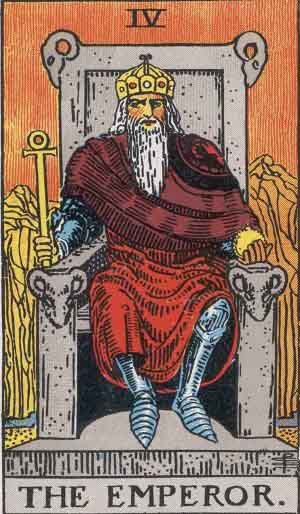
The Emperor is seated on stone. Behind him are bare mountains, rocky and unyielding. There is no lush growth here, no flowing water, no ripening wheat. The Empress’s world is one of organic abundance tended into flourishing. The Emperor’s world is different: it has been structured. What grows here has been placed deliberately. What stands here has been built. The throne is not merely a seat. It is a statement of domain: this is territory that has been claimed, organised, and held through the application of sustained and disciplined will.
He is numbered four. The number of stability, of the four corners that make a solid foundation, of the square base upon which things can be reliably built. The Emperor is not in motion. He is not reaching toward anything. He is the thing that has already been established, and from that established position, he governs. His authority is not borrowed. It is not performed. It is the settled expression of genuine mastery over a domain he has built and now holds.
When The Emperor appears once in a reading, he marks a moment of structure, authority, decision, or the call to lead from one’s own genuine power. When he returns repeatedly, the message has deepened into something more searching: either the Seeker is not building what they are here to build, or they are living under someone else’s Emperor and have not yet claimed their own, or the Emperor’s energy in them has tipped from structure into rigidity, from authority into control, from leadership into domination. The card keeps returning because one of these conditions remains unresolved.
There are three distinct patterns that bring The Emperor back repeatedly, and they look entirely different on the surface but share the same root question: what is the Seeker’s actual relationship with their own authority?
The unstructured. This Seeker lives in deliberate or habitual fluidity. They resist commitments, resist schedules, resist anything that would lock in a direction and require them to hold it consistently over time. They may frame this as freedom, as creative flexibility, as an aversion to the constrictive structures they witnessed or experienced in childhood. The freedom is real. But across time, the absence of structure has prevented anything of genuine substance from being built. Inspiration arrives and does not accumulate into a body of work. Projects begin and do not complete. Financial security remains perpetually aspirational. Relationships exist in a state of permanent tentativeness. The Emperor returning for this Seeker is not asking them to become someone else. He is asking what they are actually building, and what the persistent avoidance of structure is costing them in the currency of the life that is not quite being inhabited.
The under-authority. This Seeker is living inside someone else’s Emperor. They are living within a relationship, workplace, family system or cultural arrangement in which authority has been claimed by someone or something outside them, and they have accommodated that arrangement until their capacity to govern their own life, make consequential decisions and act from their values has become severely constrained. The someone or something exercising that authority may be a domineering partner, a controlling parent whose voice has never fully quieted, an organisation that demands a form of compliance that leaves no room for genuine professional self-determination, or a cultural or religious structure that has not been examined as a structure but accepted as simply how things are. The Emperor returning for this Seeker is pointing at the compression: at what is not being expressed, decided, or claimed because authority in the relevant domain has been ceded.
The over-structured. This Seeker has the Emperor’s energy in abundance. They have built structures, established order, developed discipline, created systems. But something in the building has tipped over into rigidity, and what was originally a genuine expression of the capacity to create lasting order has become a fortress rather than a foundation. The structures no longer serve the life they were built to support. They contain it. The rules are no longer in service of the values they were meant to embody. They have become the point. The control is no longer about creating conditions for genuine flourishing. It is about preventing any situation that cannot be predicted or managed. The Emperor returning for this Seeker is not asking for more structure. It is asking whether the structures already built are still serving the life, or whether they have become the thing that prevents it.
All three patterns engage, in different ways, with the same fundamental question: what is the Seeker’s relationship with their own authority? Not authority over others necessarily, but the specific inner authority that knows what it values, makes decisions from those values, builds structures that support the life it genuinely wants, and holds those structures with enough discipline to make them real while maintaining enough flexibility to allow them to remain alive.
There is another dimension to The Emperor’s repeated presence that deserves specific attention: the relationship with the father, or with whatever figure or institution first represented authority to the Seeker. The Emperor is not merely a symbol of structure and governance in the abstract. He is the archetype through which the Seeker first encounters what authority looks, feels, and behaves like. A father who embodied integrated authority, leading from values he lived by and building dependable structures while remaining accessible and warm, becomes an inner model for the Seeker’s own relationship with authority. A father who was absent, weak, domineering, punitive, unreliable, or otherwise significantly impaired in his exercise of the Emperor’s role leaves the Seeker without that model, and often with a specific distortion in the relationship with authority that will surface in many contexts across the life.
The father wound, in whatever specific form it takes, does not permanently determine the Seeker’s relationship with their own power. But it shapes it substantially until the Seeker becomes conscious enough of the shaping to begin to work with it directly. The Emperor returning repeatedly is often the psyche’s way of indicating that this work has become timely.
What is actually happening in the life of someone who keeps drawing The Emperor? They are either avoiding the structure and discipline that building anything lasting requires, or they are living inside authority that is not their own and has not been genuinely examined, or they are using the Emperor’s energy in its rigid and controlling form rather than its building and structuring form. Often the relationship with the father, with authority, and with their own capacity to claim genuine power is implicated across all three.
When This Card Repeats Weekly
When The Emperor appears repeatedly within a single week, it is pointing at something specific and immediate: a decision that needs to be made, a boundary that needs to be drawn, or a structure that needs to be established, and the Seeker is either avoiding or overextending their authority to act.
The most common weekly presentation is a decision that is within the Seeker’s authority to make and that they are not making. They are gathering more opinions. They are waiting for consensus that will not form. They are deferring to someone else in a situation where the decision is genuinely theirs to make. The Emperor’s short-term return is simply and directly naming that deferral: the authority exists, the decision is available, and the Seeker is not claiming it.
The boundary question is also prominent in short-term Emperor recurrence. Something in the Seeker’s current week requires a clear boundary that has not yet been stated. A request that should be declined. A behaviour in a relationship or professional context that should be named and addressed. A limit of some kind that is being approached or already crossed that the Seeker is managing around rather than addressing directly. The Emperor returning across the week is asking for the directness that the management is avoiding.
There is also an authority figure dynamic that frequently accompanies weekly Emperor repetition. Someone in the Seeker’s immediate context is exercising authority in ways that are affecting the Seeker, and the Seeker’s response to that exercise is either significantly over-accommodating or significantly reactive. Both responses point to the same thing: the Seeker’s relationship with authority is not yet at the settled, grounded place from which the Emperor’s energy responds appropriately rather than reflexively.
In the most practical terms, the weekly Emperor question is: what decision, boundary, or structure are you avoiding, and what is the cost of continuing to avoid it?
When This Card Repeats Monthly
When The Emperor returns consistently across several weeks, a pattern has become visible that is structural rather than situational. The Seeker’s relationship with discipline, commitment, and self-governance has developed a recurring shape, and that shape is limiting what can be built.
For the unstructured Seeker, monthly Emperor repetition often arrives with a visible trail of intentions not maintained. They can look back across the month and identify commitments made to themselves that were not kept: the practice that was going to be established, the professional project that was going to receive consistent time, the financial structure that was going to be put in place. Each individual failure of follow-through had what seemed like a reasonable explanation at the time. Accumulated across a month, they form a pattern that the individual explanations do not account for. The Emperor repeating across weeks is asking the Seeker to look at the pattern rather than the individual explanations: what is consistently not being built, and why?
For the over-structured Seeker, monthly repetition often arrives through other people’s responses. Colleagues, partners, family members begin to express something about the quality of the Seeker’s authority: that it feels controlling, that there is insufficient room within the structure for their own agency, that the order has become more important than the people it was built to serve. The Seeker may experience these responses as unreasonable. The Emperor returning across a month is asking whether there is something in the feedback worth examining rather than dismissing.
The father dynamic also tends to be visible at the monthly timescale. The Seeker may be able to identify, looking back across several weeks, a pattern in how they have responded to authority figures: consistently deferring in ways that cost them, or consistently resisting in ways that also cost them. The shape of the response offers insight into the nature of the authority wound the Seeker carries. The Emperor’s monthly return is asking that shape to be examined rather than simply repeated.
When This Card Repeats Seasonally
Across three to four months, The Emperor’s sustained presence signals something operating at the level of life structure: the Seeker is in a period during which what they build, or fail to build, will have consequences that extend well beyond the current season.
Seasonal Emperor repetition often marks a period of vocational or creative work that requires the kind of discipline the Emperor represents: not sporadic inspired effort, not the Empress’s patient tending of organic growth, but the consistent, regular, sometimes unglamorous work of showing up to the same thing every day and building it one increment at a time. A significant piece of work, a professional transition, a financial structure, a business, a body of creative output: these are things that the Emperor’s energy builds, and they require a seasonal commitment to discipline rather than occasional attention.
The specific quality of discipline the Emperor demands in the seasonal context is worth examining, because it is different from what many Seekers understand discipline to be. It is not punishment. It is not the harsh enforcement of standards against an unwilling self. It is the quiet, undramatic, consistent alignment of daily action with a long-horizon intention. The writer who writes on days when they do not feel like writing. The practitioner who maintains their practice when the practice is not yielding visible results. The builder who continues building when the building does not yet resemble what it will eventually become. This is Emperor discipline: not heroic, not inspired, but real, producing results that occasional inspired effort cannot create.
The question of what the Seeker is actually building is sharpest at the seasonal timescale. Three to four months is long enough to see whether consistent effort has been maintained. It is long enough to observe whether the stated direction has been genuinely worked toward or whether it has remained at the level of intention. The Emperor across a season is asking the Seeker to take stock: what has actually been built across this period? What does the building show about the Seeker’s actual relationship with the sustained discipline of making something real?
Seasonal repetition also frequently involves the Seeker being tested in their relationship with legitimate authority, either their own or others’. A leadership role may have been offered or assumed. A significant decision about the direction of work, a relationship, or a major life structure may require them to act from their own authority in a sustained and visible way. The Emperor across a season is both the invitation into that kind of action and the indicator of where the relationship with authority still has unresolved territory.
When This Card Repeats Across Years
When The Emperor has been present across a year or returns across the major chapters of a life, he is no longer pointing at a single pattern or a specific building project. He is pointing at the Seeker’s foundational relationship with their own capacity to govern their own life.
The most significant long-cycle Emperor pattern is the life that has never quite built anything lasting. The Seeker has moved through many phases, many projects, many directions, and the movement has been genuine. But nothing has accumulated into something that has the quality of permanence, of structure, of the stone throne rather than the interesting journey. What looks like breadth may be, at the long-cycle level, a pattern of consistent departure from things before they have been built enough to become genuinely foundational. The Emperor across years is asking what the Seeker is here to build, and whether they are willing to stay with it long enough for it to become real.
The opposite long-cycle pattern is the life that has built extensively but in ways that have slowly become a prison rather than a foundation. The structures are real. They are impressive, sometimes. But they have become so total, so comprehensive, so defended, that the life inside them has lost its vitality. The Seeker is managing a very well-organised existence that does not feel like a life being fully inhabited. The Emperor across years in this context is asking not for more building but for an honest look at what all the building has served, and whether those structures can be made more porous without collapsing entirely.
The long-cycle influence of a father or primary authority figure can be significant, but it should not be treated as a single cause or universal explanation. Across years, early experiences of authority may shape how the Seeker understands their own right to decide, lead, build, and set limits. An absent or chronically unreliable authority figure may leave fewer lived examples of sustained, dependable structure. A domineering or punitive figure may contribute to an association between authority, control, and harm. Either history can produce several responses rather than one predetermined outcome: avoidance of structure, compulsive control, difficulty trusting leadership, or fear of becoming what was once feared. The Emperor’s return invites the Seeker to examine which associations are actually present in their life.
Across years, the Emperor’s return is asking for the father wound to be addressed directly rather than managed around. Not necessarily through formal process or confrontation, but through the Seeker’s honest examination of what they received, what they did not receive, what they learned about power from what they witnessed, and how that learning is still operating in their current relationship with their own authority and with authority figures in their adult life.
The soul curriculum of long-cycle Emperor energy is the development of self-governance: the capacity to direct one’s own life from one’s own values and legitimate authority, to build structures that serve rather than confine, to lead from competence rather than the need to control, and to hold power without either abdicating it from discomfort or weaponising it from fear.
Life Area Interpretations
Love & Relationships
The Emperor repeating in the domain of love and relationships points most directly to the question of authority and its distribution within the Seeker’s significant partnerships.
The most common pattern is a relationship in which the Emperor’s role has been significantly concentrated in one partner, while the other, usually the Seeker, has accommodated to that concentration in ways that have progressively reduced their own sovereignty. This can happen gradually and without obvious coercion. The accommodating partner adjusts, defers, and makes themselves smaller in a hundred small ways across a sustained period, until the accommodation has become the structure of the relationship and departing from it feels disruptive or even dangerous to the relational fabric. The Emperor returning in this context is not recommending confrontation. He is asking the Seeker to name what has been compressed, to take honest stock of the cost of the compression, and to begin the work of reclaiming the authority that has been ceded.
The opposite pattern is also present in some Seekers for whom The Emperor repeats in relational contexts: they are the one whose Emperor energy has become too concentrated within the partnership. They make the decisions. They set the structures. They expect their way to be the organising principle of the shared life. They may not experience this as controlling: it may feel like leadership, like competence, like simply taking care of things. But the partner’s experience is different, and the relationship, examined honestly, has more of the quality of a governed arrangement than a genuine partnership between two people who each hold their own authority.
Both patterns point to the same relational question: is there room within this relationship for both people to exercise their own sovereign authority? Genuine partnership requires this. The Emperor’s best expression in relationship is not domination but the capacity to hold one’s own ground, to bring one’s own genuine values and perspective, to make agreements rather than concessions, and to respect the same capacity in the other person.
The father pattern in relationships is also highly relevant. The Seeker who has an unresolved relationship with paternal authority will often unconsciously recreate that dynamic in adult partnerships, either choosing someone whose authority replicates what was familiar, or reflexively avoiding anyone who carries any quality of the original authority figure, even when that quality is not problematic. The Emperor returning in love readings is sometimes asking whether the relational pattern is genuinely chosen or whether it is the father dynamic playing itself forward.
Career & Purpose
The Emperor’s most natural professional domain is leadership, institution-building, and the creation of structures that allow others to work well within them. When he keeps returning in career contexts, he is nearly always asking whether the Seeker is inhabiting this domain fully or whether something about the relationship with professional authority, their own or others’, is preventing them from building lasting professional structures.
The most common pattern is the highly capable professional who does not build the structures around their capability that would make it sustainable and lasting. They are excellent at what they do. Their skill is real. But the infrastructure around the skill, the professional systems, the consistent routines, the long-horizon planning, the capacity to delegate appropriately, the ability to make and hold professional commitments that accumulate into something significant, is consistently underdeveloped relative to the capability itself. The Magician can direct skill with will. The Emperor builds the structure that allows the skill to compound into something genuinely lasting. When The Emperor keeps returning in a career context, the Seeker is often doing the Magician’s work without the Emperor’s structure, and the result is that exceptional capability remains at the level of individual contribution rather than becoming the foundation of something built.
The Seeker who avoids professional leadership is another common Emperor career pattern. They are capable of leading. Others often see it before the Seeker does. They are invited into leadership roles or naturally occupy them without formally accepting the title. But something prevents the full claiming of the leadership identity: the awareness of what leadership requires, the fear of the specific visibility it creates, the reluctance to take on the authority that would make them responsible in a new way for outcomes and for people. The Emperor returning in career readings is asking what prevents them from claiming that role, and whether avoiding it is worth the cost.
There is also a professional dimension to the father wound that deserves naming. The Seeker who experienced authority as dangerous or unreliable may have developed a specific aversion to professional hierarchy, to institutional structures, and to anything that requires them to answer to someone with authority over their work. They may have unconsciously arranged their professional life to minimise their exposure to any authority they cannot control. The Emperor returning in this professional context is asking whether that arrangement is genuinely serving the Seeker’s professional development, or whether avoiding authority has also meant avoiding the kind of sustained accountability that produces genuine professional mastery.
Money & Stability
In the domain of money and material stability, The Emperor’s repeated appearance often points towards one of two conditions: genuine financial structure may be absent, or existing structures may have become so rigid that they prevent appropriate flexibility and engagement with the material conditions of the life.
The most common pattern is the absence of genuine financial structure. The Seeker may be earning adequately or even well, but the money exists in a state of perpetual flow without any long-horizon structure governing it. There is no consistent saving. No clear sense of what is being built toward financially. No system for tracking what is coming in and going out in ways that reflect genuine values and intentions. The Emperor returning in this financial context is asking for the specific work of building structure: not as a restriction on the life but as the foundation without which nothing of lasting material substance can be created. The Emperor’s patience in financial matters is conditional on consistent effort. He does not reward occasional inspired bursts of financial organisation. He rewards the consistent, unglamorous maintenance of structures that accumulate over time into genuine stability.
The over-structured financial pattern is present in some Seekers: an excessive control over money that prevents appropriate generosity, investment, risk-taking and enjoyment of the material abundance that has been created. The Seeker who has built very tight financial structures and now lives inside them as though the structures are more important than the life they were built to support is in Emperor imbalance. The structures have become the point rather than the means.
The Emperor’s financial question is ultimately a question of time horizon: what are you building toward, and is the daily management of your material resources in service of that direction? The Seeker who can answer that question clearly, and whose daily financial behaviour reflects the answer, is doing the Emperor’s financial work. The Seeker who cannot answer it, or whose behaviour is inconsistent with their answer, has specific work to do.
Spiritual Growth
In the domain of spiritual life, The Emperor represents form and discipline: the structures that allow spiritual development to deepen beyond inspired feeling and become part of daily life through consistent practice.
Without some form of the Emperor’s energy, spiritual life tends to remain at the level of inspiration and insight without ever becoming genuinely integrated into how the Seeker actually lives. They have peak experiences. They have meaningful readings, powerful moments of understanding, significant encounters with the sacred. But the everyday life, the one lived between the peak experiences, does not substantially change. This is not a failure of sincerity. It is a structural problem: the spiritual life has not been given the Emperor’s specific quality of consistent, daily, unglamorous form that would allow insights to become genuine transformation over time.
Giving spiritual practice a reliable structure is the Emperor’s contribution to the Seeker’s development. Not elaborate structure, necessarily. The Emperor’s spiritual discipline can be genuinely simple: five minutes of meditation maintained every day for a year is Emperor energy. A journaling practice held consistently. A physical practice that reflects a spiritual commitment. Reading or study approached with sustained intention rather than occasional enthusiasm. What the Emperor’s spiritual energy requires is not the complexity of the practice but the consistency of it. Without that consistency, even the most sophisticated spiritual knowledge remains theoretical.
The father wound has a specific spiritual dimension that is worth naming carefully. Many spiritual traditions are organised around some form of paternal authority: a teacher, a lineage, a tradition, an institution that claims to mediate between the Seeker and the sacred. The Seeker whose relationship with paternal authority is significantly wounded will often have a reflexively ambivalent relationship with all such structures. They are either drawn to spiritual authority and then feel controlled by it, or they reject the very forms of spiritual structure and transmission that might otherwise serve their development. The Emperor returning in spiritual readings is sometimes asking the Seeker to examine whether their resistance to spiritual form and structure is genuine discernment or the father wound operating in a different domain.
The Emperor’s integrated spiritual expression is not a rigid adherence to form. It is the mature recognition that genuine spiritual development, at all its deepest levels, requires not only the Empress’s organic tending and the High Priestess’s inner knowing but also the Emperor’s sustained discipline of giving the practice a reliable structure and regular time, day after day, regardless of how the practice is feeling on any given day.
Emotional & Mental Patterns
The Emperor’s emotional and mental landscape is significantly shaped by how the Seeker relates to control, specifically the degree to which genuine emotion is permitted to exist within the structures they have built.
The unstructured Seeker may experience a persistent quality of unease: the sense that life has not quite settled, that they remain perpetually between things, or that there is no dependable foundation beneath the immediate demands. This is an experiential pattern, not a diagnosis, and it can have causes unrelated to structure. Within The Emperor’s symbolic frame, however, it is worth asking whether the absence of reliable commitments, routines, boundaries, or material plans is contributing to the difficulty of relaxing into the life being lived. The card is not asking for rigidity. It is asking what might become trustworthy enough to lean against.
The over-structured Seeker’s emotional profile is different and in many ways harder to address because it is so thoroughly protected. The structures they have built serve a specifically emotional function: they prevent the experience of emotions that feel unmanageable. Vulnerability, the possibility of being affected by something outside their control, the experience of needing something they cannot ensure they will receive: these are the things that the over-structured Seeker’s Emperor is defending against. The fortress is emotionally functional. But it is also isolating: it prevents the kind of human contact that requires the willingness to be affected by another person without being able to manage the outcome.
Anger is the Emperor’s primary emotional shadow, and it deserves direct attention. When the Emperor’s authority is threatened, when structures that have been built are not respected, when decisions made from genuine authority are overridden or disregarded, the emotional response is anger. For the integrated Emperor, this anger is information: it signals that something important to the Seeker is being violated, and it can be expressed directly and proportionately. For the unresolved Emperor, the anger either floods inappropriately, overwhelming the situation with a force that far exceeds what the specific trigger warrants, or it is entirely suppressed, converted into tight control and the coldness of the Emperor who has retreated completely into the fortress.
The mental pattern of extensive planning without genuine commitment to building is also worth naming. The Seeker who plans comprehensively, who knows exactly what they intend to build and how, but who does not maintain the consistent daily effort that building requires, is engaging in a form of preparation that substitutes for the Emperor’s actual work. Planning feels like building. It is not building. The Emperor’s mental work is not the plan. It is the consistent, day-after-day execution of the plan in the direction of something that is actually taking shape.
Family & Generational Dynamics
In family and generational contexts, The Emperor’s return often raises questions about the father, a paternal figure, or whoever held structural authority in the Seeker’s early life: their presence or absence, their use of power, and what the Seeker learned about authority, discipline, protection, and responsibility from that model.
A domineering early authority figure can leave a recognisable inheritance. A Seeker raised under excessive or punitive control may develop reflexive submission in some settings, reflexive resistance in others, or neither. Submission can look like making themselves small around power, prioritising the authority figure’s comfort over their own needs, or managing authority rather than engaging with it. Resistance can look like treating all structure as control or leaving arrangements as soon as genuine accountability appears. These are possible adaptations, not inevitable consequences, and the card asks which response, if any, is active now.
An absent or chronically unreliable father or authority figure may leave a different inheritance: fewer dependable examples of what grounded authority looks like in practice. The Seeker may idealise the authority that should have been present and seek it repeatedly in other people. They may find sustained structure unfamiliar, or they may build it rigidly to avoid earlier instability. These responses are shaped by many influences and should not be reduced to one relationship, but The Emperor can help the Seeker examine whether an early absence is still informing present choices.
The generational dimension of Emperor patterns is also significant. The Seeker who is now in the position of authority within their own family, whether as a parent, a primary partner, or simply the person who organises and structures the family’s life, is enacting an Emperor role whether or not they have consciously chosen it. The question the recurring card poses at this level is what kind of Emperor they are becoming: one who builds structures in service of the genuine flourishing of those within them, or one who is replicating the patterns received without the conscious choice to do otherwise.
Health & Energy
When The Emperor keeps returning in the context of physical energy and wellbeing, he symbolically points towards the relationship between structure and daily self-care: the degree to which the Seeker’s physical life has consistent, sustainable routines that support wellbeing without claiming to explain or treat any health condition.
At the level The Emperor addresses, wellbeing is not only about knowing what generally supports the body. It also concerns whether appropriate guidance can be translated into sustainable daily structures: regular opportunities for sleep, movement, nourishment, medication or treatment where prescribed, and recovery. Individual needs vary, and tarot cannot determine what a body medically requires. The recurring card instead asks a practical symbolic question: are supportive routines absent, repeatedly begun and abandoned, or so demanding that they cannot be maintained in the Seeker’s actual life?
The over-structured Seeker’s physical pattern is different and more complex. They may have built very rigid physical structures: a fitness regimen that is excessively demanding, a dietary approach that has become more about control than nourishment, a physical practice that is maintained by willpower and self-discipline rather than attunement to what the body actually needs at different points in the cycle of the day, week, and season. The body in this pattern is being governed rather than cared for. The Emperor returning in this physical context is asking the Seeker to listen more closely to the body alongside maintaining routines: to notice how those routines affect wellbeing rather than simply maintaining the structures that health is supposed to require.
The physical experience of authority is also worth observing without treating posture or voice as proof of an inner condition. Some Seekers notice that they contract, speak tentatively, or make themselves physically smaller in situations involving power. Others become rigid or over-project certainty. The Emperor’s invitation is to experiment with a presence that feels grounded rather than performed: taking appropriate space, speaking clearly, and noticing how the body responds when permission is neither sought nor imposed.
Advanced Interpretive Sections
The Shadow Expression
The Emperor’s shadow expressions are among the most consequential of the Major Arcana, because the Emperor’s power, when exercised in its shadow forms, affects not only the Seeker but everyone within the sphere of their influence.
The tyrant is the most visible shadow: the Emperor’s energy used not to build and lead but to control and dominate. The tyrant is not necessarily dramatic in the way that word implies. They may be quiet, methodical, even reasonable-sounding in their exercise of control. What distinguishes them from the integrated Emperor is the direction of the authority: the tyrant’s structures serve the tyrant’s need for control first and the people within them second, if at all. Their rules are for others to follow, not for values to express. Their power is exercised to preserve itself rather than to build anything beyond itself. In intimate relationships, the workplace, and family systems, this shadow is both common and significantly damaging.
The abdicator is the shadow in the opposite direction: the complete refusal of the Emperor’s energy. This Seeker has so thoroughly associated structure and authority with control and harm that they have opted out of both. They do not lead when they could lead. They do not build when they should build. They avoid commitment, avoid responsibility, avoid any arrangement in which they would hold genuine authority over outcomes. The freedom this produces is real but ultimately costly: without the Emperor’s building energy, nothing of genuine substance can be established.
The father-wound reactor is a shadow in the domain of relationships with authority: the Seeker who cannot engage with any authority figure without either capitulating completely or resisting reflexively. The response is not to the actual person or institution in front of them. It is to the paternal authority they carry internally, and the current situation merely activates a response that was formed in a different context. The reactor neither submits well nor resists well: both responses are driven by the old wound rather than the current reality.
The rigid fortresser has built genuine structures and then retreated entirely inside them. Order has become its own end. Consistency has become inflexibility. What was originally a foundation has become the full extent of the life. Nothing genuinely new can enter. Nothing genuinely uncomfortable can be felt. The structures are maintained at the cost of everything the structures were built to make possible.
The Integrated Expression
The integrated expression of The Emperor is a specific and recognisable quality: the settled authority of someone who knows what they value, has built structures that reflect those values, and leads from that foundation without needing either to defend the authority or to impose it.
The integrated Emperor does not need to claim authority loudly. Their authority is visible in the quality of their consistency: the sustained daily effort in the direction of what they are building, the decisions made from genuine values rather than immediate comfort, the boundaries held with calm directness rather than anger or apology. The authority is earned rather than assumed, and because it is earned, it does not need to be performed.
The structures the integrated Emperor builds are genuinely in service of the life they are meant to support. They are maintained with enough discipline to be real and with enough flexibility to remain alive. The integrated Emperor does not confuse the structure with the purpose: the structure is in service of something, and when it stops serving that something, it can be revised without the revision threatening the Seeker’s fundamental stability.
The integrated Emperor has also done genuine work with the father wound. This does not necessarily mean resolution in the sense of reconciliation or absence of residue. It means a conscious enough relationship with what was received and what was not received that the old pattern no longer operates automatically. The Seeker can engage with authority, lead from authority, and receive authority without the wound running the response.
The integrated Emperor’s gift in relationship with others is reliability: the experience of someone whose structures can be depended on, whose commitments mean something, and whose authority serves shared values. This is one of the most valuable things one human being can offer another, and it is the direct product of the Emperor’s work put into practice.
Why This Energy Has Not Released Yet
The Emperor pattern persists for reasons that are specific and worth examining directly, because the surface-level explanations (too busy to build structure, too free-spirited for discipline, too wounded to lead) do not capture what is actually maintaining the dynamic.
For the unstructured Seeker, the most common specific reason the pattern persists is that flexibility has become the primary value, and the Emperor’s discipline is experienced as a threat to it. But the flexibility that is being protected is often not the meaningful kind: not the genuine responsiveness to life that comes from inner freedom, but the freedom to keep every option open by not committing to a direction, which also prevents them from being held accountable for not reaching it. The unstructured life is also, in this specific way, a protected life: no commitment, no building, means no specific failure to be measured. The Emperor pattern persists because the commitment required to build anything lasting would end that particular protection.
For the under-authority Seeker, the most common reason is the emotional cost of claiming sovereignty in the context where it has been ceded. Claiming authority in a relationship where authority has been significantly concentrated in the other person disrupts the entire arrangement: the other person has to adjust, the relationship has to be renegotiated, and the outcome is genuinely uncertain. The Seeker knows this, and the certainty of the current arrangement, even at the cost of their own compressed sovereignty, may feel preferable to the uncertainty of the renegotiation.
For the over-structured Seeker, the pattern persists because the structures are working, in their specific way. They are working to prevent the experience of vulnerability, the discomfort of genuine uncertainty, the specific exposure of having something unmade, something incomplete, something that could be lost. Taking the fortress apart, even partially, even in a single domain, means allowing some of that to be felt. The cost of feeling it seems, from inside the fortress, greater than the cost of the fortress itself. It is not. But the perception is powerful enough to maintain the pattern.
What This Card Wants the Seeker to Understand
The Emperor wants the Seeker to understand that genuine structure is not a cage. It is the condition that makes genuine freedom meaningful. A life without structure is not more free than a structured life: it is more chaotic, more anxious, and less capable of achieving the things that give freedom its substance. Structure is what allows the creative impulse to become a body of work. It is what allows the relationship to become a partnership supported by agreements both people can rely on. It is what allows the professional capability to become a sustainable and lasting contribution rather than an impressive series of individual efforts that do not compound.
The card also wants the Seeker to understand the specific discipline of building: that building is not glamorous, that it is not primarily inspirational, and that its most essential quality is consistency rather than intensity. The Emperor is not asking for heroic effort. He is asking for reliable daily effort in the direction of something that is genuinely worth building. That is less dramatic than many Seekers hope and more productive than most Seekers currently allow.
On the question of authority: the Emperor wants the Seeker to understand that claiming their own authority is not the same as dominating others. Genuine authority, properly exercised, creates space for others to inhabit their own authority within a shared structure. The leader who genuinely holds the Emperor’s integrated energy does not require others to be small. They build structures large enough for everyone within them to grow.
On the father wound: whatever was received or not received from the father does not constitute the final word on the Seeker’s relationship with their own power. The wound was real. It shaped things. It can also be directly addressed, and the relationship with one’s own authority can be rebuilt consciously in ways that the original formation could not provide. The Emperor returns because that work is both possible and timely.
Signs the Pattern Is Beginning to Resolve
Resolution of persistent Emperor energy tends to be practical and observable rather than felt primarily as an inner shift, because the Emperor’s domain is the external world and what is actually being built in it.
The most concrete early sign is the Seeker beginning to make and keep commitments to themselves. Not the large, dramatic commitments to transformation, but the small, daily ones: the practice maintained, the structure upheld, the consistent effort in the direction of something specific. These small maintained commitments accumulate into evidence that the Seeker’s relationship with their own discipline is changing. The evidence is more convincing than any amount of intention.
Boundaries become clearer and less conflicted as the pattern resolves. The Seeker begins to draw them more directly, with less preamble and less apology, and to hold them more consistently once they are drawn. This is not aggressiveness. It is the specific quality of directness that comes from someone who is inhabiting their own authority rather than negotiating with it.
The relationship with authority figures becomes less reactive. The Seeker can engage with people who carry power without automatically deferring or automatically resisting. They can assess an authority figure or institution on its merits rather than responding to it through the filter of the father wound. This shift is gradual and not total, but it is observable in the quality of how they engage with bosses, institutions, senior colleagues, and anyone else who carries a formal or informal authority.
Something specific begins to be built. This is the Emperor’s clearest sign of resolution: there is an actual thing taking shape in the world, something that did not exist before and that exists now because the Seeker has applied consistent effort in its direction. It may be modest. It may be in its early stages. It has the specific quality of the Emperor’s work: solid, real, and accumulating.
Reflective Questions
-
What are you here to build, and what would it look like three years from now if you applied genuine, consistent discipline to building it beginning today?
-
Where in your life is dependable structure absent, and where has structure become so rigid that it prevents you from living fully? What would appropriate structure look like in each case?
-
In the significant relationships of your life, how is authority distributed? Who holds sovereignty over what, and is that distribution genuinely chosen or merely accumulated?
-
What is your honest assessment of how your relationship with your father, or with the primary authority figure of your early life, has shaped how you relate to authority, to your own power, and to the capacity to lead?
-
Where are you currently living inside someone else’s authority in ways that have not been genuinely examined or consciously chosen? What would reclaiming sovereignty in that domain require?
-
What commitments have you made to yourself across the past three months that you have not kept? What specifically has prevented you from keeping each one?
-
If you examine your relationship with discipline honestly, is your avoidance of structure a genuine expression of your values, or is it a response to something that happened earlier in your life that is still running as though it is current?
-
Where are you planning extensively without actually building? What would it take to shift from planning to the consistent daily work that building requires?
-
What are you protecting by not claiming the authority that is genuinely yours in a particular domain of your life? Is what is being protected worth the cost of the protection?
-
What would you build if you genuinely believed you had the authority to build it, the discipline to maintain the effort, and the staying power to see it through to something lasting?
Practical Integration Actions
The Emperor’s practical work is about building: establishing real structures, making real commitments, and maintaining them consistently enough to create something lasting over time.
Choose one thing to build and commit to it for ninety days. Not a resolution, not an intention, but a specific thing: a creative project, a professional structure, a physical practice, a financial system, a relational agreement. Define what building it would require on a daily or weekly basis. Then follow that schedule for ninety days, reviewing the method without casually abandoning the underlying commitment. Revise where safety, health, material conditions, or new evidence genuinely require it. The container is long enough to produce useful evidence about sustained discipline without pretending that persistence means ignoring reality.
Establish one clear boundary and hold it. Identify a situation in your current life in which something is being permitted that should not be, where a limit is needed and has not been stated. State it clearly, directly, and without extended justification where doing so is safe. If the limit is tested, maintain it through actions available within your control. The boundary is not only the statement. It is the consistent practice that follows it.
Examine your relationship with your father directly. Not in the sense of a conversation with him necessarily, but in the sense of an honest written accounting. What specifically did you receive from him? What specifically did you not receive? What did you learn from him about how authority works? What did you learn about what power does to people? What parts of his relationship with authority do you replicate, and which parts have you swung to the opposite extreme to avoid? This examination is not for resolution in a single sitting. It is for honest visibility into the shaping that has been present and that can now be worked with consciously.
Make one decision from your own authority without seeking consensus. Identify a decision within your legitimate domain of authority that you have been deferring through consultation or waiting. Make the decision yourself, from your own values and considered assessment. Then live with the decision. The purpose is to gather evidence that you can make decisions from your own authority and navigate the results, which is the only way genuine self-governance develops.
Audit your current structures. Make two lists: the first of the structures in your life that are genuinely serving you, that support your flourishing and the flourishing of those you care for, and that you are maintaining with appropriate consistency. The second of the structures that have become excessive, that are confining rather than supporting, that are being maintained as ends in themselves rather than as means of supporting the life you want to build. The first list shows what is working. The second shows where revision is needed. Both lists require honesty to produce useful information.
Develop a long-horizon view of one significant domain. Choose the area of your life in which you most want to build something lasting: professional, creative, financial, relational. Write honestly about what you want it to look like in five years. Then work backward: what would need to be built consistently over the next year to be on track for that five-year vision? What would need to happen in the next three months? What needs to happen this week? The Emperor’s planning is not fantasy. It is the practical reverse-engineering of a genuine intention into daily action.
If you are in a leadership role, examine the quality of the authority you are exercising. Are the structures you have built genuinely serving the people within them, or are they primarily serving your need for control and predictability? Is there room within your leadership for others to develop and express their own legitimate authority? Ask someone you trust to give you an honest answer to these questions, and receive their answer with openness rather than immediately explaining your position.
If the father wound is active, address it with appropriate support. For many Seekers, the father wound is significant enough that genuine work with it benefits from professional support: a therapist, a counsellor, a practitioner skilled in exactly this territory. This is not a weakness. It is the Emperor’s specific discipline applied to the most foundational of his domains: the Seeker’s relationship with their own authority, which was first shaped in the relationship with their father, and which can be genuinely rebuilt with the right kind of sustained, structured attention.