
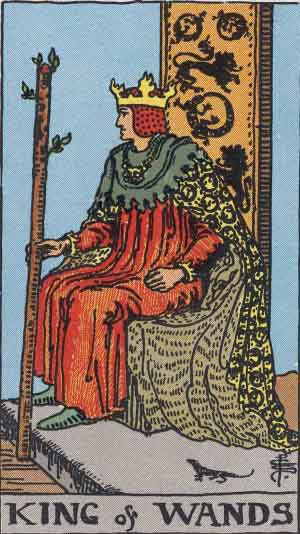
When the King of Wands repeats, vision and leadership capacity are present but their responsible use remains unsettled. The question is not simply whether the seeker will claim authority, but whether evidence, accountability, consent and the needs of those affected are strong enough to support its full expression.
Core Repeating Message
The King of Wands sits on a throne decorated with fire salamanders and lions, wearing a cloak patterned with salamanders. He holds his wand with the ease of familiarity rather than the performance of power. The salamander at his feet is a symbolic detail: the creature of fire that was believed to live in flame and be proof against it, the one who has an established relationship with the element rather than mere encounter with it. The King is not someone who occasionally handles fire; the fire is his domain, his mastery and his responsibility.
When this card appears once, it may mark a situation requiring direction, creative leadership or a clearer decision. When it appears repeatedly, it can describe unresolved authority in either direction: capable leadership is repeatedly deferred, or conviction is being mistaken for a mandate to direct others. The distinction depends on competence, role, evidence, consent and the consequences for people with less power.
One pattern is the seeker who consistently undercuts their own creative authority at the moment of its fullest expression. The vision is clear and specific; the capacity to lead from that vision is real; the specific moment arrives in which the full authority could be expressed, and something pulls back. The voice becomes slightly less certain than the knowledge warrants. The direction becomes slightly less clear than the vision actually contains. The authority is available and is not quite allowed to be fully real in the moment when it most matters. The repeating King can highlight how the authority keeps arriving at the threshold of full expression and keeps declining to be fully inhabited.
A second pattern is the seeker who carries creative authority and experiences it primarily as a burden rather than as an expression of who they are. The fire is real; the vision is specific; the capacity for creative leadership is present. But the experience of wielding that authority is primarily the experience of weight and responsibility rather than the experience of the fire expressing itself in the specific register that the King represents. This seeker is not avoiding their own authority from cowardice or self-doubt; they are carrying it with seriousness and finding that the seriousness has become the primary texture of the experience rather than the specific quality of aliveness that creative mastery at scale produces when it is inhabited rather than merely exercised.
A third pattern belongs to the seeker who has visionary capacity but who has not yet fully developed the specific quality of the King that distinguishes him from the Knight or the Queen: the capacity to lead others from creative vision rather than from personal momentum, from creative authority rather than from the magnetism of warmth. Leading others from a shared vision is a specific and different skill from having the vision or from charging ahead in its direction, and the seeker in this pattern may have extraordinary individual creative fire that has not yet fully developed into the specific quality of creative leadership that the King represents.
A fourth pattern belongs to the seeker who is waiting for external validation before using authority they have demonstrably earned. Yet some permission is real and necessary: formal roles, licences, governance, consent and legal authority cannot be replaced by self-belief. The task is to distinguish an internal request for reassurance from a legitimate external boundary, then act within the authority that evidence and responsibility actually support.
What all these patterns share is a relationship to the full deployment of creative authority: the willingness to sit on the throne with ease, to direct the fire toward a specific vision, to lead from creative mastery in full view of others without reflexively hedging, managing or deferring the authority that demonstrated mastery and a legitimate role support.
When This Card Repeats Weekly
A week of King of Wands repetition can highlight an immediate context in which the seeker’s full creative authority is being called for: a moment of creative leadership, a specific situation that requires the full deployment of visionary direction, or a creative or vocational context in which the seeker’s pattern of hedging or deferring the authority is specifically preventing something from moving forward.
The card this week is asking the seeker to identify the specific moment in the current week in which the full authority is being asked for, and to examine honestly what the characteristic pull is that prevents them from occupying it fully. Not the general pattern but the specific form it is taking this week, in this context, with these specific people or this specific creative territory.
When This Card Repeats Monthly
A month of King of Wands repetition suggests that the seeker’s characteristic relationship to their own creative authority is stabilising as a visible pattern across multiple contexts: the habit of hedging, the pull back from full authority at the moment of real power, the experience of creative mastery as primarily burdensome, or the waiting for permission is appearing consistently enough across the month to be examined.
The monthly lens asks the seeker to look at the contexts across the past month in which the King’s full creative authority was called for, and what happened in each of them. Is there a consistent quality to the moments when the authority is most pulled back? A consistent quality to the contexts or people that most reliably trigger the hedge?
When This Card Repeats Seasonally
A season of King of Wands energy can mark a sustained period in which the seeker is being consistently called into the full deployment of their creative authority and visionary leadership, and in which the specific pattern of what prevents that full deployment is being made visible with enough consistency to be worked with.
One important thing a King of Wands season offers is the experiential evidence of what creative authority, fully deployed from a clear vision, produces in the seeker’s creative and vocational world. A season is long enough to gather real evidence about the specific difference between the hedged and reduced version of the King’s authority and the full version, and about what the full version produces in terms of creative results, vocational response, and the seeker’s own experience of creative aliveness.
When This Card Repeats Across Years
The King of Wands returning across years can describe a seeker for whom the development of creative mastery and the full inhabitation of creative authority is long-arc work: who has, across multiple phases of their life, been consistently called into the specific register of creative leadership and visionary direction, and who has consistently encountered the forms of internal and external resistance that have prevented the full and unapologetic deployment of that authority.
A long-arc pattern may follow environments in which initiative or ambition brought relational and social costs. It may also reflect present institutions that reward compliance, or genuine gaps in role, support or experience. Where fuller expression once carried real costs, reducing it may have been an intelligent adaptation rather than a lack of vision. The card cannot determine the cause. Review specific events, feedback, outcomes and power conditions before deciding whether authority is being needlessly hedged or appropriately bounded.
The multi-year King also marks the seeker who has spent decades building creative and vocational mastery across a domain that is theirs, and who has arrived at a threshold of full creative authority that carries responsibility for others: for the people who work within the seeker’s creative or vocational orbit, for the communities and contexts that the seeker’s vision shapes, for the long-arc direction of something significant. This threshold is real, and its weight is not the King’s hesitation but the King’s seriousness. What the multi-year appearance is asking is whether the seeker is willing to sit with that weight as an expression of the fire rather than a burden placed upon it.
Across years, the growth arc this card traces is toward the quality of creative mastery that the King embodies: not the performance of authority but the inhabitation of it, not merely the management of appearances but the full and unapologetic deployment of it from the vision that is the seeker’s, held with responsibility for its effects.
Life Area Interpretations
Love & Relationships
In love and relationships, the King of Wands can describe the seeker whose characteristic relational difficulty is the full deployment of creative authority in the context of intimacy: who brings fire, vision and creative energy to intimate relationships, and who finds the specific combination of full creative authority and vulnerability challenging to sustain simultaneously.
This seeker may have a pattern of intimate relationships in which their creative authority is expressed in the creative or vocational domain and something else, something more managed, more accommodating, more careful of the other person, is present in the relational domain. The King in the relational register is not a domineering authority but a self-possessed creative presence that leads from a vision in partnership rather than in isolation, and that is willing to be vulnerable within that authority.
The card may also reflect relationships in which ambition or authority became a source of conflict, leading the seeker to hold more of themselves back in later intimate contexts. Healthy intimacy does not require one person to lead the other. It requires mutual consent, room for disagreement, respect for boundaries and an ability to revise a shared direction without punishment, pressure or domination.
Career & Purpose
In career and purpose, the King of Wands can describe the seeker whose creative or vocational mastery has reached a level at which creative leadership, leadership of others from creative vision, is what the situation is asking for, and who is finding the specific transition from individual creative authority to creative leadership of a larger creative or vocational domain challenging.
The vocational King emphasises creative leadership rather than administration alone, and the distinction is significant; responsible leadership still needs sound management. The specific quality the card is marking is the capacity to direct others’ creative fire from the seeker’s creative vision, to inspire and orient a larger creative or vocational enterprise from the specific perspective that creative mastery produces, without needing to control every aspect of what others do within that vision.
Money & Stability
In financial contexts, the King of Wands may highlight the relationship between vision, risk, leadership and material consequence. Where competent leadership and an opportunity are supported by evidence, habitual self-doubt may limit how fully that capacity is used in financial decisions. A strong idea or confident position does not establish future financial power, and cautious results do not prove that the seeker has failed to deploy their authority.
The grounded expression brings a clear financial direction into disciplined stewardship: test assumptions, use current figures, identify downside and liquidity needs, document decision criteria and invite independent challenge. Seek qualified financial, legal or tax advice when appropriate. Tarot can prompt reflection on the seeker’s relationship to risk and authority, but it cannot verify an opportunity or predict a return.
Spiritual Growth
In spiritual growth, the King of Wands can describe a seeker whose sustained spiritual work has developed understanding, a relationship to the sacred and discernment worth expressing. The spiritual King invites them to inhabit that maturity rather than reducing it simply to avoid being seen. Spiritual experience does not confer authority over another person or replace relevant training, credentials, consent and accountability when guiding others.
The spiritual version of this pattern can describe the seeker who has spiritual wisdom and who consistently under-voices it: who has spiritual understanding and allows it to remain private or expressed only in heavily qualified form, from a specific concern that the full expression of spiritual authority would be presumptuous, or off-putting, or spiritually inappropriate.
Emotional & Mental Patterns
The King of Wands in emotional and mental patterns can describe the seeker whose characteristic inner experience of their own creative authority involves a specific quality of ongoing assessment of whether the authority is warranted: who has demonstrated creative mastery and a characteristic habit of reviewing the evidence for that mastery in the context of each new deployment even where accumulated evidence already supports it and no material requirement has changed.
This seeker knows intellectually that the authority is genuine. The specific pattern is that this knowledge consistently requires fresh validation in each new context rather than being available as a settled quality of the seeker’s creative self-possession. It feels as though the King must re-earn the throne in each new room, and the re-earning is a sometimes exhausting feeling of being an impostor that the actual quality of the creative mastery does not warrant.
Family & Generational Dynamics
In family dynamics, the King of Wands may invite inquiry into how authority, ambition and leadership were distributed. One figure may have dominated these roles, making another person’s authority feel presumptuous, or initiative may have been discouraged, but the card cannot establish that history. Repeated messages, remembered incidents and present family behaviour should provide the evidence.
The seeker can examine which ambitions were treated as realistic, dangerous, impractical or only available to other people, who was permitted to influence decisions and what happened when someone challenged the accepted scale. Any generational explanation remains a hypothesis. Its value lies in identifying a current rule that can be tested against present evidence.
Health & Energy
In health contexts, the King of Wands may symbolically reflect sustained responsibility, contained drive or the effort of managing a public leadership role while holding back part of one’s creative capacity. Tarot cannot establish what the nervous system or metabolism is doing, identify the cause of tension or determine how much energy a person should have.
Some people notice muscular tension, restlessness or fatigue around high responsibility or habitual restraint, but these experiences can have medical, psychological, occupational and environmental explanations. Some also notice relief or aliveness when they express an appropriately supported direction more freely; that observation does not establish a cause or promise a health benefit. Track symptoms and workload without treating expression as a cure. Persistent, severe or changing symptoms deserve appropriate professional assessment.
Advanced Interpretive Sections
The Shadow Expression
The King of Wands in shadow can describe two distinct patterns, neither of which is a diagnosis or fixed identity.
The first is the seeker who has developed the performance of creative authority as a substitute for inhabited mastery: whose creative leadership is primarily the management of others’ perception of their authority rather than the expression of creative vision grounded in mastery.
The second shadow is the seeker whose creative fire, when it is not fully inhabited from earned authority, expresses as autocracy rather than creative leadership: who uses creative authority to control rather than to inspire, who applies the King’s direction without the King’s creative vision behind it, or whose fire at the leadership scale has become primarily directed toward maintaining the position rather than toward the creative purpose the position was meant to serve.
The Integrated Expression
The integrated King of Wands seeker has developed the quality of creative authority that the King embodies: the full and unapologetic inhabitation of creative mastery, the capacity to lead from a clear vision without repeatedly seeking reassurance about authority already supported by competence, role and consent, and the quality of creative leadership that inspires and orients others’ fire from the seeker’s own rather than managing or controlling it.
This seeker is recognisable by the quality of their creative or vocational field: things move in their direction when they are in the room, not because they are controlling the environment but because fully inhabited creative authority has an orienting quality felt by the people in its field. The salamander at his feet gives symbolic form to this established relationship with fire: the element is at home in his domain.
Why This Energy Has Not Released Yet
The King of Wands pattern may persist when the seeker has not distinguished reassurance from legitimate permission. Repeated external reassurance cannot substitute for recognising what one’s own experience already supports. Internal recognition matters, but so do appointment, competence, consent and oversight. The useful question is which authority is already supported by evidence, which must still be earned or granted, and which should not be claimed at all.
The pattern can also persist when the seeker has not yet examined the specific cost of the characteristic hedge: what specifically is not being produced by the managed version of the King’s authority that a fuller version could produce, and what that specific gap is costing in terms of creative results, vocational development, and the seeker’s own experience of creative aliveness.
Finally, the pattern may persist when the seeker has not yet developed ease with the specific responsibilities that full creative authority at scale produces. The King’s fire affects others; creative leadership changes the landscape of the people within its field. Until the seeker has accepted that this is the nature of the authority they carry, and developed willingness to occupy it with that understanding rather than managing it to protect against that reality, the hedge continues as a way of containing an authority whose full expression feels overwhelming in its scope.
What This Card Wants the Seeker to Understand
For the seeker whose authority is already supported by experience and a legitimate role, the King of Wands offers this image of the fire already in their hand and the wand already theirs. The throne is not vacant; the seeker is already on it. What the card is asking for is not the achievement of the authority but the willingness to sit in it with ease rather than with the specific quality of restlessness that the King’s slight forward lean in the image suggests: the restlessness of someone who is in the position and not yet fully at home in it.
The authority is genuine. The vision is specific. The fire need not be diminished simply because its responsibility is substantial. What the card is asking for is the internal movement from managing the authority to inhabiting it, from the performance of confident leadership to the actual experience of creative mastery deployed from a clear vision, in full view, without the characteristic hedge.
Signs the Pattern Is Beginning to Resolve
The King of Wands pattern begins to resolve when the seeker begins to notice, in particular moments, the quality of what full creative authority feels like when it is expressed without the characteristic pull-back: the aliveness, the clarity, the quality of creative direction that the full deployment produces and that the managed version does not. This first experience of the full expression is valuable evidence the pattern can provide.
It also resolves when the seeker begins to make specific and concrete creative or vocational decisions from visionary authority rather than from reflexive self-doubt: when the King’s direction, specific, unapologetic and the seeker’s own, begins to shape the creative or vocational field in which the seeker works.
And it resolves when the seeker develops ease with the specific quality of responsibility that creative authority at scale produces: when the weight of the King’s position begins to feel less like a burden imposed from outside and more like the specific expression of the fire that has been with the seeker for their entire creative life.
Reflective Questions
-
Think about the most recent moment in which your full creative authority was available and something pulled it back. What was the pull? What specifically did you manage down, and why?
-
Is there a specific form of external permission or external validation you are waiting for before you will allow yourself to fully inhabit your creative authority? Who or what would need to grant it, and what would it actually prove?
-
What is the specific quality of your creative authority when you allow it to be fully deployed? Can you describe the experience of it from the inside, and what does that experience produce that the managed version does not?
-
Do you experience your creative mastery and visionary capacity primarily as an expression of who you are, or primarily as a responsibility that has been placed upon you? What does your answer reveal about your current relationship to the authority you carry?
-
Is there a specific domain, context, or relationship in which your full creative authority is most consistently hedged? What is it about that specific context that makes the hedge feel necessary, and what evidence supports or challenges that response?
-
Have you experienced genuine creative leadership: the specific experience of directing others’ fire from your own creative vision? What was that experience like, and what did it produce in the people and work within its field?
-
What do you believe will happen if you allow your creative authority to be fully inhabited and fully visible? What is the specific feared outcome, and how real is it in the current circumstances of your actual life?
-
What did your family of origin communicate about the appropriate scope of creative ambition and the appropriate expression of creative authority in someone like you? Was a limit on creative scale communicated, explicitly or implicitly?
-
Think about the most authoritative creative or vocational leader you have known personally. What specific quality did they have in their relationship to their own creative authority that was distinct from what you currently carry in yours?
-
If the King of Wands has been appearing for a sustained period, what specifically has it been marking as the full creative authority and visionary leadership that has not yet been fully inhabited? What would the full inhabitation of it look like in the terms of your current creative and vocational life?
Practical Integration Actions
Identify the full authority moment. Choose one creative or vocational context in the coming week in which clearer direction is supported by your role and experience. Write down the full decision, direction or creative commitment you would express without reflexive self-doubt, the evidence supporting your role, who will be affected, what input or consent is required and how the decision can be reviewed. Commit to expressing that direction within those boundaries, then assess both the outcome and other people’s experience of the process.
Examine the permission structure. Write specifically about any external permission, recognition, or validation that you are currently treating as a prerequisite for full creative authority. Name the specific person, institution, or achievement whose grant of permission you are waiting for. Distinguish reassurance from formal permission, competence, consent or oversight that is genuinely still required. Where the evidence shows that the authority is already yours, write about what it would mean to recognise it and give yourself permission to inhabit it. Do not use the exercise to grant yourself authority that belongs to someone else.
Deploy the vision once without hedging. Choose one low-risk creative or vocational situation in the coming month in which your role includes setting or proposing direction. Here, without hedging means without reflexively diminishing what the evidence supports, not without necessary qualifications. State the direction clearly, identify its assumptions and invite specific challenge before commitment. After that review, express the vision once through the decision, proposal or action your role and the evidence support, rather than performing certainty. Do not remove qualifications that communicate uncertainty, safety limits or material risk. Notice what the fuller expression produces for the work and for you, and whether clarity improves the work without silencing other expertise.
Examine the weight. Write specifically about what the full deployment of your creative authority at scale would require from you in terms of responsibility for others: for the people in your creative or vocational field, for the direction of something significant. Write about the weight of that responsibility honestly: what it costs, what it asks for, and whether you are willing to carry it as the fire’s expression rather than as a burden placed upon it.
Develop genuine ease with the throne. Once each day, spend a few minutes in deliberate inhabitation of the creative authority your experience and role already support: not performing it, not repeatedly demanding fresh reassurance, but sitting in it as something that is already yours. Notice the specific quality of this experience, and notice any resistance that arises. The resistance is the specific information the pattern is providing, and it is worth writing about with as much specificity as the sitting itself.