
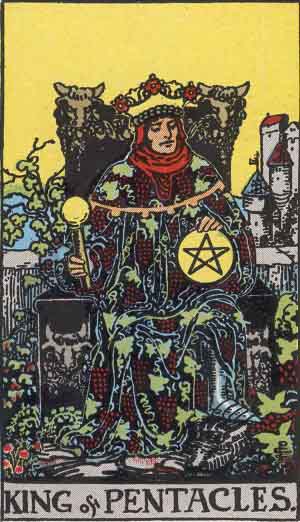
A king sits on a throne adorned with bulls and vines heavy with grapes. His robes carry the imagery of fruit and cultivated abundance. Beneath him the earth is fertile; behind him stands the castle already built. In one hand he carries the sceptre of authority. In the other, the pentacle rests with the ease of something thoroughly understood.
The King is not beginning the work, proving that he can do it or protecting a fragile first achievement. The evidence of sustained material development is already around him. His question is what comes after competence: whether the Seeker can occupy the authority their work has produced, govern what has been built, and decide what their resources and influence are now in service of.
Core Repeating Message
The King of Pentacles is the mature governing expression of the Pentacles suit’s material intelligence. He represents practical competence developed far enough that it now carries authority: the ability to make consequential decisions, direct resources, establish standards, create durable structures and take responsibility for what those structures produce.
This is what distinguishes him from a simpler card of prosperity. Wealth can be inherited, accumulated accidentally or pursued for its own sake. The King’s deeper subject is stewardship. Something has become substantial enough to require governing.
When this card appears once, it may describe the practical authority, financial judgement or grounded leadership required by a particular situation. The Seeker is being asked to respond from established competence rather than behave as though they are still learning whether they are capable.
When the King of Pentacles appears repeatedly, the issue has usually become more persistent. The Seeker’s relationship with authority in the material world is not yet settled. They may have developed expertise without fully acknowledging the standing that expertise gives them. They may control significant resources while remaining uncertain about what responsible use of those resources requires. They may accept responsibility but experience it almost entirely as burden. Or they may have learned to associate wealth, leadership or material power with behaviours they do not wish to reproduce and therefore hesitate to claim even a more ethical form of authority for themselves.
One of the most common patterns is the accomplished Seeker who still relates to themselves as though they are proving their competence.
They know their field. They have accumulated experience. Other people already rely upon their judgement. Their work has produced a demonstrable record. Yet internally they continue to defer decisions, seek permission or wait for someone else to confirm the authority their own development has already established.
The unresolved movement is not from incompetence to competence. It is from competence to ownership of competence.
That shift matters because responsibility changes as capability increases. Someone who knows little may reasonably defer to others. Someone with substantial experience eventually has to make judgements that cannot always be outsourced. The King therefore asks whether the Seeker is still behaving like the apprentice long after apprenticeship has ended.
A second pattern appears when material authority is expanding. A new role, business, body of work, financial position, property, organisation or sphere of responsibility may place more people, money or practical consequences under the Seeker’s direction than before.
The hesitation here should not automatically be treated as weakness. Increased authority genuinely carries increased responsibility. The useful question is whether the hesitation reflects information the Seeker still needs, or whether it persists after the preparation is already sufficient because occupying authority itself feels unfamiliar.
A third pattern appears when the Seeker already holds the King’s position but experiences it primarily as weight. Everything functions because they carry it. People depend upon their reliability. Financial or practical systems remain stable because they continue managing them. From the outside this may look like mastery. From the inside it may feel like being permanently responsible for preventing collapse.
This is a significant distinction. Stewardship is not the same as carrying everything personally.
Mature authority includes judgement about what requires direct attention, what can be delegated, what systems can hold without constant intervention and where other people’s competence needs room to develop. A King who cannot release any responsibility is not necessarily more responsible. He may be unable to trust the structures he governs unless his own hands remain on everything.
A fourth pattern concerns the moral meaning of material power.
Some Seekers have seen money, status, property, business authority or institutional power used coercively or selfishly. Their reluctance to occupy positions of material authority may therefore contain an intelligent ethical response: they do not want to become what they have witnessed.
The card should not flatten that response into “fear of success”. There may be a real history behind it.
The developmental work is to separate the existence of material authority from particular abuses of it. Wealth can exploit, but it can also provide. Authority can control, but it can also create stability, establish fair standards and protect what matters. Resources can be hoarded, but they can also fund work, employ people, preserve places, support families, enable independence and make long-term contribution possible.
The Seeker therefore needs a consciously examined model of material power rather than only a reaction against someone else’s model.
A fifth pattern, especially important in a repeating King, concerns accumulation without purpose.
The Seeker may be highly competent at building, earning, managing or preserving material resources and yet never have articulated what enough is, what success is for, or what responsibility follows from having more capacity than is required for immediate survival.
At this point the Pentacles question changes. The challenge is no longer simply how to obtain stability. It becomes how to use stability once it exists.
That is why stewardship is central to this card. The King’s mature expression asks:
What has been built?
What is now under your care?
Which decisions are genuinely yours to make?
What standards will govern those decisions?
Who or what is affected by them?
What are these resources ultimately intended to sustain?
The repeated King of Pentacles is therefore not simply praising material accomplishment. He is asking whether accomplishment has matured into wisdom.
When This Card Repeats Weekly
A week of King of Pentacles repetition usually points to an immediate decision involving practical authority, money, work, resources or responsibility. Something in the present situation requires the Seeker to use judgement they already possess rather than defer unnecessarily, over-consult or behave as though someone else is inherently better qualified to decide.
The issue may be a financial choice, a professional decision, the allocation of time or money, a boundary around responsibility, or a situation in which other people are waiting for direction.
The weekly question is concrete: what decision already belongs within your legitimate sphere of authority, and what is preventing you from making it?
The card may equally highlight over-responsibility. If the Seeker’s instinct is to carry the whole situation personally, the King’s lesson may be to govern rather than absorb. Delegating appropriately, defining standards clearly or allowing another capable person to carry their share can be as much an expression of authority as taking decisive action oneself.
When This Card Repeats Monthly
A month of King of Pentacles repetition suggests that the Seeker’s relationship with material authority is appearing across several situations rather than one isolated event.
The same pattern may be visible at work, with money, in family responsibilities or in the management of practical life: competence is present, but authority is repeatedly underclaimed, overcarried or exercised without a sufficiently clear sense of purpose.
Looking back over the previous several weeks can reveal the pattern. Where has the Seeker deferred a decision they were qualified to make? Where have they automatically taken responsibility that could have been shared? Where have they managed resources effectively but without asking whether those resources are serving the priorities they actually value?
At the monthly timescale, the King asks for a more stable internal position: not confidence for one decision, but a more settled relationship with one’s own practical standing.
When This Card Repeats Seasonally
A season of King of Pentacles repetition marks a sustained period in which material authority is developing, expanding or being reconsidered.
The Seeker may be growing into a senior role, establishing a business, managing more substantial finances, taking responsibility for property or family resources, consolidating a body of work, or reaching a point where years of experience now give their decisions greater consequence.
This is often the period in which the meaning of success itself needs to mature.
Earlier Pentacles development is naturally concerned with acquiring skills, building stability and creating enough. The King asks the next question: once capability and stability exist, what are they for?
That question becomes especially important across a season because the decisions being made may shape circumstances well beyond the immediate moment. Hiring, investing, pricing, allocating, maintaining, expanding, withdrawing, delegating and committing resources all create downstream effects.
The King therefore asks the Seeker to define the principles by which material authority will be exercised. Which outcomes matter enough to guide major decisions? What should money preserve or enable? What responsibilities accompany leadership? What would constitute enough rather than endless accumulation?
Without examined principles, material authority tends to be directed by momentum. The Seeker keeps building because building is what they know how to do. A King of Pentacles season asks whether the direction still deserves the competence being applied to it.
When This Card Repeats Across Years
When the King of Pentacles returns across years, material authority, stewardship and the mature use of practical competence have become part of the Seeker’s long developmental arc.
This often appears in people who have spent many years building expertise, stability or resources and whose deeper task is learning how to occupy the position their development has created.
The shift from builder to governor can be surprisingly difficult.
Building rewards direct effort. A problem appears and the Seeker solves it. A task exists and the Seeker completes it. Progress can often be measured through visible output. Governing what has been built requires a different form of competence: deciding where effort belongs, setting standards, distributing responsibility, making choices whose effects may unfold slowly and accepting that one’s influence now reaches beyond one’s own work.
The long-cycle King can therefore follow a Seeker through successive increases in responsibility. Each stage asks the same underlying question at a larger scale: can you trust what you know enough to make the decisions that now belong to you?
For some Seekers the issue is not underclaiming but overidentification with the provider or authority role. Their sense of value becomes tied to being the reliable one, the solvent one, the person who knows, manages, pays, fixes or protects. Competence becomes identity.
This can create a subtle trap. If being needed proves one’s worth, delegation feels threatening. If financial security becomes the primary evidence of safety, accumulation never produces enough safety to stop accumulating. If authority becomes the foundation of identity, disagreement can feel like disrespect rather than useful challenge.
Across years, the King therefore asks not only whether authority has been claimed but whether it can be held without becoming the whole self.
The mature long-arc expression is stewardship grounded in proportion. The Seeker knows what they are responsible for and what they are not. They understand the resources under their care, make material decisions with long-term consequences in mind, permit other competent people to exercise authority, and use what has been built in ways consistent with values they have consciously chosen.
The castle remains important. But the castle is no longer the proof that the King matters.
Life Area Interpretations
Love & Relationships
In love and relationships, the King of Pentacles often appears around provision, responsibility and the power created when one person controls or contributes a disproportionate share of material resources.
The integrated expression can be deeply stabilising. The Seeker may be dependable, financially responsible and skilled at creating practical security for a partner or family. They may express love through sustained provision rather than dramatic gestures.
The repeating card asks whether that provision is operating as care, identity, authority or some mixture of the three.
Where one partner controls more money, property or practical resources, a real power differential exists even when neither person intends harm. The King asks whether that difference is acknowledged and handled responsibly. Does material provision support the other person’s agency, or does it quietly give the provider greater control over decisions?
The card can also describe someone who equates being a good partner with carrying every practical burden. Reliability is valuable, but partnership becomes distorted when one person becomes indispensable by doing everything themselves.
A repeating King therefore asks whether material competence is helping the relationship become more secure and reciprocal, or whether provision has become the main way the Seeker proves love, earns belonging or maintains authority.
Career & Purpose
In career and purpose, the King of Pentacles is one of the clearest cards of established practical mastery.
It often appears for someone whose experience has accumulated to the point that they are no longer simply performing work well. They are capable of setting direction, making high-consequence decisions, stewarding budgets or organisations, mentoring others and determining the standards by which work will be judged.
When the card repeats, the unresolved issue is frequently the move into that authority.
The Seeker may still present themselves as less experienced than their record demonstrates. They may remain in execution while avoiding leadership, charge below the value of established expertise, continue seeking approval for decisions already within their competence, or allow formal titles to determine whether they believe their judgement counts.
The King asks for an evidence-based assessment of standing. What has actually been learned? What results have been produced? What responsibilities are already being entrusted to the Seeker? What decisions are other people already relying upon them to make?
For some Seekers, the repeated King points in the opposite direction. They have achieved authority but remain too operational, unable to release work that others could now perform. Their next vocational development is not to work harder. It is to build systems, delegate intelligently and use experience where it has the highest leverage.
Money & Stability
In financial contexts, the King of Pentacles concerns financial capability developed into stewardship.
The card may describe someone who has learned how to earn, preserve, allocate or grow resources effectively. When it repeats, however, the question moves beyond whether the Seeker is financially capable. It asks how financial authority is being exercised.
What is money being asked to do?
For a Seeker still establishing security, the answer may appropriately be protection: housing, reserves, reduced vulnerability and the ability to withstand disruption. For someone whose basic stability is already strong, the question may change. Money can create autonomy, fund creative or commercial work, support other people, enable long-term projects, preserve assets, buy time or contribute to causes that matter.
The shadow appears when accumulation continues without a consciously chosen purpose. More becomes automatically preferable to enough because the act of acquiring and protecting resources has become self-justifying.
The repeated King therefore asks the Seeker to distinguish financial competence from financial wisdom. Competence answers, “Can I manage this?” Wisdom asks, “What am I managing it for?”
Spiritual Growth
In spiritual development, the King of Pentacles brings the question of values into material form.
It is relatively easy to hold spiritual or ethical principles in abstraction. The King asks what those principles do when the Seeker is allocating money, employing people, setting prices, owning property, managing resources, making business decisions or determining what they will preserve for the future.
His spiritual work is not detachment from the material world. It is ethical participation in it.
The repeating card may therefore appear when a Seeker’s material capability has grown faster than their consciously articulated philosophy of material responsibility. They know how to create or manage resources, but have not yet examined what responsible possession means to them.
The King asks for coherence between declared values and practical structures. How is money earned? What effects does the work create? How are people treated inside the systems the Seeker controls? What is protected? What is shared? What constitutes enough? Which forms of prosperity strengthen life rather than merely enlarge possession?
Material stewardship becomes spiritual practice when these questions are lived through decisions rather than admired as principles.
Emotional & Mental Patterns
In emotional and mental patterns, the King of Pentacles often reveals the psychological relationship between competence, responsibility, security and control.
One expression is settled self-trust. The Seeker knows what they know, makes practical decisions without unnecessary drama and does not require constant external confirmation.
The repeating card usually appears because that position is not yet fully stable.
A highly capable Seeker may still experience every major decision as though competence must be proved again from the beginning. They may seek excessive reassurance, overprepare, postpone decisions or treat uncertainty as evidence that they are not ready.
Another pattern is hyper-responsibility. The Seeker feels safest when everything important remains under their control because their experience has taught them that if they do not manage it, it may not be managed adequately. That belief may contain real history. Perhaps they genuinely have been the person who prevented practical or financial instability.
The problem arises when a once-adaptive form of reliability becomes the only acceptable operating position.
The King asks whether the Seeker can retain high standards while allowing capable systems and people to exist outside direct personal control. Mature authority should increase the capacity of the whole structure, not require the permanent exhaustion of its most competent person.
Family & Generational Dynamics
In family and generational dynamics, the King of Pentacles often concerns inherited models of provision, money, authority and material success.
Some Seekers inherit a constructive model: adults who handled resources responsibly, provided without using money as leverage, thought beyond immediate gratification and demonstrated that material stability could support wider wellbeing.
Others inherit more complicated lessons. Money may have been used to control. The person who earned most may have expected final authority over everyone else. Wealth may have been equated with virtue, poverty with failure, generosity with weakness or financial dependence with obedience.
These experiences can strongly influence how the Seeker later responds to their own material authority.
Someone who witnessed financial control may resist earning or holding greater power because they do not want to reproduce it. Someone raised around chronic instability may pursue security long after their circumstances have become secure. Someone taught that the provider deserves control may unconsciously recreate that arrangement despite consciously rejecting it.
The repeated King asks the Seeker to separate inheritance from choice.
What did your family teach you about who gets to make decisions when money is involved? What did provision mean? What did success mean? What happened to people who depended financially upon someone else?
The goal is not to reject the inherited model automatically. It is to know which parts are being consciously carried forward and which are merely repeating.
Health & Energy
In health contexts, the King of Pentacles points toward long-term physical stewardship rather than diagnosis.
His material orientation makes him particularly relevant to the structures that support physical wellbeing over time: consistent care, appropriate professional advice, realistic routines, adequate resources, suitable environments and decisions that favour sustainability over short bursts of effort.
The card can also illuminate the bodily cost of carrying too much practical responsibility. A person who experiences themselves as permanently responsible for maintaining work, finances, family logistics or other people’s stability may remain in a sustained state of practical vigilance. The card does not establish a medical cause for any symptom, but it can prompt useful examination of whether responsibility has become so continuous that genuine recovery time is repeatedly displaced.
The King’s mature relationship with the body is stewardship rather than domination. The body is not another asset to force into productivity. It is part of the material life under the Seeker’s care.
When this card repeats around wellbeing, the useful questions are therefore practical: are sustainable systems in place, is appropriate support being used, and is the same long-range judgement applied to physical wellbeing that the Seeker applies to the other important domains they manage?
Advanced Interpretive Sections
The Shadow Expression
The shadow King of Pentacles confuses stewardship with possession.
He may be materially successful and highly competent, but the resources under his control increasingly exist to preserve his position rather than serve a considered purpose. Security becomes accumulation. Responsibility becomes control. Standards become inflexibility. Prudence becomes an inability to release anything.
This shadow does not require obvious greed. It can appear in respectable forms.
The Seeker may tell themselves they are simply being responsible while continually postponing generosity, investment, succession or change because no level of security feels sufficient. They may insist upon overseeing everything because no one else will do it exactly as they would. They may provide generously while expecting that provision to purchase influence.
Another shadow is the equation of material standing with personal worth. Achievement then becomes difficult to enjoy because it must constantly be maintained as evidence of value. A loss of status, income, control or property feels larger than the practical change itself because identity has been built around being the successful, reliable or powerful one.
The deepest shadow question is therefore not how much the Seeker possesses. It is whether possession has begun possessing the Seeker.
The Integrated Expression
The integrated King of Pentacles has nothing left to prove through the appearance of competence because competence has become established.
They make material decisions from a considered framework of values. They understand the resources under their care, know what those resources are intended to support, and can distinguish prudent preservation from fear-driven accumulation.
Their authority is steady rather than performative.
They can make difficult decisions without manufacturing certainty. They can delegate without experiencing another person’s competence as a threat. They can hold high standards without believing every task must remain under their personal control.
They also understand that stewardship extends beyond possession.
Resources create consequences. Financial decisions affect people. Professional authority shapes working conditions. Property creates obligations. Experience carries a responsibility to develop others. Stability can become a platform from which wider contribution is possible.
The integrated King therefore holds material authority as responsibility without reducing it to burden. What has been built is enjoyed, protected and used.
Why This Energy Has Not Released Yet
The King of Pentacles pattern persists when the Seeker’s external development and internal sense of authority have not yet caught up with one another.
This frequently happens after competence has developed incrementally. There was no single moment at which the Seeker became “the experienced one”. They simply kept learning, solving problems and accumulating responsibility. Because each stage followed naturally from the one before it, their self-concept may still belong to an earlier stage.
Other people may already recognise authority that the Seeker has not fully registered.
The pattern also persists when responsibility has become fused with identity. If the Seeker’s value comes from being indispensable, then delegation is emotionally more complicated than a workload decision. Releasing responsibility can feel like releasing importance.
Another barrier is inherited distrust of material power. A Seeker who has seen wealth or authority used badly may have good reason to approach it carefully. The unresolved issue is not the caution itself. It is whether caution has prevented the development of an ethical form of authority that differs from what they witnessed.
Finally, the pattern remains active when the Seeker is highly developed in the mechanics of material life but has never articulated its purpose.
They know how to build, earn, preserve and manage. They have not yet answered what the building is ultimately for.
Until that question becomes conscious, the earlier behaviours tend to continue automatically because they are familiar and effective. The King returns because effective action without examined direction is no longer sufficient at this stage of development.
What This Card Wants the Seeker to Understand
The King of Pentacles wants the Seeker to recognise that his authority did not appear from nowhere.
The castle behind him belongs to the cumulative development of the Pentacles suit: opportunity received, competing demands managed, craft developed, resources protected, hardship endured, reciprocity learned, long growth tolerated, skill practised, independence established and material continuity understood.
The King stands at the far end of that development.
His authority is therefore earned rather than arbitrary. It comes from accumulated practical contact with reality: things tried, learned, built, corrected, sustained and understood.
For a Seeker who chronically underclaims themselves, this matters. Acknowledging earned authority is not arrogance. Pretending long-developed expertise is equivalent to inexperience does not create humility. It simply makes the Seeker less able to use what they know.
The card also asks the Seeker to recognise that authority changes responsibility.
Once someone has the knowledge, resources or standing to materially affect outcomes, neutrality becomes less available. Decisions will be made either consciously or by default. Resources will serve something, even if that something is only their own preservation.
The King therefore asks not merely, “Do you recognise what you have built?”
He asks, “Now that it exists, how will you govern it?”
Signs the Pattern Is Beginning to Resolve
The pattern begins to resolve when the Seeker makes decisions from the level of competence they actually possess.
They no longer require excessive external confirmation before exercising judgement within their established domain. They can explain the reasoning behind a material decision without either apologising for having authority or performing certainty they do not possess.
Another sign is more intelligent delegation. The Seeker stops equating responsibility with personal control of every component. They define outcomes, establish standards, choose capable people and allow those people to work.
The relationship with material resources also becomes more explicit. The Seeker can articulate what money, professional authority, property, business capacity or other resources are intended to support. Decisions can then be tested against that purpose rather than made primarily through habit.
For someone whose history has created distrust of authority, resolution appears when they begin constructing a form of material leadership they can respect rather than simply avoiding the forms they reject.
The strongest sign is proportion.
The Seeker can value material stability without making it the measure of personal worth, exercise authority without needing domination, and accept responsibility without believing that everything depends upon them.
Reflective Questions
-
What have years of practical work actually taught you? Which skills, judgements or forms of authority are now established enough that continuing to describe yourself as inexperienced is no longer accurate?
-
Where are you still seeking permission or confirmation for decisions that already fall legitimately within your competence?
-
What resources are currently under your stewardship: money, property, professional authority, a business, intellectual property, family resources, organisational capacity or something else? What responsibilities accompany them?
-
What do you believe material success is for once basic security has been achieved? Have you consciously answered that question, or has continued accumulation become the default direction?
-
Where does responsibility become burden for you? Which responsibilities genuinely belong to you, and which remain with you because delegation, trust or relinquishing control feels difficult?
-
What did you learn from your family or early environment about people with money or authority? Which parts of that model still shape your willingness to claim material power yourself?
-
Do you use provision as a way of expressing care? If so, does your provision support the autonomy of the people receiving it, or does it sometimes create an unspoken claim on their decisions?
-
Where has your competence outgrown your current role, pricing, position, level of responsibility or self-concept?
-
If the resources you currently possess were understood as tools rather than proof of success, what would you want them to protect, enable, build or contribute to?
-
If the King of Pentacles has repeated over a long period, what has changed in the scale of responsibility you are being asked to hold? What would it mean to govern that responsibility rather than simply carry it?
Practical Integration Actions
Take an evidence-based inventory of authority
Write down the practical capabilities, resources, responsibilities and results you have accumulated over time. Avoid both inflation and modesty. Record what can be demonstrated.
Include the decisions people already rely upon you to make, the problems you can now solve that once required outside help, the resources you are trusted to manage and the experience that materially changes the quality of your judgement.
The purpose is not affirmation for its own sake. It is accurate self-assessment.
Define what the resources are for
Choose the principal material resources under your control and complete the sentence:
“This resource exists to…”
Do this for money, professional authority, property, a business, time, organisational capacity or whatever is relevant.
If you cannot define the purpose, that absence is useful information. It may explain why the resource is being maintained or expanded largely through momentum.
Audit responsibility versus control
List the responsibilities you currently carry and divide them into three categories:
- decisions that legitimately require your direct judgement;
- work that remains your responsibility but can be delegated;
- work that does not actually need to remain under your control.
Then act on one item from the second or third category.
The King develops through governance, not through proving that one person can carry an entire system.
Make one consequential decision from established competence
Identify a practical decision that has been delayed despite sufficient information and despite falling clearly within your sphere of authority.
Make it.
Document the reasoning rather than seeking further permission simply to reduce discomfort. If the decision genuinely requires more evidence, identify exactly what evidence is missing rather than treating indefinite uncertainty as prudence.
Write a material stewardship statement
Set out the principles you want governing your use of money, resources and authority.
Include what you want to protect, what you are willing to invest in, what you consider enough, what responsibilities you believe accompany material success, and what forms of wealth or authority you would not pursue at the expense of your values.
This gives future material decisions a framework more deliberate than habit.
Examine the inherited model of authority
Write down the most influential examples of money, leadership and provision you saw while growing up.
For each, identify separately:
What was worth carrying forward?
What caused harm or distortion?
What do you intend to do differently?
The aim is to build a model of material authority that is consciously yours.
Practise material generosity with purpose
Choose one use of resources beyond immediate self-maintenance that directly reflects your stated values.
The scale should be appropriate to your circumstances. What matters is that the act be intentional rather than symbolic. The exercise is not about proving generosity. It is about experiencing material capacity as something that can create effects beyond accumulation.