
The COMPASS Method™
Turn intuitive perception into clear, coherent understanding
Learn to recognise and accurately decode the information that arrives before words, then give it a reliable structure for interpretation. The COMPASS Method™ helps you understand what is moving beneath the surface, communicate what you perceive clearly, and use that insight to navigate readings, relationships, business decisions, and life with greater confidence.
You already perceive more than you can explain
The difficulty is not always receiving the information. It is knowing what to do with it.
Intuitive information often arrives before language. It may appear as a feeling, image, tension, bodily response, pattern, or half-formed knowing. Without a reliable interpretive structure, it can remain vague, become distorted by projection, or disappear beneath too much analysis.
The result is not a lack of intuition. It is intuitive information without a dependable container.
-
You sense the answer but cannot yet hold the thread
You recognise that something important is present, but the reading fragments into individual meanings, extra cards, and explanations that do not resolve into one coherent understanding.
-
You question what you perceived
You receive an intuitive impression, then immediately wonder whether it is accurate, imagined, influenced by fear, or simply what you expected to find.
-
You understand more than you can communicate
The insight feels clear internally, but translating it into language another person can understand becomes difficult. You soften, qualify, over-explain, or lose the central point.
When the answer never quite lands
Unstructured intuition creates more work, not more clarity
Without a reliable interpretive container, capable readers often keep working the reading long after the useful signal has already arrived.
- Pull more cards because the first answer does not feel complete
- Keep searching for clarification instead of trusting what is present
- Give clients broad or vague interpretations
- Struggle to explain how they reached a conclusion
- Lose time moving between meanings, impressions, and possibilities
- Second-guess themselves after the reading
- Confuse additional information with greater accuracy
- Recognise something important but cannot identify the central thread
The problem is rarely that nothing is coming through. The problem is knowing what belongs, what matters, and when the answer is complete.
What changes
What once arrived as a vague feeling, image, tension, or half-formed knowing becomes information you can decode, test, and use.
The COMPASS Method™ gives intuitive perception a disciplined interpretive structure. You learn to recognise the deeper pattern, test meaning against context, and translate pre-verbal information into clear understanding.
- Business decisions Recognise patterns earlier and act with clearer professional judgement.
- Relationship dynamics See what sits beneath words, behaviour, and recurring tension.
- Meaning in transition Find direction within challenging or uncertain periods.
- Clarity and agency Navigate readings and everyday life with greater confidence.
- Clearer self-readings Settle with what is present instead of chasing the next card.
- Clearer client readings Give friends and clients a coherent thread they can use.
- Less anxiety, less over-pulling Stop treating extra cards as proof that the answer was incomplete.
- Less over-explaining Say what belongs without diluting the central point.
- Interpretive precision Test impressions against context until the reading coheres.
- Knowing when it has landed Recognise when the answer is complete and the work can stop.
You learn to see more of what is happening, understand what it means, and decide how to respond.
Why other training often stops too soon
Knowing card meanings is not the same as knowing how to interpret what is happening.
Most tarot and oracle education concentrates on symbols, keywords, spreads, and technique. Those foundations matter, but they do not fully address the moment when several impressions arrive at once and you must decide what belongs, what carries the most weight, and how the pieces resolve into one useful understanding.
-
Meanings give you vocabulary
They help you recognise what an individual card may represent. They do not automatically tell you which meaning matters here, in this question, for this person, at this moment.
-
Intuition gives you information
It may arrive as an image, feeling, physical response, association, memory, tension, or sudden knowing. Without a structure for testing and organising it, valuable information can remain unclear or become mixed with assumption.
-
Interpretation creates understanding
Interpretation is the disciplined work of bringing card, question, context, relationship, and intuitive signal together until the reading becomes coherent and useful.
The COMPASS Method™ teaches the part between perception and understanding.
A proprietary interpretive framework
Seven pillars create the container. You learn how to work within it.
The COMPASS Method™ is not another card-meaning system, spread library, psychic-development course, or fixed script. It is a structured framework for recognising, testing, organising, and communicating intuitive information.
Center and Seal form the bookends of the method. They establish how you enter the work and how you recognise completion. The five pillars within that container are not used as a rigid sequence. Their emphasis changes according to the reading, the context, and your own intuitive strengths.

The seven COMPASS pillars
-
Center
Arrive before interpreting. Settle attention, establish the question, and recognise what you are bringing into the reading.
-
Open
Make space for information that does not match the answer you expected or preferred.
-
Map
See the structure of the whole reading before becoming absorbed in individual details.
-
Perceive
Notice what is actually present through cards, imagery, sensation, pattern, language, and intuitive response.
-
Align
Test what you perceive against the question, context, evidence, and relationships within the reading.
-
Sense
Follow the living thread between the elements and recognise where meaning gathers weight.
-
Seal
Recognise when the answer has landed, communicate the central understanding, and close without adding noise.
The framework is consistent. Its application remains responsive.
You are not taught to force every reading through seven mechanical steps. You learn how to hold a dependable interpretive container while working intelligently with the information, strengths, and circumstances present.
The method in practice
From a collection of card meanings to one coherent answer
Before COMPASS
A reader understands each card individually but cannot identify which one is central. They pull clarifiers, add more possibilities, and explain every symbol. The seeker receives information, but no clear answer.
With COMPASS
The reader centres the question, maps the spread, identifies the cards carrying the answer, tests the intuitive signal against context, follows the relationship between the central and supporting cards, and stops when the reading has landed.
The difference is not more information. It is greater coherence.
The live training experience
A concentrated method. Three months to put it into practice.
COMPASS begins with an intensive live teaching phase, then moves quickly into application. You learn the full interpretive framework, begin using it inside The Deck Compass, and continue refining it through real readings, journalling, observation, and feedback.
Phase One · Install the framework
Learn the seven pillars across four live sessions
The teaching phase takes place over four alternate days. Each session lasts 60–90 minutes and generally introduces two pillars of the method.
Center and Seal are taught first because they form the bookends of the framework. Center establishes how you enter the work. Seal establishes how you recognise completion and close cleanly.
The five pillars held within that container are equally important, but they are not taught as a rigid sequence. You learn how their emphasis changes according to the question, the reading, the context, and your own intuitive strengths.
-
Session 1
Establish the container
Learn Center and Seal as the structural bookends of the method, including how to arrive before interpreting and how to recognise when the answer has landed.
-
Session 2
Develop perceptual range
Work with two of the internal pillars and begin recognising how intuitive information arrives through imagery, language, sensation, pattern, and relationship.
-
Session 3
Test and organise meaning
Add two further pillars and practise distinguishing useful signal from assumption, habit, emotional investment, and unnecessary complication.
-
Session 4
Complete the framework and enter practice
Learn the final pillar, bring the full method together, and receive your onboarding into The Deck Compass platform.
Phase Two · Apply and integrate
The method becomes useful through real practice
For the remaining almost three weeks, you use The Deck Compass to conduct readings, document what you perceive, and examine how you moved from intuitive information to interpretation.
-
Conduct readings through the platform
Use the COMPASS framework in live and personal readings while the method is still fresh.
-
Journal inside each reading
The Deck Compass includes structured journalling so you can record impressions, decisions, changes in emphasis, and the point at which the answer became clear.
-
Share your journal for review
You can share selected journalling notes with Leigh for review through the platform, helping you identify patterns in how you perceive and interpret.
-
Build your own responsive practice
You learn which pillars require greater attention in different circumstances and how to use the framework without turning it into a mechanical checklist.
Personalised mentorship
One of your readings is observed, then reviewed with you privately
When you feel ready, you conduct a reading for a seeker while Leigh observes. The purpose is not performance or assessment. It is to see how the method functions inside your real reading practice.
After the reading, you receive private feedback on how you held the structure, where the intuitive signal was strongest, how you tested and communicated the interpretation, and whether you recognised the point of completion.
You may schedule this observation at any point before your complimentary three-month Deck Compass membership expires.
Three months included
Continue practising after the teaching phase ends
Your enrolment includes three months of membership in The Deck Compass, valued at US$117.
- Continued access to the reading and journalling platform
- Journal sharing and review through the member interface
- One guaranteed live member training each month
- Access to other member activities scheduled during your membership
- Connection with your cohort and the wider practitioner community
At the end of the complimentary three months, access ends unless you choose to continue your membership at US$39 per month.
You are not buying four lessons.
You are receiving the complete COMPASS framework, concentrated live teaching, structured platform practice, personalised observation and feedback, ongoing journal review, and three months in a live practitioner environment.
The aim is not simply to understand the method. It is to make it part of how you perceive, interpret, and respond.
US$997 · Direct enrolment · Maximum six participants
Choose your cohort
Two new cohorts begin each month
COMPASS cohorts begin near the start and middle of each month. Each cohort follows the same four-session intensive and guided practice structure.
Choose the cohort whose four live sessions you can attend. Your place is reserved only after payment is completed.
All sessions are shown in Mexico City time. Please confirm the conversion for your location before enrolling.
- Every confirmed cohort proceeds, even with one participant.
- Maximum six participants per cohort.
- Enrolment closes 48 hours before the first session.
Complete your enrolment
One complete offer
The COMPASS Method™ Live Practitioner Training
US$997
One programme. No stripped-back version. No need to decide how much support you will need before you begin.
- Four live teaching sessions
- 60–90 minutes per session
- Almost three weeks of guided application
- One observed seeker reading with private feedback
- Journal sharing and review through The Deck Compass
- Three months of Deck Compass membership
- One guaranteed live member training each month
- Maximum six participants
- Every confirmed cohort proceeds
Included membership value: US$117
Results in practice
What Changes When the Method Becomes Part of Your Practice
Stronger professional interpretation
Working with Leigh has been a game changer for me.
I’ve worked with tarot and oracle in my practice for many years, but I had a wall around trusting my intuition and knowing what to do with the intuitive information I was receiving. As a business and life coach, I often receive messages that do not come from the material directly in front of me, and I did not know how to ground that information practically or communicate it clearly to clients.
Leigh’s training reflects the real depth of her experience and goes far beyond the topic on the surface. For me, as an adult student wanting to tighten my practice, that breadth was pure gold. I cannot speak highly enough of her skill as a trainer or the depth of knowledge she brings to this work.
I am deeply grateful for what I have learned. I will continue applying these skills and will return for any training Leigh offers next. I highly recommend her training to anyone who has reached the point in their practice where they want to go deeper but are unsure how to develop their skills and offerings.
A clearer container for self-reading
“What the method gave me was a way to anchor my own readings in a system that brought real clarity.”
One of the challenges when you read for yourself is not continuing to reach for more cards, looking for deeper answers or different answers, instead of settling with the cards already in front of you. The COMPASS Method did exactly that, and it reduced my anxiety considerably.
I used to read and then wonder, have I got this right, what am I supposed to do next. What this gave me instead was a container to hold the information, and by being able to sit with it in a still way, I was able to glean the answers I actually needed.
This has been incredibly valuable, and it is now something I work with automatically as part of my practice.
Greater accuracy, control, and confidence
“This training has given me the confidence to read well and to use the cards as a tool rather than let them dictate the reading.”
I’m relatively new to tarot, and I did this training so I’d have a system I could actually use. What I’d tried before mostly followed the Golden Dawn method, and I found the cards tended to drive the process. What I found with the COMPASS Method training was that it gave me a way of actually being in charge of the tools I was using, which is ultimately what I want to be able to do.
So many spreads and ways of using the cards end up determining the direction of the reading, when I think it should be the other way around.
This training has given me, as a relatively new reader, the confidence to read well and to use the cards as a tool rather than let them dictate the reading, while still getting really clear responses. The best part is that my accuracy has gone through the roof because I’m taking my time, and yet I’m actually a lot faster at reading the cards than I was before. It’s an interesting thing when you learn a skill properly: you can end up getting better results in less time.
Why Leigh created COMPASS
Four decades of intuitive practice, shaped by the discipline of clear communication
Leigh Spencer is a fourth-generation Matakite, tarot practitioner of more than 40 years, professional journalist and editor of more than 30 years, and founder of The COMPASS Method™.
The method emerged from the meeting point between intuitive perception and editorial discipline: noticing what is present, testing what belongs, identifying the central thread, and communicating it in language another person can understand and use.
COMPASS was developed because many capable readers do not need more meanings. They need a reliable way to organise what they already perceive.
The COMPASS Method™ is a proprietary interpretive framework developed by Leigh Spencer. As the method continues to be applied and taught, aspects of its language, supporting materials, platform experience, and teaching sequence may be refined for the benefit of participants. Any change affecting a confirmed cohort or included benefit will be communicated in advance and will not reduce the value of what has been purchased.

FAQ
Common questions
How do I choose a cohort and enrol?
Select a month, choose one cohort by its start date, review the three further teaching dates, enter your name and email, confirm attendance and terms, then continue to payment. Your place is reserved only after payment is completed.
Do I need to be an experienced professional reader?
No. COMPASS is for readers who already understand the basic language of their cards and can complete a reading independently. You may read professionally, for friends, or primarily for yourself.
Is COMPASS only for tarot readers?
Tarot and oracle readers are the primary audience. The interpretive principles can also support coaching, facilitation, writing, leadership, and other work involving pattern recognition and intuitive judgement.
Is this suitable for complete beginners?
No. The programme does not teach basic card meanings. You should already be able to work with your deck and complete a reading without step-by-step instruction.
Will I have to read in front of the group?
Live practice is part of the programme, but the environment is small, structured, and developmental. You are not expected to perform. The purpose is to apply the method and receive useful feedback.
What happens if I miss a teaching session?
Attendance is strongly recommended. Where scheduling permits, you may attend the equivalent lesson with another cohort. Relevant written materials will also be provided. The programme is not designed as a replay-based course.
Are sessions recorded?
Teaching sessions are not routinely recorded, protecting participant privacy and live discussion.
How much time should I allow?
Allow 60–90 minutes for each of the four live sessions, plus time for practice readings and journalling during the remaining integration period.
What does the observed reading involve?
You conduct a reading for a seeker while Leigh observes. The seeker must understand the training context. The reading is not recorded by default. Leigh provides private feedback afterwards.
When must I complete the observed reading?
You may schedule it when you feel ready, provided it takes place before your complimentary three-month Deck Compass membership expires.
What happens after the three complimentary months?
Your access ends unless you choose to continue your Deck Compass membership at US$39 per month.
Is membership renewed automatically?
Renewal mechanics are confirmed separately at checkout. This page does not state that billing is automatic until the Stripe configuration has been audited.
What is the refund and transfer policy?
You may request a full refund within 48 hours of purchase, provided the cohort has not begun. After that period, payment is non-refundable because your place and live delivery capacity have been reserved. One transfer to another available cohort is permitted with at least 72 hours’ notice. If Tides of Knowing postpones or cancels a cohort, you may transfer or receive a full refund.
What if the method changes after I enrol?
COMPASS is a proprietary system and may be refined as it is applied and taught. Any change affecting your confirmed cohort or included benefits will be communicated in advance and will not reduce the value of your enrolment.
Ready to work with what you already perceive?
Learn to decode intuitive information, give it structure, and use it with greater clarity
COMPASS is designed for readers who are ready to move beyond meanings and build a dependable interpretive practice.
US$997 · Direct enrolment · Maximum six participants
Two cohorts begin each month. Every confirmed cohort proceeds. Enrolment closes 48 hours before the first session.
A lower-commitment path
Not ready to enrol yet? Start with discernment.
If you are not ready for The COMPASS Method™ live training, The Discernment Checklist is the quieter alternative: a practical way to sharpen question framing and reading closure before you commit to the full programme.
Free checklist
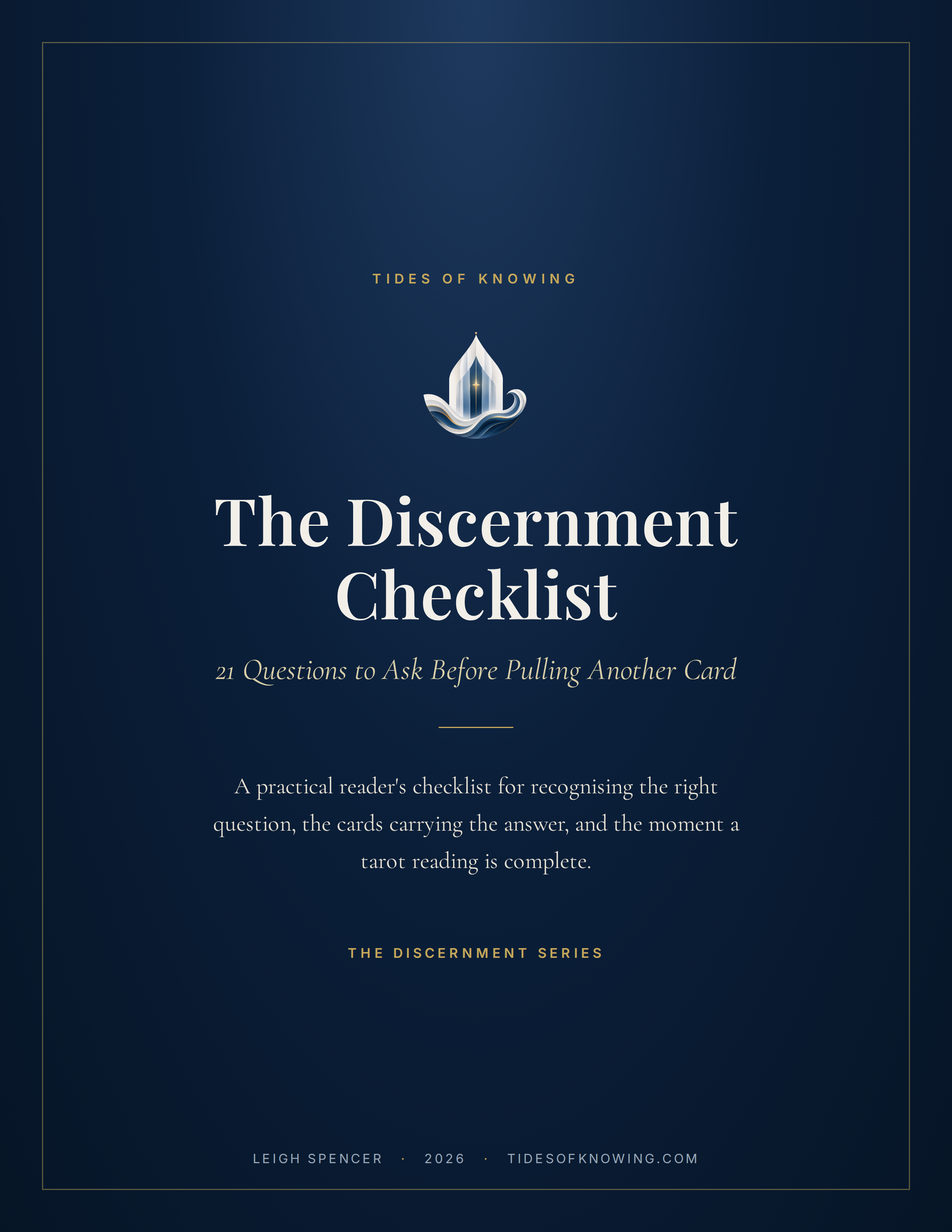
The Discernment Checklist
21 Questions to Ask Before Pulling Another Card
Use this reader’s checklist to test the question, recognise the cards carrying the answer, decide whether another card is needed, and close the reading cleanly when the answer has landed.
An original interpretive framework created by Tides of Knowing: The COMPASS Method™.