
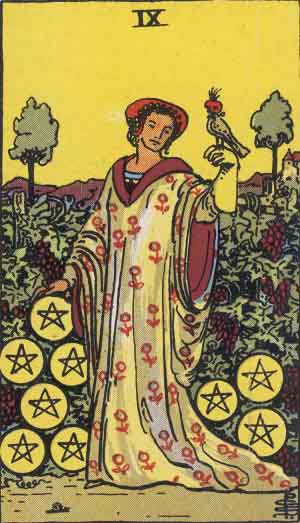
A figure stands alone in a garden rich with vines and fruit. A falcon rests on their gloved hand. They are well-dressed, unhurried and at ease within cultivated surroundings. The image emphasises stewardship and self-possession, but it does not tell us which advantages, inheritances, relationships or labour helped make the garden possible. The question this card keeps returning with is whether the seeker can recognise and inhabit what has been built, while remaining honest about the support behind it and open to connection beyond its walls.
Core Repeating Message
The Nine of Pentacles shows a figure in a lush garden, surrounded by vines laden with nine pentacles, a trained falcon on their gloved hand. The aloneness can suggest self-possession, privacy and the capacity to enjoy one’s own company, but it need not imply that independence is absolute. Gardens depend on land, time, knowledge, labour and wider systems. The garden has been cultivated and the falcon trained; the image invites the seeker to think of themselves as a responsible participant in that tending, rather than merely a visitor to its fruits. The Nine concerns mature stewardship of a material life the seeker can substantially direct, together with the ability to receive its pleasures without denying interdependence or the conditions that made them possible.
A single appearance may invite recognition of practical achievement and the ease it can make available. Repetition draws attention to a gap in the relationship with that sufficiency: the seeker has built some stability, or has potential for greater agency, but cannot yet fully inhabit it. What exists outside may not be felt inside, and a sense of material worth or security may lag behind present circumstances. The distinction asks for an honest view of both the resources and the experience of living with them.
The most common pattern is stability that has been built but is difficult to feel. A house may be owned, income may be reliable and the garden well tended, while the seeker still experiences life as precarious. The evidence of some independence is present; the felt ease is not. Those outward markers do not guarantee that all risks have passed, but where a careful assessment supports security, the question is what keeps it from becoming a lived experience rather than a fact acknowledged only at a distance.
A second pattern belongs to the seeker who wants greater material agency but has not yet built the conditions for it. Skill and resourcefulness matter, yet income, disability, care obligations, discrimination, immigration status, debt and access to capital can materially constrain what is possible. The seeker may also be working within arrangements that underrecognise their skill or no longer fit what they can responsibly build. Employment and support are not failures of independence. The repeating Nine asks what form of self-direction is realistic and desired now: perhaps clearer ownership, a personal reserve, paid recognition of skill, or greater influence over how shared resources are used.
A third pattern is material success accompanied by comfortable loneliness. The garden is abundant, but building an independent life has left little room for relationship or community. Solitude here differs from the self-possessed ease suggested by the image: the seeker is secure in some practical respects yet misses warmth and connection. The trained falcon is itself in relationship with the figure, a reminder that independence need not mean permanent isolation. The question is what kind of chosen connection could make the cultivated life more fully inhabitable.
A fourth pattern is hard-won self-reliance maintained through control and vigilance after some of the conditions that required them have changed. Independence took effort and cost, and support can now feel like a threat to what was carefully established. The task is to distinguish help that would compromise agency from help that could be received without undoing the work of becoming more self-directed.
What all these patterns share is a relationship to cultivated sufficiency: the challenge of recognising what the seeker’s effort and judgement have produced without pretending that any material life is made alone. The Nine asks for both ownership and context. Can the seeker receive earned ease, acknowledge help and privilege where they exist, and use independence as a foundation for chosen connection rather than as proof that no one else is needed?
When This Card Repeats Weekly
A week of Nine of Pentacles repetition asks how the seeker is relating to the material life immediately around them. Is an available comfort, a measure of sufficiency or the possibility of greater self-direction being received? Or does the week pass in tending and managing what exists without really living in it?
The practical question is concrete: what pleasure, comfort or ease do current circumstances support that the seeker is not allowing themselves to receive? What is getting in the way?
When This Card Repeats Monthly
Across a month, the relationship between material circumstances and felt sufficiency becomes easier to compare across contexts. Ease may not yet have been built, may exist without being felt, or may remain difficult to inhabit. Repeated examples can show whether the gap is temporary or has become a familiar part of how the seeker lives.
The monthly lens asks for an honest account of what has been built and what degree of independence or sufficiency is present. What prevents it from feeling like enough, or from being received as something the seeker has helped cultivate and can appropriately enjoy? The assessment concerns this life as it is, rather than an imagined threshold at which ease will finally be permitted.
When This Card Repeats Seasonally
A season gives time to see whether material self-possession is developing. In the ordinary pattern of days, is the seeker becoming more at home with what has been built, or is the difference between outer conditions and inner experience becoming settled? The answer involves both the practical security available and the person’s capacity to receive it.
The central seasonal question concerns what the seeker feels entitled to receive from their practical efforts. Does that inner valuation acknowledge what they have built, or minimise it? Material achievement can deserve recognition without becoming a measure of human worth, and pleasure need not wait until the seeker has proved that every part of life is secure.
When This Card Repeats Across Years
When the Nine of Pentacles returns across years, building sufficiency and feeling at home in it may be long-running work. Independence can remain out of reach, or be achieved in some practical respects without becoming a felt reality. Across several phases of life, the seeker may find ease more elusive than the outer evidence would suggest.
One possible history is a household where material sufficiency coexisted with anxiety, or instability made security feel fragile and temporary. Those expectations may persist when adult circumstances change, and a felt sense of safety need not follow a new balance sheet immediately. Other explanations may be current rather than inherited. The card cannot reconstruct a childhood or establish a bodily mechanism; the seeker’s experience and an accurate view of present risks must guide the inquiry.
The long-cycle Nine may also describe a person who has spent years building security for others as a provider, caretaker or financial supporter while giving their own wellbeing less room. The capability is present, yet self-provision has not received the same direction or resources. Sometimes a different choice is possible; sometimes caring duties or unequal conditions constrain it. The question is what realistic space can be made for the seeker’s own sustaining life.
Across years, the growth arc is towards material self-possession: building meaningful agency, recognising what has been contributed by the self and by others, and feeling at home within the life that is available. This does not require solitary financial independence, ownership or a particular income. It means that the seeker has a voice in material decisions, can receive appropriate support without being diminished by it, and can enjoy what has been cultivated without making productivity the measure of human worth.
Life Area Interpretations
Love & Relationships
In relationships, the Nine of Pentacles concerns the meeting of material independence and intimate interdependence. The seeker may be building or already living with self-sufficiency, yet find its place within a relationship unsettled. How can practical autonomy remain intact while vulnerability, mutual care and shared decisions are allowed room?
One expression is the person who has built the garden but experiences opening to another as a threat to its integrity. Independence makes vulnerability harder rather than easier. Another is a pattern of choosing for material self-sufficiency that has led to more relational solitude than intended. Both ask what the protection is preserving and what kind of connection it may be excluding.
Career & Purpose
In career and purpose, the Nine of Pentacles may mark a desire for greater vocational self-direction: more control over standards, time, clients, methods or the use of one’s expertise. That can occur in employment, self-employment, partnership or a portfolio of roles. Leaving secure work is not inherently more integrated, and the card is not evidence that independent income will succeed. The useful enquiry is which form of autonomy the seeker actually values, what protections would be lost, and what evidence, runway and professional advice would be required before changing the structure.
The Nine can also invite someone who has achieved vocational autonomy through skill, effort and support to receive its benefits. Work may now offer room for judgement, choice or a more self-directed rhythm, yet the seeker may still live as though that freedom is not theirs to use. Recognition includes inhabiting the autonomy, not only continuing to earn it.
Money & Stability
In financial contexts, the Nine of Pentacles focuses on agency, sufficiency and the ability to enjoy resources without losing sight of obligations and risk. Income is not a direct measure of personal worth, and material outcomes are shaped by more than capability. The card asks whether the current structure gives the seeker appropriate knowledge, access and influence over financial decisions, and whether their labour and skill are fairly recognised within the conditions they can realistically change.
The Nine can symbolise financial self-sufficiency, rather than great wealth or maximum accumulation, but self-sufficiency should not be confused with the absence of support. Pensions, benefits, partners, families, communities, public services and institutions are part of many sustainable lives. Its integrated expression is responsible stewardship and meaningful choice within the seeker’s real network of resources. Where financial decisions are consequential, verified information and suitably qualified advice remain more reliable than symbolic interpretation.
Spiritual Growth
In spiritual growth, the Nine of Pentacles can describe embodied self-possession: knowing the value of one’s experience, trusting one’s perception and finding an inner ground that does not need constant external confirmation. This is spiritual self-sufficiency with room for connection. The seeker can draw on their own resources without treating guidance, community or shared practice as a failure to stand on their own ground.
Emotional & Mental Patterns
In emotional and mental patterns, the Nine of Pentacles can describe an inner life that has not caught up with improved material conditions. Anxiety or insufficiency remains in the background despite evidence of greater stability, or the seeker’s account of their own capability understates what has been built. The task is to assess the discrepancy without assuming that outward success removes every source of insecurity.
The texture may be a sense of not-quite-enough: life looks good, but feels safer guarded than inhabited. Ease seems temporary, and receiving it appears to risk the stability vigilance has protected. The Nine can be recognised from the outside before it is felt from within. That difference is an experience to explore, rather than proof of a particular bodily cause.
Family & Generational Dynamics
In family dynamics, the Nine of Pentacles may mark a seeker whose material life differs from that of their family, or whose wish for privacy and autonomy challenges established expectations around shared resources. The seeker may be living with a degree of stability for which there was no clear family model, and finding internal permission to enjoy it may feel difficult. Pride, gratitude, loyalty, guilt and caretaking can coexist. The card does not establish survivor’s guilt or prescribe withdrawal from family support. It invites clear boundaries and honest recognition of both contribution and obligation, including the cultural and relational meanings that individual independence may carry.
Health & Energy
In Health & Energy, the Nine of Pentacles asks whether the seeker’s environment, time and available resources support rest, access, nourishment, movement and care suited to their actual needs. Greater material choice can improve access, but it does not guarantee health, and dependence on carers or services does not diminish self-possession. The card is not a diagnosis and should not be used to attribute symptoms to insufficient self-care. A useful question is whether an old habit of economising on care persists even where more support is now affordable and accessible. Its practical value lies in noticing where available support is not being used, where care remains inaccessible, and which decisions belong with qualified health practitioners.
Advanced Interpretive Sections
The Shadow Expression
In shadow, independence becomes defended isolation. The garden is carefully maintained, but the protection that helped establish a stable life now makes relational openness difficult. Its boundaries keep out not only unwanted interference but some of the warmth the seeker would welcome. The ease of the Nine is not simply an impeccably guarded perimeter; it includes living within what has been cultivated.
The Integrated Expression
The integrated Nine of Pentacles seeker inhabits their material life with self-possession and appreciation. They recognise their own effort, acknowledge the people and systems that also contributed, and can receive pleasure without making it a performance of status or proof of worth. Their autonomy supports connection rather than defended isolation. They can ask for help without collapsing their sense of competence, offer help without superiority, and make material choices that reflect both personal values and real responsibilities. In the language of the image, the garden is both tended and inhabited; the ease is lived rather than performed.
Why This Energy Has Not Released Yet
The Nine of Pentacles pattern may remain active when the seeker’s felt sense of security does not match present conditions, or when present stability is more conditional than it appears. The first task is accurate assessment: assets, income, debt, obligations, access, support and genuine risks. Simply deciding to feel secure may not close the gap between knowing and experiencing it. Where the facts indicate sufficiency, repeated experiences of using and enjoying resources within safe limits may gradually make that sufficiency more believable. Where the facts indicate vulnerability, practical planning and support are more appropriate than pressure to feel secure.
The pattern may also persist while the care the seeker makes possible for others is not extended to themselves. Their effort supports a productive garden, yet they receive little of its fruit. The question is where self-provision can become part of the arrangement, alongside real obligations, rather than remain indefinitely deferred.
What This Card Wants the Seeker to Understand
The cultivated garden can be read as an image of work, judgement and continued tending made liveable. The figure appears at ease rather than merely displaying status. That visible ease invites the seeker to ask whether they inhabit what has been built, without using the image to prove that its abundance is solely self-made or free from inherited advantage or future risk.
The Nine is not simply an invitation to accumulate more until enough finally arrives. It asks what it would mean to live in the sufficiency already present: to receive the ordinary comfort and choice that present resources support, rather than guard them from a distance. Where resources are not sufficient, building support remains part of the work.
Signs the Pattern Is Beginning to Resolve
One sign of resolution is receiving a pleasure or comfort that current circumstances support and that has been repeatedly deferred. Ease becomes an experience rather than something acknowledged at a distance. Notice how that experience feels, while keeping the practical assessment of affordability, obligations and risk separate from the feeling itself.
Another sign is describing one’s material circumstances in language that accurately recognises what has been built. Achievement and support can both be named without habitual minimisation, exaggeration or a need to apologise for sufficiency. The description becomes closer to the life actually present.
Reflective Questions
-
What has your sustained effort contributed to your material life: stability, practical skills, independence or sufficiency? Can you describe honestly what you have built, alongside the help and conditions that made it possible?
-
Is there a gap between your circumstances and your felt sense of security or sufficiency? What is the discrepancy, and what does an accurate assessment of your current resources and obligations show?
-
What would it feel like to inhabit your present life more fully, receiving the ease, stability or sufficiency it offers? Is that possible now, and which parts of your vigilance still answer a real need?
-
Which pleasures, comforts or forms of ease do your present circumstances support that you are not receiving? What prevents you from accepting them?
-
Which parts of your stability are sustained by your own work and capability, and which depend on other people or systems? Without judging those dependencies, what form of greater self-direction is possible and wanted?
-
Is your wellbeing consistently deferred in favour of others, as though the garden you tend mainly produces for someone else? What would it mean to make room for your own flourishing while recognising real responsibilities?
-
What did your family communicate about what you were entitled to receive materially and the kind of life you could inhabit? Does that message fit your adult circumstances, or does it need examination?
-
Have you felt at home in a materially stable life you helped create? What made that self-possession possible, and what did it feel like?
-
Is there a form of independence, financial autonomy or practical capability that you want to develop and have some resources to pursue? What currently makes it difficult, and which conditions would need to change?
-
If the Nine of Pentacles has been appearing for a sustained period, what form of sufficiency has it invited you to recognise or build? What one act would help you receive the life already available, or move towards a realistic next degree of self-direction?
Practical Integration Actions
Inventory what you have built. Write a complete, honest account of your practical capability and material stability: financial resources, skills, structures and forms of self-direction developed so far. Record your own contribution alongside important support. This is an inventory, not a celebration or an apology. Its purpose is clarity about what exists, so that appreciation rests on an accurate foundation.
Receive one earned thing. Identify one material pleasure, comfort or form of ease that fits your current budget, obligations and shared agreements, and that you have been unnecessarily deferring. Before the end of this week, where feasible, receive it deliberately without requiring it to prove success or worth. The action can be free or modest. Notice the experience in your body, whether enjoyment is available, what concerns arise and which concerns are supported by facts. This is a practice in inhabiting sufficiency, not an instruction to spend beyond your means.
Examine the self-sufficiency honestly. Assess which aspects of your material life are sustained by your effort and capability, and which rely on external support, structures or other people’s provision. The purpose is to see those relationships clearly rather than judge dependence. Identify where further self-direction is both possible and desired, and which supports make that development feasible.
Update the internal valuation. Research how comparable skills, responsibilities and outcomes are recognised in your actual market or context. Use several credible sources and include geography, experience, employment conditions, benefits, demand and barriers to access. Write an assessment of the practical value supported by this evidence. Notice whether habitual modesty or self-deprecation has led you to discount the contribution the evidence supports. Compare this evidence with your current compensation or material return without treating the difference as a verdict on personal worth. If action is appropriate, identify a safe next step such as documenting outcomes, seeking specialist advice, negotiating or exploring alternatives.
Practise genuine ease. For one week, protect a realistic daily period of time for enjoyment or rest without turning it into another productivity target. It might be an hour on some days and a shorter interval on others. Choose something supported by your present circumstances, and keep genuine responsibilities visible rather than denying them. The practice is to experience the life you are helping to sustain, while observing whether vigilance is serving a current need or continuing automatically after that need has passed.