
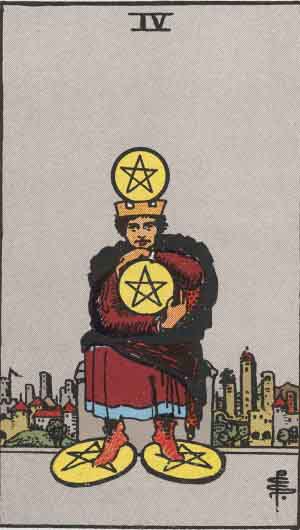
The figure in this card has the pentacles. No immediate threat to them is shown in the image. The city behind them is evidence of what has been built. But the arms are wrapped around the pentacle at the chest, the feet are planted on two more, and the fourth is balanced on the crown of the head. Every available point of control is occupied. The question this card keeps returning with is not whether the seeker has something worth protecting. It is what the grip is costing them, and whether what is being held is still growing or has simply stopped.
Core Repeating Message
The Four of Pentacles shows a figure seated in deliberate holding: pentacles at the crown, the chest and both feet leave no part of the figure free for movement or reception. The established city behind them suggests material development that has already occurred. The image now presents guarding rather than building, a posture of protective control characteristic of someone who has something and fears losing it.
When this card appears once, it may mark legitimate protection of something valuable that has been built or accumulated. Careful stewardship can be warranted. Repetition draws attention to protection that has become the usual mode of engagement with money, resources or security: a tightness that may have stopped protecting and started preventing. The distinction depends on what present circumstances actually require.
The most common pattern is the seeker who has developed scarcity as the dominant frame through which material life is interpreted: attention goes first to what may be lost, what may not be enough, and what must be protected. That vigilance may reflect present financial risk, earlier instability, inherited family practice, or some combination of these. Where vigilance was learned under real scarcity, it may have been a necessary protection rather than a simple error in thinking. The card does not establish which explanation is true. It invites a comparison between the fear, the available evidence, and the real consequences of continued restriction. The decisive question is whether the current level of control is protecting a defined need or governing every material choice long after more proportionate forms of stewardship have become possible.
A second pattern belongs to the seeker who finds future-oriented use of resources difficult because investment requires releasing something currently held, while the return remains uncertain. The hesitation may be prudent, especially where income is unstable, obligations are high, or the proposed opportunity has not been properly tested. The repeating Four asks for discernment rather than automatic spending. Has the risk been calculated, the essential reserve protected, and independent advice sought where the decision is consequential? Release can still feel like the beginning of loss even when the risk is limited. If those safeguards are present, persistent refusal may reveal that preserving the present balance has become more important than allowing any measured development.
A third pattern extends the grip beyond money. Position, status, routine or familiar structures are held so tightly that a role cannot change, a routine cannot shift or an arrangement cannot be reorganised without feeling like a threat. Here the Four describes excessive practical control rather than financial hoarding alone: development is resisted because it would alter what is established and known.
A fourth pattern belongs to the seeker whose holding has been appropriate but whose circumstances now support a different phase. The resources are theirs, and protecting them made sense in its time. Now an investment, gift or restructuring could serve further development, yet the old grip remains. The question is whether a once-useful posture can change when the conditions that justified it have changed.
These patterns concern the relationship between protection and circulation. Material security often requires holding some resources in reserve; the difficulty begins when that protection becomes indiscriminate constraint. What served security can start preventing the exchange, investment or receiving through which material life develops. The task is to recognise that point without treating all holding as a problem.
When This Card Repeats Weekly
A week of Four of Pentacles repetition draws attention to an immediate situation in which the grip is engaged. A decision, opportunity or practical change asks the seeker to consider release, investment or restructuring, and the familiar response is to hold on. The week’s work is to examine that response in the circumstances now present.
What is being gripped, and what is the cost in this week’s practical situation? The question concerns a concrete instance, not only a general pattern: which resource, position or arrangement is held so tightly that it cannot move or develop?
When This Card Repeats Monthly
A month of Four of Pentacles repetition suggests that protective control may be operating across several practical contexts. Maintenance may be necessary and responsible, yet the month also makes its opportunity costs easier to see: which projects, conversations, repairs, investments, or forms of support remain unavailable because every movement of resources is treated as unacceptable loss? The distinction is between purposeful conservation and restriction that continues without a defined threshold for release.
Looking across the past several weeks, which opportunities were not taken because they required releasing something already held? Which conversations were avoided because they might lead to restructuring? What development remains unavailable because its necessary conditions have not been allowed to form?
When This Card Repeats Seasonally
A season of Four of Pentacles energy offers time to see and feel the cost of sustained holding. The effect is no longer confined to one decision; the posture shapes material life across the season, revealing what it protects and what it keeps from developing.
The most important question a Four of Pentacles season raises is what the grip is protecting against: which loss or destabilisation the tightness is organised around preventing. Naming that feared outcome allows the seeker to test it against present facts, including real costs, responsibilities and unequal access to security. The card should not be used to dismiss prudent saving or the realities of poverty. Its concern is the point at which protection has no workable definition of enough and therefore cannot recognise when a limited, considered release is safe.
When This Card Repeats Across Years
When the Four of Pentacles returns across years, protective control may be a long-running pattern across several phases of life. Holding resources feels more available than generosity, investment or flexibility. The question is how that relationship developed and whether it still fits the seeker’s circumstances, rather than assuming the same degree of protection is needed in every phase.
For some seekers, this long-arc pattern is connected with earlier scarcity or repeated material instability. For others, it reflects present structural insecurity, responsibility for dependants, cultural values around thrift, or fear created by a single consequential loss. When earlier scarcity required a tight grip, that response may have been accurate and necessary, and loosening it can take more than an intellectual recognition that life has changed. A tarot image cannot reconstruct that history. Across years, the work is to distinguish continuing realities from inherited or remembered expectations, then build forms of security that are responsive to evidence rather than governed by an undifferentiated expectation of loss.
The long-cycle Four can also invite enquiry into family attitudes towards saving, ownership, debt, generosity and control. These may have been spoken rules or simply repeated behaviours. The task is not to assume a generational cause, but to identify which inherited principles remain useful, which belong to circumstances that no longer apply, and which prevent the seeker from making an independently assessed response to present conditions.
Across years, the growth arc moves towards material wisdom: holding resources with appropriate care and releasing them with considered generosity, in response to present conditions rather than an unexamined fear formed in another time. Both holding and letting resources move become choices made with attention to what the life actually needs.
Life Area Interpretations
Love & Relationships
In love and relationships, the Four of Pentacles can describe protective control over space, time, emotional resources or practical investment. The same tightness seen around money appears in the shared life, limiting the giving, receiving and flexibility that intimacy needs.
One expression is giving time, attention or resources with a degree of calculation or conditionality that the other person can feel. Another concerns shared practical arrangements: controlling the finances, withholding generosity or resisting any flexibility in how resources are shared. The issue is control that constricts the relationship, rather than an assumption that every personal limit or separate resource is wrong.
The relational Four can also describe clinging to an arrangement that is no longer nourishing because its familiarity feels safer than the practical and material uncertainty of change.
Career & Purpose
In career and purpose, the Four of Pentacles can describe holding a position, professional identity or career structure as tightly as the figure holds the coins. A possible change, investment or restructuring feels difficult to consider because the present position, however constrained, is held and known. Protecting what exists can leave little room to assess what further development would require.
The seeker may have potential in a direction that would require releasing part of the current structure, yet prefer its familiar security to the risk of moving. That preference may have sound material reasons. The repeating Four asks whether it has been assessed against present circumstances or whether the grip prevents a viable next step from receiving a fair hearing.
Money & Stability
In financial contexts, the Four of Pentacles is most directly concerned with the boundary between prudent retention and fear-led restriction. Saving, maintaining an emergency reserve, declining unsuitable investments and limiting generosity to what is affordable can all be sound decisions. The repeating pattern becomes relevant when money can only be held, never assigned to a carefully evaluated purpose, or when control of shared resources replaces transparent agreement. The card offers a question about function, not financial instruction: what is each protected resource for, and what evidence would justify its eventual use?
The financial question is whether the current holding serves long-term security or has become a way of managing anxiety primarily through money. The distinction concerns the function of the protection, not the size of the balance alone.
Spiritual Growth
In spiritual growth, the Four of Pentacles can describe a protective grip on practices, beliefs or understanding. New experience has little room to change the framework already held. The question is whether the seeker can allow an encounter to deepen or revise their understanding, rather than require it to confirm what they already know.
This is not necessarily spiritual dishonesty; the beliefs may be sincerely held. Yet sincerity and openness are different qualities. The grip can leave little room for being changed by an encounter with the sacred, even when the commitment itself is deeply felt.
Emotional & Mental Patterns
In emotional and mental patterns, the Four of Pentacles describes anxious accounting: persistent monitoring of resources, with any reduction in material or emotional reserves experienced as a possible threat. The inner life becomes organised around keeping what is held at a sufficient level, as though continual attention were required to prevent loss.
This may feel like watchfulness running in the background: attention repeatedly turns to what could go wrong, and anxiety about sufficiency remains even when present circumstances appear stable. The holding posture is therefore not only physical or financial. It can become a way of relating inwardly to the practical world.
Family & Generational Dynamics
In family dynamics, the Four of Pentacles may draw attention to learned rules about material holding and scarcity. A family history of deprivation or loss can influence those rules, but so can migration, caregiving responsibilities, class expectations, cultural practice or current insecurity. The card cannot determine the origin. It helps the seeker observe which attitudes are actually present and how they shape present-day choices about ownership, shared resources and support.
The orientation may be explicit, expressed through rules that equate frugality with virtue and spending with danger, or implicit, visible in conflict, secrecy or anxiety around money. Some of those lessons may remain protective. Others may make ordinary use of resources feel morally suspect. The useful enquiry is comparative: which rule fits the seeker’s actual responsibilities now, and which is being repeated because it has never been consciously examined?
Health & Energy
In Health & Energy, the Four of Pentacles symbolically describes sustained protective holding. A seeker may notice bracing, shallow breathing, held shoulders, a set jaw or fatigue from vigilance, and may find that relaxing feels vulnerable rather than restoring, especially around material stress. These are experiential possibilities, not a diagnosis or proof that a psychological pattern caused a symptom. Persistent pain, breathlessness, fatigue or other concerning changes deserve assessment from a qualified health professional.
The practical invitation is to notice when effort is being maintained after the immediate demand has passed, and whether safe rest, gentler pacing or supportive care is available. Any correspondence between material anxiety and bodily tension should be treated as personal data to explore, not as a universal mechanism. The card can support awareness of energy use, but it does not replace medical evaluation or establish that changing financial behaviour will alter a health condition.
Advanced Interpretive Sections
The Shadow Expression
In shadow, accumulation becomes the main definition of material success and the principal source of felt safety. Generosity, investment and exchange become difficult because the grip is habitual, rather than because each use of resources has been consciously assessed. The seeker is no longer choosing to hold in response to a particular need; holding has become what material life is. The question of what the resources could serve disappears behind the effort to keep them.
The Integrated Expression
The integrated Four of Pentacles seeker holds resources with care and discernment while remaining able to use or share them wisely. They distinguish protection that serves long-term security from holding that mainly manages anxiety. Security is supported by practical conditions and a more settled relationship to them, rather than measured only by maximum accumulation. Where circumstances allow it, vigilance can ease without abandoning stewardship.
Why This Energy Has Not Released Yet
The Four of Pentacles pattern may remain active while protection still feels safer than proportionate use, even when the seeker can intellectually see that some conditions have changed. It may also remain because the risk is real, the reserve is genuinely needed, or the available choices are poor. Resolution therefore begins with an accurate material assessment, not with forcing release. Where present facts support flexibility, repeated experiences of limited, planned and reversible use can help the seeker discover that stewardship does not require total control.
The pattern may also persist when the relationship between material holding and emotional safety has not been examined. The grip may be providing a sense of protection for which the seeker has not yet found another form. Understanding that function matters before asking them simply to let go.
What This Card Wants the Seeker to Understand
The city behind the figure can be read as a reminder that material life is built through both protecting what matters and investing in what is ready to grow. Security is not the same as maximum accumulation. It involves knowing what needs to be held and what can responsibly be allowed to move.
Holding everything with equal tightness does not necessarily create greater security than holding and releasing with discernment. It can produce another kind of insecurity: material stasis, a life protected but not growing, held but not fully inhabited. The cost of immobility belongs in the assessment alongside the risks of change.
Signs the Pattern Is Beginning to Resolve
One sign of resolution is a deliberate, proportionate act of release: a considered investment, contribution or financial decision that serves the future rather than simply protecting the present balance. The gesture need not be dramatic. Its significance lies in choosing a sound use of resources while keeping essential needs and obligations secure.
It may also be resolving when the seeker can notice different responses to holding, planned use and freely chosen generosity without treating any one sensation as proof of the correct financial decision. For some, giving or a considered investment brings a sense of aliveness different from the reassurance of holding; that contrast is worth noticing without making it a decision rule. Greater capacity to pause, review evidence and choose proportionately is more reliable than a demand to feel relaxed. The shift is from automatic gripping to informed stewardship, with safeguards for essential needs and the freedom to say either yes or no.
Reflective Questions
-
What are you holding most tightly in your material life right now: money, position, routine, structure or something else? What fear lies beneath the grip?
-
Is there an investment, financial commitment or practical restructuring that you believe would support development but have been unable to make because of the grip? What would it require you to release?
-
What level of reserves and protection would support your material security in your present circumstances? If you are holding substantially more than that, what purpose does the additional holding serve?
-
Can you trace the origin of your material tightness? Was there a period or experience when the grip intensified, or did the protective orientation develop more gradually?
-
What does your body do when you consider releasing a portion of what you hold? How does the experience feel physically, and where do you most reliably notice the grip?
-
What did your family communicate, through practice and atmosphere, about resources? Was holding celebrated, giving treated with suspicion, or generosity modelled?
-
Is there a domain where holding seems to manage anxiety more than it supports security? What would security there look like if you were building it from present needs rather than only defending what already exists?
-
Have you experienced material generosity, as giver or receiver? What did it feel like, and what did it produce in the relationship between those involved?
-
What would you want to do with your resources if fear of losing them were less dominant? Treat the answer as information about your practical aims, rather than as an instruction to ignore real risks. What might your material life be able to produce with a looser grip?
-
If the Four of Pentacles has been appearing for a sustained period, what possible release has it invited you to examine? Which considered act of investment or generosity has the grip been preventing, and what would make it appropriate to undertake?
Practical Integration Actions
Name the grip honestly. Write specifically about what you are currently holding most tightly in the material domain: the exact resource, the exact amount, the exact structure, the exact arrangement. Write about what specifically you fear would happen if it were released, in as much concrete detail as you can. The exercise is not to diminish the fear but to see it clearly enough to assess whether it is responding to the current material reality or to a remembered one.
Make one act of deliberate release. Identify a small, affordable and reversible use of resources that serves a defined purpose without reducing essential reserves or compromising obligations. Where feasible and safe, make that defined release before this month ends. This might be a modest contribution, a planned repair, a tested investment in learning, or greater flexibility in a shared arrangement. For consequential financial decisions, verify the terms and seek appropriately qualified advice. Notice both the practical outcome and your response before and after, without treating discomfort alone as evidence that the decision was wrong.
Examine the scarcity frame. For one week, keep a simple record of the moments when a scarcity orientation shapes your material thinking or material behaviour: when the lens of not-enough, of potential loss, or of the need for protection shapes a practical decision. The exercise is not to judge the orientation but to make it visible as a pattern that is operating consistently and to assess whether it accurately reflects the current material reality.
Update the security assessment. Write an honest assessment of your present material security: what you have, what it provides, which risks exist and what level of holding serves your current responsibilities. Compare that assessment with the protection already in place. Where does the grip exceed what the evidence warrants, and what would a proportionate response look like?
Practise one genuine material generosity. Identify a person, project or cause you want to support and choose a meaningful contribution this month that is comfortably within your means. Let it be a considered use of resources rather than a token gesture, without making hardship the test of sincerity. Where resources are shared, retain consent and transparent agreement. Notice the experience in your body and sense of material life, what it reveals about giving, sufficiency and choice, and its practical effect on your own stability.