
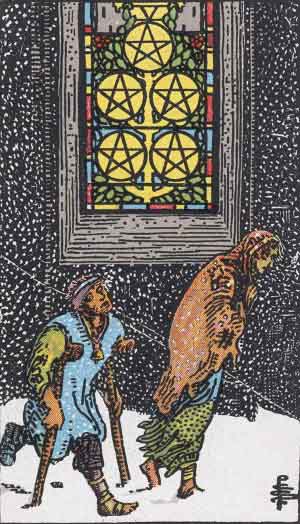
Two figures cross snow beneath a lit church window. The glass burns with colour and warmth, its own five pentacles worked into the design, and neither figure looks up to notice it. One walks on crutches. Neither has stopped. The question the card keeps asking is not whether the cold is real. It is why the warmth above them remains out of reach, and whether a way towards it can be found.
Core Repeating Message
The imagery is plain. Two figures move through snow, bent against the weather, passing directly beneath a stained-glass window lit from inside a church. One is injured and using crutches; neither wears adequate clothing for the conditions. The window’s five pentacles echo the card’s own number, placed just out of reach above two people who have not looked up to find it.
A single appearance of this card can mark a period of material strain: shortage, exclusion or hardship worth naming honestly rather than minimising. Repetition invites examination of how a continuing condition is shaping the seeker’s stance towards practical life. Feeling outside the warmth may still accurately reflect deprivation or exclusion; it may also persist after circumstances begin to change. The card asks for that distinction, rather than deciding it in advance.
The clearest version of this pattern is the seeker in real difficulty who has not yet reached help that may be close by, much as the figures pass beneath the lit window without pausing. That help might be financial, communal or relational, and only partly visible from where the seeker stands. Its existence and accessibility need checking. Where support is available, repetition can highlight how consistently it remains unclaimed; where it is not, the obstacle is not a failure to look up.
A second version belongs to the seeker for whom scarcity has become a habit of perception beyond what present facts justify. Earlier hardship may have made scanning for lack a useful protection, and that habit can persist as circumstances improve, filtering out evidence of sufficiency before it registers. This interpretation needs evidence of change, rather than an assumption that the present shortage is imagined.
A third version is the seeker managing hardship in private. The difficulty is real, but keeping it out of view may also limit support from people who could respond safely and practically. Isolation and hardship can reinforce each other: the harder things get, the less speakable they feel, and the less speakable they feel, the harder they get. Disclosure may help interrupt that cycle, provided the recipient is trustworthy; it is not a guarantee of help or an obligation to tell unsafe people.
A fourth version belongs to the seeker whose circumstances have improved but whose sense of safety has not yet caught up. They still brace for the cold, checking for threats that the present may no longer contain. Felt expectations can change more gradually than a bank balance or job title, but the card cannot establish a nervous-system mechanism or prove that all danger has passed.
Across all four, the through-line is the same sensation: standing just outside warmth that has not yet been reached, claimed, or fully believed in, whether the obstacle is circumstance, perception, silence, or simple lag between an old reality and a new one.
When This Card Repeats Weekly
At the scale of a single week, the Five of Pentacles is naming something immediate: a specific bill, a specific shortfall, a specific moment of exclusion currently active in the seeker’s life. The task the week sets is narrow and practical: name precisely what is missing, and check, without assuming either that help exists or that it is unavailable, whether a particular person, service, or resource is actually within reach and simply has not been approached yet.
The useful move here is small and singular: not a full solution, but one concrete approach towards a form of support whose availability can be checked. In the language of the image, it is a search for a door towards the warmth, rather than a claim that a visible entrance has simply been ignored.
When This Card Repeats Monthly
Across a month, the pattern has widened beyond a single incident. Difficulty may be showing up in several parts of practical life, suggesting a settled condition rather than a passing squeeze. The month gives time to ask whether support exists but has been difficult to accept because of shame, habit or fear of judgement, or whether cost, eligibility, safety or other access barriers keep it out of reach.
It is also long enough to test whether the sense of insufficiency still matches present circumstances or has begun operating on its own logic, generating a feeling of lack that outpaces what the current month’s actual numbers or actual relationships would justify.
When This Card Repeats Seasonally
Over a season, the Five of Pentacles describes weeks of daily life lived at a certain distance from warmth: real constraint, real exclusion, a felt sense of being on the outside of resources that others seem to hold without effort. A season is long enough for that texture to shape mood, decisions, and self-image.
The central question a season raises is one of company. Who currently knows the true extent of the difficulty, and who among them has the actual capacity to help? A season gives enough time to distinguish support that genuinely does not exist from support that exists but has never been asked for, and to begin building relationships through which practical help might become possible.
When This Card Repeats Across Years
Returning across years, the Five of Pentacles describes something closer to a life pattern than a life event: material insufficiency, exclusion, or precarity that has recurred across separate chapters of the seeker’s life rather than resolving into lasting security after any one of them.
For some seekers, this long arc is connected with an early household under financial strain, where money, food, housing or safety could not be counted on. Expecting scarcity may have been accurate and protective then, and that expectation may continue after the original conditions change. For others, hardship reflects continuing low income, exclusion or unmet practical needs. The card cannot reconstruct a childhood or distinguish these causes without the seeker’s history and current evidence.
A related long-arc pattern may involve carrying someone else’s story rather than only their own: a family narrative about who is allowed material security and who is not, inherited rather than tested against current fact. If such a story is present, it may govern decisions without being compared with what current conditions actually allow.
Across years, the growth this card traces is towards examined reality: facing hardship honestly, recognising which expectations belong to earlier circumstances, accepting help where it is available and building greater stability where conditions permit. The memory of the cold does not need to be erased. It can remain accurate without being asked to describe every future situation.
Life Area Interpretations
Love & Relationships
In relationships, the Five of Pentacles often shows up as a specific self-consciousness about what one partner can or cannot materially provide compared with the other. That gap, real or perceived, can quietly shape how much someone contributes, defers, or withdraws from shared decisions about money and practical life.
The same card also marks the partner managing hardship in silence, maintaining an appearance of coping while the private reality is considerably harder. That gap between the public front and the private situation can limit intimacy and the possibility of practical support. Honest disclosure may help in a safe relationship, while coercion, financial control or fear of retaliation calls for care about what is shared and with whom.
Career & Purpose
In work, the Five of Pentacles frequently describes a career shaped by necessity rather than choice: jobs taken because they paid something, not because they fit. Over time, a run of decisions made purely to cover shortfall can leave someone in a role that meets none of their actual interests or strengths.
It also marks the sense of standing outside a professional community one would like to belong to, watching networks and opportunities operate at a visible distance without yet having found the specific route in.
Money & Stability
Financially, the most direct reading concerns an actual gap between what is needed and what is available. The useful question is not how to solve it entirely, which may lie outside the seeker’s immediate control, but what financial or practical help can be identified and accessed. Current figures, eligibility and terms matter; debt, benefits or financial advice may be needed to assess options rather than relying on the card to establish that support exists.
The lit window suggests that help may be closer than it feels from inside hardship, while leaving open the question of how accessible it is. The task is not to fix everything at once. It is to identify one possible door, check whether it can be approached and take a feasible step towards it.
Spiritual Growth
Material hardship can affect spiritual life in different ways. It may deepen a practice through an honest encounter with vulnerability, or make spiritual life feel like an indulgence that current circumstances cannot afford. These are possible experiences, not a requirement to find spiritual value in deprivation.
The Five also points towards a specific kind of connection available through shared hardship: the recognition that passes between people who have each known real difficulty, and the support that becomes possible once that difficulty is spoken about honestly rather than carried alone.
Emotional & Mental Patterns
Internally, this card describes a background hum of financial vigilance: a low-level watchfulness for shortage that runs even during periods of relative stability, and a quiet discomfort when comparing one’s own circumstances with someone else’s.
That vigilance may sit beneath conscious notice, showing up as a reflex rather than a decision, a flinch at spending or a reluctance to ask for anything, and may build gradually until it becomes visible enough to examine directly.
Family & Generational Dynamics
For some seekers, family history includes poverty, loss of security or exclusion from resources others had. Alongside practical effects, there may be shame around asking for help or vigilance about scarcity, conveyed through family attitudes whether or not they are discussed openly. That history is worth examining when supported by experience; the card does not establish a direct inheritance or make it the explanation for present hardship.
Sometimes a family influence is explicit, told as a story of hardship and survival. Sometimes it is felt in the household atmosphere, such as tension around money that was never explained. Where those patterns are present, the seeker can ask how history interacts with present circumstances rather than assume either that the old story explains everything or that its effects have disappeared.
Health & Energy
In health contexts, the Five of Pentacles can draw attention to the practical conditions around wellbeing. Material strain may coincide with irregular sleep, inadequate nutrition or reduced access to healthcare; these resources deserve attention in their own right. The card cannot determine the cause of a symptom or establish which treatment is needed. Persistent, severe or changing symptoms deserve appropriate professional assessment, alongside help with practical barriers to care where available.
Carrying hardship alone can add to its felt weight. Some people find concealment exhausting or notice that isolation makes practical support harder to obtain. That experience is worth taking seriously without assuming a single physical mechanism. A safe connection may ease isolation even while the material difficulty still needs direct attention.
Advanced Interpretive Sections
The Shadow Expression
In shadow, hardship can become part of identity as well as circumstance. When improvement does arrive, it may feel destabilising, as though the person formed in the cold does not recognise themselves in the warmth. Some may return to familiar restrictions or decisions that maintain shortage even when alternatives exist. That possibility needs careful evidence: continuing poverty, exclusion or repeated setbacks are not proof that a person has recreated hardship because ease feels unfamiliar.
The Integrated Expression
The integrated version of this card belongs to the seeker who has named the hardship plainly, received help where it was available and safe, and found meaningful connection with others who have known similar difficulty. They still remember the cold accurately, but they are no longer defined by it. In the language of the image, they have found the door and gone inside.
Why This Energy Has Not Released Yet
One version of the pattern persists when the seeker has not been able to tell a trustworthy person who could help what the situation is. Isolation can sustain itself: the harder things get, the less speakable they feel, and silence can leave the difficulty harder to address. A deliberate, bounded disclosure may interrupt that cycle. It is one possible step, not the cause or cure of every hardship, and its value depends on the listener’s safety and practical capacity.
It may also persist while the story being told about the situation is older than the situation itself, when a scarcity frame formed years earlier keeps governing present decisions regardless of what current circumstances actually allow.
What This Card Wants the Seeker to Understand
The window is lit. That is an observation about the image, and a prompt to look for support that hardship may make difficult to see. It does not prove that a service, community or person will be accessible or helpful. Looking for a door is itself a meaningful first move: finding what is actually available, what remains barred and what one feasible approach could reveal.
The card is equally clear that hardship is not proof of failure. The two figures are not depicted as having done anything wrong. They are cold, and warmth has not yet been reached. Those are two separate facts, and the card asks the seeker not to collapse them into one.
Signs the Pattern Is Beginning to Resolve
Resolution may begin with one honest conversation: telling a trustworthy person enough about the difficulty to let them respond, rather than deciding their reaction in advance. What changes first may be the isolation around the situation, even if the practical need remains. The conversation should respect the seeker’s safety and control over what they disclose.
It also begins when the seeker accepts one concrete form of help that actually addresses part of the shortage. Not a total fix, but a real instance of support received, which starts to correct the assumption that the cold is permanent and the warmth permanently unreachable.
Reflective Questions
-
What specific form of material hardship is currently active in your life, and is it a present, factual shortage, or has it become a lens you apply even when circumstances have already shifted?
-
What form of support already exists in your life that you have not yet asked for? What has actually stopped you from reaching for it?
-
Is there someone you have not told the full truth about your current material situation? What would it take to tell them, and what makes that difficult?
-
When you compare your circumstances with other people’s, do you consistently feel on the outside looking in? How accurate is that comparison to your actual current situation?
-
Where did your relationship with scarcity begin? Was there a period of hardship that shaped your expectations, including how safety feels in your body, and do those expectations still match present conditions?
-
Can you recall a time you accepted real help during genuine difficulty? What did that experience teach you about asking again?
-
How connected is your sense of material hardship to your sense of belonging, of being inside or outside a community’s warmth and acceptance?
-
Is there a family story about who gets to have security and who does not that is still shaping your decisions? Does it still match your actual present life?
-
What is one concrete, achievable action that would make your current difficulty meaningfully more manageable, not solved entirely, just one step closer to the door?
-
If this card has kept returning, what possible source of support has it invited you to examine, and what has made that request difficult? Is the obstacle within the request itself, the conditions of access or your expectation of the response?
Practical Integration Actions
Name the cold precisely. Write an honest account of your current material situation: what is genuinely short, what it costs you day to day, and where you have been minimising or exaggerating it. Precision here matters more than comfort, since vague hardship is much harder to address than specific hardship.
Locate the door. Identify one possible source of support you have not yet approached, whether a financial resource, a programme or a request to a person. Check what it offers, whether you are eligible and any costs or conditions. Write down what has stopped you so far, then plan one feasible approach within the week. If the first door is inaccessible, that is information about the resource, not a verdict on whether you deserve help.
Tell one person. Choose someone whose response you trust and who is safe to approach. Share a bounded, honest account of what is happening; you do not need to tell the whole story or disclose details that could put you at risk. Notice what the conversation costs you, what it opens up and how the person actually responds, including whether they can offer useful support.
Interrupt the comparison. For a week, notice each moment when comparing yourself with someone else triggers a feeling of exclusion or lack, and jot it down briefly. The goal is not to stop comparing but to see the pattern clearly, and to ask each time whether it reflects your actual circumstances or an older, more automatic reflex.
Record what you have already survived. Write honestly about a past period of material hardship: what it involved, how you managed, what support you received and what has changed since. Include any effects that remain. The purpose is an accurate record of resilience and available support, rather than proof that hardship left no lasting damage or that the present difficulty will resolve in the same way.