
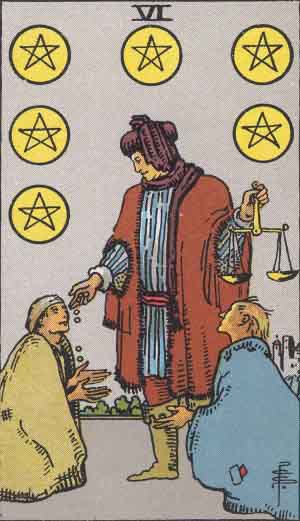
A figure holds a pair of scales in one hand and distributes coins with the other to two people kneeling below. The scales imply measurement: something is being weighed and calibrated, not simply given. The people below receive what is extended to them. Each position in this image carries its own specific power. The question this card keeps returning with is not whether exchange is occurring. It is what the seeker’s characteristic position in the exchange is costing them, and whether the terms of that exchange have ever been genuinely chosen.
Core Repeating Message
The Six of Pentacles shows a figure with a pair of scales distributing coins to two kneeling recipients. It is an image of material exchange in motion: resources flowing from one person to others, calibrated by measurement, taking place between people in visibly different positions. The card is not a criticism of generosity or of need. It is an image of the relationship between giving and receiving, and of the power that material exchange can carry when people occupy different positions.
When this card appears once, it may mark a situation involving financial generosity, practical support or resources exchanged across a difference in power. Repetition draws attention to a position that has become fixed: the seeker repeatedly gives or receives in the same way, while the terms and relational consequences remain insufficiently examined. The question is how that position serves the people involved, rather than whether each exchange is numerically equal.
The most common pattern is the seeker who consistently gives and rarely receives: who extends money, practical support or time readily, while their own needs receive less attention. They may find it difficult to allow help or to receive it fully, or may be in structures that offer little in return. The asymmetry may arise from personal habit, explicit agreement, structural inequality, caregiving responsibility, or relationships in which other people simply have less to give. Reciprocity does not require equal amounts from people with unequal resources. The card asks whether the arrangement is understood, consented to and sustainable, and whether the seeker has room to name a need without jeopardising safety or belonging.
A second pattern belongs to the seeker who regularly receives support and finds reciprocal participation difficult, even where some freely chosen contribution may be possible. Uncertainty, shame or earlier conditional giving can complicate that step. This is not necessarily a failure of will: disability, illness, unemployment, discrimination, age, study or care work may make support necessary without creating a moral debt. Contribution may take the form of presence, care, knowledge, appreciation or agreed responsibility rather than money, and sometimes capacity does not permit it. The question is whether the terms preserve dignity and agency while leaving room for participation the seeker actually wants and can sustain.
A third pattern concerns generosity entangled with power. The seeker gives, but the gift carries an unacknowledged condition: it maintains a relational position, secures a response or keeps the giver feeling safe. Like the scales in the image, the exchange is calibrated towards a result rather than freely extended. The card does not dismiss the generosity; it asks what the giving is also doing in the relationship, and whether those terms have been recognised by both people.
A fourth pattern belongs to the seeker navigating a significant structural power differential: support from an employer, institution, partner, relative or public system may be necessary, while the provider can influence important choices. The card invites careful reading of formal and informal terms, but it does not presume that the seeker can safely renegotiate them. Where coercion, financial abuse or retaliation is possible, private advice, documentation and specialist support may matter more than direct confrontation. The terms may support development in some respects while limiting it in others; understanding both matters. Agency sometimes begins with understanding the structure and widening options gradually.
What all these patterns share is a relationship to exchange that includes power, history, capacity and specific terms. Choice matters, but it does not operate in isolation from poverty, disability, care obligations, employment conditions or unequal access to resources. A repeating Six asks the seeker to make the arrangement as visible as possible: what is freely chosen, what is necessary, what is expected, and whether each person’s dignity and material security are being protected.
When This Card Repeats Weekly
A week of Six of Pentacles repetition draws attention to an exchange already in motion: resources, time, practical help or financial support are passing between people, and an imbalance, unspoken condition or difference in power needs attention. The immediate task is to identify the exchange clearly enough to see what each position involves.
This week, the card asks how the giving and receiving relate to each person’s capacity. Is a condition, spoken or unspoken, attached to the support offered or accepted? Does the exchange support mutual wellbeing and development, or mainly preserve a relational arrangement with material consequences? Equal amounts are not the test; clear terms, consent and sustainable participation are.
When This Card Repeats Monthly
A month of Six of Pentacles repetition suggests that the same position in giving and receiving is recurring across practical contexts. Questions of power, reciprocity and terms are no longer confined to an occasional exchange. Looking across the month makes it easier to see what remains fixed even when the people or resources change.
Map the past several weeks: where was the seeker mainly giving, where mainly receiving, and where did the exchange feel mutual? What do the reciprocal arrangements have in common, and what distinguishes those that left one person’s needs or agency less visible? The comparison concerns the quality and terms of the relationship, not a demand for equal quantities.
When This Card Repeats Seasonally
A season gives time to see what the prevailing exchanges are producing. Which relationships are maintained through the present flow of support, what is gained and what is given away, and how does the pattern shape the seeker’s material circumstances? The effect may only become clear across repeated exchanges: whether giving and receiving make room for development or continually reproduce the same limitation.
The central seasonal question concerns the terms. Under exactly what conditions does support flow? Who established those conditions, and were they chosen by the seeker or accepted as the default arrangement available? Making the terms visible does not itself create freedom to change them, but it clarifies the situation that any next step must address.
When This Card Repeats Across Years
When the Six of Pentacles returns across years, giving, receiving and material power may be long-running areas of difficulty. Across several phases of life, the seeker may give without enough support for their own needs, or receive help without much room for self-directed development. The role remains familiar even when the circumstances change.
For some seekers, this long-arc pattern connects with early exchanges in which support carried conditions, generosity was used to secure compliance, or practical caretaking became an established role. In such a history, receiving without conditions may feel unfamiliar even when a present offer is freely given. For others, the pattern emerged later through partnership, work, migration, disability, caregiving or economic change. The card cannot identify the origin by itself. It offers a framework for comparing repeated exchanges and noticing where the same position, expectation or power imbalance continues to reappear.
Across years, the growth arc is towards ethical material reciprocity: giving without covert control, receiving without imposed shame, making conditions explicit and allowing contribution to reflect actual capacity. Some relationships will remain materially asymmetric, especially in care. Integration is not numerical equality. It is an exchange in which support does not erase agency, contribution is not coerced, and changing needs can be discussed honestly where it is safe to do so.
Life Area Interpretations
Love & Relationships
In love and relationships, the Six of Pentacles may mark a persistent asymmetry in practical care or material provision. Unequal contribution is not automatically unfair, because partners may have different income, health, time, access or caring responsibilities. The more revealing questions concern agreement and impact: do both people understand the arrangement, can either raise concern without punishment, and does the structure allow dignity, rest and meaningful agency for each person?
The relational Six also concerns how support affects intimacy and autonomy. A giver may become attached to the influence their provision brings, while a receiver may experience obligation or reduced freedom that sits uneasily with equality in the relationship. The issue is not which partner contributes more, but how the material arrangement shapes what each feels able to choose.
Career & Purpose
In career and purpose, the Six of Pentacles focuses on the exchange of skill, time and expertise for compensation, access, mentoring or institutional support. A persistent imbalance may reflect underpayment, invisible labour, unclear expectations or dependence on a gatekeeper. It may also reflect a legitimate apprenticeship, grant or accommodation whose value cannot be reduced to immediate output. Where participation or vocational independence is possible and wanted, the seeker can also examine whether a familiar support arrangement leaves room to develop it. The card invites the seeker to compare written terms, actual demands and available alternatives, and to seek employment, legal or professional advice when the stakes exceed personal reflection.
Money & Stability
Financially, the Six of Pentacles asks about the flow of money and resources: where they go, where they come from and what conditions travel with them. Giving may leave the seeker’s own needs unsupported, or receiving may involve terms whose consequences have not been examined. Unequal amounts can still be fair. The question is whether the arrangement protects both practical needs and meaningful agency, rather than whether every payment is returned in kind.
Does the exchange support the seeker’s longer-term financial wellbeing and development, or preserve a dynamic that mainly serves another purpose? The answer depends on the actual terms and effects, including what support is necessary and what choices remain available.
Spiritual Growth
In spiritual growth, the Six of Pentacles asks how material giving has become linked with spiritual worth. The seeker may equate generosity with virtue or need with spiritual deficit, sometimes without recognising how those assumptions shape behaviour. The task is not to abandon giving, but to examine whether giving and receiving are being used to measure spiritual standing instead of responding honestly to need, capacity and care.
Emotional & Mental Patterns
In emotional and mental patterns, the Six of Pentacles describes a form of inner accounting. The seeker monitors whether they have received enough or given too much, remaining alert to the balance in important relationships. Generosity is complicated by the emotional meaning of the exchange: what it says about care, power or what one person owes another.
A generous impulse may coexist with resentment at a recurring imbalance. Need may be accompanied by shame about depending on someone else. Or giving may carry anxiety about what would happen to the relationship if the support stopped. These are different emotional experiences, and each asks for attention to what the exchange means to the person in that position.
Family & Generational Dynamics
In family dynamics, the Six of Pentacles can illuminate household rules around provision, dependence and entitlement. One person may have controlled resources, support may have followed behaviour or performance, or care may have flowed according to age, illness, culture and necessity. There may also have been little experience of needing and receiving without conditions. The card does not establish what happened. It asks which terms were visible, which remained unspoken, and how those arrangements continue to shape the seeker’s expectations of giving and receiving now.
A learned position can become an adult default: provider, grateful receiver, mediator, debtor or person who refuses help. A person may have learned to provide because that was the available role, or to expect that receiving requires performance and every gift brings a bill. Yet repetition is not destiny, and family history is only one possible influence. The useful work is to recognise the role, test whether it still fits, and separate freely chosen care from exchanges maintained by fear, guilt or obligation.
Health & Energy
In Health & Energy, the Six of Pentacles symbolically asks whether care, rest, assistance and practical burden are distributed sustainably. A person who gives extensively may notice fatigue or reduced capacity, while a person receiving support may experience relief alongside concerns about autonomy or access. The effort of maintaining a generous role can also feel tiring, beyond the practical tasks themselves. These are possible lived experiences, not predictable bodily signatures or diagnoses. Physical symptoms require appropriate clinical attention. The card’s useful domain is the practical ecology of support: who carries which tasks, what help is available, and whether the arrangement can adapt to changing capacity.
Advanced Interpretive Sections
The Shadow Expression
In shadow, generosity becomes a way to manage a relationship: provision maintains a position, and its conditions remain unacknowledged. The scales are held, not set down. Every gift and receipt is measured, and losing that measuring role feels like losing relational safety. The concern is covert control through the exchange, rather than ordinary clarity about a gift’s limits or the terms of an agreed arrangement.
The Integrated Expression
The integrated Six of Pentacles seeker can give from available resources without covertly controlling the recipient, receive needed help without imposed shame, and take part in exchange that is mutual and openly understood. Generosity supports shared flourishing rather than an unspoken economy of obligation. They can use the scales with discernment and set them down when freely given care calls for it, while retaining clear agreements and respect for actual capacity.
Why This Energy Has Not Released Yet
The pattern may persist while the terms of important exchanges remain too implicit to assess. What is expected in return for support, what is assumed and what has actually been agreed? Making those conditions clear creates a basis for accepting, questioning or changing them where it is possible and safe.
It may also persist because the cost of a familiar position has not been fully recognised. Repeated giving can leave needs unmet; receiving on restrictive terms can narrow room for development. Familiarity makes the arrangement feel like simply the way things are, rather than a pattern worth examining. Recognising that cost does not make necessary support a failure or guarantee that the terms can be changed immediately.
What This Card Wants the Seeker to Understand
The scales are a tool, not a definition. Exchanges of resources can carry complexity and power, and those dimensions deserve acknowledgement rather than the pretence that giving and receiving are always neutral acts. The image invites examination of how the scales are used, not an insistence that every relationship become a ledger.
Reciprocity that serves everyone involved requires honesty about the terms. The giver examines what the giving is for; the receiver considers what accepting it asks. The aim is not equal exchange at every moment, but attention over time to whether the arrangement supports each person’s material flourishing, dignity and freedom within their actual circumstances.
Signs the Pattern Is Beginning to Resolve
The Six of Pentacles pattern may be resolving when the seeker can make one deliberate change without violating capacity or consent: a habitual giver names a need or accepts help without immediately repaying it or diminishing its value, while a habitual receiver participates in a form that is genuinely available and freely chosen. Contribution need not be financial and is not owed as the price of care. The meaningful shift is greater agency and clarity within the exchange, not movement towards a predetermined role.
It may also be resolving when terms become clearer through a safe conversation, written agreement, benefits review or professional consultation. Direct discussion is appropriate only where it does not expose the seeker to coercion, financial abuse, job loss or retaliation. In higher-risk situations, confidential support and a gradual options plan are valid forms of movement.
Reflective Questions
-
What is your usual position in material exchange: giving more than you receive, receiving more than you give, or participating in a relationship that feels mutual? What stays consistent across contexts, and how does each arrangement reflect the capacities of the people involved?
-
What conditions, spoken or unspoken, are currently attached to the material generosity you extend to others? What do you expect, need, or hope for in return for the practical support you provide?
-
What conditions, spoken or unspoken, are currently attached to the material support you receive from others? What do you believe is required of you in exchange for what is given to you?
-
Is there an important material relationship in which a difference in power shapes the exchange? What are its full terms, and which have you chosen rather than accepted from necessity?
-
How do you feel when someone offers material generosity without a condition or expectation of return? Is receiving comfortable, or does it bring discomfort or a sense of obligation?
-
What is your emotional experience when material need requires asking for practical help? What makes the request difficult, and what experiences may have shaped that difficulty?
-
Are there relationships where you give readily but your own needs remain insufficiently supported? What is the cost over time, taking account of each person’s resources and what they are able to contribute?
-
What did your family communicate, through practice and atmosphere, about giving and receiving? Was generosity conditional, freely given or absent, and what did accepting help require?
-
Is there a material relationship where dependence, yours or another person’s, limits room for development or choice? What would greater mutuality look like within the actual capacity and needs of those involved?
-
If the Six of Pentacles has been appearing for a sustained period, what adjustment to an exchange has it invited you to examine? Which conversation about giving or receiving has been avoided, and what would make it safe and useful to address the terms?
Practical Integration Actions
Map your material exchange relationships. Write an account of your significant exchanges: whom you support and on what terms, who supports you and on what terms, and where the relationship feels mutual or persistently one-sided. Note each person’s capacity as well as what flows between you. The purpose is to see the whole arrangement clearly, without assuming that unequal resources require equal returns.
Practise genuine receiving. In the next two weeks, notice one offer of practical support and assess it before accepting or declining: are the terms clear, is consent genuine, and does the help preserve your agency? If the offer is safe and freely given, practise receiving it without inventing an immediate debt. If it carries pressure or unclear conditions, declining or requesting clarification may be the more integrated response. Notice how receiving feels in your body, what it costs emotionally and what it opens, without diminishing or deflecting the gift. Record what the exchange actually asks and what you assumed it would ask.
Name one condition honestly. Choose an important material exchange and write down its conditions: what you expect for what you give, or what you believe is expected for what you receive. The first task is to make those terms visible, not to change them immediately. Then assess which you want to maintain, which need clarification and what is realistically within your power to reconsider.
Make one contribution. If you are primarily receiving within a significant relationship and want to participate differently, identify one contribution towards the person who supports you that fits your actual capacity and the other person’s consent. It might be practical help, information, attention, appreciation or money, but it should not reduce essential resources or turn necessary support into a debt. A small act can offer an experience of contributing as well as receiving without needing to settle the whole balance. If no contribution is currently possible, naming gratitude and clarifying expectations can still support dignity and mutual understanding.
Examine the power honestly. Write privately about the material relationship in your life with the clearest power differential: whether you hold power or someone else does, who controls resources, which choices are affected, what is formally agreed and what is implicitly expected. Consider what that position produces in your view of yourself and the other person, and whether the terms support both people over time. If the pattern includes threats, surveillance, restricted access to money, coerced debt or retaliation, treat it as a safety concern rather than a reciprocity exercise. Seek confidential specialist, legal, employment or financial support suited to the situation before attempting direct renegotiation.