
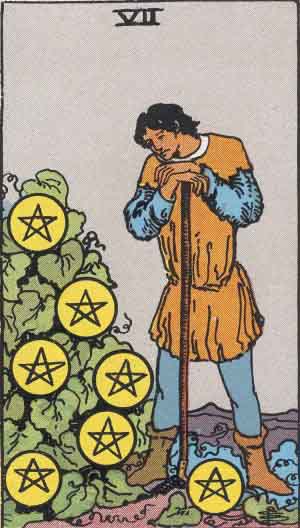
A figure leans on a staff and looks at a vine heavy with pentacles. In the image, fruit has grown, but the figure is paused: attention rests on what has emerged and what remains to be done. When the Seven of Pentacles repeats, the question is how the seeker lives through the stretch between planting and harvest. Can assessment become a useful pause within cultivation, rather than an early departure or a permanent position at the edge of the vine?
Core Repeating Message
The Seven of Pentacles shows a deliberate pause. A figure stands at the edge of a cultivated vine, leaning on a staff and looking at seven pentacles. Work has produced something visible. The figure is not idle, but neither are they actively tending: they are considering what has grown, what it means and what comes next. This is the image of the long middle, when initial effort is behind the seeker and the final result is still ahead, asking for a way to wait that also allows the work to continue.
A single appearance may mark a useful assessment point: effort has been invested and the seeker pauses to judge progress or make adjustments. Repetition draws attention to a recurring difficulty with the interval between work and return. Some find it hard to stay with slow-growing things, assess too early and withdraw; others remain in assessment and cannot return to cultivation. Both concern how evaluation relates to the work still needed.
The most common pattern is the seeker who begins with sincere intention, works for a time and then questions the investment when visible results fail to meet the expected timetable. They may withdraw, turn towards something new or repeatedly begin and stop before a fair period of development has passed. Potential remains unrealised, not because nothing was planted, but because cultivation keeps being interrupted. The fruit in the image offers a reminder of sustained tending; it does not tell the seeker that every stalled undertaking deserves more time.
A second pattern belongs to the seeker for whom assessing and waiting have become more familiar than active cultivation. They know how to pause and evaluate; what is harder is returning to the committed, ordinary work of tending without interrupting it repeatedly for strategic reassessment. Assessment has a necessary place, but when it becomes the main activity it can substitute for the work whose progress the seeker keeps trying to measure.
A third pattern is the seeker who may be in the long middle of a significant development and finds the period between effort and measurable result difficult to sustain. Development may be underway before its full result is easy to see, and the uncertainty can be emotionally difficult even when there are reasons to continue. The tarot image cannot prove that an unseen return is forming. That conclusion requires evidence appropriate to the undertaking: milestones, feedback, market response, agreed clinical measures, or observable changes in capability and conditions. The difficulty lies in tolerating uncertainty long enough to gather useful evidence without converting patience into blind faith.
A fourth pattern is a real crossroads. The seeker has committed effort over time and is asking whether to continue in the same direction or make a substantial change. The Seven does not criticise this assessment; it marks its significance. A decision with material consequences deserves an honest review of what has happened and what continuing would require, rather than an automatic instruction either to stay or to leave.
These patterns concern time and practical development: doing real work before its return is confirmed, and learning how patience, trust and discernment can work together. The long middle needs enough presence for a fair trial and enough clarity to recognise when the evidence calls for change.
When This Card Repeats Weekly
A week of Seven of Pentacles repetition brings the long middle into the immediate present. Something the seeker has invested in is between effort and visible result. How are they meeting that interval: with continued attention and a realistic patience, or with an assessment driven by the wish for certainty sooner than the undertaking can provide it?
The practical question this week is whether the developing thing needs action, observation or a decision point. Continue what is supported by evidence and proportionate to the stakes, define what information is still missing, and set an appropriate review date. Lack of immediate confirmation is not proof of failure, but neither is repetition of the card proof that the investment should continue.
When This Card Repeats Monthly
A month of Seven of Pentacles repetition suggests that the difficulty is recurring across more than one area of practical life. The seeker may assess too early, withdraw before useful evidence can emerge or repeatedly get stuck in evaluation. The wider view helps distinguish one undertaking that genuinely needs review from a habitual response to the experience of waiting.
The monthly lens asks which developments are in the long middle, what continued cultivation each requires and which are most at risk of being abandoned or over-interrogated before receiving a fair share of time and attention. The task is to look at the actual needs of each investment, rather than apply one impatient timetable to all of them.
When This Card Repeats Seasonally
A season offers a longer view of patient investment. When returns are delayed, which undertakings does the seeker stay with and which do they leave? What results are the sustained investments producing, if any, and what do the departures reveal? The season gives enough material to examine the relationship between continued effort and observed development, rather than judge either from a single moment.
The central question is discernment: how does the seeker distinguish something that deserves more time from something that has run its course? The Seven asks for neither blind patience nor reflexive withdrawal. It asks for an assessment capable of telling a vine that still needs cultivation from one that no longer offers a viable harvest.
When This Card Repeats Across Years
When the Seven of Pentacles returns across years, staying with long-term development may be a recurring challenge. Across different phases of life, sincere beginnings are followed by difficulty remaining through uncertainty to a possible harvest. The pattern deserves examination where it repeatedly prevents worthwhile work from receiving a fair opportunity to develop.
For some seekers, this long-arc pattern follows earlier investments that failed to produce the expected return, or environments in which sustained effort was repeatedly disconnected from security and reward. In that history, waiting may feel unsafe and early withdrawal may offer a sense of control, even when leaving also carries a cost. For others, impatience reflects current pressure, opportunity cost, attention needs or a field that changes faster than the original plan. The card cannot establish a cause. It invites the seeker to understand what evidence they require before continuing, revising or leaving, and whether that standard changes according to fear rather than material reality.
The long-cycle Seven may also describe someone who has had little opportunity to practise slow, supported development. Immediate needs, unstable conditions or reward systems built around rapid output can make long horizons impractical. Patient tending is a skill, but it depends on resources, feedback and enough safety to wait. The seeker may need to build those conditions, shorten the review cycle or choose a more viable investment rather than interpreting every interruption as a personal failure of commitment.
Across years, the growth arc moves towards material patience: investing in a worthwhile direction, tending through the middle and giving development the time its nature requires. Anxiety need not set the timetable, but neither should hope override evidence. Patience becomes a capacity to stay responsively, rather than a promise to wait indefinitely.
Life Area Interpretations
Love & Relationships
In relationships, the Seven of Pentacles can describe difficulty with the less visibly rewarding middle of a connection. The seeker enters with sincere intention, yet periods without clear confirmation of growth prompt doubt, reassessment or withdrawal. Some relationships need time and shared effort before changes become apparent, and repeated early departure can prevent that development. Patience still needs evidence of mutual care, consent and a workable direction; the card is not a reason to remain in a harmful or persistently one-sided relationship.
Career & Purpose
In career and purpose, the Seven of Pentacles concerns the long middle of skill and professional development. Mastery often takes sustained effort over time, and difficulty working without confirmed return can lead the seeker to stop before their effort has had a fair chance to accumulate. The question is whether the work is developing capacity or opportunity, and whether the next period of investment is justified by what can actually be observed.
The card can also mark a vocational crossroads: a direction has received serious investment and now deserves an honest decision about its future. Discernment asks whether to continue, adjust or leave, rather than follow either reflexive persistence or reflexive departure.
Money & Stability
In financial contexts, the Seven of Pentacles concerns review horizons, evidence and opportunity cost. Saving, debt reduction, business development and regulated investments often unfold over time, but no tarot card can establish that a particular product, venture or strategy will produce a return. Premature withdrawal can interrupt a viable plan before cumulative progress becomes clear, but past effort alone is not evidence that further investment is warranted. The repeating Seven asks whether the plan has clear measures, realistic time frames, understood fees and risks, and predetermined review points. Consequential decisions should rest on verified information and appropriately qualified financial or legal advice, not on symbolic reassurance or fear of abandoning what has already been spent.
Spiritual Growth
In spiritual growth, the Seven of Pentacles can ask for sustained, patient practice whose effects are easier to recognise in retrospect than from day to day. Looking back may reveal changes that were difficult to see while they were happening. The question is whether a practice remains meaningful and supportive when it offers little immediate confirmation, while leaving room to reassess a path that no longer serves the seeker.
Emotional & Mental Patterns
In emotional and mental patterns, the Seven of Pentacles describes anxious monitoring: checking for progress or failure more often than useful assessment requires. The long middle becomes a period of uncertain vigilance rather than grounded patience, and attention is repeatedly drawn from the work towards the question of whether it is working.
The image becomes an inner posture: standing beside what is developing, looking again, reassessing again, and finding it difficult to set the staff down and pick up the tools. The task is not to stop thinking, but to let assessment return the seeker to purposeful action when the evidence supports it.
Family & Generational Dynamics
In family dynamics, the Seven of Pentacles may illuminate how time, work and delayed return were understood in the household. Some families could plan across long horizons; others had to prioritise immediate needs, change direction quickly or distrust promises of future reward. Neither history can be reduced to a simple lesson about patience. The card invites the seeker to identify the actual rules they absorbed and decide which fit the resources, risks and opportunities available now.
These learned expectations may influence how the seeker experiences the long middle, sometimes as an immediate feeling of trust or unease before a conscious assessment is made, but they do not determine it. Present evidence, access to support and the nature of the investment remain essential to any decision about staying or leaving.
Health & Energy
In Health & Energy, the Seven of Pentacles symbolically reflects the difficulty of evaluating change across time. The seeker may have made practical changes to their wellbeing and be waiting to learn what effect those changes have had. Some approaches need an appropriate trial period, while others require prompt adjustment when symptoms worsen, side effects appear or agreed measures do not improve. The card is not evidence that an intervention is working invisibly and should never be used to continue unsafe or ineffective care. Follow qualified clinical guidance, track relevant outcomes and seek review when expected progress does not occur. The symbolic task is patient observation joined with evidence-based reassessment.
Advanced Interpretive Sections
The Shadow Expression
In shadow, assessment becomes so habitual that commitment to a developing undertaking remains out of reach. The seeker stands at the edge of the vine, looking and considering, but does not return to cultivation. The uncertainty and time involved in committing feel riskier than staying in evaluation. Where the work is viable, repeated withdrawal of attention can leave it without the sustained care needed to reach harvest, while the seeker continues to assess the lack of results.
The Integrated Expression
The integrated Seven of Pentacles seeker can distinguish patient tending from premature withdrawal and from continuing after a fair assessment calls for change. They remain engaged through the long middle, review progress honestly at appropriate intervals and decide whether to stay or pivot with greater clarity. Trust supports the work without closing their eyes to what it is producing.
Why This Energy Has Not Released Yet
The Seven of Pentacles pattern may remain active while the seeker lacks a trustworthy way to distinguish productive waiting from avoidable delay. Previous disappointment can make returning to cultivation feel riskier than remaining in assessment, even when the seeker understands the reasons to continue, while sunk costs can make departure feel like failure. Resolution depends less on manufacturing confidence than on creating a fair test: defined aims, observable indicators, tolerable limits, outside feedback and a review point at which continuation, revision or conclusion are all legitimate outcomes.
The pattern may also persist because the seeker has not chosen what they most want to develop and are willing to tend through its full course. Patience needs an object: a real undertaking with conditions and demands that can be met. It is difficult to learn sustained cultivation while the direction remains indefinitely abstract.
What This Card Wants the Seeker to Understand
The vine in the image has produced fruit, and the figure’s pause has a place within cultivation. The question is whether it remains a pause or becomes a permanent posture. Assessment should lead somewhere: back to tending, to an adjustment, or to a considered decision to plant differently. The card gives value to review without asking the seeker to live forever at its threshold.
The card also asks the seeker to take in what has already grown. The pentacles on the vine represent an existing result of earlier work. Dismissing or overlooking such evidence does not make assessment more rigorous; it makes the current state harder to see clearly. The task is to acknowledge what is actually present, while keeping it separate from what is hoped for next.
Signs the Pattern Is Beginning to Resolve
One sign of resolution is a committed return to the active tending of an undertaking that merits it. The staff is set aside and the tools are picked up: attention moves from repeated evaluation into the work itself. The return is purposeful, with necessary monitoring still in place, rather than a refusal to assess again.
It may also be resolving when the seeker can receive a real result without turning it into a universal rule. A first harvest may make the value of patient tending feel real rather than merely understood. One successful harvest can build confidence, yet it does not guarantee that every long investment deserves continuation. The deeper development is evidence-responsive patience: staying when the ground, indicators and available resources support staying, and leaving without self-betrayal when they do not.
Reflective Questions
-
Which investment, project or practical development is in the long middle of your life right now? Are you tending it, assessing it, or waiting for results without either cultivation or clear-eyed review?
-
Is there a pattern across multiple areas of your life where investment is withdrawn, redirected or abandoned before a fair evaluation can be made? What evidence suggests that more time might have changed the result, and what remains unknowable rather than certain?
-
How do you distinguish an undertaking that deserves more patient investment from one that has run its course? What is your actual process for making that judgement?
-
How does the long middle feel in your body when effort has been made but a visible result has not yet arrived? Is there grounded patience, anxious vigilance or something else?
-
Are you considering withdrawing from an investment before its expected development period is complete? What prompts that reassessment, and what information would help distinguish a warranted pivot from a premature departure?
-
Have you known the satisfaction of staying with an investment through to a harvest? What did that experience teach you about sustained effort and practical results, without guaranteeing that every undertaking will follow the same course?
-
What did early experiences of investment and patience teach you about waiting for a return? Can you identify occasions when sustained effort was rewarded and occasions when it was not?
-
Is there anything you keep assessing without returning to cultivation? What prevents you from moving from review back into active tending?
-
What is the longest you have stayed with a practical development through difficulty and uncertainty before receiving a harvest? What made it possible to remain in that particular instance?
-
If the Seven of Pentacles has been appearing for a sustained period, which development has it invited you to assess for continued investment? What commitment to the long middle would be supported by the evidence now available?
Practical Integration Actions
Inventory your investments. List each significant project, direction, commitment or practical undertaking into which you have put resources and which has not yet reached its anticipated result. Assess each honestly: is it developing, approaching a natural completion, or at a crossroads requiring a decision? The purpose is to see what is in the ground and its present condition, rather than treating every unfinished investment as the same kind of wait.
Set a genuine development horizon. For one investment that appears to merit further tending, define a realistic future review point, whether three months, six months, a year or a shorter interval suited to the undertaking, and the specific indicators you would expect to see if it is developing. Include cost, time, wellbeing, opportunity cost and a clear condition for earlier review. Commit only within limits you can safely sustain. For financial, legal, business or health decisions, test the horizon against reliable data and appropriately qualified advice. The purpose is to replace constant anxious reassessment with a fair evaluation, not to bind yourself to a failing course.
Return to active cultivation. Identify one development that has received more analysis than action and choose a week of focused tending where that period is safe and appropriate, or a shorter interval if the situation requires it. Define the work, the available resources and the measure you will review at the end. Do not suspend necessary monitoring, safety checks or professional guidance. Return to the concrete work each day within those limits, noticing what that quality of attention makes possible. The exercise is to generate better evidence through engaged practice, then assess the result at the agreed point rather than after every individual effort.
Acknowledge what has already grown. Write about the results one current long-term investment has already produced. Keep to what is concrete and verifiable, rather than what you hope it will yield or believe it ought to have yielded. Notice what it is like to receive that evidence as the outcome of work already done, instead of looking only towards what is still absent.
Examine one historical pattern. Choose an earlier investment you left before its expected development was complete. Record when you withdrew, what prompted it, what might have happened had you stayed and what you now carry from the experience. Distinguish evidence from unknowable alternatives; an imagined harvest is not proof that leaving was wrong. The purpose is historical perspective rather than self-criticism, so that a recognisable pattern of early departure can be noticed without dismissing departures that were warranted.