
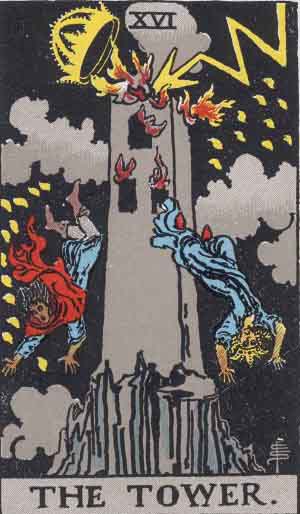
Lightning changes the landscape in an instant. The Tower asks what a disruption has exposed, without claiming that every collapse was deserved, chosen, or preventable.
Core Repeating Message
The Tower stands against a dark sky, struck by lightning at its crown, two figures falling from its heights, a crown displaced from the top of the structure. The lightning bolt enters from the upper right, from outside the frame. The fire leaps from the windows. The falling figures have their arms spread wide, in what might be terror and might, from a different angle, be something closer to the spreading of wings.
This is a card that can make people tense when it appears. It carries a reputation for disruption, for the sudden and unwelcome reversal, for the collapse of what has been built. That reputation captures part of its meaning. But it does not go far enough, and the seeker who keeps encountering this card can look more closely at what the lightning represents before deciding how the image relates to their life.
The lightning is striking the Tower, not the people. The Tower can be read as the structure: the belief system, the professional edifice, the relationship structure, the internal architecture of self-concept or worldview that the seeker has constructed, sometimes over years, sometimes over decades, sometimes as a defence, sometimes as a genuine aspiration. In the false-foundation reading, a crucial part of that structure rests on something that cannot support it. Not built in bad faith necessarily. Often built in good faith, with effort and sincere hope. But built on an assumption, a belief, an identity, or an arrangement that was not, in fact, solid ground. Here the lightning represents truth or revelation: the encounter with evidence that the structure can no longer accommodate. What looked secure becomes open to question, and the gap between what is real and what has been maintained as real becomes harder to conceal. This is a meaningful pattern to examine where the facts support it, rather than an explanation to impose on every loss.
The crown falls from the Tower. In this reading, the crown is pride: the investment in the structure itself as something to be proud of, something to point to, something that proved a particular claim about who the seeker is or what they have achieved. When protecting that claim becomes more important than seeing the structure clearly, the pride of ownership can obstruct rebuilding on more solid ground. The displaced crown asks how much of the structure is being defended because it must continue to prove something about its owner.
When The Tower appears repeatedly, one useful question is this: what has disruption exposed, and which part of the response is genuinely within the seeker’s influence?
A single appearance may be read in relation to a specific disruption: something in the seeker’s life has been challenged or revealed. Repeated appearances invite a longer view of how the seeker meets such moments. Sometimes that view reveals a persistent relationship with false foundations: a person keeps building on a particular assumption, even when experience has repeatedly shown its limits. The issue is not that the seeker is malicious or stupid, but that a familiar way of finding certainty has survived each attempt to rebuild. Whether this pattern is present needs to be examined in the life itself; the card’s repetition alone cannot establish it.
There are several primary patterns this card marks when it appears repeatedly.
The first is the false certainty builder: the seeker who responds to uncertainty by building structures of false certainty: the narrative that makes the uncertain situation feel managed, the belief that provides a stable platform from which to operate, the identity that makes the ambiguous more tolerable by declaring it settled. These structures serve a genuine function in the short term. The problem arises when a useful working understanding calcifies into a claim about what is certain, controllable or permanent. The Tower’s lightning captures the challenge to exactly these claims: the belief that cannot accommodate uncertainty, the narrative that cannot survive new information, the identity that cannot tolerate a serious challenge to its account of itself.
The second is the egocentric architect: the seeker who has built their professional, relational, or spiritual life primarily around the elevation of their own importance, competence, or rightness. This pattern can be difficult to recognise in people with genuine achievement and competence, because justified confidence and ego investment may be closely intertwined. Within this reading, the lightning exposes the ego investment rather than denying the achievement: it illuminates the place where the “I did this” has become more important than the truth of what was accomplished and what it cost their work, relationships or values. The achievement may remain worthwhile even when the claim built around it needs to change.
The third is the loyalty-to-the-wrong-thing maintainer: the seeker who has remained in a significant structure, a relationship, a professional commitment, a belief system, a way of understanding themselves, out of loyalty, out of investment, out of the genuine difficulty of dismantling something they have spent significant time and energy constructing. The structure was perhaps good at one point, or was built in the sincere hope that it would be. It is now maintained by loyalty rather than by ongoing alignment. The Tower draws attention to the gap between the commitment as it is remembered or defended and the reality of living within it now, a gap that past effort alone cannot close.
The fourth is the revelation-resistant seeker: the person who consistently meets new information that challenges a significant belief, self-concept, relationship or situation by constructing the existing Tower more vigorously, rather than considering whether it needs to change. This seeker has a strong instinct to defend and reinforce the structure when it is challenged. Over time, each added explanation can make the position harder to reconsider, because more of the seeker’s life and identity is now invested in defending it. The Tower becomes taller and more elaborate, and a later correction may carry greater costs than an earlier willingness to examine the evidence.
The fifth is the post-disruption rebuilder: the seeker who has experienced significant disruptions and collapses, and who has responded by rebuilding, often very efficiently, a new Tower with the same false foundation in a slightly different form. The disruptions have been real. The rebuilding has been real. In this pattern, the premise beneath the new structure is the same one that failed to support the old one. A different relationship, career or framework can look like a fresh beginning while leaving that premise untouched. The question is what the rebuilding has changed beneath the surface, and whether the experience of the previous collapse has been examined as carefully as the new structure has been planned.
Sixteen reduces to seven (one plus six), and seven in the Major Arcana is the Chariot: directed will, purposive movement, the exercise of genuine agency in a chosen direction. In this numerological reading, The Tower as sixteen asks what happens when will has been directed towards a structure built on a false premise. The effort need not be dismissed, but its direction may need to change. The Chariot’s energy remains a useful image for what can be redirected after disruption: the capacity to choose, to act, and to bring commitment into closer alignment with what experience has revealed.
For the seeker who keeps drawing this card, the work is an honest assessment of what has been built and what, if anything, needs attention. That can include the willingness to examine foundations before a crisis: to identify false certainties, ego investments, maintained structures and unexamined premises while there is still room to respond. This is difficult work, particularly when a structure has offered belonging or security for years. It can reduce avoidable fragility and make it easier to recognise useful information when disruption comes. It cannot make every loss preventable or every catastrophe illuminating, but it can help the seeker respond to the circumstances they actually face.
When This Card Repeats Weekly
The Tower appearing multiple times in a single week may mirror something immediate that feels disrupted or unstable. It is not a prediction of crisis. The practical task is to distinguish present facts, time-sensitive risks, and necessary support from the fear that something must be about to collapse.
The weekly appearance can be read as an invitation to take an existing instability seriously without turning the card into confirmation that an event will occur. Some disruptions reveal an unsustainable structure; others arise through accident, another person’s conduct, economic conditions, illness, or forces beyond the seeker’s control. Naming the cause accurately matters because useful rebuilding begins with reality, not blame.
A weekly Tower repetition may also mark the seeker who is in the middle of a significant revelation: a truth about themselves, about someone they love, about a situation they thought they understood, that is fundamentally changing the way they see something important. The revelation is the lightning. The belief or narrative that is being disrupted is the Tower. Read in this way, the card gives the change sustained attention. It asks what the new information means, and whether the seeker is allowing that information to alter their understanding or trying to fit it back into the previous account for the sake of familiar stability.
When This Card Repeats Monthly
A Tower month can describe a sustained period of structural disruption: the initial shock has not settled, and the seeker is still working through what has been revealed, what has changed, and which parts of their previous understanding remain reliable.
Unlike a sudden Tower moment, which may arrive with dramatic force, the Tower month has a different quality: it is the sustained aftermath, the period in which the initial disruption has occurred and the work of understanding what it means for the seeker’s life is underway. The month becomes a period of reckoning: sitting in the rubble of what has fallen and assessing what was there, what was sound, what was false, what remains, and what might be rebuilt on more honest ground. The answer may emerge slowly, as practical consequences become clearer and the first shock gives way to a fuller account of what happened.
A Tower month can also prompt review during a building phase: the seeker may be adding structure to a premise they have not examined, while noticing signs that their current life is less stable than it appears. The question is what supports that concern. Are they examining the available evidence, or adding more elaborate explanations and commitments to avoid looking at it? More construction can make an unsupported premise harder to address later, but unease alone does not establish that the premise is false. The monthly repetition offers a reason to pause and assess which of these responses is taking place.
When This Card Repeats Seasonally
A season of Tower energy can be a demanding developmental period, because it involves sustained contact with disruption in something central to the seeker’s life. Where a false foundation has been exposed, the work reaches beyond one correction into the beliefs, commitments and expectations that grew around it.
The seasonal Tower image may speak to disruptions that change a person over time: the sudden ending of a long-term relationship they believed was stable; the professional or reputational crisis that unsettles an identity built over years; the revelation about themselves, someone they love, or a significant situation that challenges how they have understood their life; the physical or health crisis that alters everyday capacity and plans; the spiritual disorientation in which beliefs that have provided meaning no longer hold under scrutiny. These experiences differ in their causes and consequences. What connects them here is the extended work of living with a changed reality.
Where a Tower season exposes a false structure, clearing it can create room to build with a more honest understanding of the ground. The season is costly. It is disorientating. The seeker may live for an extended period with uncertainty about what can be repaired, what has ended, and what form life will take next. Managing daily demands is part of that work, not a failure to engage with its meaning. Over time, the season may bring a closer relationship with the actual conditions of one’s life, rather than the view from the Tower’s elevation. That possibility can matter deeply without making the loss necessary or promising that everything built afterwards will be better.
When This Card Repeats Across Years
The Tower appearing across years invites one of the more demanding long-arc enquiries in the Major Arcana: how has the seeker’s relationship with disruption and revelation changed over time? Repeated upheavals may shape a life deeply, whether they expose a recurring false premise or arise from conditions the seeker could not control. The developmental question concerns what can be learned and supported in the aftermath, without treating each event as a lesson arranged for the person’s benefit.
These seekers may have lives characterised by what others perceive as dramatic reversals, catastrophes, or remarkable recoveries: careers that have collapsed and rebuilt, relationships that have imploded, leaving the seeker to construct a new life from the rubble, belief systems that have been shattered and reconstructed, identities that have been disrupted and then reconstituted with different materials. A long-arc Tower reading places those experiences alongside one another. It asks where the circumstances differed, where a familiar premise returned, and what the seeker now recognises that was not visible earlier. Greater understanding need not include gratitude for the events themselves.
One long-arc Tower pattern involves building repeatedly on a particular kind of false premise. This premise may concern relationships: the belief that a particular kind of person will finally provide what was missing, when the evidence across several relationships suggests otherwise. It may concern professional identity: the belief that achievement in a particular domain will finally produce the security or recognition that it keeps not quite producing. It may concern spiritual understanding: a series of frameworks that each, in turn, have proven insufficient to hold the full complexity of genuine experience. The Towers may look different while the same expectation remains beneath them. Recognising that continuity can change how the seeker rebuilds, provided the comparison also allows for what was different and what lay outside their influence.
The growth arc this card can trace across years is from shock toward informed response. Early encounters may feel catastrophic and incomprehensible, especially when no warning was visible or the cause lay outside the seeker’s control. With time, the seeker may become better at separating recurring choices from external events, noticing evidence of instability where it exists, and responding without assigning themselves responsibility for every collapse. This is not immunity from disruption. It is a more reality-based capacity for assessment, support, repair, and rebuilding.
Life Area Interpretations
Love & Relationships
In love and relationships, The Tower’s repetition can give form to the disorientation of a significant relational disruption. One pattern worth examining is the collapse of a structure built, at least in part, on something false: a projection, an untested assumption, or a pretence that no longer holds. Whether this pattern applies depends on the relationship’s actual history, not on the card alone.
The false foundation in relationships takes many forms. It may be the projection: the seeker who has built a relationship with the imagined version of someone rather than the actual person, and whose relationship structure collapses when the actual person becomes undeniably different from the projected image. It may be the assumption: the seeker who entered a relationship on the premise that it would develop in a particular direction, that the other person shared a particular set of values or intentions, that the shared project of the relationship was genuinely what both people thought it was, and whose relationship structure collapses when that shared premise turns out to have been significantly different for the two people involved. It may be the pretence: the seeker who has been maintaining a relationship structure that does not genuinely correspond to the actual relationship, and whose Tower falls when the maintenance is no longer adequate to conceal the gap.
In each of these patterns, the Tower’s collapse may be experienced as the relationship ending or being severely disrupted, and that experience is real. The card invites attention to what the change has revealed: aspects of the actual person or relationship that the previous structure made difficult to see. That information can become a basis for a more honest relationship, whether through repair or through clearer choices about future relationships. It does not erase what was valuable in the connection or make the grief unnecessary. The work of seeing more clearly and the work of mourning may proceed together.
The Tower also offers a useful relational enquiry when a recognisably similar pattern appears across several relationships: the same assumption about what another person will provide, the same gap between an imagined partnership and the one being lived. In this long-arc pattern, the seeker can examine what is consistent beneath the different relationships rather than treating each ending as wholly unrelated. The comparison needs care: another person’s conduct and the circumstances of each relationship still matter. Recognising a recurring choice can inform future decisions while leaving room to mourn each individual loss.
Career & Purpose
In career and purpose, The Tower’s repetition invites examination of professional foundations. One possible pattern is a mismatch between the professional edifice and the person within it: the role no longer reflects their values or capacities. Another is a gap between the premise on which a career or organisation was built and the conditions in which it now operates.
The most dramatic form is the sudden professional collapse: the business that fails, the career disrupted by redundancy or reputational damage, the credential or expertise that becomes less relevant. These are significant Tower-like experiences, but they do not establish that the seeker built dishonestly or should have foreseen the change. Organisational decisions, economic conditions and other people’s conduct may be central. Where a similar obstruction recurs, the card can also support a closer enquiry: is the same professional aspiration relying on an assumption that experience keeps challenging? The task is to distinguish that pattern from external events, while attending to the practical support needed after a disruption.
A more gradual Tower pattern appears when a professional identity has been built to such elaborate heights that maintaining it becomes an end in itself. The seeker’s reputation, network, achievements and self-concept consume so much energy that the work beneath the edifice has become almost irrelevant. This may unfold through a slow erosion of engagement rather than a single lightning strike: keeping up the appearance of competence or success begins to displace the practice that gave it substance. The useful question is where maintenance has replaced participation, and whether the seeker can reconnect the professional structure with work they can honestly stand behind.
Money & Stability
The Tower in financial contexts invites examination of the assumptions beneath apparent stability. A false premise may be involved: a plan relies on conditions that do not hold, an expectation of security has not been tested, or a financial identity does not correspond to the resources actually available. The card can focus that enquiry, but it cannot establish the cause of financial difficulty.
One form is a financial crisis in which a structure maintained beyond its means reaches the point where that maintenance is no longer possible. In this reading, the Tower is the financial structure, and the lightning is the encounter with limits it can no longer conceal. Other crises follow a sudden loss of income, increased costs, or circumstances that an otherwise workable plan could not absorb. In either case, attention returns to the actual ground: what is there, what is owed, what is available, and where practical support is needed. Understanding that ground matters more than forcing the event into an explanation of personal failure.
The Tower’s financial invitation is the honest examination of foundations: does the structure that has been built correspond to the financial reality beneath it? The enquiry may expose assumptions about perpetual income growth, the hope that a particular risk will continue not to materialise, or the maintenance of a lifestyle that available resources no longer support. These are specific premises to examine against the facts, rather than reasons to assume that every financial commitment is unstable. Looking closely can help distinguish what remains workable from what needs adjustment or informed advice.
The card appearing repeatedly in financial contexts asks for financial honesty: not frugality or self-denial as virtues in themselves, but a clear account of what is there and what the foundations of financial life actually are. This includes recognising both choices that can be changed and constraints the seeker did not create. The aim is a more informed response to present circumstances, without making anxiety about a possible collapse the basis for every decision.
Spiritual Growth
Spiritually, The Tower is the card of spiritual crisis: the moment at which the belief structure, the spiritual framework, the theological or cosmological understanding, or the spiritual community that has held the seeker’s spiritual life can no longer accommodate what they are experiencing.
This can be profoundly disorientating for a spiritually engaged person, because the framework is often among the most fundamentally organising structures in their life: the lens through which other experience is interpreted, the source of meaning and coherence, the community of shared understanding that has provided genuine belonging. When this structure collapses, more than an idea may be lost. Familiar practices, relationships and a shared language for making sense of life can become difficult to inhabit, even where the seeker still values much of what they received from them.
The Tower’s spiritual disruption may arise through experience that a particular framework cannot accommodate: the prayer that was not answered in the expected way, the suffering that its explanation of suffering cannot account for, the encounter with a dimension of experience it has categorised as impossible or forbidden, the encounter with genuine doubt that the framework insists must be overcome rather than explored. The challenge may concern the framework itself, the way it has been taught, or the room the community allows for questions. Those distinctions matter when considering what remains meaningful and what needs to change.
The spiritual Tower’s fall can open a period of discovery before another framework is settled. Rather than adopting a new system solely to end the uncertainty, the seeker may spend time with what remains meaningful in lived experience: the questions that persist, the practices that still sustain them, the understanding they can honestly claim. That encounter may be frightening, illuminating, or both. It does not place them outside every inherited lens, and support from a community need not make their understanding less their own. What may develop is a spiritual life more closely examined through experience, without a promise that the next understanding will be complete or superior to all that preceded it.
Emotional & Mental Patterns
In the emotional and mental domain, The Tower’s repeated presence tends to mark a seeker whose internal architecture, their self-concept, their narrative about their life and its meaning, their understanding of what they are capable of and what they are not capable of, is regularly being disrupted by the encounter with genuine new information or genuine new experience.
The emotional signature of the Tower pattern is distinctive: a recurring experience of something being fundamentally challenged and collapsing, followed by a period of genuine disorientation, followed by a gradual and often painful reconstruction, followed by the disruption of the new structure by the next Tower event. If this cycle is recognised as a pattern, the seeker is often both exhausted and frustrated by it: the sense of having worked very hard to build or rebuild, only to find the new structure disrupted again, can produce a quality of despair about the possibility of genuine stability.
The mental dimension of the Tower pattern often involves a characteristic style of belief formation: the tendency to build strong, elaborate, comprehensive belief systems rather than holding beliefs more lightly and more provisionally. The seeker who needs their beliefs to be definitive and comprehensive has built a taller Tower than the seeker who holds them as working understandings, open to revision by genuine new experience. When many conclusions depend on one untested premise, a challenge to that premise can unsettle much more than a single belief. The card asks whether this way of forming beliefs contributes to the scale of the disruption, while leaving room to assess the event itself and its other causes.
Family & Generational Dynamics
The Tower in family and generational contexts marks the disruption of significant family structures: the collapse of a family narrative, the revelation of a family secret, the disruption of a family dynamic that has been maintained by a particular collective pretence, or the sudden change in family circumstances that renders the existing family structure genuinely unviable.
Family systems can build very tall Towers, because the collective investment in a particular structure is much larger than any individual’s investment, and the collective resistance to disruption is correspondingly significant. The family that has organised itself around a particular narrative of who they are, what they have achieved, what the members are allowed to be, what the family story means, can maintain false foundations through collective agreement for generations. When the Tower falls in a family system, the disruption is correspondingly significant, both in its immediate scale and in its potential long-term significance: it can genuinely reorganise the family’s understanding of itself and genuinely allow a more honest relationship to the actual family history and the actual family members.
The seeker who draws The Tower repeatedly in family contexts may be examining a truth that others are reluctant to acknowledge. Where evidence supports that understanding, they can be in the difficult position of knowing something a shared family narrative conceals. Feeling instability, however, is not by itself proof of a hidden truth. Another possibility is that their own growth is changing them in ways the existing family structure cannot accommodate; their presence begins to challenge an inherited account of who they are allowed to be. The image of lightning can describe that disruption without deciding whether, when or how they should confront it. Safety, support and the limits of their influence remain relevant.
Health & Energy
In health and energy readings, The Tower can symbolise the subjective shock of sudden symptoms, injury, diagnosis, or an abrupt change in capacity. It does not identify a condition, explain its cause, or predict a crisis.
The most immediate expression is the loss of continuity that a health event can create: plans change, assumptions about capacity are revised, and ordinary life may need to be reorganised. The event is not evidence that the seeker ignored a spiritual lesson or built on a false bodily narrative. Medical symptoms and diagnoses have multiple causes and belong with appropriately qualified care.
The more gradual form concerns limits that have become harder to accommodate, such as sustained strain, inadequate rest, inaccessible support, or demands that exceed current capacity. These experiences may justify practical review, but tarot cannot determine whether a symptom is stress-related or what change is medically required. Persistent, severe, or sudden symptoms warrant professional assessment, and urgent symptoms warrant urgent care.
The Tower’s practical health invitation is to take changes seriously, document what is happening, seek appropriate assessment, and make evidence-based adjustments where possible. Early attention can be useful, but it cannot prevent every illness or crisis, and a difficult outcome is never proof that the seeker failed to listen.
Advanced Interpretive Sections
The Shadow Expression
The Tower in shadow produces two very different but equally significant patterns, and the seeker may inhabit either or both across the arc of their life.
The first shadow is a pattern in which intensity becomes familiar enough that the seeker may escalate conflict, abandon workable structures prematurely, or feel restless when stability requires slower engagement. This describes observable behaviour, not an unconscious cause for every disruption. Accident, abuse, redundancy, illness, and other external events must not be recast as something the seeker generated.
The second shadow is the opposite: the seeker whose experience of disruption has been so costly that they have built an elaborate defence against anything that might expose them to it again. They may try to ensure that no Tower will ever fall through sustained vigilance, avoiding commitments that could be disrupted, or managing relationships and situations to prevent unwelcome revelations. These defences can be understandable attempts to protect what remains after loss. The difficulty is that they may also keep the seeker from building anything meaningful enough to involve uncertainty. A life organised around preventing another fall can become severely constrained, even when the need for safety behind that organisation is real.
The Integrated Expression
The integrated Tower seeker has developed a more resilient and honest relationship with disruption. They are less compelled either to intensify it or to organise their life entirely around preventing it. Equanimity may be part of that development, but so is the ability to recognise fear, ask for support, and respond with skill while still affected by what has happened.
In its integrated form, the Tower energy describes the person who has learned to examine their foundations before a crisis, reviewing the premises on which important choices rest and correcting what no longer fits the evidence. This does not mean they are never surprised or overwhelmed by disruption. It means they have practices they can return to: assessing what happened, distinguishing immediate needs from longer-term questions, and drawing on support as they work out what can be repaired or rebuilt. Honest examination remains useful even when the event could not have been anticipated.
The integrated Tower seeker may also bring a distinctive capacity to others’ disruptions: they can remain present without making the situation about their own alarm, rushing the person into a new life plan, or minimising the significance of what has fallen. They can help with urgent needs while allowing the meaning of the event to remain unsettled. From experience, they may know that a person’s worth exceeds the structure they have lost, and that rebuilding need not reproduce everything that stood before. They offer that perspective without insisting that the loss was beneficial or that a better structure is guaranteed to follow.
Why This Energy Has Not Released Yet
One way the Tower pattern persists is through rebuilding the same false foundation under a new structure. The visible change can be considerable while the assumption beneath it remains intact. For a seeker whose experience supports this pattern, repeated appearances of the card can keep that unfinished examination in view.
A false foundation can persist when reconstruction takes all the attention after a disruption. The seeker may work hard to replace what fell without examining which assumptions failed, what evidence was missed or unavailable, and what the event actually revealed. A rebuilt structure can then be differently shaped at the visible level while resting on the same unsupported premise. The question is whether the rebuilding has incorporated what is now known, rather than whether it looks sufficiently different from what came before.
The pattern may also persist when the seeker’s response to disruption is to rebuild quickly and defensively, without reviewing the evidence available from the previous structure. Greater complexity can increase exposure when the same untested assumption remains. It does not guarantee another collapse, but it makes proportionate review, contingency planning, and outside perspective especially useful.
The pattern can also persist when the seeker is frightened of the open ground: not knowing what a new structure will look like or when it will become possible. That fear can make any familiar form feel preferable to uncertainty, encouraging a return to an old premise before it has been examined. Quick practical repair may be necessary, but the meaning of the event need not be settled at the same speed. Where there is room to pause, tolerating an unfinished understanding can allow a different foundation to emerge.
What This Card Wants the Seeker to Understand
The Tower asks the seeker to consider what the lightning image illuminates: disruption can expose information that was previously obscured. It does not claim that disruption is benevolent, exact, or proportionate. Some losses are arbitrary or unjust, and the first requirement may be safety, grief, advocacy, or material support rather than meaning-making.
It wants the seeker to understand that what falls in a genuine Tower moment is not the self. The self is the figure falling, arms spread, released from a structure that was not genuinely theirs in the first place, falling toward genuine ground. What falls is the structure: the accumulated pretence, the false certainty, the ego investment, the maintained narrative, the structure built on the premise that could not hold. None of these were the seeker. All of them were things the seeker built, for genuine reasons, from genuine needs, with genuine effort. And all of them are less genuinely real than the seeker themselves.
This distinction between the self and the structure is a metaphor for a person’s worth extending beyond what they have built. It does not mean that loss leaves the person untouched, or that a home, relationship, livelihood or belief was never truly theirs. Such losses can alter identity and material safety as well as bring grief. The ground beneath the fallen Tower is what can now be known and worked with, not a guarantee of greater security. Where pretence has cleared, a more honest foundation may become possible; finding and building on it can still require time, care and practical support.
Signs the Pattern Is Beginning to Resolve
The Tower’s pattern begins to resolve when the seeker develops skill in foundation examination: looking honestly at what they are currently building, identifying the premises on which it rests, and bringing those premises under the same scrutiny they would give anything else important in their life.
Another sign is a changed relationship to disruption: the seeker may become more able to take in new information, identify what needs attention, and respond without treating every challenge as the collapse of their whole life. Some events will still feel catastrophic because their consequences are severe. Integration is visible in the capacity to assess, seek help and adapt where possible, rather than in a requirement to experience every loss as useful clarification.
It resolves when rebuilt structures show greater durability: choices are grounded in current evidence, commitments can be reviewed, and contingency plans acknowledge uncertainty. Sound foundations reduce avoidable fragility, but no structure is immune to external events.
The pattern can resolve as the seeker becomes willing, where circumstances allow, to sit in the cleared space after a disruption without rushing to fill it. They allow what is becoming clearer to inform the next structure, rather than using the collapse only as an occasion for faster, more elaborate rebuilding. The pause concerns premature certainty; it can coexist with necessary practical steps.
And it resolves, finally, when the crown, the pride of ownership of the structure, loosens its grip. The seeker no longer needs every achievement, commitment or belief to prove something about them. They can value what they have built while remaining willing to examine it, repair it or change direction when the evidence calls for that. What they build is not less significant for being more lightly held. It may be easier to keep in honest relationship with the life it is meant to support, even though losing it could still hurt deeply.
Reflective Questions
-
Looking at significant disruptions in your life, which elements arose from recurring choices and which came from other people, systems, chance, or circumstances beyond your control? What pattern, if any, is supported by evidence?
-
What are you currently building, professionally, relationally, or in your understanding of yourself, on assumptions you have not yet examined? What are you assuming is solid that you have not yet verified?
-
When a significant belief or structure in your life is genuinely challenged, what is your characteristic response? Do you examine the challenge with genuine openness, or do you reinforce the structure against the challenge? What drives this response?
-
Where circumstances allowed, what would it have meant to sit in the cleared space after a Tower disruption, to inhabit uncertainty before deciding what to build next? Have you had that opportunity, or have practical needs or the wish for certainty led you to rebuild quickly?
-
Where in your current life is the crown sitting most prominently: where are you most invested in the elevation of a particular structure or achievement or identity, in a way that might be obscuring your honest assessment of what is actually beneath it?
-
Think about the structures you build in your significant relationships: the narratives you construct about the people you love, the certainties you develop about what they are and what the relationship is. How carefully have you examined these? How would they hold up to honest scrutiny?
-
What is your honest relationship to genuine uncertainty? When you cannot see the solid ground beneath a current situation, what do you do? What does this reveal about your characteristic approach to the absence of a clear structure?
-
What certainty might you be maintaining without examination? Not the belief you are already questioning, but the one that feels so obviously true that you have not thought to ask what supports it.
-
If you stress-tested one significant structure in your current life, what evidence would support its stability, what vulnerability would require attention, and what proportionate contingency would increase safety?
-
What would it look like to build something in your life on a solid foundation: not the most impressive structure, not the most elevated, but one grounded in what you know about yourself, your values, and what genuinely matters to you?
Practical Integration Actions
Examine your current foundations. Choose the most significant structure currently operating in your life: a significant relationship, a professional commitment, a belief about yourself, a life direction. Write an honest account of what that structure rests on: what you are assuming is solid, what you have taken for granted as stable, what you have not yet verified. Include the evidence that supports its stability as well as any concern. This is a bounded practice of foundation examination, not a search for reasons to distrust everything. Its value lies in identifying a proportionate next step while there is room to act.
Trace the disruption pattern. If you have experienced multiple significant Tower moments across your life, write a brief account of each one. For each, identify what structure fell, what contributed to the disruption, what was revealed, and how quickly and how similarly you rebuilt afterwards. Distinguish a recurring choice or unsupported premise from another person’s conduct, external conditions, or chance. Compare the accounts for patterns the evidence supports, including important differences. There may be a false foundation worth examining, but you do not need to invent one to make the accounts fit the card.
Practise holding structures more lightly. Choose one significant belief or narrative in your life and deliberately hold it more loosely than usual for one month: remain open to information that challenges it, engage genuinely with perspectives that see the same situation differently, notice your own resistance when the structure is challenged. This is not nihilism; it is a practice of epistemic flexibility. The aim is to revise a belief when the evidence warrants it, without feeling compelled either to defend it at all costs or to abandon it at the first objection.
Develop a genuine rebuilding process. If you are in the aftermath of a significant Tower moment, notice the impulse to rebuild immediately in the same form. Attend to urgent needs for safety, housing, care or income first; these do not have to wait for a complete understanding of the event. Alongside practical repair, make room where possible to write an honest account of what the disruption has revealed, what remained beneath the structure that fell, and what you understand now that you did not understand before. Let that account develop rather than forcing a final meaning, and use it to inform the choices you are able to make about what comes next.
Address the crown. Identify the areas of your life where your ego investment in a particular structure is most significant: the professional achievement, the relational identity, the self-concept, the belief system. For each, ask honestly: what would it mean not to need this structure to prove my worth or rightness? This is different from denying a practical need for work, connection or stability. Reducing ego investment can make it easier to assess the structure on its merits, rather than adding a premium because it must say something about you. It does not make an unsound structure solid by itself.
Welcome genuine challenge. For one month, practise deliberately engaging with genuine challenges to your significant beliefs and structures rather than defending against them. This does not mean abandoning your positions; it means taking the challenge seriously and examining whether the structure holds up to honest scrutiny. A well-supported belief may survive that examination, while an unsupported one may need revision. Attend to the quality of the evidence and argument, rather than treating every objection as equally sound or every defence as resistance.
Attend to early warning signals. Record concrete concerns, bodily changes, and recurring unease, then distinguish observation from interpretation. Check relevant facts, consult trusted or qualified support where appropriate, and respond proportionately. Attention can reveal an avoidable problem earlier, but intuition is not proof and no practice can make every disruption unnecessary.
Build on genuine ground. After a Tower disruption, alongside any necessary practical rebuilding, spend time identifying what remains solid: your values, the capacities currently available to you, what you actually know, and the relationships you can rely on. Some of these may have changed, so include their limits rather than treating them as another certainty beyond examination. Build from this ground rather than only from the desire to restore the elevation of the previous structure. What is built here is not immune to disruption. The value is in making choices that fit the evidence and resources available now, with room to revise them as life changes.