
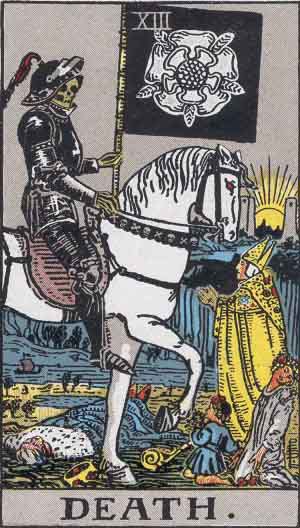
This card does not return to threaten the Seeker or predict physical death. It returns to ask what may be ending, what evidence supports that reading, and what honest completion could require.
Core Repeating Message
Death rides a white horse through a landscape that spans every station of human life. Before the pale rider, a king lies fallen near the horse’s feet. A bishop stands with hands raised, robes still elaborate. A young woman looks away. A child faces the rider, a contrast that can suggest openness beside the woman’s aversion. In the distance, two towers frame a sun low on the horizon. Read as rising or setting, it can evoke the light that follows darkness or the darkness that follows light. The card holds both possibilities.
The banner Death carries bears a white rose, traditionally read as a symbol of purity, continuity, or what remains worthy of carrying forward. It is not a promise that everything essential will survive unchanged, nor proof that what is lost was never real. Endings can take people, capacities, relationships, places, identities, and futures that mattered profoundly. The rose offers a more careful question: amid genuine loss, which values, memories, skills, bonds, or forms of meaning can still be tended, and which structures are ready to be released?
This is the inquiry Death carries with particular weight when it repeats across days, weeks, or months: what is ending, changing form, or asking for deliberate completion? Repetition does not prove that a relationship, role, or chapter is over, and the card should not substitute for evidence, conversation, or practical assessment. It asks the Seeker to test whether they are preserving something still alive, mourning something already lost, or avoiding a decision whose consequences deserve clear attention.
Resistance to genuine endings is among the most consistently human of all psychological dynamics, and it is one of the experiences this card brings into focus. Death repeating can be read as an invitation to listen for an ending that is being held off through one of the many sophisticated forms that refusal takes. That reading needs to be tested against the seeker’s circumstances; the card establishes neither physical danger nor its absence.
The forms of this refusal are numerous and are worth examining carefully, because most of them do not feel, from the inside, like refusal. They feel like loyalty, like pragmatism, like appropriate caution, like love, like responsibility. The seeker who is maintaining a relationship that has genuinely ended because they love the person and cannot bear the grief of release is not experiencing themselves as refusing an ending. They are experiencing themselves as committed, as holding something valuable. The seeker who is sustaining a professional identity that no longer genuinely corresponds to who they are is not experiencing themselves as resisting change. They are experiencing themselves as stable, as reliable, as responsible. The seeker who fears that making room for life would betray someone they have lost is not experiencing themselves as refusing the ending. They are experiencing themselves as faithful to what they lost.
All of these experiences are real. The love is real. The stability is real. The faithfulness is real. They may be reasons to seek repair, accommodation, a slower transition, or more information, and they may also coexist with a necessary ending. Death does not decide which is true. It asks what the available evidence, consent, safety, values, and lived consequences show. When a form is being maintained after its purpose or vitality has gone, that maintenance can consume energy and delay grieving, but no Seeker is required to force an ending merely to satisfy the symbolism of the card.
There are several primary patterns the repeated Death card tends to mark.
The first is the held relationship: the seeker who is in a relationship, with a partner, a parent, a friend, a colleague, a version of their family, that has genuinely ended in all the ways that matter, but that has not been formally or emotionally released. The form of the relationship persists, the conversations continue, the functional logistics carry on, but the animating reality that once made the relationship what it was has died. The seeker often knows this at some level. They feel it in the flatness of the exchanges, in the absence of the quality of connection that once characterised the relationship, in the way that what was once effortless now requires sustained management. These experiences call for honest examination; strained connection can also need care or repair. Where an ending is borne out by that examination, Death asks the seeker to stop managing the form after the substance has gone, and to allow acknowledgment of what has ended to make room for grieving and forward movement.
The second is the sustained identity: the seeker who has genuinely changed, whose values, priorities, capacities, and understanding have shifted, but who is continuing to inhabit, professionally, relationally, or domestically, the identity that was real before the change and is no longer fully real now. They are still performing the role of someone they used to be, because the role carried obligations, relationships, and a social position that changing would disrupt, or because the fear of who they might be on the other side of the change is more present than the discomfort of the current misfit. Death appearing repeatedly here is asking the seeker to stop performing the old self and begin the genuine, if uncertain, work of allowing the new self to take shape.
The third is the unacknowledged or unsupported loss: the Seeker who has lost a person, relationship, capacity, period of life, dream, or imagined future and has had little room to recognise its impact. Grief has no single correct expression, sequence, or timetable. Maintaining daily function, feeling numb, grieving privately, or finding words only much later does not make the mourning false. Death repeating here may invite the Seeker to notice what has not been witnessed or supported, without claiming that grief must be completed before life can move. The task is not to perform a particular depth of feeling, but to make humane space for whatever responses are genuinely present.
The fourth pattern is the liminal prolonger: the seeker who is between the end of one chapter and the beginning of the next, repeatedly postponing a next step they otherwise feel ready and able to take because uncertainty is frightening and the known territory of the ending, however painful, feels safer. This seeker may describe themselves as taking time to grieve or as being careful about the next step, both of which may be true. The question is whether that time is supporting the transition or narrowing their life through avoidable postponement, not whether grief has exceeded an allotted term.
The fifth is the systemic maintainer: the seeker who is, through their participation and their energy, sustaining a system, a family structure, a professional organisation, a social circle, a way of operating in some domain of their life, that has genuinely run its course. The system no longer serves its original purpose. The structure no longer corresponds to the needs and values of the people within it. But it has momentum, and the seeker’s willingness to continue providing their energy to it is a significant part of what maintains that momentum. The Death card appearing here is asking not for dramatic sabotage or abandonment but for honest examination of what the seeker is sustaining and why, and whether their continued sustaining of something over is genuinely in service of anything alive.
Thirteen is the number that traditionally follows the completed twelve: the twelve signs of the zodiac, the twelve months, the twelve apostles. Thirteen is the number that comes after the full cycle: not just its completion but what that completion requires, the genuine ending that makes a genuine new beginning possible. Death as thirteen is not a terrible number; it is the most necessary number in any sequence that intends to continue. The cycle cannot begin again until it has genuinely ended.
For the seeker who keeps drawing this card, the work is not the dramatic act of ending. It is the quieter, often more demanding work of releasing: allowing what is over to be genuinely over, allowing the grief that accompanies genuine endings to move through rather than around the interior, and developing enough trust in the process of genuine ending to allow the white horse to pass without trying to pull the rider back or run ahead of the hooves.
When This Card Repeats Weekly
Death appearing multiple times in a single week may draw attention to an immediate ending or change, including one the seeker is actively, if perhaps unconsciously, resisting.
The weekly appearance may mark a threshold in a longer process of ending: the point at which something fading has become difficult to ignore. A conversation cannot be taken back, a decision has narrowed a possibility, or new information has changed the terms of something important. The card does not confirm that the matter is irreversible, and its symbolism should not be confused with literal death or illness. It asks the Seeker to identify what has actually changed, what remains negotiable, and what now requires acknowledgement, repair, appeal, boundary, grief, or practical planning rather than reflexive denial or premature finality.
A Death week may also mark the seeker who is in the middle of a very immediate grief, one that is fresh and raw because the loss has just occurred. Here the card is not asking the seeker to do anything other than to let the grief be real, to resist the cultural pressure to function and to cope and to be fine in the ordinary time that the ordinary world allocates to loss, which may be far less than the seeker needs. The card appearing this week is permission to let the ending be as significant as it actually is.
When This Card Repeats Monthly
A Death month suggests that the seeker is in a sustained process of genuine transition: something that has been alive in their life for some time is in the process of genuinely ending, and the ending is taking the full measure of time that genuine endings require.
There is a common misunderstanding about endings, which is that they happen at a single moment, the conversation, the decision, the departure, the loss, and that everything after that moment is recovery or rebuilding. Genuine endings often do not work this way. They happen in layers. The outer form may end quickly; the interior reality of what has been lost takes much longer to genuinely resolve. The Death card appearing monthly is marking a seeker who is in the middle of a real ending that is genuinely still in process, and it is asking them to respect the process rather than trying to accelerate it.
A monthly Death pattern may also mark a seeker who is in a period of multiple endings: where several things are simultaneously concluding, where a whole chapter of life is clearly over and the previous way of being, working, loving, or understanding is genuinely giving way to something not yet formed. This is genuinely disorienting, because endings, even necessary ones, take with them not just the things that were not working but also the things that were, and the grief of loss includes the genuine losses alongside the things that were genuinely ready to go.
When This Card Repeats Seasonally
A season of Death is one of the most significant developmental periods available within the Major Arcana, because it marks a sustained and potentially transformative encounter with genuine ending that can change the seeker in ways they cannot fully predict from the beginning of the process.
At this timescale, Death can be read alongside the major structural transitions of a human life: the ending of a significant long-term relationship, the close of a substantial professional chapter, the passing of a parent or significant elder, the departure of a child from the family home, the end of a significant period of physical capacity or health, the close of a developmental phase in the seeker’s own interior life that has been real but is now genuinely complete. These are not small endings, and the seasonal frame makes room for the sustained attention they deserve.
What a genuine Death season asks of the seeker is a quality of presence with loss that contemporary culture is not well-equipped to support. The expectation in most modern contexts is that grief will be relatively brief, that the ending will be followed quickly by adjustment and then by forward movement, and that the sustained presence with what has genuinely ended is either indulgence or pathology. The seasonal Death marker is asking the seeker to resist this expectation. Genuine endings of significant things take genuine time. The full encounter with loss, the acknowledgment of everything that the ending takes with it, the reorganisation of identity and direction that becomes necessary once something genuinely central to the previous chapter is gone, is not accomplished in the time that ordinary contexts allocate.
The seasonal marker may also accompany the deliberate release of an identity, way of being, belief, value, or commitment that the Seeker has outgrown. Such a transition can be demanding because the person is both choosing change and living through its losses. Death across a season asks for measured trust in the process without promising that everything valuable will survive or dismissing what does not. Some cherished parts of life are genuinely lost; other values, capacities, and relationships change form or become clearer. The white rose symbolises discernment and continuity, not a clean sorting of the real from the unreal.
When This Card Repeats Across Years
Death appearing across years is among the most significant long-arc patterns in the Major Arcana, and it can name a seeker whose core curriculum involves repeated, deepening encounters with genuine ending and the possibility of renewal.
These seekers often have lives that are characterised by what others sometimes perceive as dramatic change: multiple significant relationships, multiple professional chapters, multiple relocations or reconfigurations of their external circumstances, multiple significant losses, multiple periods of genuine reinvention. Such a history need not mean instability or failure to commit. The Death card across years can name a developmental curriculum in which ending and renewal recur, while asking the seeker to distinguish changes that support growth from repeated exits that prevent it.
This does not mean the seeker is comfortable with endings. The Death card across years belongs equally to seekers who are genuinely at ease with transition and seekers who find every ending an excruciating encounter with loss and uncertainty. What the long arc can build, whatever the seeker’s natural orientation, is a growing competence in the art of genuine release: the capacity to recognise when something is genuinely over, to allow the grief of that ending its full measure, seeking support when it becomes overwhelming, and to stay with the uncertainty before a new form is clear.
Across years, the growth arc Death traces is from reactive ending, in which endings happen to the seeker and are experienced as loss without genuine integration, to conscious transition, in which the seeker develops genuine skill in the art of completing what needs completing, grieving what needs grieving, and allowing genuine new beginning in its own time. The late-arc Death seeker is often recognisable by a particular quality of ease with impermanence: they do not hold things beyond their natural term, they do not maintain forms after the animating reality has departed, and they can remain present in the dark between the old shape and the new one, even when it frightens them, because experience has shown them that this space can be generative.
This seeker, across years, becomes a genuine resource for others in transition: the person who can companion another through loss without urgency, who understands the difference between grief and stagnation, who can sit with someone in the dark between their endings and their new beginnings without flinching or rushing them toward the light they are not yet ready for.
Life Area Interpretations
Love & Relationships
In love and relationships, the Death card’s repetition most often marks one of the most painful and most necessary human experiences: the ending of a significant love that has genuinely run its course, or the genuine transformation of a relationship that cannot continue in its current form.
The first and most direct pattern is the relationship that is genuinely over but has not been allowed to officially end. This may be because ending would cause pain to someone the seeker loves. It may be because the seeker is genuinely uncertain whether the ending is real or whether it is a passing phase. It may be because the practical, logistical, financial, or familial entanglement of the relationship makes ending very complicated and very costly. Any of these reasons may be real, and they shape what action is possible and responsible. Alongside them remains the fundamental question the Death card is raising: is this relationship genuinely alive in the ways that matter, or is the seeker maintaining its form after its animating reality has departed?
The Death card’s presence does not mean the seeker must end the relationship immediately. It means they must be honest about what is actually happening. And genuine honesty, in a relationship that has lost its animating reality, is often the beginning of the conversation that determines whether genuine renewal is possible or genuine ending is what is needed. These are two different paths, and both are legitimate, and neither is available without the honest assessment that the card is requesting.
For the seeker whose primary relational loss is grief for a relationship that ended some time ago, the Death card appearing repeatedly may draw attention to what remains painful or unsupported. The ending may have been formal and even accepted intellectually, while the interior work of mourning the self that existed in that relationship and the future anticipated within it continues. The card here asks what needs time, witness, or practical care, without making release of every bond or feeling the measure of whether the ending is real.
Career & Purpose
In career and purpose, the repeated Death card most commonly marks a professional identity that is genuinely over and that the seeker is continuing to inhabit because they do not yet know who they are on the other side of leaving it.
This is one of the most common and one of the most genuinely difficult patterns the card marks, because professional identity is among the most strongly constructed and most socially reinforced aspects of the adult self. The person who has spent fifteen years building expertise in a particular field, who is known and valued in a particular professional context, who has organised their daily life, their financial structure, their social identity, and their internal narrative around a professional role, faces an enormous practical and psychological disruption in genuinely releasing that identity, even when it is genuinely over.
The Death card appearing repeatedly in career contexts does not justify walking out without preparation or abandoning practical responsibilities. It asks the seeker to be honest about the level of genuine misalignment between the professional role they are in and the person they have genuinely become, and to begin, even in small and preliminary ways, the genuine work of transition rather than continuing to sustain a professional persona that does not genuinely correspond to them.
The card also appears frequently when a seeker’s genuine purpose, the work they are actually here to do, has been living alongside or underneath the professional role they have been in, and the professional role has genuinely served its purpose and is now genuinely complete. The purpose may continue even when its professional form has ended. Releasing attachment to that form can allow the seeker to explore how the work might be carried differently, with closer attention to who they have become and what is now possible.
Money & Stability
The Death card in financial contexts most often marks a significant financial ending: a model of income generation, a financial arrangement, a form of economic stability, a financial identity that has genuinely run its course and that the seeker is attempting to maintain past the point of genuine vitality.
This might be the income source that is clearly declining but that the seeker is continuing to invest in because moving to a new model involves uncertainty about how replacement income will develop. It might be a financial arrangement within a relationship that is changing, and the financial change is one of the losses the seeker is most resistant to facing because it makes the relationship ending concrete in the material world. It might be a relationship to money itself, a way of managing, saving, spending, or valuing money, that no longer serves the person the seeker has become and that needs genuine examination and genuine revision.
The Death card’s financial message is to examine the cost of maintaining an arrangement that may no longer be viable, rather than to assume that dissolution is the necessary route to a better financial life. The seeker who keeps investing in a declining form can carry both the cost of maintenance and the anxiety of uncertainty. Compare those costs with the risks and resources involved in changing it, including whether a gradual transition is possible. Release may create room for renewal, but the practical plan must rest on evidence about income, obligations, and available support rather than a promise in the card.
Spiritual Growth
Spiritually, Death can be one of the most demanding initiations in the sequence of the Major Arcana: an encounter with endings that unsettle the seeker’s understanding of who they are. Some experience a sense of continuity beneath the loss of a familiar spiritual identity, a contact with what feels more essential than the forms that carried it. This can deepen equanimity in the face of impermanence without establishing that an untouched essential self survives every loss.
Many spiritual paths recognise a version of the Death initiation, the moment or the sustained period in which the practitioner is asked to relinquish something central to their previous spiritual identity: a belief, a teacher, a community, a practice, a way of understanding the nature of the divine or the nature of themselves. This relinquishing may be experienced as loss, sometimes as a kind of spiritual death, even when relief is present too. The familiar ground is gone. The understanding that had organised the seeker’s spiritual life no longer holds. The community or teacher that had been the primary vehicle for their development is no longer available, or is available in a form that the seeker can see is no longer genuinely serving their growth.
The Death card appearing repeatedly in spiritual contexts is asking the seeker to stop trying to keep alive a spiritual form or understanding that has genuinely completed its function. This is not an invitation to cynicism or to the abandonment of genuine spiritual life. It is an invitation to genuine spiritual maturity: the recognition that a spiritual form can be a vehicle for what the seeker experiences as a deeper reality. When that vehicle has served its purpose, faithfulness to what it once carried may require releasing the vehicle, however beloved, however central to one’s spiritual identity.
The seeker who allows the spiritual dying, who can sit in the genuine dark of having released a belief, a teacher, a community, or a spiritual identity without immediately filling it with a new one, may discover something in that dark: a quality of contact with whatever is most essentially real that does not depend on the particular forms that have been carrying it. This is one spiritual gift the Death image can hold, without making the loss necessary or requiring the seeker to experience it as a gift.
Emotional & Mental Patterns
In the emotional and mental domain, the Death card’s repeated presence most often marks a seeker who is engaged in a sustained and unfinished encounter with loss, and whose emotional and psychological resources are being substantially consumed by the work of maintaining something that is genuinely over.
Some seekers recognise an emotional experience associated with this pattern: a combination of grief that surfaces unexpectedly and a weariness that is not fully explained by the obvious demands of the seeker’s life. The grief is the grief of what is genuinely ending or has genuinely ended. The weariness may partly reflect the cost of maintaining the form after the animating reality has gone: the sustained effort of performing a relationship, a professional role, an identity, a belief, as though it is still fully alive when the seeker privately knows it is not.
The psychological work the card may invite is mourning without performance: making room for the interior encounter with loss while recognising that grief is non-linear, culturally shaped, and not entirely within the Seeker’s control. It takes its own time rather than the time a schedule or social context allocates. Repetition cannot confirm that grief has been suppressed or predict that weariness will continue. It can prompt questions about what has been acknowledged, what remains unsupported, and whether counselling, community, ritual, rest, or practical help would make the loss more bearable.
Mentally, the Death pattern often produces circular thinking about endings: the seeker who returns repeatedly to the question of whether the ending is real, whether there is something that could have been done, whether the relationship or the chapter or the form could be restored if the right approach were found. This circularity is not a failure of intelligence. It may reflect difficulty accepting an established ending, but it can also persist while information, practical arrangements, or the possibility of repair remain unresolved. The useful distinction is between inquiry that can still change a decision and repeated reassessment that brings no new information and leaves the seeker less able to meet present needs.
Family & Generational Dynamics
In family and generational contexts, the Death card appears when something in the family system has genuinely ended and the family has not yet allowed the ending to be real.
This is common in families following a significant loss, particularly the death of someone whose presence organised the family’s identity and relationships. The family system changes, but there is no single timetable or correct ritual for recognising that change. Keeping a room or belongings unchanged can be a meaningful expression of love rather than evidence of dysfunction. A systemic Death pattern is more usefully considered when family members feel unable to discuss changed roles, practical needs, conflicting mourning styles, or how shared life will be reorganised. The question is whether remembrance and present-day needs can coexist without coercing everyone into one form of grief.
The seeker who draws Death repeatedly in a family context may be the person in the family system who is most aware of what has genuinely ended and most in need of the other family members’ willingness to acknowledge it. They may also find acknowledgement difficult, particularly where the family has little room for different responses to loss or for discussion of what needs to change.
Generationally, the Death card marks the seeker who is in the process of genuinely ending a pattern that has been transmitted through multiple generations: a way of being in relationship, a way of relating to work or money or power or vulnerability, a way of understanding what is possible, that has been real in the family system for a long time and that the seeker is, through their own development and their own honest encounters with its cost, genuinely bringing to an end. This is significant ancestral work, and it is not comfortable, and the Death card appearing repeatedly in this context can offer a symbol of the work and support for the courage it requires; the evidence of change lies in how the pattern is being lived differently.
Health & Energy
The Death card in health and energy contexts invites examination of the possible energetic cost of maintaining something genuinely over: the sustained physiological and psychological expenditure of keeping a form alive after its genuine content has departed.
Some Seekers notice depletion while sustaining a relationship, professional role, or belief structure that no longer feels viable. That association may be meaningful, but there is no distinctive bodily signature that proves something is over. Fatigue that does not improve with ordinary rest has many possible causes and deserves appropriate assessment. The card’s grounded contribution is to include emotional labour, role strain, grief, and misalignment among the factors worth documenting, while refusing to treat symbolism as diagnosis.
Death appearing repeatedly in a health context can invite the Seeker to observe whether symptoms change around particular roles, relationships, workloads, anniversaries, or transitions. Chronic tension, persistent fatigue, and anxiety are not evidence that a situation has ended, and an unclear cause is not a symbolic cause. Record patterns, seek qualified medical or psychological care where appropriate, and use the card only as a prompt for questions about capacity, support, boundaries, treatment, and change.
An acknowledged ending may bring relief, greater congruence, or renewed energy, and it may also bring prolonged grief, practical hardship, disability, or uncertainty. There is no required sequence and no guarantee of restoration. The body can respond to change in many ways, none of which proves that the decision was right or wrong. What helps is proportionate care: realistic pacing, social and professional support, attention to material consequences, and permission for relief and sorrow to coexist.
Advanced Interpretive Sections
The Shadow Expression
The Death card in shadow depicts one of the most recognisable and one of the most painful patterns available to the human psyche: the seeker who is repeatedly drawn to ending.
In this shadow form, the seeker has come to seek the clarity, intensity, or relief they have sometimes experienced after endings, however painful. That immediate release has become more familiar and more sought-after than the sustained engagement that genuine ongoing relationship, work, or development requires. They end relationships at the point where the initial intensity fades and the sustained ordinary-level engagement begins. They leave professional situations as soon as the novelty is exhausted. They release friendships, practices, communities, and projects in the name of growth or authentic evolution when what is genuinely operating is the avoidance of the sustained, incremental, less dramatic work of genuine long-term engagement.
The Death seeker in this shadow does not stay long enough in anything to discover what genuine depth and genuine commitment produce. They mistake repeated endings for genuine transformation, when the change they need may lie in sustained engagement through the difficult middle of things.
A second shadow expression is the seeker who treats their history of genuine loss as a fixed identity: who has allowed the genuinely painful endings they have experienced to become the primary story of who they are, the defining lens through which they understand their life, and who has organised their current experience primarily around the prevention of further loss. They are living in sustained anticipatory grief, pre-mourning things that have not ended in order to be protected from the impact if they do. This shadow produces a particular quality of emotional distance that is sometimes mistaken for maturity but is actually armour.
The Integrated Expression
The integrated Death seeker is among the most genuinely free people available to any human community, because they have developed genuine equanimity about impermanence: they do not hold things beyond their natural term, they do not maintain forms after the animating reality has departed, and they can remain present in the dark between endings and new beginnings, even when it frightens them, because they have known that space to be generative.
In its integrated form, the Death seeker has developed what might be called a clean relationship to completion: they can recognise when something has genuinely served its purpose and genuinely end it, whether or not the ending is comfortable, whether or not the external circumstances have reached a neat resolution, whether or not others in the situation are yet ready to acknowledge what has ended. They do not delay endings that are genuinely ready. They do not accelerate endings that need more time. They have developed, through repeated genuine encounter with the process, an honest sense of when something is genuinely over.
This seeker carries a distinctive lightness that comes from loosening the effort to keep a completed form alive. They can be present in their current life, relationships, and work while still carrying grief and meaningful bonds with what preceded. And they can companion others through loss with a quality of grounded presence that comes from having been in the dark themselves, discovering forms of continuity amid change, and finding ways to begin again without requiring another person’s loss to follow the same path.
Why This Energy Has Not Released Yet
The Death card’s pattern may persist when an ending remains difficult to acknowledge or act on, and reasons for this can include grief, fear, identity, and what might be called the comfort of the known loss.
Grief may contribute to non-release when an ending affects something central to the Seeker’s identity or meaning and has received less time, recognition, or support than it needs. Yet grief is not a task that becomes finished through sufficient feeling, and managing daily life is not evidence of avoidance. The pattern may persist because circumstances, attachment, trauma, practical consequences, or continuing bonds remain active. The card asks what kind of acknowledgement or support is missing without prescribing how mourning should look.
Fear as a reason concerns what comes after an ending: uncertainty about identity, livelihood, belonging, or safety once something central is released. This fear may contain realistic information as well as imagined catastrophe, so it deserves assessment rather than dismissal. Death does not promise an untouched essential self or imply that every lost part was expendable. Significant endings can alter people permanently. The card asks which capacities, values, supports, and choices remain available, and what protection or preparation the transition genuinely needs.
The comfort of the known loss is perhaps the most subtle reason for non-release, and the most important to understand: there is a way in which a sustained and familiar grief, however painful, is experienced as more manageable than the unknown of a life less organised around it. The seeker knows this grief. They have learned to live in it, to organise their life around it, to understand themselves through the lens of it. The possibility that the grief might become less consuming, that something genuinely new might begin, that they might discover they are someone different from who the grief has required them to be, is genuinely frightening in a way that is often not consciously acknowledged.
What This Card Wants the Seeker to Understand
Death wants the Seeker to understand that the white rose on its banner can be read as a symbol of continuity without becoming a threat or a guarantee. It does not divide life into what was truly theirs and what deserved to disappear. It asks what can be carried with integrity through change: a value, memory, skill, relationship, responsibility, or form of meaning. What remains may be altered, and what is lost may still have been real and precious.
It wants them to examine what resistance to an ending is protecting and what it is costing. Holding off an ending past the point where a responsible transition is possible can consume energy that might otherwise be available for new engagement, growth, or relationship with the life now available. Maintaining a form whose vitality has gone can narrow those possibilities, even when the attachment and the reasons for caution remain real.
The card wants the Seeker to understand that mourning is not weakness and that responses to loss can include sorrow, anger, relief, numbness, longing, confusion, or moments of ordinary life. No single emotional state is the precondition of renewal. Giving grief recognition and support can make more of life available, but it does not complete a predictable process or erase continuing bonds. The aim is an honest relationship with loss, not a performance of acceptance.
Death wants the seeker to understand that the darkness between the old life and the new one is not empty. It can hold the slow work of dissolution and the beginnings of renewal before either has a recognisable shape. The figure on the white horse is not the last thing in the image. The sun in the distance, rising or setting, speaks to what continues after the harvest, after the clearing of what was over.
Signs the Pattern Is Beginning to Resolve
The Death pattern may begin to resolve when acknowledging what has changed brings greater clarity, even if grief remains. Relief may accompany that clarity, but it is not required and is not a diagnostic signature of healthy mourning. The relevant shift is less argument with the fact of change and more capacity to meet present needs, remember what mattered, and make decisions without using the card to rush or judge the emotional process.
It may resolve further when the seeker finds themselves able to speak about what has ended in a way that acknowledges what was genuinely lost and what, if anything, was ready to go: when the account of the ending is more honest and less defended, when it does not require either the minimising of loss or the elaboration of grievance to be told.
It may resolve further when genuine curiosity about what comes next begins to be present alongside the grief, when the seeker catches themselves wondering, sometimes even with a tentative quality of hope, about who they might be and what might be available as this transition unfolds.
It may resolve further when the seeker begins to set down things that have been completed: relationships that have been formally over for some time but carried forward in repeated attempts to recover their former shape, beliefs that have been genuinely released but referred to out of habit, identities that have been shed but still dressed in on occasion. The setting down is quiet, not dramatic, often unobserved by others. But the seeker can feel it.
And it may resolve further when something new begins to take shape, whether through deliberate effort, circumstance, support, or the space created by an ending. The white rose remains as a symbol of what can be carried, not proof that every essential thing survived. Morning in the image does not cancel the night. It suggests that time and life continue, and that a next form can emerge without making the loss unreal.
Reflective Questions
-
What in your life is genuinely over that you are still maintaining in some form: through continued investment of energy, through the performance of a role, through the retention of an identity, through the avoidance of grief? Name it as specifically as you can.
-
What are you most afraid you will lose or become if you genuinely allow what is over to end? Is that fear about the external loss, or about the loss of a part of your own identity that the ending would require?
-
Think about your relationship to endings generally. Do you tend to hold things too long, or to end things before they have genuinely run their course? What has shaped this tendency, and what is it costing you?
-
Where in your life are you consuming significant energy maintaining something that is not genuinely alive? If you could release that energy, what would you do with it?
-
Is there a grief you carry that has had little recognition or support, or one you have felt pressure to present in a particular way? What would giving your actual response time and space look like, without requiring it to reach completion?
-
What do you know from your own experience about what survives genuine endings? What has remained, changed, or become clearer in you, and what mattered deeply even though it was lost?
-
If you look at the Death pattern in your life across a longer arc, which endings have made room for something new, and which losses remain painful without a compensating gain? What does this history tell you about the conditions that support renewal, and what you cannot know in advance?
-
Is there an identity, a professional role, a relational position, a belief about yourself, that you have outgrown but continue to inhabit? What has made it difficult to allow this identity to genuinely end?
-
What would your life look like if everything that is genuinely over were genuinely released? What would be available that is not currently available?
-
The white rose on Death’s banner can symbolise what remains or can be carried forward. Which values, capacities, memories, relationships, or forms of meaning feel available to you now? Which have changed, and what support might they need through this ending?
Practical Integration Actions
Name the genuine ending. Write, for yourself alone, an honest naming of what is genuinely over in your life right now: the relationship, the professional chapter, the belief, the identity, the version of the future, the way of being. Not as a complaint or a grief list, but as a genuine inventory of what has completed. The act of honest naming is itself a step toward genuine release.
Allow the grief its own time. If it feels safe and supportive, set aside a brief time each week for one month to notice what is present around the loss without demanding insight, tears, acceptance, or completion. Grief may arrive as sadness, anger, relief, numbness, physical sensation, memory, or no clear feeling at all. Stop if the practice becomes destabilising, and seek appropriate support if grief is impairing safety or daily functioning. The aim is permission and witness, not forcing an emotional process.
Release the maintenance work. Identify one specific way you may be investing energy in maintaining a form that no longer matches its reality: contact continued from habit, a professional pretence, or the performance of a belief you no longer hold. Check the evidence and consider safety, consent, contracts, dependants, and material consequences before acting. Choose one small, reversible step that reduces unnecessary maintenance without abandoning responsibility, and notice what the step clarifies.
Create an ending ritual. Design a simple personal ritual that marks the genuine completion of something significant: the writing of a letter to what is being released, not to be sent but to be genuinely written; a walk through a significant landscape at the close of a chapter; a deliberate setting down of an object that represents what is ending. Consciously marking an ending can give it recognition and a place in your story, without requiring the ritual to complete grief or make the loss feel resolved.
Talk to what you have lost. In a journal or in genuine silent conversation, speak directly to what has genuinely ended: the relationship, the version of yourself, the professional chapter, the belief. Say what was genuinely good about it. Say what, if anything, was ready to end. Say what you will genuinely carry forward and what you are genuinely releasing. This gives words to interior communication that mourning may need, without requiring a final goodbye or a particular emotional result.
Examine the inherited relationship to endings. How did your family of origin handle endings, losses, completions, and transitions? Were they grieved openly, or managed privately? Were they acknowledged as significant, or minimised in the name of moving on? Were the people in your family of origin genuinely good at releasing what was over, or did they hold things long past their natural term? Your current relationship to endings has been significantly shaped by what was modelled, and examining this inheritance can reveal patterns that are not genuinely your own but that you have been living as though they were.
Trust the dark. After an ending, resist unnecessary pressure to fill every space immediately with new commitments, relationships, or identities. Give the transition a realistic time container while continuing to meet safety, care, financial, legal, and daily responsibilities. This is not passive trust that something better must appear. It is deliberate room for grief, information, and preference to emerge before avoidable commitments are made, with review points if waiting begins to narrow rather than support your life.
Identify what remains. After an ending, or in the middle of one, describe the qualities, capacities, values, memories, relationships, and ways of engaging that remain available now. Do not require them to be permanent, independent of every role, or untouched by loss. Let the list include what has changed and what needs support. This is one grounded reading of the white rose: not proof of an indestructible essence, but a present-tense inventory from which the next step can be made.