
When this card appears again and again, the question is never whether you can move forward: it is whether the forces pulling at you are genuinely under your direction, or whether you have confused speed with intention.
Core Repeating Message
The Chariot does not appear for the passive seeker. It comes for someone in motion, or someone who urgently needs to be. Yet its repetition signals not a victory lap but a recurring confrontation with one of the deeper challenges in any life: the task of holding opposing forces in genuine tension and driving forward anyway, not by suppressing the contradiction but by mastering it.
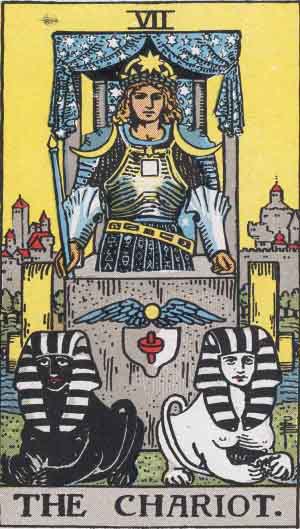
In the Rider-Waite-Smith image, the charioteer stands upright above two sphinxes, black and white, whose contrasting qualities suggest forces that must somehow be directed together. No visible reins connect the driver to them. That absence matters symbolically: the vehicle is not governed by brute force but by will, concentration and an inner coherence strong enough to contain contradiction without pretending it has disappeared. The armour is ceremonial as much as protective. The figure has earned something, but the posture remains taut and watchful. This is not ease. This is mastery in active practice.
When the card repeats, several patterns are worth examining honestly.
The first is the pattern of the forced driver: the person who has learned to override internal conflict by sheer willpower, treating opposing impulses as problems to subdue rather than forces to understand and direct. They move forward. They are productive, disciplined and often admirable from the outside. But internally, the tension is being actively held in place, and that requires energy. They are gripping the reins so tightly their hands are white.
This is an early form of Chariot mastery rather than its mature expression. Sheer will can carry a person remarkably far, particularly when stopping has previously felt unsafe, impractical or simply unavailable. But what is overridden does not necessarily disappear. The body may register the strain through persistent tension or difficulty downshifting; relationships may begin to absorb the cost of relentless self-direction; creativity may narrow when only productive or controlled states are permitted.
When the card repeats here, the invitation is not simply to try harder. It is to examine what the control is accomplishing and what it is costing. Is the direction arising from genuine inner alignment, or is forward motion also serving to keep an unresolved conflict from becoming fully conscious? The distinction matters because both patterns can look equally capable from the outside.
The second pattern is the speedless charioteer: the person who has significant capacity for forward movement but cannot seem to actualise it because the opposing forces within them are too evenly matched. They are perpetually deliberating. One part wants the career pivot, another fears the financial instability. One part wants the relationship to deepen, another fears the vulnerability required. The chariot sits motionless, the sphinxes pulling left and right with equal strength, and nothing moves. This person is often deeply frustrated with themselves. They read as capable from the outside and feel stuck from the inside. The Chariot repeating here is asking: which of these forces is actually yours, and which belongs to a story you inherited? Because the vehicle will not move until the driver genuinely takes the reins, and taking the reins requires knowing which hand is your own.
The third pattern is the misdirected driver: someone who is moving very quickly, decisively, even successfully by external measure, but in a direction they have not examined recently (or ever). The chariot is in full motion; the momentum is real; the problem is that the destination was chosen a long time ago, or chosen for reasons that no longer hold, or chosen for someone else’s expectations and never quite chosen by the self at all. When this card repeats for such a person, it arrives as a quiet disruption: have you looked up lately? Do you know where this is going? The speed that felt like freedom begins to register as a kind of captivity, because all that forward motion is foreclosing on alternatives they never stopped to weigh.
Beneath all three patterns, the Chariot’s repeating question is about the relationship between will, direction, and inner alignment. Not willpower in the sense of grinding endurance. Not direction in the sense of a five-year plan. And not inner alignment in the sense of easy peace. The charioteer is not at peace, not in any simple sense. They are holding tension. But the tension is directed, contained, and in service of movement. That is the distinction. That is what the card is asking the seeker to develop.
In modern occult tarot correspondence systems, The Chariot is commonly associated with Cancer, a pairing that can seem paradoxical: a sign linked with home, emotional depth and the interior life attached to an image of directed force. Yet the contrast is useful. The card’s mastery is not the absence of feeling but the ability to include feeling without surrendering direction. A driver cut off from emotion steers with incomplete information; one overwhelmed by emotion may struggle to steer at all. The Chariot asks for both: the feeling acknowledged, and the hands still on the reins.
In tarot numerology, seven is often associated with testing, inward development and the point at which what has been built meets resistance or pressure. The Chariot is not the beginning of the journey, as The Fool is, nor the gathering of tools represented by The Magician, nor the establishment of structure associated with The Emperor. It is a stage at which capacities already developed have to function under real conditions, with competing demands and no guarantee that the environment will accommodate hesitation.
Seven therefore asks: what happens to your direction when it is tested?
For the seeker who keeps drawing this card, the work is not to become someone different. The opposing forces are not flaws to be corrected. The tension is not a problem to be solved. The Chariot asks the seeker to become genuinely capable of holding what they already are, all of it, in one directed hand, and moving forward from that wholeness into a life that is actually chosen, actually theirs, and moving in a direction they can look at without flinching.
This is the card’s repeating gift: not comfort, but capacity. Not resolution, but direction. Not the absence of conflict, but the skill to drive through it.
When This Card Repeats Weekly
A week of Chariot repetition tends to feel either intensely focused or intensely pressured, and the task is to distinguish between these two experiences clearly, because they can look identical from the outside and feel very similar from the inside.
If the week is characterised by genuine focus, the Chariot appearing multiple times is confirming that the energy is coherent and the direction is sound. The seeker is moving with their full capacity behind them, and the card is a marker of momentum rather than a warning. In this case, the question to sit with is not “what is wrong?” but “what is this momentum building toward, and am I clear about that destination?”
If the week feels pressured, the repetition is worth investigating more carefully. Chariot weeks can carry a driven, relentless quality: the sense that one must push, must produce and must not let up. Sometimes that pressure is genuinely situational. At other times, external expectations, perfectionism, fear of falling behind or an internalised requirement to remain capable have begun acting as the driver.
In this expression, motion can become partly reactive. The seeker may be moving towards something they want while simultaneously moving away from failure, uncertainty, vulnerability or the discomfort of stopping. Those motives can coexist. The important distinction is not whether the effort is sincere, but how much freedom the seeker retains to alter the pace, reassess the destination or stop without experiencing the pause itself as threatening.
Weekly, the Chariot asks: are you moving forward this week, or just moving? Are you tired because you are genuinely spent from meaningful effort, or tired because you have been running at full speed without checking the direction? Even a brief pause to take stock, to name what is actually being pursued and why, can shift a week from draining momentum to sustaining it.
When This Card Repeats Monthly
A month of recurring Chariot energy is significant and worth examining structurally. The Chariot over weeks suggests a theme running through daily life at a level of some urgency. Something in the seeker’s life is demanding directed movement, genuine mastery, or a resolution of competing impulses, and it has been demanding this consistently enough that the cards keep returning to it.
Monthly, the Chariot often appears when a seeker is in the middle of a period of high output: building something, launching something, sustaining something that requires their continuous effort and focus. In these months, the card is both encouragement and reminder. Encouragement: your effort is registering, the energy is real, continue. Reminder: check your trajectory. A month is long enough that even a slight misalignment of direction compounds significantly. The charioteer who discovers after four weeks that they have been moving at speed in the wrong direction has further to travel back than the one who checks the course weekly.
Monthly Chariot repetition can also appear during periods of genuine internal conflict: a month in which two major life forces are pulling against each other and the seeker has not yet found a way to move forward that honours both. The card’s monthly repetition here is patient but persistent. It is not asking the seeker to choose one impulse and abandon the other. It is asking them to develop the capacity to drive with both, which is harder, which takes longer to learn, but which produces movement that is sustainable rather than costly.
When This Card Repeats Seasonally
A season of Chariot energy signals a period in the seeker’s life that will later be recognisable as a chapter of becoming. Something is being built, tested, or driven toward that requires sustained will, inner discipline, and the ongoing mastery of forces that might otherwise scatter the energy entirely.
Seasonally, the Chariot often marks the following kinds of periods: a sustained professional push, such as the build phase of a significant project or business; a period of deliberate self-development in which the seeker is committing to practices, studies, or transformations that require consistent daily effort; a relationship period in which two people with real differences in temperament, value, or vision are working to build something together and must regularly renegotiate their direction; or a period of recovery and rehabilitation in which the body or psyche is being disciplined back to strength after a period of depletion.
What characterises all of these is the quality of sustained, directed effort under genuine conditions of opposition or difficulty. The Chariot season is not easy, but it has the particular satisfaction of effort that is genuinely one’s own. At the end of a Chariot season, the seeker typically knows more about what they are made of than they did at the start.
The shadow risk of a Chariot season is the drift into compulsive drive: the loss of the ability to stop, rest, or recalibrate. The card appearing seasonally is worth monitoring for signs of this. If the seeker cannot slow down without anxiety, cannot rest without guilt, and cannot examine their direction without feeling threatened by the question, the Chariot has shifted from mastery into compulsion. This is not failure; it is information. The card appearing again under these conditions is asking them to remember that the charioteer who cannot stop is not actually in control of the vehicle.
When This Card Repeats Across Years
The Chariot appearing across years is one of the more distinctive long-arc patterns in the Major Arcana. It suggests a recurring encounter with will, direction and the management of inner conflict, not as a temporary circumstance but as a developmental theme that keeps assuming new forms.
For some seekers, this pattern does begin early. A child who grows up amid instability, conflicting adult demands, excessive responsibility or an environment in which competence brings safety may learn to organise themselves around strong forward motion. Taking charge, anticipating problems, performing well or keeping emotion contained can become highly intelligent adaptations. They build real capacity. The adult does not merely imagine that they are capable; they often are unusually capable because those capacities were practised early and intensely.
The difficulty is that an adaptation can outlive the conditions that produced it. The Chariot may then return throughout adult life with a more nuanced question: is the driving still necessary in the same way? Does stopping still carry the meaning it once did? Has determination become so closely associated with safety, identity or worth that the seeker continues accelerating even when circumstances no longer demand it?
This is not the only origin of a years-long Chariot pattern. Strong self-direction can also be developed through ambition, leadership, creative work, entrepreneurship, caregiving, migration, recovery, competitive environments or repeated periods in which substantial responsibilities genuinely have to be coordinated. The card does not establish the biography. It helps identify the recurring structure.
The long-term Chariot can also belong to someone whose work repeatedly requires them to hold contradiction at a high level: the leader balancing competing constituencies, the artist who needs both privacy and audience, the activist navigating idealism and pragmatism, the parent balancing autonomy and responsibility, or the seeker carrying two legitimate values that cannot be perfectly reconciled.
For these people, the card is not necessarily identifying dysfunction. It may be naming the nature of their work.
Across years, the developmental movement is from control towards mastery. Control is grip-heavy. It depends on containing uncertainty by exerting sufficient force. Mastery is more responsive because the opposing forces have become known rather than merely restrained. The seeker can still mobilise tremendous will when required, but no longer needs maximum tension in order to experience themselves as competent.
This can produce a profound change over time: still capable, but less white-knuckled; still decisive, but less threatened by uncertainty; still able to move fast, but increasingly able to distinguish urgency from importance; still commanding when circumstances require it, but no longer dependent on command as the only available form of strength.
Perhaps most importantly, stillness itself changes meaning. What once registered as loss of control, vulnerability or dangerous inactivity can gradually become another expression of authorship. The mature charioteer can stop the vehicle because they know they remain the driver when it is stationary.
Life Area Interpretations
Love & Relationships
In love and relationships, the Chariot’s repetition points toward the dynamics of momentum, direction, and opposing wills within the relational field.
For the seeker who is single, the Chariot appearing repeatedly in the relational position can indicate someone who is in a kind of forced drive when it comes to love: either charging toward relationships with such purposeful energy that potential partners feel pursued rather than courted, or alternatively, holding themselves so firmly in directed solitude that no one can get close enough to form a genuine connection. The card here is asking: what are you actually moving toward? And are the forces that govern your relational life genuinely yours, or are they inherited blueprints, old survival strategies, or someone else’s narrative about what you should want?
For the seeker in a relationship, the Chariot’s repetition often flags a dynamic in which the partnership has competing directional energies that have not been successfully integrated. Two people pulling in different directions, not necessarily about large things, but about the lived texture of daily movement: pace, ambition, timing, the amount of rest versus the amount of doing. The relationship is in motion but the motion is slightly uneven, slightly effortful, and each partner is managing their side of the tension rather than genuinely driving together.
This does not mean the relationship is doomed. The Chariot is a card of direction and developed mastery, so repetition can indicate that the partnership now needs a more deliberate conversation about shared movement. Are both people still oriented towards the same broad future, or have they been assuming alignment while living with a persistent divergence? The useful questions are practical: where are we going, what are we building, and are we still choosing to build it together?
In its more difficult expression, the Chariot in a relationship context can indicate a dynamic in which one partner has effectively taken the reins entirely, and the relationship is moving at their speed in their direction with very little genuine co-navigation. This can feel like decisive leadership from the inside of the driving seat and like being carried rather than partnered from the passenger’s experience. When the Chariot repeats here, it is asking for genuine shared direction, not passenger comfort.
Career & Purpose
The Chariot is one of the most directly career-relevant cards in the Major Arcana, because it speaks precisely to the conditions of professional life: the need for sustained directed effort, the management of competing demands, the question of where one is actually heading and why.
When this card repeats in career contexts, the first question is always about genuine direction versus performed momentum. Many professional seekers are moving very fast in their career and have not examined the destination in some time. The Chariot appearing here is not critical of the speed; it respects the drive. But it is asking the seeker to look up from the instrument panel occasionally and confirm that the destination still resonates. That the career being built is the one they actually want, not simply the one they began building in their twenties under a different set of values and haven’t stopped to reconsider.
For seekers in leadership or management positions, the Chariot’s repetition often points to the central challenge of that work: holding competing priorities, timelines, team dynamics, and strategic directions simultaneously, and continuing to move forward without losing either the big picture or the human detail. This is Chariot work in its most literal professional form. The card appearing here is a marker of the intensity of this period and an invitation to examine whether the style of leadership being practised is genuinely integrative or primarily dominant. The leader who controls by suppression and force is effective in the short term and brittle in the long one. The leader who has learned to hold tension while continuing to move is far more durable.
For seekers who feel stuck in their career despite a strong desire to move, The Chariot asks them to examine both external constraints and internal conflict rather than assuming one or the other is solely responsible. The opposing forces may include ambition and security, meaningful work and financial stability, creative expression and expertise already invested in another field. Naming these tensions clearly makes it easier to see which obstacles can be acted on, which must be accommodated, and which have become reasons to postpone a direction indefinitely.
The card does not choose the direction for the seeker. It asks for conscious authorship. A primary direction may need to be chosen, but choosing it does not require pretending the competing value has disappeared. The task is to carry that value without allowing it to halt every movement.
Money & Stability
Money and the Chariot share a particular relationship because financial life regularly exposes competing drives: security and freedom, saving and present enjoyment, growth and caution, independence and the fear of making a costly mistake. These conflicts are rarely created by numbers alone. People also bring inherited beliefs, family modelling, earlier experiences of scarcity or instability, confidence or discomfort with financial systems, and sometimes a learned expectation that money is something other people understand or control.
When the Chariot repeats around money, the central question is therefore not simply what the seeker should do financially. It is whether they are able to take an active, informed role in directing their financial life rather than allowing fear, habit, avoidance or inherited rules to make the decisions by default.
When the Chariot repeats in financial contexts, it is usually pointing to one of two patterns. The first is the seeker who is working very hard financially but whose financial direction has not been clearly examined or chosen. They are earning, spending, saving, and investing in ways that were largely inherited or habitual rather than genuinely constructed, and the Chariot is asking them to take the reins of their financial life in a more deliberate way: to look at where the money is actually going and to assess whether that direction matches what they say they value.
The second pattern is the seeker who is financially paralysed by the competing forces of their own financial psychology. They cannot save because one part of them believes it is futile, while another part wants the security. They cannot invest because one part of them fears loss absolutely, while another part recognises that inaction also has a cost. They are motionless in the chariot, the two financial impulses exactly balanced, and nothing moves.
The Chariot here is not asking for reckless action or certainty that cannot exist. It is asking for movement towards financial agency. Sometimes that means making a decision. Sometimes it means gathering the information necessary to make one. Sometimes the meaningful movement is simply opening the account, examining the figures or learning what has previously felt too intimidating to approach. The antidote to paralysis is not impulsiveness. It is increasing the seeker’s capacity to participate consciously in the direction of their own financial life.
Spiritual Growth
The Chariot’s spiritual dimension is one of its most nuanced contributions to the Major Arcana sequence. Coming after The Lovers, which asks the seeker to identify what they genuinely value and to choose from that place of inner alignment, The Chariot asks what happens next: now that you know, can you actually move from that knowing? Can you translate inner alignment into outer directed action?
Spiritually, the Chariot repeating suggests a seeker who is at a particular stage of development: past the early openings and revelations, past the period of simply receiving insight, and now in the phase where the insight must be lived. This is harder than receiving it. It is easy to have a profound experience of unity, clarity, or purpose in meditation or in a reading. It is considerably more difficult to drive your actual life from that place, with the same clarity, amid the ordinary competing demands of daily existence.
The Chariot’s spiritual repetition often marks what might be called a phase of embodied discipline: the period in which the seeker is learning to bring their spiritual understanding into genuine relationship with the material world, rather than keeping it safely sequestered in the sacred space of practice. This can feel unglamorous. It can feel like the spiritual work has become less interesting, more grinding, more about showing up than about revelation. This is not a regression; it is a deepening. The charioteer who can only drive on ceremonial roads has not yet achieved the card’s full teaching.
For seekers on more formal spiritual paths, the Chariot’s repetition can indicate that they are being asked to examine the difference between spiritual discipline and spiritual compulsion. Discipline is directed, purposeful, and genuinely in service of growth. Compulsion is fear-driven, rigid, and often more about avoiding something than moving toward something. The charioteer who is fleeing rather than advancing has not yet found the card’s gift.
Emotional & Mental Patterns
The Chariot’s relationship to emotion is one of its central paradoxes. Mature Chariot energy does not eliminate feeling. It develops enough internal organisation to feel without automatically surrendering direction. Yet many people first learn the opposite version of this skill: they become effective by overriding whatever emotion appears to interfere with what must be done.
That strategy can be remarkably successful. The seeker may become highly capable, decisive, productive and dependable precisely because they have learned how to function regardless of how they feel. This should not be dismissed as false competence. The competence is real. The question is what happens when an emergency strategy becomes a permanent operating system.
When The Chariot repeats in the emotional domain, it can point to a widening gap between outer functioning and inner registration. The person continues doing what is required while becoming less fluent in the signals that might tell them they are grieving, angry, frightened, depleted, unfulfilled or moving in a direction that no longer fits. Over time, this can be experienced as an exhaustion that achievement does not resolve, a muted emotional life, irritability without an obvious cause, or a low-level sense that success is somehow failing to produce the expected feeling of arrival.
The important distinction is that The Chariot does not prove why any of these experiences are occurring. It identifies a pattern worth examining: whether effectiveness has become dependent on keeping certain information outside conscious consideration.
The card asks: what has been left in the chariot’s wake? What has not been permitted to accompany the journey?
Mentally, Chariot energy can manifest as fast, decisive thinking. This is an asset in situations where action matters, information is incomplete and somebody has to choose. But the same cognitive strength can become rigid when ambiguity itself begins to feel intolerable. The seeker may reach conclusions quickly not only because they think clearly, but because unresolved uncertainty creates an uncomfortable loss of command.
The mind that drives is effective. The mind that can only drive is limited.
This is why pauses matter. Some understanding cannot be produced through greater analytical pressure. Contradictory information sometimes has to remain unresolved long enough for a more complex pattern to become visible.
Anxiety adds another layer. For some seekers, purposeful activity genuinely regulates anxiety. Having something concrete to do can reduce rumination, restore agency and channel nervous energy constructively. The Chariot should not dismiss that strategy because it works.
The problem emerges when motion becomes compulsory. If the seeker can function only while busy, becomes disproportionately uncomfortable when activity stops, or repeatedly creates new urgency as soon as the previous urgency subsides, activity may no longer simply be regulating anxiety. It may also be preventing contact with it.
This is the grain of truth behind the idea that motion can begin to “perform” anxiety rather than relieve it. The behaviour still looks purposeful, but the underlying urgency has migrated into the activity itself.
The Chariot repeating here does not diagnose an anxiety disorder or prescribe stillness as treatment. It asks a more precise question: do you still have a choice about when to move and when to stop?
Family & Generational Dynamics
The Chariot carries particular significance in family and generational readings because ambition, competence, self-control and the legitimacy of personal will are frequently learned within the family long before they become conscious adult choices.
Some families strongly reward forward motion. Difficulty is met by working harder. Vulnerability is tolerated less readily than competence. Achievement attracts attention, reassurance, status or approval. In such environments, a child can learn that being capable is not merely useful but relationally important.
In some families that pattern goes further. Achievement effectively becomes one of the currencies through which belonging, approval or safety is experienced. This does not mean the family lacks love, nor that every achievement is driven by deprivation. It means the child may learn to associate accomplishment with relational security strongly enough that later rest, failure, uncertainty or ordinary dependence carry more emotional charge than their surface circumstances would suggest.
These seekers often become excellent charioteers. They know how to mobilise themselves, persist and perform under pressure. Those are genuine capacities. The repeating card asks whether the adult is still free to decide when those capacities are needed, or whether forward motion remains tied to an older requirement to prove value, preserve stability or keep the system functioning.
Other families transmit the opposite problem. A seeker may grow up without strong models of sustained self-direction, or in an environment where initiative is discouraged, individual will is overridden, failure is treated as dangerous, or dependence is reinforced. In those circumstances, The Chariot can be developmental in a different direction. It asks the seeker to experience their own will as legitimate, to discover that choosing a direction is not automatically selfish or unsafe, and to practise carrying an intention through resistance.
A third Chariot pattern belongs to the identified achiever within a family system: the child or adult who comes to carry collective hopes for advancement, respectability, economic security, migration, education or status. Their achievements may genuinely matter to them while also serving a larger family story.
That is why the generational Chariot asks such a persistent question: whose destination is this?
The aim is not automatically to reject inherited ambition. Family aspirations can carry love, sacrifice, wisdom and opportunity as well as pressure. The task is discrimination. What have I consciously chosen to continue? What am I carrying because it genuinely belongs to me? What once served the family but no longer needs to govern my route?
The deepest generational expression of The Chariot is therefore not rebellion but authorship. The seeker becomes capable of honouring what formed them without allowing formation to become destiny.
Health & Energy
The Chariot’s energy in the body can appear at two apparently opposite ends of the spectrum: exceptional physical coherence and sustained over-driving. Distinguishing between them is important because both can involve high output, discipline and considerable endurance.
At its most vital, the Chariot resembles the state athletes, performers and other highly practised people sometimes describe when intention and physical execution become unusually integrated. Attention is concentrated, movement feels economical, competing signals have been organised around the task, and very little effort is wasted. The person may be working extremely hard, yet the effort has coherence.
The shadow version also works hard, but the quality is different. The body is being asked to remain mobilised beyond the point at which it would naturally downshift. Muscular tension may linger after the demand has passed. Sleep may become lighter or less restorative. The person may struggle to settle after intense activity or find themselves habitually overriding tiredness, discomfort or the need for recovery because these signals interfere with the intended direction.
Prolonged stress and repeated activation of the body’s stress-response systems can affect arousal, sleep, muscle tension and recovery, but tarot cannot determine which physiological process is responsible for an individual’s symptoms. The useful Chariot observation is therefore the pattern of sustained mobilisation: a system repeatedly being asked to remain ready, productive or in command.
This is also why simply telling a highly driven person to rest can miss the point. If stopping has become associated with falling behind, losing control, disappointing others, becoming vulnerable or having to encounter feelings that activity keeps at bay, rest is not experienced as a neutral absence of work. It can itself produce agitation.
That does not make the agitation imaginary. Nor does it mean every difficulty resting has the same cause. It means that the capacity to downshift is part of the embodied Chariot question.
When the card repeats in a health context, one useful distinction is therefore between effort that increases capacity and effort that continually spends it. Training, rehabilitation, disciplined movement and focused physical work can all be powerful Chariot expressions when adequate recovery allows the system to adapt. Over-driving occurs when feedback is repeatedly subordinated to will: tiredness is always something to defeat, pain is always an obstacle, rest is continually postponed, or stopping is interpreted as weakness rather than information.
The body can indeed be driven. Human beings demonstrate that capacity repeatedly. But biological systems also depend on cycles of exertion and recovery. A will that never modifies itself in response to physical information eventually ceases to represent mastery and becomes another competing force inside the vehicle.
Energy cycles are therefore worth observing during Chariot periods: not only how much energy the seeker has, but how readily activation gives way to restoration, whether sleep feels genuinely restorative, whether periods of effort are followed by recovery, and whether the person retains the ability to stop without excessive agitation or guilt.
None of these observations should be used to diagnose symptoms. Persistent or concerning physical changes require appropriate clinical assessment. Tarot’s contribution is different: it can draw attention to the seeker’s relationship with exertion, recovery, bodily feedback and the belief that will should always prevail over limitation.
Advanced Interpretive Sections
The Shadow Expression
The Chariot’s shadow is not laziness or passivity. Its shadow is control dressed as competence.
In shadow, the Chariot seeker can substitute the performance of mastery for its deeper form. They may be fast, decisive and apparently in command, and all three qualities may be real strengths. The shadow emerges when speed also prevents reflection, decisiveness prevents uncertainty from remaining open long enough to teach anything, and command becomes necessary not merely for effectiveness but for emotional safety.
A person can outrun inner conflict for a surprisingly long time. Work gets completed. Businesses are built. Families are managed. Difficult transitions are survived. The strategy should therefore not be caricatured as simple avoidance. Often it developed because movement genuinely worked.
Yet successful coping can become self-sealing. The more competent the seeker becomes at converting discomfort into action, the less opportunity there is to discover what the discomfort contains. Grief becomes another project. Fear becomes preparation. Vulnerability becomes self-improvement. Uncertainty becomes a problem requiring immediate resolution.
This is where the Chariot’s shadow acquires its characteristic grim efficiency. There can be real satisfaction in achievement while another part of the person remains perpetually mobilised for the next demand. Others may see confidence and capability while the seeker experiences a private sense that relaxing the grip would expose something they are not certain they can manage.
For some people, that fear has a history. Control may have developed in response to environments that were genuinely chaotic, unpredictable or unsafe. When the surrounding world could not be relied upon, becoming exceptionally self-directed was an intelligent answer. The later difficulty is that the nervous system, identity and habits of attention do not automatically update merely because circumstances improve.
This can produce loneliness and fragility, but those words need careful interpretation. The person is not secretly weak. Quite the opposite. Their strength may have become so structurally important that depending on another person, admitting uncertainty or relinquishing control feels unusually consequential. The fragility lies not in the person but in a system that allows only one mode of functioning.
Control keeps some threats outside, but it can also keep out spontaneity, receptivity, intimacy and help. Armour is useful when something is attacking. Worn continuously, it changes the range of movement available to the person inside it.
The shadow Chariot therefore asks a difficult but precise question: what do you believe would catch up with you if you stopped?
It may be grief. It may be fear. It may be exhaustion, anger, disappointment, uncertainty or simply the unfamiliar experience of having no immediate task through which to establish competence. The card does not presume the answer. Its value is in making the pursuit visible.
The Integrated Expression
The integrated Chariot is one of the most genuinely impressive expressions of human capacity: someone who has developed the ability to hold significant inner complexity in a state of active, directed coherence without suppressing any of it.
This is not the person who has resolved their contradictions. The integrated Chariot has contradictions. The ambitious part and the contemplative part. The tender part and the formidably capable part. The part that wants to be seen and the part that prefers invisibility. What has changed is not the presence of these forces but the driver’s relationship with them. They are no longer enemies to be managed; they are the team that pulls the chariot, and the driver has come to know each one well enough to work with its nature rather than against it.
The integrated Chariot moves with an authority that is not imposing: it does not need to be. They are clear about where they are going and why, and this clarity is not defensive but genuinely grounded. They can change direction when the evidence warrants it without feeling that the change undermines their authority. They can rest without guilt and resume without reluctance. They have developed the capacity to be both steady and responsive, both directed and genuinely curious about where the journey is actually going.
In practical terms, the integrated Chariot is someone others are drawn to follow not because they are commanding but because they are genuinely oriented. Their will is in the service of something larger than themselves, and this is perceptible.
Why This Energy Has Not Released Yet
When The Chariot keeps appearing, three patterns are especially worth testing: the seeker may still be confusing speed with direction; they may understand their competing forces without yet taking ownership of them; or they may be driving towards a destination that no longer, or perhaps never did, belong fully to them.
The speed-and-direction pattern is common because motion is persuasive. It creates evidence of effort and can produce the subjective feeling of progress even when the larger trajectory has not been examined. A full calendar, sustained output or rapid decision-making can all make the harder question temporarily unnecessary: where is this actually taking me?
In some cases the speed does more than simulate progress. It also regulates emotion. Activity creates structure, produces reward, restores agency and reduces the amount of unoccupied mental space in which uncertainty can surface. This helps explain why slowing down can feel disproportionately uncomfortable when direction itself is in question.
The ownership pattern is subtler. The seeker may already understand their competing impulses extremely well. They can explain the contradiction, identify its origins and perhaps even articulate what each side is protecting. Yet insight has not become authorship. They remain a highly informed spectator of their own conflict.
The Chariot’s demand at this point is behavioural as well as interpretive. Eventually a direction has to be chosen, tested and lived. That choice does not eliminate the opposing impulse. It establishes which value is currently driving and which must be carried without being permitted to stop the vehicle.
The destination pattern is perhaps the most difficult because it can require acknowledging that substantial effort has been spent building a life, role or identity that does not satisfy in the way it was expected to. That recognition can produce genuine grief. Time, money, training, reputation and relationships may already be invested in the route.
This is one reason people continue driving. Momentum is not merely habit; it has accumulated consequences. Changing direction may involve loss as well as liberation.
The Chariot therefore does not casually instruct the seeker to abandon the road. It asks them to look at it clearly. No amount of additional speed can answer a question about destination. Only conscious reassessment can do that.
What This Card Wants the Seeker to Understand
The Chariot wants the seeker to understand that genuine mastery is not the same as relentless effort, and that the two are often confused in ways that cost the seeker significantly.
It wants them to understand that the sphinxes are not enemies. The two forces that seem to be pulling them apart are both part of them, both legitimate, and both necessary for genuine forward movement. The card’s invitation is not to choose one and subdue the other but to become the kind of driver who can hold both with skill and keep moving.
It wants them to understand that stopping to take stock of direction is not a failure of will but an exercise of it. The charioteer who never looks up from the horses’ backs is not more disciplined than the one who occasionally surveys the terrain; they are less. Genuine mastery includes the wisdom to pause, to assess, and to adjust course without treating any of this as defeat.
The Chariot wants the seeker to understand that the authority they are looking for is not external. It is not in the achievement, not in the recognition, not in the evidence that others can see their capability. It is in the quality of the relationship they have with their own will: whether it is directing them from a place of genuine inner clarity or driving them from a place of fear, urgency, and the need to prove something.
Finally, it wants them to understand that there is a kind of freedom on the other side of this work that is not available to the person who has never genuinely picked up the reins. The seeker who has learned to drive their own life, with all its contradictions, with all its opposing forces, with eyes on a destination that is genuinely and fully their own, is free in a way that the person still waiting for external conditions to be perfect can barely imagine. This freedom is the Chariot’s deepest gift.
Signs the Pattern Is Beginning to Resolve
The Chariot pattern begins to resolve when the seeker discovers that stillness no longer threatens their sense of agency.
At first this may appear simply as an increased ability to rest without anxiety or guilt. At a deeper level, however, something more significant is changing: the person no longer needs continuous movement, productivity or problem-solving in order to experience themselves as purposeful, competent or fully present in their own life.
This is what is meant by “not needing to be in motion to feel that they exist”. It does not mean the seeker literally doubts their existence. It describes an identity that has become so organised around doing, achieving or directing that periods without forward motion can feel strangely empty or disorienting.
Resolution also becomes visible in the way the seeker describes where they are going. Titles, milestones and externally legible achievements may still matter, but they are no longer the whole answer. The person can articulate what the direction means to them and why they are choosing it.
The competing forces remain. Integration does not require unanimity. One part may still want security while another wants freedom. One may value recognition while another protects privacy. The difference is that these forces have become participants in a consciously directed life rather than combatants fighting for control of it.
Decision-making also becomes less reactive. The seeker can move quickly when circumstances warrant speed and slowly when complexity requires thought. Neither tempo is interpreted as inherently superior. Pace becomes a tool rather than an identity.
Another sign is the capacity to change course without experiencing revision as humiliation or defeat. The seeker no longer needs yesterday’s decision to remain correct in order to trust themselves today.
Over time, the most important evidence is coherence. Looking backwards, the route may contain detours, pauses and substantial changes of direction, but the seeker can recognise an increasing degree of authorship. Their life does not have to look linear. It has to feel increasingly chosen.
Reflective Questions
-
When you imagine moving forward in your life, what is the first feeling that arises? Is it clarity, urgency, fear, or something else, and what does that feeling tell you about the nature of the forward motion you are in?
-
What are the two most significant competing forces or impulses within you right now, and when did you last examine which of them is actually yours versus which was inherited, expected, or adopted for reasons that may no longer apply?
-
Is there a destination you have been moving toward, in career, relationship, identity, or any other domain, that you have not stopped to genuinely evaluate in some time? What might you find if you looked at it honestly now?
-
What do you do with inner conflict? Do you tend to force past it, deliberate around it indefinitely, or have you found a way of holding it while still moving?
-
Where in your life have you confused speed with direction, and what might you be moving away from rather than genuinely moving toward?
-
Think of a time when you were genuinely in command of your life rather than simply in motion. What was different about that period? What conditions made that quality of directed movement possible?
-
If the forces that are currently pulling you in opposite directions each had a voice, what would each one say? And who is the driver in that scenario: are you genuinely directing both, or are you being pulled by one of them?
-
What would it cost you to slow down or stop temporarily in the area of your life where the Chariot keeps appearing? And what does your reaction to that question tell you?
-
Is the authority you exercise in your life genuinely yours, arising from your own values and direction, or is it performative authority, a competence you have developed in service of others’ expectations or your own need to demonstrate capability?
-
What would it feel like to know that the direction you are moving in is one you have consciously chosen, even if uncertainty remains? What is currently standing between you and that sense of authorship?
Practical Integration Actions
Map the competing forces. Take a sheet of paper and draw a simple chariot: two pull-points on the harness, and a driver’s seat. On each pull-point, write one of the major competing forces in your life right now. In the driver’s seat, write your name. The question is not which force should win. The question is: are you genuinely driving both, or are you being driven by one of them?
Audit your direction. Identify the three domains in your life where you are most in motion: career, relationship, a personal project, a daily habit. For each one, write two sentences: where this domain is currently heading, and whether that destination is genuinely what you want. If you cannot write the second sentence, that is information.
Schedule a deliberate pause. Choose a defined period in which you deliberately stop producing, solving or advancing anything. The purpose is not relaxation as a performance task and not proving that stillness is spiritually superior to motion. It is observation.
Notice what happens when there is temporarily nothing to achieve. Does relief appear? Restlessness? Guilt? An immediate desire to manufacture another useful task? Does the mind begin rehearsing what should happen next?
These responses do not automatically indicate pathology. They reveal what motion has been doing for you. If stopping creates disproportionate discomfort, ask what the activity normally provides: structure, reassurance, identity, emotional regulation, avoidance, stimulation, a sense of worth, or simply genuine pleasure in being engaged.
The Chariot’s question is not whether you should move or stop. It is whether both remain available to you as choices.
Work with paralysis directly. If you are experiencing the frozen-charioteer pattern, choose one area of indecision and write out both positions in full: what one force wants, what the other fears or protects, and what one small step in a chosen direction would look like. Do not solve the whole journey. Identify the next movement.
Track your decision tempo. For one week, notice the pace at which you are making decisions. Are you rushing decisions to avoid sitting with uncertainty? Are you delaying decisions to avoid committing to a direction? Neither pace is wrong in every instance, but a consistent pattern in either direction is worth noting.
Write the destination. In your own words, without using achievement language, without naming outcomes or milestones, describe where you are genuinely trying to go in the area where the Chariot keeps appearing. If you cannot do this, the work of this period is to develop that clarity before the speed is added back. The charioteer who does not know where they are going is not a driver; they are a passenger at the reins.
Assess the cost of control. Identify one area of your life in which you are maintaining control by effort rather than by mastery. Write honestly about what that effort is costing you: in energy, in relationship, in creative capacity, in joy. Then write one thing that might change if the quality of control shifted from grip to genuine integration.
Acknowledge what is in the chariot with you. The charioteer does not travel alone; the opposing forces come with them. Name one part of yourself that you have been treating as an obstacle to your forward movement rather than as a legitimate companion on the journey. Write it a short letter: what does it need you to understand? What does it have to offer the journey that you have not yet allowed?