
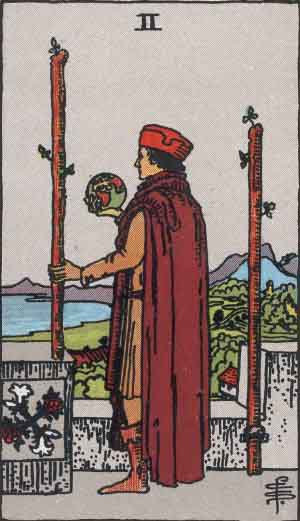
A figure holds the world while looking beyond the security of the wall. When the Two of Wands repeats, vision is already present, but movement remains negotiable. The question is what information, resource or decision is genuinely needed next, and what further planning is merely postponing contact with reality.
Core Repeating Message
The Two of Wands shows a figure standing at the top of a castle wall, gazing outward across the sea towards a clearly visible horizon. One wand rises from the stone behind them, already claimed and planted. The other is held in hand. In the other hand, a globe: the world already held, already being considered as something to move through and across. The image is not one of uncertainty about direction. Everything in it suggests that the direction is already known. What it presents is the moment between the claiming of established ground and movement outward towards what the horizon is showing.
When this card appears once, it may mark a juncture between established ground and possible expansion. When it appears repeatedly, it can describe a person who returns to the survey point: refining scenarios, preserving options or waiting for certainty without testing the direction through proportionate action.
One common pattern is the seeker whose planning has become a destination rather than a preparation. The vision is present. The desire to expand is felt. The direction is clear enough to describe. But between the act of planning and the first act of movement, hesitation takes hold, and planning keeps cycling as though one more iteration will produce the certainty required to begin. The plan becomes more detailed, more protected against feared outcomes. More planning continues to feel like progress while no actual departure occurs.
A second pattern belongs to the seeker who has already departed in imagination and who, on examination, finds that the imaginative departure has been substituting for the real one. They know in considerable detail where they are going and what arrival will look like. They can feel alive in the realm of possibility, and the vision carries a quality of warmth that the present moment does not match. The seeker has learned to sustain themselves on the rehearsal rather than on the actual work of moving towards what they have rehearsed.
A third pattern involves the seeker whose fire for expansion is genuine but who has developed a criterion of readiness that the present conditions never quite meet. The timing is not right: the finances are not yet secure enough, the responsibilities too pressing, the opportunity not perfectly aligned. The criterion shifts; what stays constant is that the moment of departure is never the current moment. The objection is always technically plausible, which makes it an effective protection against a commitment the seeker both desires and fears.
A fourth pattern belongs to the seeker for whom departure would mean leaving something behind: a relationship, a version of themselves, a belonging that the expanded future cannot accommodate. This seeker is not held at the threshold by absence of vision or absence of fire. They are paused at the point where what they are moving toward and what they would be moving away from have both become fully real, and holding both simultaneously is difficult. The wand planted in the wall behind them is as much a symbol of what has been built in relationship as of what has been built alone.
What all these patterns share is a relationship to commitment: holding the vision, desire and expanded possibility without yet taking an action that makes the direction part of present life. That action need not close off every other option to be real. The Two of Wands returns because the threshold is still occupied. The question it keeps asking is what, specifically, is keeping the seeker at the wall.
When This Card Repeats Weekly
A week of Two of Wands repetition highlights a current threshold: a plan may need a first test, a direction may need clearer criteria, or an option may need an explicit decision date. Do not manufacture urgency. Establish whether any deadline is real, who set it and what is lost by waiting compared with acting now.
The weekly repetition asks the seeker to be honest about what is happening between the awareness of the possibility and the action toward it. Is the plan being refined beyond what is needed? Is the available opportunity being kept at a safer distance than it actually warrants? What, specifically, would the next concrete step require, and what is stopping that step from being taken this week?
When This Card Repeats Monthly
A month of Two of Wands repetition suggests that the seeker’s characteristic posture at the threshold of expansion is becoming visible across multiple contexts, and the month is offering enough material to examine how the pattern operates.
The seeker who draws this card monthly is often in transition: no longer where they were, but not yet where they are going. The Two marks this in-between territory well. A month in it is not unusual; the question is whether the seeker is moving through it or building a residence at the threshold.
The monthly recurrence asks how many times this month an opening has appeared and been met with additional planning rather than initial movement. The preparation may sometimes be necessary; the card is asking the seeker to look honestly at the pattern beneath individual occasions and to notice whether preparation is serving departure or has become a substitute for it.
When This Card Repeats Seasonally
A season of Two of Wands energy marks a sustained period in which the seeker’s life is organised around an expansion that has not yet been fully committed to, and the season offers enough time to understand what the expansion requires and what is preventing movement towards it.
A Two of Wands season is rarely comfortable. The seeker is close enough to the next territory to feel its pull acutely, but the pull has not yet converted into forward movement, and the resulting quality is a particular restlessness: the aliveness of desire combined with the frustration of remaining at the threshold.
What the season asks is honesty about the form the hesitation is taking. Not the general category of fear or readiness, but the particular content: what action, what communication, what release would departure require, and which of these is the one the seeker has actually been avoiding?
The season also invites the seeker to examine what is being protected by remaining at the threshold, and whether that protection is worth the cost of continuing to stay. The vision has been held long enough now to have become familiar. The question the season is asking is whether familiarity with the vision has started to feel like enough.
When This Card Repeats Across Years
The Two of Wands returning across years can describe a long-running pattern: a seeker who has, across multiple versions of their life, approached the threshold of a larger territory, held the vision, and consistently found reasons to continue surveying rather than depart.
One possible origin is earlier experience in which initiative brought disappointment, disruption or disapproval. Where watchfulness once helped preserve safety, surveying may still feel safer than departure even after conditions have changed. Another is more practical: current obligations, limited resources or insufficient information may make caution appropriate. The long-cycle card asks the seeker to distinguish inherited expectations from present conditions rather than supplying a fixed explanation for the hesitation.
The long-cycle Two of Wands also belongs to seekers who have departed before and been hurt by what they found: who moved towards an expansion they wanted and found that the journey broke something they had not expected to lose. These seekers are not avoiding expansion out of timidity. They are protecting against a specific category of loss that departure has previously produced.
Across years, the growth arc this card traces is from sophisticated survey to departure: the seeker who develops the capacity to distinguish between preparation that serves movement and preparation that substitutes for it, and who begins to make concrete first commitments towards the life the horizon has been showing them.
Life Area Interpretations
Love & Relationships
In love and relationships, the Two of Wands most often marks the seeker whose desire for something larger or more alive in a current or potential connection has remained at the planning stage rather than being brought into actual expression.
This might be the seeker who has a clear sense of what they want from a relationship and has not yet stated that want clearly to the person involved. The desire is specific; the conversation has been rehearsed internally; the reason for continued silence is technically plausible, but the pattern of relational surveying rather than relational commitment is the Two of Wands signature.
The card may also mark the seeker who is ready for partnership but keeps approaching the territory of real relational commitment and surveying it from a careful distance. The desire is present. The vision of what partnership would look like is detailed. What is missing is commitment to the people and conditions of their present life, not the ideal version.
Career & Purpose
In career and purpose, the Two of Wands is among the most directly applicable cards in the suit. It can describe someone who holds both the desire for a larger vocational life and a specific view of what it might contain. Repetition often focuses attention on the threshold between potential and the committed movement that would test whether that potential is workable.
The plan exists. The direction is clear enough to describe in detail. What is not yet present is a concrete first action that converts the plan from possibility into process: the conversation that names the intention publicly, the launch that makes the direction concrete, the professional commitment that makes the vision something the seeker is actually living rather than perpetually approaching.
The card also marks the seeker on the cusp of vocational expansion who is treating the cusp as a sustainable position rather than a transitional moment. Cusps do not remain cusps indefinitely.
Money & Stability
In financial contexts, the Two of Wands most often marks the tension between the seeker’s desire to deploy their resources in service of a larger life and the characteristic pattern of treating resources as something to be secured rather than used.
The seeker may be unsure whether current resources support an initial step. Replace a global sense of insufficiency with figures: essential reserves, likely costs, downside limits and the smallest affordable test. Where the decision is material, qualified financial or legal advice may be more useful than symbolic interpretation.
The card also marks the seeker holding back their investment in their own creative or vocational vision, who has not yet invested the time, money or other resources that would signal commitment to the direction the card keeps pointing toward. The act of investing in the vision is often the concrete form in which commitment first shows up in financial life.
Spiritual Growth
In spiritual growth, the Two of Wands marks the seeker who has had an experience or recognition of a larger spiritual territory, a wider sense of what their spiritual life could hold, and who keeps returning to familiar ground rather than walking towards the expanded possibility the experience revealed.
The spiritual vision may be clear and specific: a practice, a path, a depth of engagement that the seeker has glimpsed and desires. What the card marks is the characteristic pattern of treating this vision as something to be periodically visited in imagination rather than committed to in daily life.
This card also marks the seeker at a spiritual threshold who is being called to deepen, to commit, to move past the comfortable surveying position of someone who reads about paths without walking one. The wand in the hand is the spiritual fire they carry. The globe is the larger spiritual territory available. The question is whether they will allow that territory to be more than something held in hand and gazed at.
Emotional & Mental Patterns
The Two of Wands in emotional and mental patterns marks a cognitive style: the seeker who processes potential futures with considerable detail and energy, who can feel alive in the realm of possibility, and who finds the actual commitment to one path significantly harder than the sustained engagement with multiple possible ones.
This seeker’s inner life is often rich with vision. Planning takes real mental effort. But the characteristic move away from committed choice and toward continued survey means that the richness of possibility in the inner life does not regularly become action in the outer one.
The emotional quality this card marks is a form of restlessness: not the generalised dissatisfaction of the disengaged, but the particular quality of aliveness without movement. The fire is present. The direction is visible. The gap between them is what produces the restlessness the seeker often describes as frustration or vague impatience without being able to name clearly what they are frustrated by.
Family & Generational Dynamics
In family dynamics, the Two of Wands can mark an inherited ambivalence about expansion and departure. Where forward movement was costly, through explicit discouragement or the implicit expectation that belonging required staying, departure may carry emotional weight beyond the practical demands of the expansion itself.
The seeker may find that their hesitation at the threshold carries a relational texture: the implicit sense that to go would be to leave, that departure means separation from people or ways of life that hold meaning. The threshold is not only vocational or creative; it is also relational, and the wand planted in the wall behind the figure is as much a symbol of what was built in relationship as of what was built alone.
The generational work the card marks is developing the capacity to expand without experiencing expansion as abandonment: to hold fire for a larger life alongside care for what was built before.
Health & Energy
In health contexts, the Two of Wands may symbolically reflect the felt tension of being poised for change while practical movement remains limited. A person can feel neither fully at rest nor engaged in the action they are preparing for. That experience does not establish a physiological cause for tension, fatigue or restlessness, and tarot should not be used to diagnose a condition.
If the effort of staying ready feels tiring, consider whether one reversible administrative step would reduce uncertainty, or whether the responsible action is rest, further information or professional support. Persistent pain, distress, sleep disruption or changes in functioning deserve appropriate assessment.
A small experiment may clarify whether movement brings relief, pressure or no meaningful change. Treat that response as personal feedback, not proof of the card’s explanation, and keep the experiment safe, limited and reversible.
Advanced Interpretive Sections
The Shadow Expression
The Two of Wands in shadow produces the seeker who has become so sophisticated at planning and surveying that they have lost touch with the felt sense of departure. The planning is detailed and intelligent. And it has become, over time, a complete substitute for the action it was originally supposed to produce.
This seeker may present as someone consistently on the cusp of something significant. They carry a sense of potential that feels real, because the vision and the fire are real. But the consistent absence of movement eventually creates a visible gap between the presentation of potential and any actual development.
The shadow also produces the seeker who has become angry with the gap itself, frustrated by remaining at the threshold but directing that frustration entirely towards external conditions. In this form, they have not yet examined how their own shifting criteria may keep those conditions from ever being enough.
The Integrated Expression
The integrated Two of Wands seeker has developed the capacity to move from survey to departure: to use preparation as what it actually is, a precursor to movement, and then to convert that preparation into a concrete first step towards the expanded life the horizon shows them.
Their planning serves movement rather than replacing it. They can hold a vision in detail without mistaking the vision for the destination. They have developed tolerance for the uncertainty that departure requires: taking a considered step before every condition is optimal, rather than waiting for a perfection the pattern keeps postponing.
They are recognisable by initiative visible in their life. Plans have become arrivals. The world is still in hand, but the journey has begun.
Why This Energy Has Not Released Yet
The Two of Wands pattern can persist when the seeker has not yet honestly distinguished between genuine preparation and the form of preparation that has become a destination in itself. Without this distinction, every additional round of planning feels like legitimate progress rather than a repetition of the pattern.
The pattern can also persist when the seeker has not yet been able to honestly acknowledge what departure would require them to leave behind. Expansion does not require the destruction of what has been built. But it does require some letting go, and until the seeker has been honest about what that means in their life, the threshold will continue to feel safer than the journey.
Finally, the pattern persists when the seeker has not yet fully reckoned with the cost of sustained staying. The planning position can be comfortable: it maintains the aliveness of possibility without the exposure of commitment. But sustained threshold-standing also carries its own cost, and the seeker who has not yet named that cost honestly may struggle to find the motivation to move.
What This Card Wants the Seeker to Understand
The Two of Wands wants the seeker to understand that the world they are holding is not the destination. It is showing them where they need to go. The wand behind them is already planted; that ground is already theirs. What the card is asking for is not the abandonment of what has been built but the willingness to allow the building to continue beyond the current wall.
A returning vision may carry the fire of a meaningful direction, and holding that direction for a long time without moving towards it can become a particular kind of weight. The card is not asking the seeker to leap or to assume the vision is workable simply because it returns. It asks for the next concrete step that would bring the possibility into contact with life, rather than leaving it perpetually planned.
Signs the Pattern Is Beginning to Resolve
The Two of Wands pattern begins to resolve when the seeker makes a concrete first commitment towards the expanded life the card has been pointing at: not the finalisation of the plan, but the step that makes the plan something they are actually living rather than something they are holding.
It can also begin to resolve when the seeker notices a bodily difference between continued planning and actual movement. A first step may bring an aliveness, relief or motivation that further preparation did not provide. The useful sign is a change they can observe, rather than an assumption that every departure will feel better.
And it resolves when the seeker begins to identify what specifically they are protecting at the threshold and can engage with that protection directly rather than through the pattern of sustained survey.
Reflective Questions
-
What is the most specific version of the expansion this card has been pointing toward? Not the general category but the particular direction: where, into what, toward what? Can you name it plainly and without hedging?
-
When did you last take a concrete step toward this expansion rather than a planning or preparation step? What was it, and what happened after?
-
What would the next concrete step actually require of you? Not theoretically but in the specific terms of your current life: what action, what communication, what release?
-
What have you learned from prior experiences of departure that informs how you currently stand at this threshold? Have you been hurt by expansion before, and in what specific way?
-
Is there something or someone you are protecting by remaining at the threshold? Is that protection serving what or who you are protecting, or has it become a pattern that no longer matches the actual current situation?
-
What does further planning give you that departure does not? Be honest about the specific quality of the planning position: what comfort, what sense of control, what safety does it provide?
-
What would you need to know or have before you could take the next real step? Is this requirement essential, or is it a standard of certainty that no practical first step could meet?
-
When you imagine having departed towards the expanded life this card keeps showing you, what is the predominant feeling? And when you imagine remaining at the threshold indefinitely, what is that feeling?
-
What did your early experience of departure teach you about what happens when people go? Were departures in your family associated with loss, disruption, or consequence in ways that have stayed with you?
-
If the Two of Wands has been appearing for a sustained period, what expansion has it brought to your attention, and what has been consistently preventing you from committing to it?
Practical Integration Actions
Name the departure plainly. Write a specific, unhedged statement of what the expanded life looks like: not the general category of wanting more but the particular direction and form. Write it in the present tense as though it has already become real: not “I want to” but “I am moving toward X and it looks like Y.” The exercise is not a commitment to any particular timeline; it is the practice of knowing what you are pointing towards.
Identify the next irreversible step. Separate, in writing, further planning from an action that, once completed, would make the direction part of your present life. Irreversible here means that the action will have happened and brought experience that planning alone cannot provide, not that you must make your future difficult to change. Prefer a bounded, reversible commitment where possible: a pilot, enquiry, application, trial conversation or costed prototype. Name the step precisely enough to take it this week if you choose, what you expect to learn and the conditions under which you would pause, continue or change course.
Examine the readiness criterion. Write down the specific conditions you are currently treating as necessary before departure can begin. For each condition, ask honestly: is this necessary, or is it a standard of certainty that has been raised repeatedly as previous conditions were met? The exercise is not to force premature action but to distinguish between genuine prerequisite and sophisticated deferral.
Write about what you are protecting. Spend time writing honestly about what staying at the threshold is protecting: what relationship, what identity, what comfort, what form of safety. The protection may be genuine and may deserve acknowledgement before it is asked to shift. The exercise is not to dismiss the protection but to see it clearly enough to make a considered choice about whether it is still serving you.
Take one step that cannot be untaken. Choose one safe first action you have identified, give it a clear limit and complete it before this week ends where that is feasible and safe. If conditions require postponement, set an explicit review date rather than leaving the step indefinitely open. Once taken, the step becomes part of your experience rather than remaining in a planning document; this does not require a large action or a decision that is costly to reverse. Notice what happens in your body, and record the practical result, including any evidence against the preferred direction. Let commitment mean meeting reality and using what you learn, with room to pause or change course.