
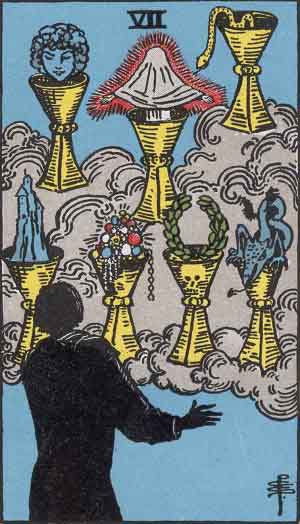
Seven cups in the clouds, each holding a different vision. The question this card keeps returning to ask is what keeps the seeker in the clouds, and what would allow them to step down and drink from one.
Core Repeating Message
The Seven of Cups shows seven cups floating in clouds, each containing a different image: a castle, a wreath of victory, a figure shrouded in cloth, a serpent, a dragon, gems, and the head of a person. Some of these images are clearly desirable; others are clearly dangerous; some are ambiguous enough that their nature depends entirely on what the viewer brings to them. The cups are not resting on any surface. Nothing in this image is grounded. Everything is available in imagination, and nothing has been concretely chosen.
The Seven of Cups is concerned with imagination, projection, desire, and the proliferation of possibilities until choice becomes difficult. The seeker can see every cup but has not yet tested any of them against lived reality. Sometimes this reflects avoidance; sometimes it reflects inadequate information, competing obligations, or a genuine period of exploration. The card asks which condition is actually present.
When the Seven of Cups appears once, it can reflect choice overload, imaginative expansion, uncertain desire, or the tendency to interpret a situation through hope or fear. When it appears repeatedly, it brings the seeker’s decision process into focus: how options are evaluated, where evidence is missing, and whether possibility is supporting discernment or replacing action.
The most common pattern is the seeker who lives primarily in possibility. The interior landscape is genuinely rich: vivid imagination, creative or emotional aliveness, capacity for vision, genuine desire. But the relationship between this interior wealth and concrete action in the world has not been developed. Plans are made and revised before they are executed. Relationships are imagined before they are genuinely encountered. Creative projects exist in their ideal form in the seeker’s mind, and moving them into the inevitable imperfection of actual form feels like a reduction rather than a realisation.
A second pattern is projection. A potential partner may carry the seeker’s hopes or fears before enough is known about their character. An opportunity may be treated as rescue or disaster before its terms have been checked. Strong feeling is still real feeling, but it is not the same as reliable information about another person or a future outcome. The Seven of Cups asks the seeker to separate observation, interpretation, desire, and fear.
A third pattern is the seeker who uses fantasy as a primary emotional resource. The interior life of vivid imagination, of elaborate envisioned futures, of sustained emotional engagement with people and situations that do not yet and may never exist, is genuinely nourishing in a way that present-tense actuality is not. The cups in the clouds are more satisfying than the single cup on the table, because they can be shaped by the imagination in ways that the actual cup cannot.
A fourth pattern is honest uncertainty about what is wanted. Several options may express different values, responsibilities, fears, and stages of life, with no single desire entitled to be called the deepest one. The task is not to force inner unity but to identify criteria, trade-offs, and time horizons clearly enough to make a provisional choice or to decide what information must be gathered first.
Whatever the form, the card asks the seeker to bring imagination into contact with life. Not every cup needs to be chosen; some of the visions in the seven cups are genuinely not what the seeker actually wants. But possibility becomes lived experience through a cup chosen, grasped and committed to, its contents actually drunk rather than endlessly imagined.
When This Card Repeats Weekly
When the Seven of Cups repeats within a week, the seeker may be facing too many options, unclear criteria, persuasive promises, or strong feelings that make comparison difficult. The immediate task is to reduce noise and establish what can be verified before treating urgency as clarity.
If a decision is required, each option may carry both benefit and cost. The card does not demand a choice before essential information is available, and delay may be responsible where safety, money, consent, legal terms, or other people are involved. It asks whether continued thinking is producing new evidence and clearer criteria, or simply repeating the same loop.
The weekly repetition might also mark a week of specific projection onto a person or situation: seeing what the seeker needs to see rather than what is genuinely there. This is uncomfortable to acknowledge but genuinely useful to notice: what specifically is being projected, what need is generating the projection, and what would genuine attention to the actual person or situation reveal?
When This Card Repeats Monthly
A month of Seven of Cups repetition suggests that a pattern of living in possibility rather than actuality, or of difficulty with concrete choice, has stabilised as the month’s dominant emotional experience.
The monthly framing asks the seeker to look at what has not been chosen or acted on across the month: what visions have been entertained, what plans have been made and revised, what genuine opportunities have been met with continued deliberation rather than genuine commitment. Not as self-criticism but as honest inventory. What is the actual cost of the cups remaining in the clouds?
The monthly repetition may also be marking a period of creative gestation: a time when multiple possibilities are developing and the right moment for commitment has not yet arrived. In this case, the card is more about discernment than urgency, asking the seeker to distinguish genuine gestation from habitual postponement.
When This Card Repeats Seasonally
A season of Seven of Cups appearances can mark a sustained period of working through the seeker’s relationship to imagination, projection and choice. This is significant material and worth a season of attention.
The seeker may be engaged in discernment: sorting through competing desires, exploring what they actually want versus what they have been taught to want, developing a clearer interior compass for the first time. This is valuable work, and the Seven of Cups across a season can mark progress towards clarity, even when that clarity arrives slowly.
A season without concrete choice or action is a reason to examine what is holding the cups in the clouds, rather than proof of avoidance. If possibility has become a substitute for engagement, that pattern needs to be honestly named and examined.
When This Card Repeats Across Years
The Seven of Cups returning across years or major life phases can describe a seeker for whom the gap between imagination and reality, between possibility and genuine commitment, is a deep structural feature of their life. Year after year, the cups float. Year after year, the choice that would ground one of them into actual life does not quite occur.
This long-arc pattern often belongs to seekers who have an understandable difficulty with commitment and its consequences. To drink from one cup is to acknowledge that the other cups cannot all receive the same time and attention. This can carry a particular kind of grief, the grief of the unchosen possibilities, that some seekers cannot yet make their peace with. The seven cups floating remain available in imagination as long as none is grasped; commitment gives time and attention to one path at the cost of others. Some alternatives may close permanently, while others can be revisited, but even a provisional choice can involve a real loss.
Across years, the growth this card asks for is clarity about desire and competing values, the courage to commit to imperfect actuality, and peace with the losses that a chosen commitment entails.
Life Area Interpretations
Love & Relationships
In love and relationships, the Seven of Cups most often marks the seeker who projects onto potential or actual partners rather than genuinely encountering the actual person. The person in front of them becomes a vessel for the seeker’s strongest wishes or strongest fears: either the ideal who will provide everything finally and completely, or the threat who will produce the most dreaded outcome, and in both cases the actual person is somewhat beside the point.
The card may also mark the seeker who keeps encountering new connections but cannot commit to any of them: who experiences genuine initial feeling and then, as the relationship takes on the particular shape and imperfection of intimacy, begins to sense that this particular cup is not the right one and orients towards the next available possibility. The cups continue to float; the seeker never quite lands in a relationship with the particular, imperfect person who is actually there.
The Seven of Cups also marks the seeker who is romanticising a relationship rather than genuinely engaging with it: experiencing the relationship primarily in terms of what it represents symbolically, or what it confirms about the seeker’s hopes, rather than what it actually is in its daily reality.
Career & Purpose
In career and purpose, the Seven of Cups marks the seeker who has genuine creative or vocational vision but a consistent difficulty translating vision into actual form. The projects exist in a state of vivid imaginative possibility; bringing them into imperfect form, with the disappointment that can entail, is perpetually deferred.
The card may also mark the seeker who is unclear about their vocational direction: who has multiple genuine interests and capacities, and multiple plausible paths, but cannot orient towards any one of them with enough commitment to begin building momentum.
Genuine vocational discernment, as distinct from indefinite postponement, requires the willingness to act on a provisional commitment: to choose, not with certainty that this is the only right path, but with enough conviction to begin, and to allow the beginning itself to generate the information that further choice requires.
Money & Stability
In money and stability, the Seven of Cups warns against evaluating an investment, opportunity, loan, or strategy mainly through the future it promises. Attractive presentation, urgency, social proof, and relief from current pressure can all distort judgement. The grounded response is due diligence: verify terms and fees, compare alternatives, test assumptions, and obtain qualified advice before committing money that cannot safely be lost.
The card can also highlight difficulty accepting the ordinary constraints of financial stability: a budget, incremental saving, debt repayment, or a plan that develops slowly. Yet it should not reduce structural hardship to poor commitment. Where income is inadequate or obligations are unmanageable, realistic support and advocacy matter alongside any examination of choice.
Spiritual Growth
In spiritual growth, the Seven of Cups can describe the seeker who collects spiritual experiences and frameworks without staying with any practice deeply enough for it to shape their life. Every cup in the cloud holds a different spiritual possibility: each one is attractive, and the seeker moves from one to another with genuine enthusiasm and initial feeling, without staying long enough for depth to develop.
Spiritual growth asks the seeker to give a chosen practice time to do its work; this need not mean exclusive commitment to one tradition. The seven cups floating in the clouds represent spiritual possibility; the work of the Seven of Cups is the willingness to come down from the clouds and drink from one cup with sustained attention.
Emotional & Mental Patterns
In emotional and mental patterns, the Seven of Cups can describe feelings that become most vivid around imagined futures, possible relationships, or rehearsed outcomes. Present experience may seem quieter or harder to read by comparison. This is not evidence of delusion or a mental health condition. It is a prompt to notice how imagination, uncertainty, and attention are interacting.
This is not a deficit of genuine feeling; the seeker is often richly emotional. Feeling is directed chiefly into imagination: it is most vivid when envisioning possibilities rather than engaging with what is present. This produces a particular kind of emotional life: intense, vivid, private, and somewhat disconnected from the actual circumstances of the seeker’s current life.
Family & Generational Dynamics
In family dynamics, the Seven of Cups may reflect the use of imagination, stories, future plans, or private interests as refuge when family life felt constrained, unpredictable, or emotionally thin. That possibility should not be treated as a recovered childhood fact. The seeker can honour imagination as an adaptive resource while examining whether current conditions still require the same degree of retreat.
Where imagination became a refuge, this capacity for rich interior life remains genuinely valuable in adulthood. The difficulty can arise when it continues to operate as a primary resource rather than as one among several: when the seven cups in the clouds are more real than the single cup on the table because the table was not consistently reliable and the clouds never disappointed.
Health & Energy
In health and energy readings, the Seven of Cups can mirror mental overload, scattered attention, difficulty settling on the next task, or a felt sense of being ungrounded. These experiences have many possible causes, and the card cannot explain confusion, brain fog, dizziness, sleep disruption, or other symptoms. New, persistent, or concerning changes need appropriate assessment.
The symbolic integration is concrete orientation: one task, one verified fact, one sensory point of contact, one pause before another option is added. Such practices may help the seeker organise attention, but they are not treatment and need not replace rest, practical accommodation, or professional care. Grounding here means returning choice to observable reality.
Advanced Interpretive Sections
The Shadow Expression
The Seven of Cups in shadow depicts the seeker who has made fantasy itself the primary emotional reality: who lives so thoroughly in the interior world of imagination and projection that the actual world becomes somewhat peripheral. Relationships, work, creative projects, and spiritual life are all experienced primarily through the screen of what the seeker needs them to be, and genuine contact with actual reality is progressively reduced.
A second shadow is the seeker who uses the proliferation of possibilities as a structural means of avoiding genuine commitment and genuine accountability. If nothing is ever quite fully chosen, nothing can be fully failed. The seven cups protect against the specific vulnerability of genuine investment in one thing.
The Integrated Expression
The integrated Seven of Cups seeker has developed a rich relationship between imagination and concrete life. They can envision, they can dream, they can hold multiple possibilities with genuine openness, and they can also come down from the clouds and choose with commitment, knowing that the choice is genuine rather than certain and that engagement with the chosen cup will reveal its real contents.
This seeker can also project less: they have developed enough curiosity about actual people and situations to approach them with genuine attention rather than the screen of need and fear. They are interested in what is actually there.
Why This Energy Has Not Released Yet
The Seven of Cups pattern may persist because choosing one direction means accepting the opportunity cost of the others. That loss can be real, especially when options concern identity, care, livelihood, or belonging. It may also persist because the options are not equally safe or viable. Discernment includes grieving what will not be chosen and refusing the fiction that every displayed cup is genuinely available.
The pattern also persists when the seeker’s desires are not yet clear enough to orient towards with conviction. In this case, the work is not choosing faster but the sometimes slow work of discernment: coming to know what is actually wanted, how competing values matter, and where surface wishes, protective deflections or others’ expectations are shaping the choice.
What This Card Wants the Seeker to Understand
The Seven of Cups wants the seeker to understand that genuine choosing is not the enemy of possibility. It is how possibility becomes lived experience. The cup chosen and actually drunk reveals its contents in ways that the cup imagined in the clouds never can.
The card asks the seeker to test a persistent option against evidence rather than treating attraction or resistance as a verdict. A cup may be promising, unsuitable, unsafe, or simply not ready to choose. Small, reversible experiments can reveal more than fantasy where experimentation is appropriate; high-stakes decisions still require full due diligence, consent, and attention to consequences.
Signs the Pattern Is Beginning to Resolve
The Seven of Cups pattern begins to resolve when the seeker begins to distinguish between what they genuinely desire and what they are projecting: when they can notice the difference between seeing what is actually there and seeing what they need to be there. This discernment, even imperfect, signals genuine movement.
It also resolves when the seeker takes genuine committed action in a domain that has been held in possibility: begins the project, enters the relationship with genuine presence, commits to the practice, makes the concrete financial or vocational choice. The action does not need to be irreversible; it needs to be genuine. And it resolves when the seeker can be genuinely present to what is actually in front of them without needing to make it into something else.
Reflective Questions
-
What is the most persistent vision in your internal clouds right now: the thing you most often imagine, plan for, long for, or project onto? How long has it been floating there?
-
In your most significant current relationship or desired relationship, how much of what you feel is directed at the actual person, and how much is directed at who you need or fear them to be?
-
What would it specifically cost you to fully choose one of the cups: to commit genuinely and concretely to one direction, relationship, or creative project? What would you be foreclosing?
-
Is there a project, relationship, or life direction that you have been planning and revisiting for more than a year without genuinely beginning? What is the honest reason it has remained in the planning stage?
-
Where in your life do you most readily access genuine feeling: in imagination, or in genuine present-tense engagement? What does this tell you about where your emotional life is most fully alive?
-
What specifically do you imagine as the consequence of genuine commitment, the thing you are most protecting against by keeping the cups in the clouds?
-
When have you made a genuine choice in the past and committed to it? What happened? What was it like to discover what that cup actually contained?
-
Are there any visions in your clouds that you genuinely know, on honest examination, do not belong to your genuine desire but to someone else’s expectation of you or to a former version of yourself?
-
What is your relationship to uncertainty: to the genuine unknowing of what a chosen cup will contain? Is this uncertainty something you can work with, or does it consistently prevent genuine commitment?
-
If you were to bring one of the floating cups down from the clouds and commit to it genuinely, right now, with full acknowledgement that it is imperfect and its contents uncertain, which one would it be?
Practical Integration Actions
Name what you actually want. Spend thirty minutes writing about what you genuinely want in the domain of your life where the Seven of Cups is most active: not what you think you should want, not all the possible things, but what you most honestly and specifically desire. If several desires compete, name what matters in each. Write towards precision. Genuine desire, named specifically enough, becomes actionable in ways that vague longing cannot be.
Notice your projections in real time. For two weeks, practise genuine curiosity about actual people and situations by regularly asking yourself: “What am I actually seeing here, and what am I adding?” Not harshly; projection is part of human perception. But developing the habit of distinguishing observation from interpretation is one of the most direct practices available for the Seven of Cups pattern.
Make one genuine beginning. Choose one possibility that has remained in imagination and identify a small, reversible way to gather real information: draft a page, request written terms, attend an introductory session, or ask a bounded question. Do not use experimentation to bypass consent, safety checks, or financial limits. The purpose is evidence, not forced commitment.
Practise staying with what is. Once a day, for two weeks, spend five minutes of genuine present-tense attention on what is actually in front of you: the actual relationship, the actual work, the actual body, the actual day. Without comparing it to imagination, without planning beyond it, without projecting onto it. Simply be with what is actually there, and notice what genuine presence to the actual reveals that imaginative engagement with the possible cannot.
Acknowledge the foreclosed. Write briefly about what you are releasing by choosing one cup: the other possibilities you will set aside or let go of if you commit to this one. Do this with genuine acknowledgement of loss rather than with the pretence that commitment costs nothing. Making the unchosen conscious can help you commit wholeheartedly to the chosen.