
Low light can magnify what is imagined and obscure what is real. The Moon asks for curiosity, evidence, and enough safety to tell the difference.
Core Repeating Message
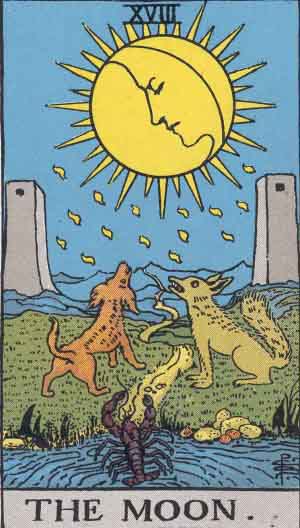
The Moon dominates a blue sky above a landscape of extraordinary symbolic density. Below her, a pool, from which a crayfish or lobster appears to be emerging toward the land. On the land, two animals, a dog and a wolf, raise their heads to the moon as though howling. Between them, a path winds through the landscape toward two towers in the distance, between which it continues toward the hills and out of view. The great moon draws the scene into the symbolic half-light associated with this card. Read as a moonlit landscape, it suggests a light that is beautiful and unreliable: it illuminates the shapes of things without making their nature clear, makes the familiar strange and the strange familiar, and gives just enough light to see that something is there while leaving its meaning uncertain.
The Moon does not produce its own light. It reflects the light of a source that is not present in this image. This gives the card a psychologically suggestive metaphor: what illuminates the Moon’s landscape is borrowed, indirect, sufficient to see by but not sufficient to see clearly by. The seeker moving through this landscape is not in complete darkness, but they are not in full clarity either. They are in the half-light that can represent the territory of the unconscious: where feelings are real but their causes may not be clear, where the shapes that appear may or may not correspond to what is actually there, where even the imagined howling and rustling at the edge of the path leave room for more than one interpretation.
When The Moon appears repeatedly, one useful question is: what in this person’s inner life is asking for attention, and what would make it safe and useful to explore?
The crayfish, that strange and ancient creature, appears at the water’s edge. It has not yet arrived on the land. In a symbolic reading, it occupies the liminal zone between the deep pool, the unconscious, the dark interior waters where ordinary daylight does not reach, and the land, the waking consciousness where things can be named and considered. The card’s recurring question can concern what is approaching awareness, or what makes that approach difficult. The image need not become a demand to bring everything in the pool onto land.
The Moon’s territory is the territory of the unconscious in a psychological reading: the aspects of inner life that are not directly available to waking awareness but may influence perceptions, emotional responses, relationships, dreams and fears, including currents of experience that don’t quite make sense in ordinary daylight. The unconscious is not an enemy. It is not inherently pathological. Habits, associations and expectations can shape experience before they are recognised, and noticing them may create room for choice. The card offers a language for considering these influences while their particular sources remain open questions.
There are several primary patterns through which this card’s repeated appearance can be explored.
The first is the dream-haunted seeker: the person whose dream life is unusually vivid, persistent or emotionally significant, and who has not yet found a way to relate to this dimension of their experience. A dream can feel as though something is pressing at the threshold between sleep and waking life, wanting to be known, without being a coded message or a record of hidden events. This seeker may remember dreams vividly, find that particular images persist in waking consciousness, or be woken by dreams that disturb or move them in ways they cannot readily explain. The card’s invitation is to attend, if that feels helpful, to personal associations and recurring feelings rather than to interpret through a fixed symbolic dictionary. Curiosity can coexist with uncertainty about why a dream occurred.
The second is the fear-pattern seeker: the person whose emotional life is significantly shaped by fears, anxieties or a quality of dread whose relationship to current danger is unclear. The fears feel real, and they have real effects on behaviour, choices and daily experience. Sometimes they reflect earlier learning, something from the pool that has not yet been clearly seen; sometimes they register present threats that deserve practical attention. The card appearing here is not asking the seeker to dismiss the fear or simply decide to feel less afraid. It invites curiosity about what the fear is tracking: what is happening now, what evidence is available, and what in the history, the inheritance or the deeper interior might also be contributing?
The third is the projection-active seeker: the person considering whether perceptions of other people, situations or recurring patterns are being coloured by feelings and expectations they have not yet recognised as their own. They may see threatening qualities in people who may or may not be threatening. A situation may feel more dangerous, unstable or significant than the available evidence suggests, or provoke a strong response whose sources are not yet clear. The Moon appearing repeatedly can invite examination of what the seeker brings to these perceptions, without denying the qualities of others or the facts of a situation. The distinction between perception and projection emerges through observation, reflection and safe checks, not by assuming that a strong feeling must have come from the pool.
The fourth is the psychically sensitive seeker: the person who understands their unusual receptivity in spiritual terms, who notices emotional atmospheres in rooms and relationships before these are openly discussed, and who is strongly affected by the moods of people around them. They may experience strong intuitive responses whose relationship to observable cues, personal history and projection is difficult to untangle. The Moon appearing repeatedly need not invalidate the meaning this sensitivity holds for them. It invites greater skill in discernment: noticing what was observed, what was inferred and what remains unknown, while leaving other people’s private experience theirs to describe. A felt sense may prompt attention; its intensity alone cannot establish its accuracy.
The fifth is the cycle-captive seeker: the person whose emotional, relational or practical life follows patterns that repeat across time, raising questions about influences they have not fully identified. Relationships reach a familiar ending with different people. The same kind of professional impasse returns. Emotional crises take a recognisable shape across changing circumstances. The Moon can invite enough attention to begin exploring the pattern: what belief, old hurt, inherited template or unresolved feeling might be involved, and what external conditions or other people’s conduct keep recurring? Similar outcomes do not prove an unconscious organising cause, but looking at both inner responses and outer circumstances may reveal choices, constraints or support needs that were previously difficult to see.
Eighteen reduces to nine (one plus eight), and nine is the Hermit: the lamp held aloft in the darkness, the wisdom of interior encounter, the light that the seeker carries for themselves. This is a numerological relationship, not the cards’ order in the deck. Read alongside the Hermit, The Moon’s uncertain, shadow-haunted, intuitively lit landscape offers a contrast to that hard-won clarity. The winding path can suggest patient movement toward deeper self-knowledge, without promising a particular destination or making the Moon’s terrain an ordeal that everyone must complete. The connection is an invitation to reflect on how a light of one’s own develops while much remains unknown.
For the seeker who keeps drawing this card, the work may be the development of a patient relationship with the less conscious dimensions of experience: neither the elimination of every shadow nor the colonisation of the unconscious by a rational mind that demands an immediate explanation for everything. It is the ongoing practice of meeting oneself where the pool meets the land, where the crayfish appears at the edge, where a feeling or pattern may be becoming easier to name. What can be explored, and how far, depends on the seeker and the conditions of their life, rather than on a requirement to complete the image’s symbolic journey.
When This Card Repeats Weekly
The Moon appearing multiple times in a single week can provide a focus for a period of heightened inner activity: a feeling, dream or uncertainty may seem particularly pressing, asking for attention in the midst of ordinary life. The reading offers a way to notice what repeats and what helps it become more intelligible, without turning that attention into an urgent demand.
This may correspond to a vivid or persistent dream period: the seeker is dreaming more intensely than usual, particular images recur across the week, or the dreams feel unusually significant or disturbing. The weekly appearance can invite curiosity about personal associations, perhaps by recording a few images or noticing their emotional texture. Such attention is useful only if it supports rather than disrupts sleep and daily life; images may be meaningful without having a single message to decode.
It may also correspond to a week of heightened psychic or intuitive sensitivity as the seeker understands it: they notice more than usual, feel more easily moved, or experience their surroundings and relationships with unusual rawness. This is recognisable Moon territory, and the weekly reading can invite them to honour that experience without assuming that every impression is accurate. Rest, boundaries and space from an overwhelming atmosphere may help them distinguish what they have observed from what they have inferred, and their own feelings from the responsibility they feel for others.
The Moon in a week may also invite reflection when a familiar pattern becomes difficult to ignore: a strong emotional reaction whose relation to the situation is unclear, a fear that has arisen with unusual intensity, a relational dynamic that is recognisably familiar in a way that prompts the question of where this territory has been encountered before.
When This Card Repeats Monthly
A Moon month can describe a sustained period of interior attention that the ordinary pace of life seldom allows: an emotion or pattern seems to be approaching the edge of the pool, and the seeker is taking time to understand it. The month gives the reading a frame for reflection, rather than a timetable in which something hidden must reach consciousness.
This may be a month of unusual emotional richness and difficulty: the seeker feels closer to their interior life, more affected by feelings they cannot yet place, and correspondingly unsettled by what they encounter. Repeated appearances of the card can invite a review of what support is available: a therapeutic relationship where appropriate, creative practice, trusted connection, or another form of engagement that helps them navigate the terrain. If exploration becomes destabilising, slowing down or stopping is a legitimate response. Support should make room for ordinary life and present safety as well as for what seems to be emerging.
A monthly Moon pattern may also resonate with a recurring emotional season: a periodic encounter with familiar interior territory whose causes are not yet fully understood. The seeker can notice what changes from month to month, including circumstances, demands and available support, alongside the feelings that recur. Integration may be part of that exploration, but repetition alone does not show that earlier work was incomplete or that a cycle will end once the right insight is found.
When This Card Repeats Seasonally
A season of Moon energy can be read as a demanding developmental period: a sustained encounter with the less conscious dimensions of experience that may change how the seeker relates to their own interior. Its significance is personal: in what becomes easier to name, what remains difficult, and what kind of attention the seeker can sustain.
Seasonal Moon appearances may resonate when the ordinary pace of busyness, activity, social engagement or professional focus has slowed, through circumstance or choice, and previously overlooked feelings have become more noticeable. Some of that activity may have served as a defence against discomfort; some may have been necessary work, pleasure or connection. In the card’s imagery, this can feel like a season at the pool’s edge, with time to consider what is present without deciding in advance that something hidden must emerge.
A Moon season can invite engagement beyond the familiar comfort of ordinary self-awareness. There is a difference between revisiting an explanation one already knows and wondering about an older pattern, an inherited assumption, an unfelt emotion or an experience not yet understood. That wondering need not become a search for buried events. The seeker can work with what is actually remembered or felt, keep interpretations provisional, and choose the pace and degree of contact that their circumstances can support.
When This Card Repeats Across Years
The Moon appearing across years can become a symbol for a sustained, deepening relationship with the unconscious dimensions of experience, a recurring life theme explored between the pool and the path. At different times, that relationship may feel liberating, difficult or simply unfinished, reflecting the changing life around the inner work as well as the work itself.
Some seekers who recognise this long-arc pattern have rich interior lives: vivid dreams, strong intuitive responses, intense emotions, and sensitivity to relational and environmental atmosphere. That richness can be a gift and a source of difficulty, particularly when impressions arrive more quickly than they can be understood. Learning to navigate it may bring greater groundedness: noticing a feeling without immediately explaining it, distinguishing an observation from an assumption, and returning to everyday relationships and responsibilities when inward attention becomes too absorbing.
The long-arc Moon pattern may be meaningful to seekers engaged in depth work across years: sustained therapy, creative work that draws on dreams and associations, spiritual practice concerned with the deeper interior, or patient attention to longstanding hurts. The card’s return can offer an occasion to reflect on that work and its pace; it cannot confirm that healing is underway or that a particular method is helping. The relevant questions concern lived changes, the quality of support and whether the process remains useful, rather than how quickly a symbolic resolution can be achieved.
Across years, one growth arc The Moon can illuminate is movement from overwhelm toward navigation. At first, a seeker may feel strongly affected by emotions they cannot identify, subject to patterns they cannot fully see, carried by currents that seem outside their control. With time and suitable support, they may become more practised at distinguishing interior from exterior, projection from perception, an intuitive impression from an anxiety-shaped story. Later they may find greater familiarity with their own depths: not mastery over the unconscious, but more comfort with not-knowing and more capacity to navigate by partial light without losing self-direction. The movement can be uneven, and renewed uncertainty does not cancel what has been learned.
Life Area Interpretations
Love & Relationships
In love and relationships, The Moon’s repetition can invite reflection on the less conscious influences in relational life: inherited expectations of how relationships work, earlier emotional experiences that colour the current one, or projections that make it harder to distinguish an impression from what is happening between two people. The Moon’s indirect light gives these uncertainties an image; the relationship itself supplies the evidence with which to examine them.
One relational Moon pattern is the seeker who cannot quite trust what they see in their significant relationships: who wonders whether their perceptions of the people they love are accurate or partly shaped by what they bring to the encounter. The dog and the wolf turn towards the same moon, yet offer different images of instinct and familiarity. The seeker may oscillate between positive and negative views of a partner without knowing how those shifts relate to the partner’s actual conduct. Discernment calls for attention to both: what was said or done, and what memories, expectations or fears influenced its meaning. Where safe, direct conversation can clarify an uncertainty; where conduct is harmful, reflection on projection must not replace boundaries or support.
A second pattern is the relational cycle: the seeker who keeps finding themselves in the same relational dynamic with different partners, who keeps arriving at the same relational impasse, who keeps experiencing the same quality of relational difficulty that seems to persist regardless of the specific person involved. The cycle is a recognisable Moon theme, and the card can invite examination of both inner patterns and recurring circumstances: expectations, choices, available options and other people’s behaviour. Understanding one’s part can support agency without making a seeker responsible for another person’s harmful conduct.
The Moon in relational contexts can also mark a seeker who is highly attentive to tone, expression, silence, and shifts in relational atmosphere. This sensitivity may register observable cues, but any conclusion drawn from them remains an inference rather than psychic certainty. Discernment means checking assumptions through direct communication where safe, respecting privacy, and separating the partner’s stated experience from the seeker’s own response.
Career & Purpose
In career and purpose, The Moon’s repeated appearance can focus attention on fears, anxieties or less conscious patterns that are difficult to separate from the facts of professional life. The question is how these influences interact with actual capability, working conditions and the opportunities or constraints the seeker faces.
One professional Moon pattern is the impostor experience: the persistent, sometimes severe sense that the seeker does not belong in the professional space they occupy, that their credentials are somehow fraudulent, that they will eventually be discovered to be less competent or less legitimate than they appear. The feeling and the evidence may tell different stories, but the discrepancy needs examination rather than a verdict from the card. Work completed, feedback, role expectations and access to support can help the seeker assess their capacity alongside any real gaps or exclusion they face. The experience can still limit professional behaviour, even when there is strong evidence of competence, and deserves attention without being treated as either proof of fraudulence or proof that the workplace is safe.
A second pattern is the seeker whose professional decisions may be influenced by fears whose connection to the present situation is unclear: concern about success, visibility, failure, discrimination, security, or exposure. The Moon asks for a comparison between the feeling, the available evidence, and the actual conditions. Some fears reflect earlier learning; others identify current risk, and neither should be assumed without checking.
Creative work has a particular relationship to The Moon, because the creative process often moves through this symbolic territory: drawing from the pool of dreams and associations, taking shape before its maker can fully explain it, and remaining uncertain in the way the Moon’s landscape is uncertain. The seeker who keeps drawing The Moon in creative contexts may find value in trusting the process in its nonlinear, not-yet-intelligible form, and resisting the demand that what comes from the pool be immediately explicable and useful. An image can be worth exploring before its meaning is settled.
Money & Stability
The Moon’s symbolic relationship to money centres on the unconscious beliefs and the inherited patterns that shape the seeker’s relationship to financial reality in ways that are not always clearly visible in ordinary financial assessment.
One financial Moon pattern is behaviour whose emotional influences are not immediately clear: spending that relieves a feeling rather than meeting a material need, decisions made in heightened anxiety or optimism that look different when compared with the figures, or patterns that repeat despite a conscious intention to change them. These are invitations to look at the circumstances and the behaviour together, including what resources and choices were actually available.
Financial anxiety falls within The Moon’s symbolic territory when the intensity of fear and the available financial evidence seem difficult to reconcile: when fear persists after circumstances improve, or a sense of scarcity remains despite signs of present security. The first step is to establish what those circumstances are, including obligations, irregular income, dependants and foreseeable risks that a headline balance may conceal. If the fear still seems out of proportion, the seeker can consider what earlier insecurity or family expectations might contribute. The question is what the anxiety is responding to, without assuming either that present danger is absent or that history explains it completely.
Spiritual Growth
Spiritually, The Moon concerns an often demanding kind of inner knowing: the understanding that may develop through encounter with less conscious dimensions of experience, and through navigation of an interior landscape that does not resolve into the comforting certainties of an established spiritual framework. Here, knowing can include an honest recognition of what remains unknown.
The Moon’s spiritual territory includes mystical experience, a sense of contact with depths beyond the familiar self, and encounters with images or feelings that arise outside ordinary deliberate thought. Such experiences may hold profound personal or spiritual value while leaving their source and meaning uncertain. Openness therefore belongs alongside discernment: attending to an experience without turning it immediately into a claim about another person, an unseen event or an external force. The Moon’s indirect light can sustain wonder without making every interpretation of what it reveals equally reliable.
A spiritual Moon reading may resonate with a seeker exploring the deeper interior through dream work, meditation, creative practice, therapy where appropriate, or the contemplative practices of a particular tradition. Each offers a different way of attending to experience, and none is required by the card. The choice can be guided by what the practice involves, the quality of its support, the seeker’s beliefs and whether it helps them remain connected to daily life. Going deeper need not mean pushing beyond a tolerable degree of uncertainty or distress.
The Moon may also speak to a spiritual crisis of not knowing: uncertainty about what an inner experience means, or difficulty distinguishing a spiritual interpretation from imagination, fear and personal history. The capacity to hold some uncertainty without forcing it into a settled framework can be valuable. A crisis is not valuable merely because it is uncomfortable, however, and overwhelming or destabilising experiences need support rather than pressure to continue. Pausing an interpretation or a practice can preserve the openness that exploration needs.
Emotional & Mental Patterns
In the emotional and mental domain, The Moon’s repeated presence can offer a way to explore responses whose sources are not yet fully understood. It directs attention towards the less familiar parts of experience without deciding that these, rather than present circumstances, explain what the seeker feels.
The emotional signature in this reading is distinctive: feeling affected by things that do not quite make sense in ordinary daylight terms, having responses whose intensity is hard to explain, or sensing that something lies below the surface of daily life. Anxiety is a prominent Moon theme, particularly when it does not attach clearly to an identifiable threat but remains as a background unease, sometimes gathering around a particular fear. The absence of an obvious cause leaves a question open; it does not establish an unconscious cause or rule out current pressures, health factors or other explanations.
In the mental domain, a Moon pattern can involve difficulty with uncertainty: needing clarity urgently, or filling the not-yet-known with a constructed narrative because an explanation feels easier to bear than the open question. This resembles seeing shapes in indirect light and deciding what they are before coming close enough to examine them. Sometimes a provisional judgement is necessary, especially where safety or a timely decision is involved; the useful distinction is whether it remains open to new evidence or hardens into certainty without it.
The Moon’s mental gifts, when cultivated with discernment, include an intuitive intelligence that notices possible patterns in incomplete information, attends to emotional undercurrents, and brings insights from interior reflection into ordinary life. These possibilities become useful through checking and revision: asking what was observed, considering alternative explanations, and learning when an impression was accurate and when it was shaped by expectation. Depth of feeling can enrich attention without making it infallible.
Family & Generational Dynamics
In family and generational contexts, The Moon can illuminate a significant source of recurring patterns: learned expectations, family templates and an emotional inheritance that may shape experience before the seeker recognises its influence. This is a lens for considering family life, not evidence that a particular inherited wound must be present.
The family of origin can be imagined as the first deep pool. What was lived and not yet understood, what was communicated without being said, what was felt but seldom named, what was feared or left unresolved, may contribute to the seeker’s expectations of intimacy and safety. Earliest experience is not always available as clear memory, yet habits and relational lessons can be learned through the texture of daily life. A present feeling is not a reliable record of a particular past event. The value of this image lies in exploring the patterns one can recognise without filling gaps in memory with a story the symbolism seems to demand.
A seeker who recognises this family dimension may notice expectations that feel older than their current circumstances: assumptions about closeness, conflict or danger that were absorbed before they could be clearly understood. Some may connect with remembered events; others may remain uncertain in origin. The Moon can invite reflection on how these expectations operate now, what supports them and what challenges them, without requiring a recovered memory or a complete account of the past before a different response becomes possible.
Ancestral transmission is also within The Moon’s symbolic territory: emotional patterns, relational templates and family fears can be passed between generations through stories, behaviour, circumstances and the atmosphere of home. A correspondence between a present pattern and family history may be meaningful, but resemblance alone does not establish where the pattern came from. Separating documented events, relatives’ accounts and one’s own interpretations allows the seeker to explore that inheritance with care. There may be choices about what to carry forward even when the history remains incomplete.
Health & Energy
In health and energy readings, The Moon can symbolise uncertainty about symptoms, disrupted sleep, anxiety, or the difficulty of knowing what a bodily experience means. Emotional strain can affect wellbeing, but tarot cannot establish a somatic cause, diagnose anxiety, or explain physical symptoms.
The most direct experience may be tension, digestive change, fatigue, vivid dreams, or disturbed sleep whose causes are not yet clear. These experiences can arise from many medical, psychological, medication-related, social, and environmental factors. Persistent, severe, or sudden symptoms warrant qualified assessment, and urgent symptoms warrant urgent care rather than symbolic interpretation.
The Moon’s practical health invitation is to observe without prematurely assigning meaning: record timing, severity, context, sleep, medication, and other relevant factors, then bring that information to an appropriate professional. Reflective awareness may complement care, but it cannot distinguish physical from psychological causes on its own.
Dream and sleep engagement is relevant to the Moon as symbolic material and as a practical wellbeing issue. Dreams may reflect memory, emotion, imagination, or ordinary sleep processes; they are not coded diagnoses or predictions. Recurrent nightmares, insomnia, or significant daytime impairment deserve evidence-based assessment and support.
Advanced Interpretive Sections
The Shadow Expression
The Moon in shadow describes a pattern in which its uncertain, imaginal territory begins to colonise ordinary waking life, making it harder to stay in relationship with both inner experience and external facts.
In the first shadow form, the distinction between perception and projection becomes difficult to sustain. A slight seems loaded with significance. An ambiguous signal becomes threatening. Relationships feel haunted by shapes whose sources are uncertain. The seeker lives in the Moon’s landscape as though it were full daylight, treating impressions formed in indirect light as clear and reliable truth. This can intensify anxiety and relational difficulty, particularly when interpretations are repeatedly taken as facts. The task is to examine those interpretations alongside actual conduct and circumstances; an image of projection is never enough to dismiss a threat or decide what another person has done.
The second shadow is the seeker who uses the Moon’s territory as a refuge from ordinary waking demands: who treats dreams, intuition, or mystical language as more authoritative than facts, consent, commitments, or consequences. The issue is not imagination or spiritual practice. It is the substitution of subjective certainty for the discernment and practical engagement that daily life requires.
The Integrated Expression
The integrated Moon seeker is developing a valuable capacity: moving between conscious reflection and less familiar inner experience, drawing from the depths without becoming wholly absorbed by them, and bringing intuitive richness into ordinary life. Discernment grows through willingness to test an impression, recognise projection and revise a cherished explanation. Integration is a practice of relationship with the pool, not proof that its contents can now be read without error.
This seeker may bring a useful relational and environmental sensitivity to the people around them: noticing changes in atmosphere, following threads of meaning in conversations that others overlook, and staying present with complexity without demanding premature resolution. They can ask rather than assume what another person feels, recognise when their own history may be involved, and accept correction when an interpretation does not fit. The value of this sensitivity lies as much in how it is used, with curiosity and respect for privacy, as in whether a first impression turns out to be accurate.
The integrated Moon seeker also has a particular quality in relation to their own dreams, intuitions, and the subtler dimensions of their experience: they attend to these with respect and curiosity rather than either dismissing them as irrational or treating them as literal truth. They have developed the capacity to work with symbolic and imaginal material as a source of reflection and possible self-knowledge, whose interpretations remain open to revision. This can enrich other areas of life without requiring every image to carry a hidden truth.
Why This Energy Has Not Released Yet
One reason a lived Moon pattern may remain difficult is that approaching unfamiliar feelings or unresolved experiences feels frightening or uncomfortable. Avoidance can limit reflection, but it is not the only explanation for continued difficulty, and a repeated card cannot establish that a seeker is refusing necessary inner work.
The material represented by the pool need not be traumatic. It may include an emotion not yet named, a familiar expectation whose origins are unclear, or an experience for which an adequate explanation has not been found. Its unfamiliarity can make it unsettling, and contact with a painful memory may be intense. That intensity does not establish that an original emotional charge has been stored unchanged, or that a newly imagined scene is a recovered fact. The Moon’s indirect light is a useful image for uncertainty here: an invitation to approach carefully, without deciding in advance either how threatening the material is or what understanding it will bring.
A pattern may remain hard to understand when every moment of quiet is filled with busyness, analysis, social contact or other activity that helps a person avoid discomfort. These habits may also serve necessary or supportive functions, and their meaning depends on the person’s life. The Moon can prompt a question about whether any tolerable space for reflection is missing. It cannot show that a card keeps appearing because hidden material is pressing for release, or that reducing activity will bring a particular truth to the surface.
It may also persist when interior material feels too intense to approach. That concern should not be dismissed: some memories and emotions require stabilisation, pacing, or qualified support, and no one is obliged to excavate trauma to satisfy a symbolic reading. The useful question is what degree of contact, if any, is tolerable and safe now.
What This Card Wants the Seeker to Understand
The Moon wants the seeker to notice both the howling and the quieter parts of the landscape. Read symbolically, the howling is the conspicuous dimension of distress: the anxiety, fear and recurring emotional patterns that announce themselves loudly and can therefore be named. Quieter habits or expectations may also deserve attention, especially when they shape experience without being noticed. But quiet does not mean more dangerous, and a present threat should not be set aside in pursuit of something hidden. The image invites curiosity about what has been overlooked while leaving safety, support and the seeker’s willingness to approach the pool at the centre of the enquiry.
It wants the seeker to understand that the crayfish can represent material nearing awareness, without asserting that every sensation or dream carries a hidden truth. Nothing needs to be forced or welcomed beyond the seeker’s capacity. Safety, support, consent, and the freedom to pause are more important than completing a symbolic process.
The Moon wants the seeker to notice that there is a path through the pictured landscape. Its territory need not be imagined only as a trap: the path winds between the animals, towards the towers and beyond what is visible. As a metaphor, it offers the possibility of movement while the destination remains unclear. Navigation may involve attending to what is encountered, pausing to regain orientation, or seeking company rather than pressing forward alone. The image offers hope without promising eventual daylight as a reward for enduring enough darkness; a safe detour or a decision to rest can belong to the journey too.
Signs the Pattern Is Beginning to Resolve
One sign of movement in a Moon pattern may be a more workable relationship with dreams: the seeker can attend to an image or feeling with curiosity, perhaps record it, and explore personal associations without demanding a definitive interpretation. Sometimes this helps give shape to what previously felt like an undifferentiated pressure. Sometimes a dream remains opaque, and being able to leave it there is itself a change from urgently searching for a message.
Another sign is a more differentiated relationship with anxiety: beginning to distinguish evidence of a current threat from the influence of an older pattern, while allowing that the two may overlap and that some causes remain unclear. This differentiation is not always clean or easy, and reflection alone may not settle it. Being better able to identify what needs practical action, what can be explored and when support is needed can matter more than finding a single explanation for every feeling.
Movement may also appear when projection has less hold over perceptions of significant others: the seeker can describe what a person said or did separately from the meaning they first assigned to it, or consider another explanation without losing sight of a real concern. Imagined threats may become less overwhelming, while actual harmful conduct becomes easier to name. Greater clarity is not necessarily a more positive view of the other person; it is a view more responsive to evidence.
The crayfish reaching land offers another image of change: an old hurt, inherited assumption or previously unnamed feeling becomes easier to recognise and discuss. The insight may be significant, quiet or unsettling, and further understanding may change it again. It does not prove that a hidden event occurred, and naming something does not guarantee that its emotional force will diminish. What matters is whether the new understanding helps the seeker respond more freely and safely in the present, rather than whether it completes the symbolism of emergence.
And there may be growing ease in the Moon’s landscape: not-knowing and indirect light become less exclusively frightening, and the seeker finds more room to explore without having to settle every ambiguity. This need not be perfect comfort. It can be the practical confidence to pause, check an impression, ask for support or return to ordinary life while a question remains open. Continued appearances of the card neither confirm nor cancel that change.
Reflective Questions
-
What themes, images, or emotional textures recur in your dreams, if any? What personal associations do they evoke without assuming that they contain a prediction, diagnosis, or coded message?
-
Where do fear or anxiety and the available evidence seem misaligned? What current risk should be checked first, and what earlier experience might also be influencing your response?
-
Think about the recurring patterns in your significant relationships: the dynamics that keep appearing with different people in similar forms. What might your expectations or responses contribute, and what recurring circumstances or other people’s conduct also need attention?
-
What is your honest relationship to not-knowing, to uncertainty, to the ambiguity that the Moon’s indirect light produces? Is this a state you can inhabit with some equanimity, or is it one that produces an urgency to fill it with the first available narrative?
-
Is there a feeling or question you are reluctant to approach directly, beyond the fears you already acknowledge? What is the quality of that reluctance: uncertainty, shame, overwhelm, a need for privacy, or something else? What degree of attention, if any, feels safe and useful now?
-
What do you remember of your family of origin’s emotional atmosphere: what was expressed, left unnamed or difficult to discuss? Which patterns seem relevant to your life now, and where are memory, family accounts and present interpretation distinct or uncertain?
-
Where in your current life are you most likely to be seeing things through the Moon’s indirect light rather than through clear perception? Where are your perceptions most likely to be a mix of what can be observed and what you are bringing from the interior?
-
What might a patient relationship with the less conscious parts of your experience look like: not mastery or elimination, but growing familiarity with feelings and patterns you can observe? What would help you explore where the pool meets the path while retaining the freedom to pause?
-
When you are in states of heightened sensitivity or heightened interior activity, what conditions help you to remain grounded and connected to ordinary waking reality, and what conditions tend to increase the overwhelm or the confusion?
-
The crayfish at the pool’s edge can suggest something approaching awareness. Does that image connect with a feeling, question or pattern you are beginning to recognise? What remains uncertain, and what would help you attend to it without forcing an emergence?
Practical Integration Actions
Begin a genuine dream practice. If it supports rather than disrupts your sleep, keep a journal beside the bed and briefly record remembered images, emotions, fragments, and residual feeling on waking. Review for personal associations after one month without treating recurrence as prophecy, diagnosis, recovered fact, or instruction. Stop the practice if it increases distress or sleep disruption.
Develop a genuine anxiety inquiry practice. When anxiety arises, first check whether there is a current threat or a practical need that requires attention. If you feel sufficiently settled, you might spend up to five minutes with these questions: What seems to be happening now? What evidence supports the fear, and what remains unknown? Does the feeling seem familiar from other circumstances? What older experience might also be involved? Stop if the inquiry increases distress, and seek appropriate support when needed. The aim is a clearer account of your experience, not a requirement to remain anxious until its deeper meaning is found.
Track the projections. For one month, record strong responses to people or situations, separating observable facts, your interpretation, bodily feeling, and what remains unknown. Ask what your history may contribute and what external conduct requires attention. This is not an exercise in explaining away another person’s harmful behaviour or doubting your safety.
Create genuine quiet. If quiet feels supportive, create a short period without external input and notice what arises without requiring hidden material to surface. Begin with a few minutes, remain oriented to the present environment, and stop or switch to a grounding activity if silence increases distress or disconnection.
Seek genuine depth support. If the Moon’s themes connect with a difficulty in your life, consider what kind of support would fit the actual concern. A qualified professional may help with persistent distress, sleep problems or troubling emotional patterns; you can ask about their approach, evidence, training and how they respond when a practice becomes overwhelming. Depth psychotherapy, creative arts work, somatic approaches and reflective dreamwork differ in purpose and method, and a symbolic reading cannot select a treatment or establish that one is needed. Support should leave you free to question an interpretation, set a pace and pause, rather than requiring the crayfish to complete its emergence.
Engage the creative process as interior access. If you have a creative practice of any kind, such as writing, drawing, music, movement or working with clay or fibre, try using it as a way to explore inner experience. Let the hands and the imaginal intelligence take their part. Not necessarily as production of something to show others, but as a space in which a feeling or association can take form before you know what it means. Work without a required outcome or judgement of artistic merit. What appears can be attended to with curiosity without being treated as evidence of a hidden event, and you can stop if the process becomes overwhelming.
Research the ancestral inheritance. If the Moon’s themes seem to have a family or generational dimension, you may choose to explore what is accessible: conversations with willing relatives, family photographs, letters you have permission to read, shared stories, or reflection on patterns in generations you know directly. Distinguish documented history, another person’s account and your own inference; resemblance does not prove a cause or fill a gap in memory. Respect privacy and the option not to revisit painful history. Recognising a pattern does not require forgiveness or a complete explanation. It may help you choose what to carry forward, while leaving unresolved questions unresolved.
Develop the discernment practice. When you receive a strong impression about a person or situation without clear information, treat it as a hypothesis. Ask what evidence exists independently of your interior state, what your history may contribute, what alternative explanations fit, and what safe fact-checking is possible. Intuition can prompt attention, but it does not become trustworthy without verification.