
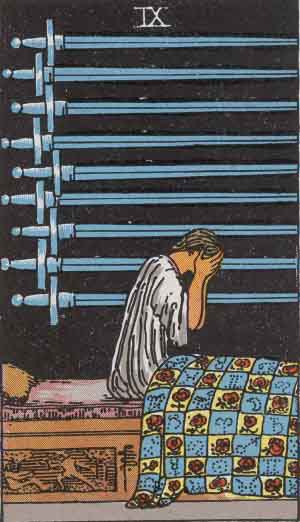
A figure wakes in darkness beneath nine swords. The question this card keeps returning to ask is what belongs to a real problem, what belongs to the mind’s night-time amplification, and what support is needed now.
Core Repeating Message
The Nine of Swords shows a figure sitting up in bed in darkness, hands pressed to their face, with nine swords arranged on the wall above. The figure appears alone, but the image cannot tell us whether the distress arises from thought, an external threat, illness, grief or several pressures at once. The swords can symbolise recurring thoughts in the still hours of night, when perspective and support may feel least available. The scene centres private suffering without claiming that it is self-created.
This is a card of the inner critic, night worry and the mind’s capacity to rehearse danger or failure when other sources of information are limited. A 3 a.m. assessment may differ from the view available after light, food, rest or conversation, but night-time concern is not automatically false. The card asks which thoughts contain actionable information and which are repeating pain without improving understanding.
When this card appears once, it can reflect a period of intense worry, self-reproach or mental suffering. When it appears repeatedly, it invites examination of recurring thought patterns, their triggers and their impact on sleep and daily life. It does not diagnose anxiety or establish that the mind is the primary cause. Repetition can also be a prompt to seek appropriate support rather than continuing to analyse severe distress alone.
One common pattern is the seeker whose inner critical voice has become so well-developed and so automatic that the seeker can no longer reliably distinguish between what the voice says and what is true. The voice has the character of knowledge. It speaks with precision about the seeker’s failings, failures and particular ways in which they have been insufficient or have caused harm. And this precision makes it difficult to identify the voice as a voice rather than as honest perception, because honest perception can also be precise.
A second pattern is the seeker whose anxiety tends towards the nocturnal: who functions with reasonable competence during the day and who is visited, consistently, by a quality of mental suffering that arrives in the night and that produces a picture of their situation, their past, their prospects, and their capacities that bears little resemblance to the picture available in daylight. The nine swords are a nocturnal phenomenon for this seeker, and the repetition of the card draws attention to the hold this nocturnal pattern has developed on the seeker’s interior life.
A third pattern belongs to the seeker who faces a genuine difficulty and finds worry expanding beyond the information currently available. Each concern generates another until the chain feels more certain than the evidence supports. This is not a judgement that the fear is disproportionate. The practical task is to separate present facts, plausible risks, worst-case projections and matters requiring immediate action.
A fourth pattern is the seeker who is directing significant self-criticism at themselves for something specific: a failure, a decision, a harm caused or a good not done. This is what the inner critic has taken as the basis for a sustained and merciless internal prosecution that has moved beyond proportionate, useful reflection into punishment.
When This Card Repeats Weekly
A week of Nine of Swords repetition can mark an immediate period of significant distress. The seeker’s thoughts may be contributing to the pain, but external events, sleep disruption, health, medication or other factors may also be involved. If distress feels unmanageable, functioning is deteriorating, or the seeker may harm themselves, urgent human and professional support takes priority over interpretation.
The card this week is not asking the seeker to immediately resolve the anxiety or silence the inner critic. It is asking them to pay close attention to the nature of the suffering: to notice, as accurately as possible, what specifically the nine swords are saying, what they are accusing, what they are anticipating. This specific attention to the content of the suffering is different from being lost inside it, and it is the beginning of a different relationship to what the nine swords represent.
When This Card Repeats Monthly
A month of Nine of Swords repetition suggests that the pattern of self-directed mental suffering is operating across this period with enough consistency to warrant asking whether it extends beyond any one acute situation. The inner critic is regularly active; the anxiety has a sustained quality; the mind’s tendency toward self-accusation or catastrophic projection has become a significant ongoing feature of the seeker’s interior life.
The monthly framing asks what has sustained the pattern across the month: recurring topics, times, environments, bodily states or unresolved practical problems. The seeker can examine whether worry is responding to identifiable risks, continuing after useful action is exhausted, or shifting its subject while retaining the same intensity. A month of disrupted sleep or persistent distress is also a reasonable threshold for seeking clinical guidance rather than relying on self-analysis.
When This Card Repeats Seasonally
A season of Nine of Swords appearances can mark a significant and sustained period of inner suffering that has become the predominant quality of the seeker’s interior life. The nine swords are reliably present; the nocturnal suffering is consistent; the inner critic is a well-established and frequently active presence.
The seasonal repetition strongly supports seeking help, not because the seeker is inadequate but because sustained suffering benefits from more than solitary interpretation. The useful form may be clinical, medical, relational, spiritual, practical or structural, depending on the cause and severity. Immediate risk, inability to stay safe or profound deterioration requires urgent local support.
When This Card Repeats Across Years
The Nine of Swords returning across years or major life phases can describe a seeker for whom the inner critic and the anxiety pattern are deep structural features of their interior life: present not only in specific periods of external difficulty but as consistent companions across the full range of life’s circumstances, including periods when external conditions appear adequate and the continued suffering invites closer examination of both inner patterns and pressures that may be less visible.
This long-arc pattern may resonate with seekers who learned early to anticipate criticism or monitor themselves closely. Self-criticism may have served a protective purpose: anticipating what others might say and trying to get there first, before an outside criticism could arrive. That is one possible history, not a conclusion supplied by the card. A critical voice can also be shaped by current abuse, discrimination, perfectionistic environments, health conditions or repeated material insecurity. Understanding its context helps determine whether the response requires inner practice, external protection or both.
Across years, what the Nine of Swords asks of this seeker is not the complete silencing of the critical voice, but the development of a different relationship to it: the gradual capacity to hear the critic’s specific content, to assess its accuracy and proportionality, and to respond to it with something more than automatic deference or reactive counterattack.
Life Area Interpretations
Love & Relationships
In love and relationships, the Nine of Swords can describe the seeker whose relational experience is significantly shaped by anxious thinking about the state, security, and future of their close connections. The anxiety may be about a specific relationship and its challenges, or it may be a more generalised pattern in which relational anxiety arises across connections of differing quality.
The card may also mark the seeker whose inner critic focuses specifically on relational themes: who is regularly assailed by the nine swords of their own thoughts accusing them of inadequacy as a partner, friend, or family member, of having failed particular people in particular ways, of being too much or too little in close connection. The relational content of the inner critic’s accusations is worth examining as carefully as the accusations themselves.
Career & Purpose
In career and purpose, the Nine of Swords can mark vocational worry, harsh self-assessment or repeated anticipation of failure. Some concerns may be distorted; others may accurately reflect insecure work, discrimination, poor management or real performance issues. The card invites a comparison between evidence, feedback and feared outcomes rather than assuming that confidence alone is the missing element.
The card may also mark the seeker who is carrying significant guilt or self-reproach about a specific professional failure or career decision, and whose inner critic has made that event the basis for a sustained prosecution that has extended beyond the period during which reflection and learning from it would have been proportionate and useful.
Money & Stability
The Nine of Swords in financial contexts can mark worry that continues beyond useful planning, but it should not be used to minimise genuine material risk. The first task is to verify figures, deadlines and available assistance. Only then can the seeker assess which concerns call for action and which repeat without adding information. Qualified financial or legal advice may be needed where consequences are significant.
The nocturnal quality of the Nine of Swords is often particularly relevant in financial contexts: the seeker whose days are managed with reasonable competence but whose nights include financial catastrophising, in which the worst-case scenarios are projected with vivid specificity regardless of whether the current circumstances point towards them.
Spiritual Growth
In spiritual growth, the Nine of Swords can describe a seeker whose spiritual life is shaped by self-accusation: who brings to their relationship with the sacred, with their own moral life, or with their sense of meaning sustained self-criticism that obstructs spiritual openness. The inner critic has colonised the spiritual dimension; whatever the seeker’s understanding of the sacred is, the nine swords are directing themselves at the seeker’s adequacy in relation to it.
The card may also mark the seeker whose spiritual challenge is to develop self-compassion: not as an aspiration but as a practice that can stand in the same room as the inner critic without immediately capitulating to it.
Emotional & Mental Patterns
In emotional and mental patterns, the Nine of Swords can describe a characteristic relationship to negative thinking in which the mind’s self-critical, anxious, and catastrophic modes are more developed and more automatically activated than its capacity for accurate assessment and equanimity. The nine swords are simply much more immediately available than any other instrument.
The specific texture of this pattern varies by seeker: some experience it primarily as self-accusation, some as anxiety about the future, some as the midnight review of past failures, some as a more diffuse quality of ongoing mental suffering that does not attach itself clearly to specific content. What is common across the variations is the disproportionate authority the nine swords have been accorded in the seeker’s interior life, and the relative weakness of any counter-perspective that might challenge their assessments.
Family & Generational Dynamics
In family dynamics, the Nine of Swords may resonate with a seeker who learnt the inner critic’s habits within the family: who grew up with a model of harsh self-assessment, or who developed the inner critic in direct response to consistent external criticism, or who absorbed from the family atmosphere anxiety about inadequacy and failure that has become so thoroughly internalised that it now presents as internal rather than inherited.
The content of an inner critic may resemble messages from family, culture, school, religion, work or current relationships. The card cannot identify its source with certainty. Tracing repeated phrases and contexts can help the seeker see the voice as learned or reinforced rather than automatically authoritative, while recognising that some current criticism may require boundaries or external intervention.
Health & Energy
The Nine of Swords in health contexts symbolically reflects the overlap between distress, sleep and bodily experience. A seeker may notice insomnia, fatigue, tension, appetite change or difficulty concentrating, but these signs are non-specific and can have medical, psychological, situational or medication-related causes. A seeker may feel exhausted despite little outward activity, or find that time set aside for rest is still occupied by worry. Those experiences do not establish their cause. Tarot cannot assess sleep architecture, nervous-system function or the severity of a mental health condition.
Gentle grounding, regular routines and supportive contact may help some people, but they are not treatment prescriptions and may not be sufficient. Persistent sleep disturbance, marked fatigue, panic, intrusive thoughts or other concerning symptoms deserve professional assessment. If the seeker is at risk of self-harm or cannot stay safe, urgent local crisis or emergency support is the appropriate next step.
Advanced Interpretive Sections
The Shadow Expression
The Nine of Swords in shadow can describe a cycle in which distress and reassurance become tightly linked. Real suffering may become the seeker’s principal way of securing care, with its presentation increasingly shaped, sometimes without conscious awareness, by the concern it brings. Repeated disclosure can then provide brief relief without changing the underlying pattern. This possibility must not be assumed from someone asking for help or used to dismiss their pain as attention-seeking. The constructive question is whether the current form of support creates safety and agency, or whether more sustained clinical, relational or practical help is needed.
A second shadow is the seeker who directs the nine swords outward when turning them inward becomes unbearable: who converts the inner critic into a mechanism for finding and accusing inadequacy in others rather than in themselves. The nine swords remain fully operational; their direction has shifted.
The Integrated Expression
The integrated Nine of Swords seeker has developed a mature relationship with their own inner critic: they can hear its assessments, note what is proportionate and useful in what it says, and respond to the disproportionate and punitive with something other than automatic deference. They have not silenced the critic; they have developed the capacity to remain present with its voice without being governed by it.
This seeker has also developed self-compassion as a practised capacity rather than as a theoretical aspiration: the ability to extend to themselves the quality of understanding and care that they would naturally extend to a person they genuinely love who was in the same situation.
Why This Energy Has Not Released Yet
The Nine of Swords pattern can persist when the seeker has not yet found a way to engage with the inner critic’s accusations that is neither uncritical acceptance nor reflexive rejection. Both of these responses tend to maintain the pattern: uncritical acceptance gives the critic authority it has not earned; reflexive rejection prevents the seeker from hearing the genuine information the critic sometimes contains alongside the disproportionate accusation.
The pattern also persists when self-compassion remains primarily a concept rather than a practised capacity. The seeker may understand intellectually that the inner critic is excessive and that self-compassion would be appropriate; without sustained practice, this understanding does not typically produce change in the relationship to the nine swords.
What This Card Wants the Seeker to Understand
The Nine of Swords wants the seeker to understand that the nine swords on the wall can represent the mind’s own instruments, and the seeker is capable of developing a different relationship to them. Not the elimination of the critical capacity, which is valuable when proportionately used, but a different quality of authority: one in which the nine swords are heard, assessed, and responded to rather than simply experienced as the definitive account of the seeker’s reality.
The card also asks the seeker to compare the 3 a.m. and 9 a.m. versions of a concern. Darkness, isolation and sleep disruption may change perspective, while some problems remain serious in daylight. Decisions can often wait for rest, food, verified information and another perspective, unless immediate safety or a deadline requires action. Morning is a useful comparison point, not automatically the more truthful one.
Signs the Pattern Is Beginning to Resolve
The Nine of Swords pattern begins to resolve when the seeker begins to develop the capacity to notice, in the moment of inner-critic activation, that the inner critic is speaking rather than simply experiencing its assessment as transparent reality. This metacognitive capacity, the ability to observe the thinking rather than only to think it, is the beginning of a relationship to the nine swords in which the seeker has more choice about how to respond.
It also resolves when the seeker begins to experience self-compassion as a felt response rather than only as a performed response to a theoretical instruction: when they can be tender with themselves in a moment of suffering, without requiring the suffering to first justify itself to the critic’s satisfaction. And it resolves when the nocturnal nine swords become noticeably less intense, less frequent, or less authoritative: when the 3 a.m. voice begins to sound, at least sometimes, less like revelation and more like an anxious mode of thought.
Reflective Questions
-
What does the inner critic most reliably say: what are its most frequent accusations, its characteristic themes, its preferred targets? Can you describe its voice in precise detail?
-
Where did this voice come from: whose voice does it most closely resemble, either in content or in quality? What in your history may have shaped it?
-
What is the relationship between the content of the nine swords and what is actually true? Which of the inner critic’s assessments, on honest examination, are proportionate and useful? Which are disproportionate and punitive?
-
At what time of day or night is the inner critic most active and most authoritative? What are the specific conditions that most reliably activate it?
-
What does genuine self-compassion feel like when you access it, even briefly: not performed self-compassion, not the attempt to neutralise the critic’s assessments, but tenderness towards yourself in a moment of difficulty? When was the last time you experienced this?
-
Is there a specific failure, decision, or harm caused that the inner critic has made the basis for a sustained prosecution? If so, has this prosecution produced genuine learning, or has it long since passed that threshold into something more purely punitive?
-
What would you say to a person you genuinely loved who was being visited by the nine swords in the way you are: what quality of response would you offer them? What prevents you from offering yourself the equivalent?
-
What is the 3 a.m. version of your current situation, and what is the 9 a.m. version? Which facts remain stable, which interpretations change, and what support is needed when night-time distress becomes intense?
-
Which physical, relational, creative or contemplative practices help you interrupt the nine-swords pattern when it is active? How consistently are you accessing these practices?
-
If the nine swords could be reduced to one sword, the most important and proportionate single piece of the critic’s assessment, what would that sword be? And is that single sword worth the full nine-sword response it is currently generating?
Practical Integration Actions
Develop a witness practice. When the inner critic is active, practise the exercise of observation rather than identification: instead of thinking the criticism, practise noticing that the criticism is occurring. “The thought is arising that I failed at this” is a different interior stance from “I failed at this.” This shift from identification to observation does not eliminate the thought, but it changes the seeker’s relationship to its authority. Even brief and imperfect practice of this observation can develop the metacognitive capacity to notice the nine-swords pattern as it happens and choose how to respond.
Write back to the critic. Choose one specific accusation from the inner critic’s repertoire, a statement about your inadequacy, failure or worthlessness that arises regularly, and write a considered response to it: not a dismissal of its concerns, not a capitulation to its authority, but an engagement with what is proportionate in it and what is disproportionate, what is useful information and what is punishment. This practice develops the capacity to respond to the critic rather than either automatic acceptance or reflexive rejection.
Develop a 3 a.m. protocol. If distress reliably intensifies at night, prepare a short plan while you are steadier: whom you can contact, which grounding or comfort options are safe for you, what decisions can wait, and when to seek urgent help. A brief written reminder of a steadier daytime view can also provide a comparison, without assuming that morning is always more truthful. Keep essential local crisis and emergency details accessible if risk is possible. The plan supports safety and perspective; it does not replace medical or mental health care.
Practise genuine self-compassion deliberately. Once a day, for one month, practise self-compassion in relation to one current difficulty: not performed self-affirmation, not the dismissal of the critic’s assessments, but tender regard for yourself in that moment of difficulty. This might be written, embodied, or simply interior; what matters is that it is genuinely felt rather than performed. This is a skill that develops with practice, and the first attempts will often feel stilted or false; this is normal and does not indicate that the practice is wrong.
Examine the inheritance. If you recognise a critical voice from your family of origin, write about whose voice it was, what it most reliably said, what it was responding to, and what function it was serving in the family system. Then examine whether this voice has been internalised and what it has become: how faithfully it has reproduced the original, what has been added, what has been modified. Understanding this possible historical influence can help develop a relationship to the critic that is informed by knowledge of its context rather than by the automatic authority that an unexamined inheritance tends to carry.