
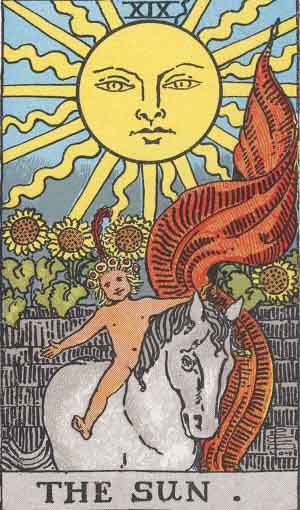
The child rides out into the light without hesitation. The adult draws the card again and again, and the question is: what has made the sun feel dangerous?
Core Repeating Message
The Sun blazes at the top of the image, enormous and warm and direct, not the reflected light of the Moon or the disciplined lamp of the Hermit but the full, generous, unembarrassed light of the sun itself. Below it, four sunflowers stand above a wall, their open faces visible to the viewer, suggesting a natural affinity with the light. A child rides a white horse through the scene, arms open, face turned towards us, a banner in one hand, exuberant in the unguarded way that joy can be when it has not yet learned to manage itself. There is the wall behind the child, and there are the sunflowers, and there is the blazing sun: the whole scene is presented in bright daylight.
The Sun’s image suggests a world brought into the open. Its dominant impression is brightness, with no mysterious pool or distant territory inviting the eye into uncertainty. This is the card of full illumination, of clarity, of the direct experience of what is good in being alive. The child’s joy appears unqualified. The sun’s warmth does not discriminate. The sunflowers can be read as an image of natural alignment: an affinity with light that does not have to be argued for or earned.
When The Sun appears repeatedly, it can invite the seeker to notice what is genuinely good and whether it is possible to receive some of it without denying difficulty. It does not prove that joy is available on demand or that caution, low mood, grief, illness, or limited capacity reflects a failure of permission.
This is a more complex and more psychologically rich question than it initially appears, because difficulty receiving The Sun’s energy need not take the obvious form of pessimism or despair. The seeker encountering this pattern may be highly functional, may be productive and capable, may even be, by external measure, quite successful. What they may be missing is the quality of absorbed, unselfconscious engagement with what is good: the child’s quality of delight, the sunflowers’ natural alignment, a direct relationship to what feels warm and alive in experience.
There are several primary patterns this card marks when it appears repeatedly.
The first is the joy-qualified seeker: the person for whom joy, when it arrives, is consistently accompanied by qualification, by the shadow thought that follows the light moment, by the almost reflexive identification of what could go wrong, what will end, what the cost will be when this good thing dissolves. This need not be cynicism; it may be a learned relationship to joy, shaped by experiences in which good things were followed by their undoing, leaving them with the belief that the safest relationship to joy is one that holds it at a slight remove so that when it ends, the distance provides some protection. The card appearing repeatedly to this seeker is asking whether the protection fits their current circumstances or has become habitual, and what a tolerable moment of delight might feel like in their body.
The second is the authenticity-restricted seeker: the person whose genuine nature, their spontaneity, their exuberance, their particular way of being most alive and most themselves, has been carefully managed in the service of being appropriate, acceptable, professionally credible, relationally comfortable, or simply not too much. They have learned to present a version of themselves that is competent but contained, and the openness that The Sun’s child represents, the willingness to ride out into the light with arms spread and delight in what is there, has been reduced over time by the social and professional and relational feedback that authentic exuberance sometimes receives. Some restraint may still serve them; the question is where it has become unnecessary concealment.
The third is the success-discomforted seeker: the person for whom achievement, recognition, or success in the areas that matter to them produces discomfort that makes it hard to enjoy what they have accomplished. They may minimise it, deflect it, immediately displace the attention to what still needs work, or experience it with a quality of anxiety rather than satisfaction. The Sun appearing repeatedly here is asking what it would feel like to acknowledge an achievement fully, to allow the satisfaction and the recognition to land without immediately managing it back toward a more comfortable level.
The fourth is the post-difficulty joy-block: the seeker who has been through something genuinely difficult and now finds ease, joy, or engagement less accessible. Vigilance or guardedness may remain after the immediate danger has passed, but the card cannot determine whether danger has passed or why recovery is taking its present form. The Sun invites gentle experiments with tolerable pleasure and safety, not pressure to recover or become unguarded.
The fifth is the purpose-separated seeker: the person who has not yet fully connected their ordinary daily life to the sources of meaning and vitality that make the sun analogy real. They may know what makes them most alive, what activities and relationships and engagements light them up in a way that corresponds to the Sun’s image, and they may be spending very little of their time and energy in contact with this. The Sun appearing repeatedly is asking about the gap between where the light is in the seeker’s life and where the seeker is actually spending most of their time and attention.
Nineteen reduces to ten (one plus nine), and ten is the Wheel: the great turning, the natural cycle, the recognition that everything passes through phases and that the sun, which sets in the evening, rises again in the morning. The Sun as nineteen is the full light within the cycle: a way of understanding clarity, vitality and joy as changing experiences rather than permanent states at maximum intensity. The work is to be present to warmth when it is present, rather than spending its brief season defending against an anticipated ending. The image offers a rhythm for reflection; it cannot promise when, or in what form, warmth will return in a particular life.
For the seeker who keeps drawing this card, the work may be the development of permission: permission to enjoy something without immediately qualifying it, to express enthusiasm where it is welcome, to be seen without always managing the impression, to inhabit what is good in their life with something of the child’s wholeness of attention. This is not a small task. For many seekers, distance from joy reflects years of entirely reasonable protective learning, and changing that relationship requires patient examination of what was learned and what still applies. Permission can make room for a moment of delight; it does not require constant happiness or the removal of every protective layer.
When This Card Repeats Weekly
The Sun appearing multiple times in a single week brings attention to something immediate: a moment of vitality or clarity the seeker has noticed, or the quality of their engagement with ordinary life. It may prompt them to ask whether enjoyment, presence, or connection is receiving less attention than the week’s practical demands. The week’s small details matter here: what briefly lifted the mood, what was brushed aside as unimportant, and what was noticed only after the moment had passed.
One weekly pattern is the seeker who is going through a good period but is not fully inhabiting it: who is functioning well, who has reasons for satisfaction, and who is spending most of their internal attention on management, on planning, on the monitoring of what might go wrong, on the maintenance of a distance from delight that may have become habitual rather than necessary. The card appearing in this week is asking: what would it take to be in the good of this week, not just to manage it from a slight distance, but to allow it to warm them?
It may also mark a week in which something joyful appears possible: creative flow, relational ease, clearer information, or a context that welcomes more of the seeker’s authentic expression. The repeated card does not confirm the situation’s safety or durability; it asks what evidence supports enjoyment and how the seeker might receive it without abandoning discernment.
When This Card Repeats Monthly
A Sun month may coincide with a period of vitality, clarity, and alignment with what makes the seeker’s life feel most alive, and the question the month is asking is whether this period is being fully inhabited or only partially received.
The Sun month may also mark the seeker who is in a creative, professional, or relational flourishing: a period in which talents are finding expression, connections are developing, and achievements are taking shape. The card repeating month after month in this context is asking whether the seeker is present to this period or whether they are spending it primarily in anticipation of its ending, in management of its implications, or in the characteristic guardedness that makes it difficult to enjoy the vitality they are experiencing.
A monthly Sun pattern may also mark the seeker who is systematically exploring what makes joy less accessible: who has identified, through whatever process of self-examination is available to them, that the Sun’s energy is not fully available in their life, and who is in a month of sustained practice that is beginning to address what they have found. The month is the practice period, and the card’s continued appearance is a possible source of encouragement as they assess the work in progress.
When This Card Repeats Seasonally
A season experienced as Sun energy can be a significant and celebratory developmental period: sustained vitality, creative expression, clarity, and connection to what makes the seeker’s particular life feel most alive.
Another form of The Sun’s seasonal recurrence concerns a seeker for whom vitality and joy have remained difficult to access across the full arc of a season. Encountering the card over three or four months can keep that question in view: what has changed, what remains difficult, and where might there be room for warmth? The seasonal scale allows the seeker to notice conditions and patterns that a single good or difficult day might obscure.
Seasonal Sun appearances may accompany a sustained invitation to step further into authentic expression, to give the seeker’s particular gifts and nature more room where circumstances make that possible. The question is not simply how to come out from behind a protective layer, but where that layer still serves a purpose and where it has become an old habit. Across a season, the seeker can explore that distinction through repeated, chosen acts of expression, allowing clarity to develop through experience rather than requiring the child’s lack of hesitation before they begin.
When This Card Repeats Across Years
The Sun appearing across years can frame a recurring life lesson involving the sustained, deepening, potentially transformative encounter with the seeker’s capacity for vitality, joy, and authentic expression, with development shaped by the ongoing question of permission: the question of what helps them feel more fully alive, and what conditions make that possible.
Two distinct kinds of seeker may recognise this long-arc pattern. The first is the seeker who has distinctive gifts of exuberance, warmth, creativity, or vitality that have been closely managed or contained across years of reasonable protective learning, and who is in the slow, often nonlinear, potentially liberating process of finding permission to express those gifts more fully. The years of Sun cards mark the ongoing invitation of this process and the ongoing encounter with what still stands between the seeker and the child’s ease, including circumstances in which exuberance is not welcomed.
The second is the seeker whose life has included significant periods of difficulty, darkness, or depletion, and who is in a long process of exploring what vitality and joy might now mean. A return to warmth may restore something familiar or develop a new appreciation for what is good, shaped by an encounter with darkness rather than untouched by it. That appreciation is one possible experience, not a benefit that suffering owes the seeker or a higher state they are required to reach.
The growth arc The Sun can trace across years is from managed access to vitality, in which the seeker engages with what is good from behind the glass of habitual protection, towards moments of fuller presence in what feels alive, delightful, and warming. This arc is not linear and is not rapid. It is the work of reclaiming room for enjoyment without demanding the same capacity at every stage of life. The glass may become less necessary in some settings and remain useful in others; noticing that difference is part of the reclamation, rather than evidence that it has failed.
Life Area Interpretations
Love & Relationships
In love and relationships, The Sun’s repetition can draw attention to a seeker whose capacity for delight in connection, the texture of joyful, warm, playful, fully present relational engagement, is not fully available in their significant relationships.
One pattern is the seeker who experiences their significant relationships primarily in the mode of seriousness, obligation, effort, or management, and who has lost access to, or has never quite developed access to, the lightness and warmth that The Sun represents in relational life. The relationship is real, the commitment is genuine, but the joy of the relationship’s presence, the pleasure in being together, the delight in who the other person is, has become thinner than it once was or less available than either person would like.
A second pattern is the seeker who has found little room for vulnerability and self-expression in their significant relationships: who presents the managed version of themselves, the competent and appropriate and suitable version, rather than the joyful, playful, exuberant version that the Sun child represents. The Sun here is not asking the seeker to be something they are not. It asks where the relational context could welcome more of who they are: where the light of their nature could enter the shared space without requiring them to ignore how the other person responds.
The card can also invite attention to joy that is already available in a relationship but is difficult to receive: when there are reasons for satisfaction and the seeker spends a period of relational good primarily anticipating its ending. The Sun in this context asks for presence, for some experience of the good of this relationship in this moment. Preparing for uncertainty and enjoying connection need not exclude one another; the question is whether imagined endings leave room for the relationship that is actually being lived.
Career & Purpose
In career and purpose, The Sun’s repeated appearance can highlight a seeker whose gifts, enthusiasms, and sense of purpose are not yet fully expressed in their professional life, or whose relationship to professional success is characterised by more discomfort than delight.
The most direct form is the seeker who knows what makes their professional life most alive and who is spending most of their professional time and energy in activities that are not that. They may be competent in what they are doing. They may be successful by conventional measures. But the vitality, enthusiasm, and sense that the work draws on something important in them, qualities The Sun represents in the professional domain, are thin or absent. The card appearing repeatedly is asking about the gap between where professional aliveness may be available and where the seeker is actually operating.
A second pattern is the seeker who has recognised professional success and who is not fully inhabiting it: who deflects recognition, who minimises achievement, who immediately displaces the satisfaction of success to the next challenge before the current achievement has been acknowledged and enjoyed. This is one of the less visible patterns that The Sun marks in professional contexts, because it is often framed as humility or drive rather than as what it may also be: the habitual management of success to prevent the vulnerability of accepting that an achievement matters to them.
Purpose and The Sun have a particular and important relationship: work that corresponds to the seeker’s gifts, connects them to what matters, and brings the aliveness represented by the Sun’s warmth can be a source of fulfilment. It is not automatically sustainable; workload, income, access, health and the conditions of employment still matter. For the seeker who has not found this warmth in their professional life, the invitation is to explore a direction of greater alignment rather than competence alone. That may involve changing the work, finding more room within it, or recognising that some gifts need a home outside paid employment.
Money & Stability
The Sun’s relationship to money is primarily about the seeker’s capacity to enjoy and receive what financial sufficiency makes possible: to spend with pleasure, to devote resources to what matters, and to inhabit financial wellbeing, when it is present, with satisfaction rather than the anxious management of its potential ending.
The most direct financial Sun pattern is the seeker who has developed a financial relationship that is primarily characterised by anxiety and management even in periods of financial stability: who finds it hard to enjoy the financial security they have built, who is constantly braced for the next potential scarcity even when current resources cover their needs, who spends more internal energy managing the fear of financial loss than experiencing the security those resources currently provide.
A second pattern is the seeker whose financial habits do not correspond to what makes their life feel most alive: who spends most of their financial resources in domains that provide comfort or management of anxiety rather than in the domains that provide vitality, joy, and experiences that make life feel worth living. The Sun appearing here is not asking the seeker to be impractical. It is asking whether, within their means and obligations, their financial choices leave room for the life that the Sun represents.
Spiritual Growth
Spiritually, The Sun is the card of genuine spiritual joy: a luminosity that may emerge from mature engagement with life, rather than spiritual bypass or a performance of serenity. In the Major Arcana’s initiatory sequence, it follows the Moon’s depths, Death’s endings, the Tower’s disruptions, and the preceding encounters with difficulty. The image allows joy to have a history, to coexist with knowledge of what is painful, rather than requiring innocence of it. It does not make joy a certificate that the whole sequence has been mastered.
The Sun in spiritual contexts can reflect either the arrival of this quality of spiritual joy or an invitation to explore the permission that might make room for it: the permission to be present in delight, to allow the spiritual dimension of life to be warming and alive rather than primarily demanding, effortful, or oriented toward transcendence of ordinary experience.
There is a form of spirituality that is primarily about what is not permitted: not about illuminating what is good in being alive in this world, but about the management of desire, the transcendence of the ordinary, the movement away from embodied joy toward something more elevated and more controlled. The Sun’s spiritual invitation is specifically the opposite of this: it is toward embodied, full-light engagement with what is good, warm, and alive in ordinary human experience, including the sensory, the relational, the playful, and the creative dimensions that some forms of spiritual orientation have undervalued.
Emotional & Mental Patterns
In the emotional and mental domain, The Sun’s repeated presence tends to mark a seeker whose relationship to their own positive emotional states is characterised by more management and more qualification than the states themselves require.
The emotional Sun pattern can belong to seekers who have developed, through entirely understandable developmental experience, a consistent and habitual downward regulation of positive states: who reduce the intensity of joy, excitement, and enthusiasm, not because these states are uncomfortable in themselves but because they have learned, often accurately in the context in which they learned it, that the expression of intense positive feeling produces difficult consequences: ridicule, disappointment, the painful gap between the expressed enthusiasm and the eventual outcome.
The mental dimension of the Sun pattern often involves cognitive qualification: the thought that accompanies a good moment with a reminder of its impermanence, the anticipation of disappointment, or the identification of what is missing or imperfect in something otherwise good. In the card’s imagery, this resembles stepping back from the sun’s warmth because it feels too exposing or too direct. The metaphor describes a possible experience; it cannot distinguish a learned habit from depression, anxiety, or other contributors to reduced enjoyment, and it should not be used to rule any of them out.
The emotional practice this card suggests is presence with positive states when they arise: spending time with moments of joy, satisfaction, or delight before habitual qualification takes over. This practice can be more demanding than it sounds, because the management is often entirely automatic and below the level of ordinary conscious choice.
Family & Generational Dynamics
The Sun in family and generational contexts can draw attention to the seeker who grew up in a family environment in which joy, exuberance, and enthusiastic self-expression were not reliably welcomed or were actively discouraged.
Families that communicate, through explicit instruction or through ambient atmosphere, that the full expression of vitality and joy is inappropriate, excessive, dangerous, or somehow threatening to the family’s stability or equilibrium, can teach children to contain positive feelings in ways they carry into adulthood. They may have been told directly that they were too much: too loud, too excited, too intense in their enthusiasm. They may have learned through observation that a parent’s wellbeing seemed fragile and the child’s exuberance was treated as a threat to it. They may have grown up in an atmosphere of depression or chronic grief in which joy felt somehow disloyal to the ambient family mood.
Whatever its specific form, this family inheritance may leave adults with a complicated relationship to their vitality and delight. They carry it and can sometimes access it, but a layer of management and qualification remains between the feeling and its expression. That containment contrasts with the child on the Sun card, whose open gesture gives the seeker an image through which to explore what has been held back.
The generational dimension of The Sun is the opportunity for a seeker who is reclaiming delight to become, in their own family, a model of permission for joy that was absent from their inheritance. The child on the horse is not the ancestor. The ancestor is the seeker. In this symbolic sense, what they make room for now may help both the inner child they carry and any younger people whose lives they influence. The inheritance they offer can include quiet pleasure, exuberance, and room for difficult feelings; it need not be a performance of happiness for the family’s sake.
Health & Energy
In health and energy readings, The Sun symbolises vitality, warmth, pleasure, visibility, and the subjective experience of feeling more alive. It does not diagnose health, establish a cause of fatigue or low mood, or promise recovery.
Pleasurable activity, creative expression, supportive relationships, and meaningful work can contribute to a felt sense of aliveness when they are accessible. This remains an experiential association, not a medical outcome or standard everyone should meet. Disability, illness, grief, medication, material conditions, and many other factors can shape energy independently of attitude.
Conversely, a sustained absence of pleasure or connection may feel depleting, but its cause cannot be inferred from the card. Fatigue, flatness, and reduced enjoyment can have medical, psychological, social, environmental, and practical contributors. Persistent or concerning changes deserve appropriate assessment rather than being attributed to suppressed joy.
The Sun’s practical health invitation is to identify one accessible source of warmth, pleasure, movement, creativity, or supportive contact and notice its effect without demanding a particular result. This can complement, but not replace, rest, medical care, mental health support, or changes to unsafe conditions.
Advanced Interpretive Sections
The Shadow Expression
The Sun in shadow produces two distinct patterns, and both are more common than might be expected.
The first shadow is the seeker who performs The Sun’s energy: who has made exuberance, positivity, warmth, and enthusiasm into a presentation, a professional identity, a social persona, that is disconnected from what they feel inwardly. They are bright and warm in the way of the arc light rather than the sun: producing a convincing brightness while feeling little of its warmth themselves, and maintaining the performance at a cost that the interior knows even when the exterior presentation is convincing. This shadow often accompanies talent for presentation and professional or social success, which makes it difficult to identify and costly to address.
The second shadow is the seeker who has come to rely on the Sun’s energy in its most intense and most unsustainable form: the seeker of perpetual highs, of escalating peaks, who has made the Sun’s summer into the only tolerable season. They cannot inhabit ordinary ease, ordinary satisfaction, ordinary quiet aliveness. They require the maximum intensity of the positive, and in its absence they experience ordinary life as deprivation. This shadow is the light turned up past visibility into something that is no longer illuminating but simply blinding.
The Integrated Expression
The integrated Sun seeker can be a warming presence in a community because they have developed a relationship with joy that is lived rather than performed. It does not demand maximum brightness or a constant positive state. There is room to receive what is good in daily life and to share that warmth when they wish, while recognising that circumstances, capacity and feeling can change. Other people may notice the ease, but it does not depend on being visible to everyone.
The integrated Sun is recognisable not by extraordinary intensity but by genuine warmth: presence in a good moment, satisfaction in an achievement, delight in connection, enthusiasm for what matters. These experiences are no longer held at quite the same automatic distance; they can belong to ordinary life rather than having to become a peak experience before they count.
This seeker has also developed a relationship to the Sun’s cycle: they know the sun does not always shine at maximum intensity, and they have developed greater equanimity about the periods of ordinary light, ordinary satisfaction, ordinary ease that are not the peak of maximum vitality but are nevertheless good in their own ways. They do not require the summer to be eternal. They inhabit the autumn and the winter of their own natural cycle with attention to what each season offers and requires, without treating reduced brightness as a failure of integration.
The integrated Sun seeker has also worked with permission: allowing more of their vitality to be seen where they choose, bringing their authentic nature into engagement with the world with less automatic qualification. What was protective can be reassessed without requiring every boundary to disappear. The arms are spread. The banner is raised. The horse is moving.
Why This Energy Has Not Released Yet
The Sun’s pattern may persist when the seeker is maintaining the habitual management of their own positive states without being fully aware that they are doing so, or when they are drawn to joy in theory but find the vulnerability of receiving it harder in practice.
The habit of managing positive states can be so thoroughly learned that the seeker does not notice it is happening. The qualification that follows the joy, the cognitive caveat that accompanies the good moment, the slight withdrawal from warmth toward a marginally safer managed distance: these can be so automatic that they are experienced as simply how joy feels rather than as the habitual management of joy. The card’s image can make this difference visible: understanding joy intellectually is not the same as experiencing it. Repeated appearances may provide an occasion to notice that gap, but they do not establish its cause or measure the seeker’s progress.
The pattern also persists when the seeker has a deeply held, unexamined belief that good things do not last, or do not last for people like them, or that happiness is a setup for disappointment, and has organised their relationship to positive states around the management of this anticipated ending rather than experiencing what is good while it is present. Such a belief may be rooted in experience. The question is whether it fits the present situation or has been extended to circumstances unlike those in which it was learned.
It persists also when the seeker’s identity is more fully organised around their capacity for serious, effortful, responsible engagement than around their capacity for delight, and the vulnerability of the child’s full openness to the sun feels inconsistent with who they understand themselves to be.
What This Card Wants the Seeker to Understand
The Sun asks whether some good can be met directly rather than automatically diminished. The Moon’s territory is real and valuable, but it is distinct from the Sun’s direct, warming engagement with what is good. Full visibility is not safe in every environment, and authentic expression does not require indiscriminate exposure. The integrated form is warm and present while retaining boundaries, context, and the right to protect what should not be made public.
It invites the seeker to question whether anticipating the loss of joy provides the protection they hope for. Holding a good experience at a distance may reduce some immediate vulnerability, but it can also mean receiving less of what is present now. Neither approach determines how devastating a later loss will be. The useful question is whether there is room to enjoy something without asking that enjoyment to prevent grief, and without making future pain the reason that every present warmth must be diminished.
The card presents the child as an image of immediacy rather than proof that difficulty has ended. Presence in what is good can be nourishing and may support resilience, but it does not prevent harm or determine how someone will respond to future difficulty. Joy and realistic preparation can coexist.
Finally, The Sun invites the seeker to value their particular vitality and gifts without claiming that the world requires unlimited expression from them. Their contribution may be public or private, quiet or exuberant, and boundaries do not make it less authentic.
Signs the Pattern Is Beginning to Resolve
The Sun’s pattern begins to resolve when the seeker notices that moments of joy are landing without the habitual qualification: that the good moment is simply good, for the duration it is good, without the immediate overlay of the thought that names its impermanence or identifies its limitation.
It resolves when laughter, enthusiasm, or authentic expression becomes more available in contexts supported by evidence of safety. Initial discomfort may reflect novelty, risk, or both; it is information to assess, not automatic confirmation of progress.
Other people may notice a change: someone in the seeker’s life may comment with delight on warmth, openness, or vitality that was previously less visible. Such recognition can be welcome, especially when the seeker is still learning to recognise the change themselves. It is not required for resolution, however; the shift may be private, and another person’s wish for a brighter version of the seeker is not the measure of its value.
It resolves when the seeker’s relationship to their own creative, professional, or relational gifts becomes less complicated: when offering what is theirs feels less exposing and more natural, when the gifts are given with something closer to the child’s quality of unguarded generosity while retaining the adult’s ability to choose what is offered, to whom, and what remains private.
And it resolves, finally, when the seeker can look back at a period of good and recognise that they were in it: present, warm, alive in the way the Sun describes, with less of the habitual distance that once kept enjoyment at arm’s length. This recognition can be both joyful and quietly poignant. Something may have become available that was previously difficult to receive, through permission, changed circumstances, support, or the passage of time. The discovery has value without proving that the same possibility was always there or that permission alone changes everything.
Reflective Questions
-
When joy is present in your life, how do you typically relate to it? Do you inhabit it, or do you find yourself qualifying it, managing it, holding it at a slight distance? How does the qualification arrive?
-
Where in your life is your authentic nature, your particular way of being most alive, most fully expressed? Where is it most significantly managed or contained? What drives the management?
-
Think about the last time you experienced genuine, unqualified delight: the child-on-the-horse quality of full presence in something genuinely good. When was it? What characterised it? What made it different from your ordinary relationship to the good things in your life?
-
What is your honest relationship to your own vitality and your own capacity for genuine joy? Do you experience these as something genuinely available to you, or as something that belongs to other, less complicated, less experienced, less seriously engaged people than yourself?
-
What did your family of origin communicate, explicitly or through the family atmosphere, about the full and unguarded expression of joy and enthusiasm? Was it welcomed, managed, discouraged, or treated as somehow dangerous or inappropriate?
-
Where in your current life are you spending the least time in contact with what makes your life feel most alive? What is taking the time and the space that vitality would occupy if it were more fully present?
-
What would it feel like, in your body, to be seen in your vitality: to be witnessed in the expression of what makes you most yourself? Does this feel appealing, frightening, or some combination of these?
-
Is there a specific belief about joy or about your particular relationship to joy that functions as a dimmer on your access to it? Something like: “things that feel this good don’t last,” or “this is not available to someone in my circumstances,” or “I don’t deserve something this good”?
-
What vulnerability, if any, does unguarded joy involve for you? What is at risk when you are fully present in delight? What might be lost if you were seen in your vitality?
-
If the child on the horse is a version of you at your most alive, most yourself, most in contact with what makes your particular life worth living: what is the shortest description of who that child is, and what does it feel like when they are present in your life?
Practical Integration Actions
Practise noticing the qualifier. For one month, every time you notice a moment of positive experience, pay attention to what happens in the following few seconds in your mind. Note the qualifier, the caveat, the “yes, but,” the thought that arrives to reduce the intensity of the good moment to a more manageable level. Do not try to stop the thought; simply notice it and name it. Over time, this practice makes the automatic management visible, and a visible habit may become more open to choice rather than simply being enacted.
Schedule deliberate engagement with what is genuinely alive. Identify up to three accessible activities, relationships, or engagements that tend to bring the vitality and joy that The Sun represents. Their place here depends on how alive you feel in them, rather than how important or productive they are. If your circumstances allow, schedule one of these per week for one month, without requiring it to produce anything or justify itself beyond the experience. Notice what it is like each time; it need not have the same effect on every occasion.
Explore genuine self-expression. Choose one context in the coming week where experience gives you reason to expect a respectful response, and bring slightly more of your authentic self than you typically do: a little more enthusiasm, warmth, or aliveness than you usually show. This does not need to be dramatic. It does need to be genuine. Notice what happens. Notice what does not happen.
Receive recognition fully. The next time something you have contributed, created, or accomplished is recognised or appreciated, practise receiving it fully: resist the impulse to deflect, to minimise, to immediately redirect to what still needs work. Instead, simply receive: acknowledge the recognition, allow it to land, and notice the satisfaction of having a contribution seen. If discomfort arises, stay with it only while that feels manageable, and consider what it is telling you. Recognition can feel unfamiliar; it can also come with expectations or unwanted attention that deserve a boundary.
Play. Choose one form of play that is available to you: something that offers the possibility of delight, that has no productive purpose, that is engaged with for the pure quality of the engagement itself. Build this into your life in a regular and deliberate way for one month. Not as self-care or as productivity maintenance but as genuine play, for its own sake, for the experience it provides. Notice what this produces in the overall quality of your engagement with your life.
Share the genuine gift. Identify one gift, one capacity or quality or perspective that is yours, that you have been holding primarily in the private domain or offering in a managed and qualified way. Find one chosen opportunity, with a person or audience you trust, to offer it more fully than you typically do: to write the paragraph and let someone read it, to make the recommendation with enthusiasm rather than automatic hedging, to express care with felt warmth rather than a merely conventional expression. Notice the quality of the response and notice the quality of your own experience of the offering.
Develop gratitude as presence practice. Rather than gratitude only as a cognitive exercise in naming what is good, practise it as a way of spending time with what you value: allowing a positive experience to register in the body and inner life rather than immediately moving past it. For one minute each day, if something good is available to attend to, try being with it rather than simply naming it. A taste, a memory, a moment of companionship may be enough. This is a practice in receiving what is present, not a requirement to feel grateful, to dismiss difficulty, or to produce a particular feeling on demand.
Examine the family permission. Write an honest account of what was communicated in your family of origin about the expression of joy, vitality, and enthusiasm. What was explicitly taught? What was implicitly communicated through the family atmosphere? What happened when you expressed enthusiasm or delight? What permission, and what limitation, did you receive? This account is not for the purpose of blame; it is for the purpose of distinguishing clearly between what you were taught about joy and what permission for joy could look like in your present life, so that you can make an informed choice about which lessons to keep and which to reconsider.