
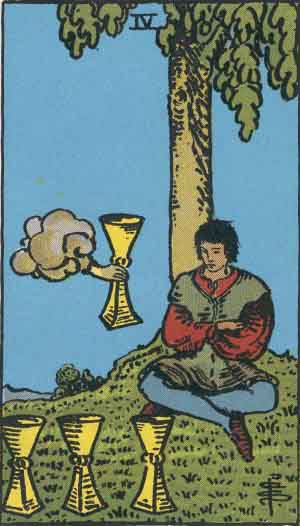
A figure sits beneath a tree, arms crossed, watching three cups before them. A fourth cup is extended from a cloud and not seen. The question this card keeps returning to ask is not why the seeker is unhappy, but what they are actually looking for that is not where they are looking.
Core Repeating Message
The Four of Cups shows a solitary figure seated under a tree in a posture of withdrawn contemplation. Before the figure sit three cups. From a cloud nearby, a hand extends a fourth cup. The figure’s gaze is interior; the offered cup goes unnoticed. The image asks whether something available has gone unregistered because the seeker’s attention is elsewhere.
This is not a card of laziness or ingratitude. It depicts a human state in which attention has narrowed and engagement is limited. The three cups can represent what is already present, while the fourth suggests something not yet evaluated. Withdrawal may obscure an option, but it may also protect capacity or register that the available choices are genuinely insufficient.
When this card appears once, it can symbolise contemplation, temporary flatness, or disengagement. When it appears repeatedly, it may invite review of dissatisfaction, withdrawal, and the quality of available choices. It does not diagnose a chronic pattern or predict when engagement will return.
One pattern is the seeker experiencing emotional flatness or reduced interest, with a persistent sense that what is present does not satisfy. Tarot cannot distinguish boredom, grief, burnout, medication effects, depression, physical illness, or an accurate response to limited options. Persistent or concerning changes deserve qualified assessment rather than symbolic explanation alone.
A second pattern is the seeker who has withdrawn into themselves in response to difficulty and who has not yet found the thread back out. The withdrawal was appropriate once; it offered protection and the interior space needed for recovery. But the conditions that made withdrawal necessary have changed, and the withdrawal itself has become the obstacle. The seeker is still under the tree, still arms crossed, still not registering that what is extended toward them may now be genuinely nourishing.
A third pattern is the seeker who is being choosy in a context where greater discernment is needed. This is the Four of Cups in a more positive register: the seeker who is waiting, thoughtfully and consciously, for something genuinely aligned before committing. The three cups before them do not satisfy because they are genuinely insufficient, and the seeker knows this without fully knowing what they are waiting for. The card returning in this context is asking them to bring more consciousness to the waiting: to know more clearly what they are looking for rather than simply knowing that what is present is not it.
A fourth pattern concerns attention fixed so firmly on familiar options that an unfamiliar one has not yet been evaluated. The fourth cup is a symbol, not proof that an opportunity exists or that its timing is right. The seeker can widen the field while still checking evidence, cost, consent, and fit.
Whatever the form, the card is patient. The figure has not walked away. The cup is still extended. Nothing in the image is closed; everything is simply waiting for the seeker’s orientation to shift.
When This Card Repeats Weekly
A week of Four of Cups repetition may mirror emotional flatness, withdrawal, dissatisfaction, or a need for reduced stimulation. The practical question is what current facts, bodily needs, and environmental conditions support rest, assessment, or renewed engagement.
This may be a week of genuine exhaustion, following a period of significant output, in which the seeker is not so much refusing what is offered as unable to access the aliveness that would allow reception. Even where something welcome is offered, the seeker may not yet have the energy to take it in.
The weekly repetition may also be marking a specific situation of dissatisfaction: something in the week’s landscape that is not working and that the seeker is sitting with rather than acting on, neither accepting nor moving on from. The card is asking whether the sitting is necessary contemplation or whether it has become a way of avoiding the discomfort of a decision.
When This Card Repeats Monthly
A month of Four of Cups repetition may prompt the seeker to track whether withdrawal or reduced interest is persistent, situational, worsening, or relieved in particular contexts. Duration matters, but the card cannot determine whether temporary apathy has become a psychological condition.
The monthly framing asks the seeker to look across the month and notice: what has been available that has not been received? What opportunities, connections, moments of aliveness have been present while the seeker’s attention was fixed elsewhere or turned inward? The card is not asking the seeker to manufacture enthusiasm they do not feel. It is asking them to notice whether the contraction changes with rest, context, or the quality of what is offered, rather than treat the present flatness as a verdict on everything available.
A month of this card may also mark the seeker who is in need of more contemplative time than their current life allows: who needs the quiet under the tree but keeps having to be somewhere else. In this case, the dissatisfaction with what is available may be partly a communication from the interior about the quality of attention the seeker’s life is actually providing.
When This Card Repeats Seasonally
A season of Four of Cups appearances can mark a significant period of interior withdrawal that has its own integrity and purpose. This can be a fallow time: not producing, not pursuing, not actively building, but sitting with something that requires the particular patience of the figure under the tree.
This is not necessarily problematic, but it becomes so when the seeker begins to lose the distinction between necessary withdrawal and withdrawal that has become habitual. A fallow period can have a quality of quiet gestation, of something developing underneath the stillness. If the retreat no longer supports that work, the stillness may become stagnation and the seeker may miss opportunities without knowing why.
The seasonal repetition asks what the withdrawal is doing, what it costs, and how the seeker will review it. Some opportunities expire and others do not, so practical deadlines should be checked directly rather than inferred from the image. A review date, outside perspective, or professional assessment can help distinguish rest from harmful disengagement.
When This Card Repeats Across Years
The Four of Cups returning across years or major life phases can raise a long-running question about dissatisfaction or withdrawal. Similar experiences can recur for different reasons across time, including circumstances, health, access, loss, discrimination, temperament, or learned protection. The card does not establish a fixed personality structure.
For some seekers, this long-arc pattern involves emotional self-sufficiency so complete that engagement with what is externally available has come to feel somewhat unnecessary. They found the interior life rich enough to live in. What can be harder is the corresponding engagement with what is offered from outside: when an outside offer is present, it may go unregistered, not because the seeker is broken, but because they have become so habituated to the interior landscape that the exterior offering simply does not reach them.
Across years, the growth this card asks for is not more productivity or more social engagement. It is the specific quality of attention that genuine presence requires: the capacity to turn toward what is actually available, to see the three cups with fresh eyes rather than through the accumulated lens of what they have failed to be, and to notice a cup they might previously have overlooked.
Life Area Interpretations
Love & Relationships
In love and relationships, the Four of Cups most often marks the seeker who is dissatisfied with what is present and cannot fully account for why. The relationship may be genuinely good, or the potential connection may be available, and the seeker remains in a position of arms-crossed contemplation: not quite accepting, not quite rejecting, not quite engaged.
This might manifest as the chronic sense that the person in front of them, while genuinely good, is somehow not quite right: the persistent awareness of what is missing rather than inhabiting what is present. The seeker compares actual relationships against an interior image of what relationship should feel like and consistently finds the actual falling short. The useful question is whether that image obscures the relationship’s value or helps them recognise a mismatch.
The card may also mark the seeker between relationships who has been offered genuine possibilities and, for reasons they cannot always articulate, has not been able to move toward them. The cup is extended. Something sits with crossed arms.
Career & Purpose
In career and purpose, the Four of Cups marks the seeker who knows their current work does not fully satisfy and who has not yet been able to identify what would. There is a quality of vocational ennui: the work is performed competently, sometimes very competently, but without aliveness or a sense that this is the work that matters.
The fourth cup can represent a creative or vocational option not yet considered, or a different use of existing skills. Before treating it as opportunity, the seeker should establish what is actually available and whether it meets material, ethical, accessibility, and practical needs.
The card returning in career contexts asks the seeker to be honest about whether the dissatisfaction is pointing toward genuine misalignment that needs to be acted on, or whether it is a more general emotional weather that would persist regardless of what work they were doing.
Money & Stability
The Four of Cups in financial contexts can describe difficulty feeling secure even where material stability is present, or a tendency to minimise that stability rather than fully register it. Whether the finances are stable needs to be established from the circumstances, not from the card.
There may also be a quality of waiting: the seeker who is waiting for some future state of material abundance before engaging with their current financial reality, as if the three cups before them are merely placeholders for the one that would truly satisfy. This waiting can interfere with stewardship of what is present and sustain a sense that it is never enough. That subjective pattern can coexist with external constraints; it does not explain away an actual shortfall.
Spiritual Growth
In spiritual growth, the Four of Cups marks the seeker in spiritual ennui: the sincere practitioner who continues their practice and consistently feels that something essential is not being reached. The prayers are said, the meditations are sat, the readings are done. And underneath, a quality of spiritual flatness persists.
The fourth cup extended from the cloud can be spiritually significant for this seeker: an offering, a direction, a practice or teacher or form outside the familiar frame may reach something the current practice is not reaching. Saturation with what is already present can make it difficult to notice what else might nourish. The question is whether an unfamiliar approach deepens the practice, not merely whether it is new.
The card asks the seeker to hold their current practice with more lightness: to practise without requiring the practice to produce a particular quality of experience, and to remain open to the arrival of something that may come from a direction not yet anticipated.
Emotional & Mental Patterns
In emotional and mental patterns, the Four of Cups can describe a relationship to emotional experience in which the seeker is attentive to their own interior but has developed a self-sufficiency that makes engagement with what is externally available feel somewhat unnecessary or somehow insufficient.
The seeker knows their own feeling-life very well. They have rich inner experience. But the aliveness they access in the interior is not consistently matched by genuine aliveness in the exterior, and over time this gap becomes a kind of chronic mild disappointment with what the world offers relative to what the interior world provides.
The mental pattern that accompanies this is often a comprehensive awareness of what is wrong with what is available: an ability to identify what is missing, what is not quite right, what does not satisfy, without a corresponding ability to identify what is actually present that is genuinely good. The four cups framing is revealing: one cup per perspective, and three of them are in front of the figure, visible and not quite satisfying, while the new one arrives from a direction the seeker has not yet turned.
Family & Generational Dynamics
In family dynamics, the Four of Cups can give an image to the seeker who learned early that withdrawal was an intelligent response to an environment that did not reliably offer what was needed. For someone who recognises this history, the withdrawn figure under the tree recalls a family system in which reaching out produced insufficient return.
The child who consistently reached and found the cup empty may develop, in intelligence and self-protection, the capacity to not reach. As an adult, this can take the posture of the Four of Cups: present, thoughtful, self-contained, and not quite oriented toward what might be arriving. The three cups before the figure may look very much like the cups the family offered, and the seeker’s crossed arms may reflect genuine learned caution about cups that look like those.
The generational work this card marks is the gradual development of the capacity to distinguish genuine nourishment from the family’s insufficient offering: to consider the fourth cup because it arrives from a different direction, while finding out whether it offers something the familiar three did not.
Health & Energy
In health and energy readings, the Four of Cups can symbolise the lived experience of reduced energy, interest, or engagement. These changes have many possible medical, psychological, social, environmental, and medication-related causes. The card cannot define them as mild depletion or show whether someone is flourishing.
The card invites a practical inventory of rest, nourishment, movement, treatment, sensory load, meaningful activity, and social contact, with attention to what is accessible and what has changed. Persistent, severe, or sudden symptoms warrant qualified assessment, and urgent symptoms require urgent care. Pleasant activity may support wellbeing but is not a substitute for treatment.
Advanced Interpretive Sections
The Shadow Expression
The Four of Cups in shadow depicts the seeker who has elevated their own dissatisfaction into a form of identity: the person for whom nothing is ever quite right, whose critical faculty has become so comprehensive that appreciation has little room to develop. This shadow can wear the clothing of discernment, of high standards, of genuine sensitivity, while functioning as a defence against vulnerability to the present.
A second shadow is the seeker who uses the withdrawn contemplative posture to avoid a decision: who remains under the tree indefinitely because as long as the cup is not yet drunk, no commitment has been made and no disappointment has been risked.
The Integrated Expression
The integrated Four of Cups seeker has developed a flexible relationship to both solitude and engagement: they can withdraw when withdrawal is needed, and they can return when the contemplation has served its purpose. They neither perform constant openness nor allow withdrawal to become their only response.
This seeker can receive the fourth cup when it arrives: they have enough curiosity about what is being offered from unexpected directions to turn toward it. They can also look at the three cups with fresh eyes and find, sometimes, that what was present and unsatisfying contains something that, on re-examination, is genuinely nourishing after all.
Why This Energy Has Not Released Yet
The Four of Cups pattern may persist when the seeker has not yet been able to examine what they are actually looking for. Dissatisfaction with what is present can contain information about what is wanted, but the longing may not yet be explicit enough to act on. The vague sense of insufficiency continues; the specific understanding of what sufficiency would look like remains underdeveloped.
The pattern can also persist when the seeker’s withdrawal has never been acknowledged as sometimes appropriate. The person who learned to withdraw intelligently often cannot distinguish necessary withdrawal from habitual withdrawal, because they were never told that withdrawal was ever justified. Everything gets managed with the same crossed arms.
Finally, the pattern tends to persist in seekers who are carrying an unspoken grief about what has not been available in their life: not acute loss but the longer, quieter grief of chronic insufficiency, of needs that were present and not consistently met. Naming and feeling this grief, rather than only managing it from a distance, may help the seeker understand what the posture under the tree still protects.
What This Card Wants the Seeker to Understand
The Four of Cups asks the seeker to consider whether an option may exist outside the current frame. It does not guarantee that a fourth cup is present or beneficial. Orientation expands what can be noticed; evidence determines what is actually available and worth receiving.
The card also wants them to understand that genuine contemplative withdrawal is not the same as habitual avoidance. Contemplation can provide rest or clarity and make renewed engagement possible. Avoidance keeps the seeker at a distance from choices or experiences they might otherwise want to meet; dissatisfaction alone does not establish which is happening.
Signs the Pattern Is Beginning to Resolve
The Four of Cups pattern begins to resolve when the seeker notices something that genuinely catches them: a moment of real interest, real aliveness, real orientation toward something in the external world. The seeker who begins to turn toward the fourth cup, even tentatively, is showing movement.
It also resolves when the seeker can look at what they have and find something genuinely worth appreciating, not from performed gratitude but from recognition that what is present has value even if it is not everything they might have wished for.
And it resolves when the seeker can articulate precisely what they are actually looking for: not just what does not satisfy, but what satisfaction would involve for them. This specificity transforms the dissatisfaction from a chronic climate into a navigable set of desires.
Reflective Questions
-
What in your current life are you genuinely dissatisfied with? Is this dissatisfaction specific enough to act on, or is it a general atmospheric quality that follows you from situation to situation?
-
When you think about what you are genuinely waiting for, what is it? Can you describe it precisely? Or does the thing you are waiting for remain somewhat vague, the thing that is not this?
-
The Four of Cups presents three visible cups and one extended from a cloud. What option might sit outside your current frame, and what evidence would establish whether it is genuinely available and suitable?
-
What is your relationship to solitude and withdrawal? Do you have access to interior spaciousness when you need it, or has the withdrawal become so habitual that you cannot always distinguish it from need?
-
Is there a grief in your emotional or vocational or relational life that you have been sitting with under the tree rather than genuinely moving through? What would genuinely moving through it require?
-
What did your family of origin teach you about reaching for what is offered? Was reaching generally rewarding, or did it consistently produce insufficient return?
-
When genuine aliveness occurs in your life: a moment of real interest, real pleasure, real engagement, do you notice it? Do you allow it to fully register before it passes?
-
What would it mean to look at the three cups in front of you, the things that are genuinely present in your life, with completely fresh eyes, as if you had never seen them before? What might you find?
-
Is there something in your current life that you have decided is insufficient and have stopped engaging with, that might, on reconsideration, contain something worth receiving?
-
What would it take for you to genuinely extend your hand toward the fourth cup? Not in principle, but practically and specifically: what conditions, what quality of internal readiness, what specific shift would allow the gesture?
Practical Integration Actions
Name what you are actually looking for. Spend twenty minutes writing about what genuine satisfaction would look like in the domain of your life where the Four of Cups feels most relevant. Not what is missing, but what the presence of sufficiency would actually feel like, look like, be. Specificity is essential here; vague longing and specific desire require different responses, and what can be named can be worked toward.
Practise genuine appreciation for what is already present. Once a day for two weeks, name one thing that is genuinely good in your current life, not in a performed-gratitude way but as acknowledgement of actual value. The practice is not about minimising dissatisfaction but about restoring access to the full picture: the three cups that are there alongside the one that is not yet held.
Examine your withdrawal pattern. Reflect on the last time you withdrew from something genuinely available: a conversation, an opportunity, a connection, a moment of pleasure. What specifically produced the withdrawal? Was it genuine need for interiority, or was it the habitual crossed arms? Understanding your specific withdrawal pattern is the beginning of being able to choose it rather than simply default to it.
Turn toward something unexpected. For one month, test one low-risk option outside your usual frame: a different creative activity, form of connection, or practical support. Define the cost, time limit, boundaries, and evidence you will use to assess it. Curiosity does not require commitment, and an unfamiliar cup may still be unsuitable.
Grieve what has genuinely been insufficient. If the dissatisfaction you carry is partly a response to deprivation, to insufficient care or nourishment or opportunity, give that grief some honest time and acknowledgement. Not the performance of processing, but genuine contact with what was inadequate and what it cost. This can be part of the work that allows the crossed arms to gradually open.