
When the Seven of Wands repeats, defence has become a continuing demand. The question is which pressure is real, which boundary is proportionate, what the position costs to hold, and whether vigilance is protecting the work or preventing it from developing.
Core Repeating Message
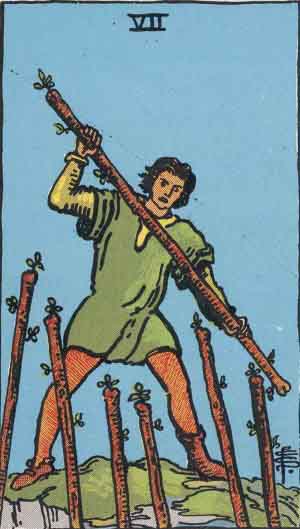
The Seven of Wands shows a figure standing on elevated ground, one wand raised to defend their position against six wands rising toward them from below. The figure has the advantage of height; they are not being overwhelmed. But they are also pressed, leaning into the challenge, holding the wand forward in a posture that is entirely defensive: not advancing, not retreating, simply holding the line against what is pushing toward them.
When this card appears once, it may describe real pressure on the seeker’s choices, values, work or position. When it repeats, it can indicate sustained external opposition, a habitual expectation of attack, or both. This distinction matters: the card should not persuade someone to lower a necessary boundary, and it should not convert ordinary disagreement into proof of persecution.
One common pattern is the seeker who has creative or vocational fire and who exists in an environment that challenges it: a professional context that does not easily accommodate their direction, a personal circle that questions their choices, a cultural or familial environment in which what they are doing is not the expected thing and is regularly treated as something that requires justification. This seeker’s defensive posture is not a distortion; it is a response to real and sustained challenge. What the card’s repeated return is asking is whether the sustained challenge has now shaped the seeker’s relationship to their own creative ground in ways that outlast the original challenge, and whether the wand is still raised even in situations where the challengers below have actually gone.
A second pattern is the seeker who has become so thoroughly identified with being challenged that they now bring a defensive quality to situations that do not contain an actual challenge. The expectation of opposition is so well established that the seeker reads neutrality as concealed challenge, sincere curiosity as veiled criticism, and mild questions as the beginning of an attack on the ground they stand on. The wands below are sometimes there; at this stage, sometimes they are being generated by the seeker’s own anticipation.
A third pattern belongs to the seeker who can only feel the value and validity of their creative work or vocational choices when those choices are being challenged. Without opposition, the fire feels less certain, the ground less solid, the direction less clearly their own. The challenge organises the seeker’s conviction in ways that ordinary forward movement does not. This seeker has developed a dependence on opposition as the structure through which creative commitment is experienced and confirmed, and the dependence can produce an unrecognised tendency to position themselves or their work in ways that reliably generate the opposition that confirms the commitment.
A fourth pattern is the seeker who continues to defend a position after time and changed circumstances have made that level of defence unnecessary. The battle that shaped the posture was real, and so was the learning from it. But the people, environment or conditions that made the raised wand necessary have changed or are no longer present. The seeker still holds the hill with the diligence of someone in the original battle; they may know circumstances are different while still feeling braced for the old challenge.
What all these patterns share is the relationship between the seeker’s fire and the experience of being challenged: a relationship in which defence has become so primary that the fire’s natural forward movement has been significantly redirected into the sustained holding of position rather than the building of what the position was claimed for.
When This Card Repeats Weekly
A week of Seven of Wands repetition can mark immediate pressure on the seeker’s creative choices, vocational direction or personal values. The work is to hold the position without giving way automatically or losing discernment about which challenges need a response and which can remain at the perimeter.
The card this week asks for evidence: what was said or done, who has decision-making power, what consequence is possible and what response is proportionate? If coercion, harassment, abuse or a safety risk is present, seek appropriate support and preserve necessary boundaries. If the evidence shows ordinary friction, a less defended response may reveal more information.
The practical question is direct: what specifically is the seeker being asked to justify, defend, or hold against challenge this week, and is that challenge requiring the full defensive posture it is receiving?
When This Card Repeats Monthly
A month of Seven of Wands repetition suggests that the seeker is in a period of sustained challenge to their creative or vocational direction, or that the characteristic posture of defensiveness is appearing across multiple contexts in ways that are worth examining.
The monthly lens asks the seeker to look at what has been consistently under challenge across the month. Is there a common theme to what is being challenged, or does the challenge seem to arise regardless of the specific terrain? Is the seeker defending the same position in multiple different contexts, which might suggest that the position is important and under challenge, or is the seeker finding challenge everywhere, which may suggest the defensive posture is operating independently of the specific terrain?
A month of this card also marks the seeker who is in a period of visibility: whose creative work or vocational direction is being seen by a wider audience and is therefore receiving a wider range of responses, some of which are challenging. The Seven of Wands in this context is marking the challenge of sustaining creative direction under public scrutiny without becoming primarily defensive.
When This Card Repeats Seasonally
A season of Seven of Wands energy marks a sustained period in which the seeker’s creative, vocational or personal ground is under pressure from multiple directions, and the capacity to keep standing firm is being tested across several months.
A central distinction a Seven of Wands season asks the seeker to make is between the challenges that require the raised wand and those that have accumulated into the general atmosphere of defensiveness without each one being a threat to something worth defending. A season is long enough to begin to see the difference.
The season also invites the seeker to examine the cost of sustained defensive posture over time. The figure on the hilltop in this image has the physical and energetic quality of someone who has been holding this position for a while. Sustained defence can be costly. The question the season is raising is whether the investment is being made in territory that warrants it, and whether any of the sustained effort could be released without losing protection that is still needed.
When This Card Repeats Across Years
The Seven of Wands returning across years names a seeker for whom the relationship between their fire and the experience of challenge has been a long-arc defining dynamic: who has, across multiple phases of their life, consistently found themselves in the posture of defending their creative, vocational or personal position against sustained pressure.
One possible origin is an early environment in which self-expression was challenged, diminished or repeatedly made to justify itself. Another is prolonged exposure to real institutional, cultural or relational opposition in adult life. The card cannot determine the source, and not every guarded response is misplaced. The task is to compare the conditions that trained the defence with the conditions operating now.
The multi-year Seven of Wands also marks the seeker who has found, over time, that their most distinctive work and individual creative direction generate the strongest challenge from the world around them. This is a real and important dynamic. The question across years is whether the seeker is still inhabiting and advancing that direction, or whether the consistent experience of challenge has gradually shaped it towards what is easier to defend rather than what is most distinctly theirs.
Across years, the growth arc this card traces is towards creative equanimity: the capacity to stand in one’s own creative ground without requiring either the challenge to confirm its value or the absence of challenge to feel safe in it.
Life Area Interpretations
Love & Relationships
In love and relationships, the Seven of Wands most often marks the seeker whose characteristic posture within intimate relationships carries the quality of defensive vigilance: who brings to relational life the anticipation of challenge to their autonomy, their choices, or their right to occupy their chosen relational ground.
This might be the seeker who experiences partner feedback as an attack and moves quickly into rebuttal before understanding the concern. It might also be someone whose boundaries are repeatedly tested and whose defence is warranted. Intimacy requires openness to influence, but it does not require accommodation of contempt, coercion or harm. The evidence of the relationship must decide which reading applies.
The card may also mark the seeker who has, in previous relationships, been required to defend their creative fire, their vocational direction, or their personal values against a partner who challenged them repeatedly. The defensive posture that was required in that relationship can persist into subsequent ones, producing a seeker who brings the experience of a previous battle into a relational space where the battle is not actually present.
Career & Purpose
In career and purpose, the Seven of Wands is among the most recognisable patterns: the seeker whose most personally meaningful creative or vocational direction is consistently the one that generates the most challenge, and who has spent significant creative energy in the defence of their direction rather than in its development.
This is a real creative predicament. Distinctive work can generate friction. The seeker is not wrong to hold the position. What the card’s repeated return is asking is whether the defence is serving the work or whether the sustained experience of defending it has begun to shape the work itself, pulling it toward positions that are easier to defend even when they are not the most productive creative directions.
The card can also describe a vocational environment that is genuinely hostile to the seeker’s direction. The question may then concern documentation, allies, formal process, professional advice or an exit plan, not simply a better attitude toward challenge. It also asks whether this is ground the seeker would want to occupy after the immediate challenge recedes. Leaving is not always immediately safe or affordable, so timing and material constraints matter.
Money & Stability
In financial contexts, the Seven of Wands may reflect pressure on a business, strategy, income source or financial boundary. This may involve market pressure on a business, changed conditions for a strategy or financial risk attached to a vocational direction. Commitment alone does not prove that the defended position remains sound, and opposition alone does not prove that it is wrong.
Test the position with current figures, downside exposure, contractual obligations and independent evidence. Distinguish intrusive opinion from informed concern, and notice whether a reflexive defence is preventing useful information from being considered. Material decisions may require qualified financial, legal, tax or debt advice, especially where persistence could deepen loss.
Spiritual Growth
In spiritual growth, the Seven of Wands marks the seeker whose spiritual direction is in tension with the expectations of a religious, spiritual, or cultural community: who has developed spiritual understanding or practice that is distinctive from what their community endorses, and who is in the work of holding their spiritual ground against the pressure of inherited or institutional expectation.
This is a real and significant spiritual experience. The seeker who has found their own spiritual truth and is holding it against community pressure is doing something brave and costly. What the card’s repeated return is asking is whether the holding is producing spiritual development, or whether the posture of defence has become so primary that the development of the spiritual direction has been partly displaced by the sustained effort of defending it.
The spiritual work the card marks is developing creative spiritual authority that does not require external validation to be secure, and does not require external challenge to feel alive.
Emotional & Mental Patterns
The Seven of Wands in emotional and mental patterns may symbolise ongoing readiness to defend a position, choice or direction. This can be an adaptive response to real pressure, a habit that has outlasted its context, or a mixture that changes from one setting to another.
Where anticipation is strong, neutral questions may be heard as probes and mild feedback as attack. Yet this should be tested against observable interactions rather than assumed. Ask what another reasonable observer would identify, whether the same pattern appears across contexts and whether some environments are in fact less safe than others.
Sustained vigilance can feel costly even when no challenge is currently present: body and mind may remain braced for a response that is not being required in that moment. Over time, that readiness can become tiring.
Family & Generational Dynamics
In family dynamics, the Seven of Wands may invite inquiry into whether the seeker’s nature, direction or choices repeatedly required justification. Family expectations can shape later defensive habits, but the card cannot establish that history or determine that every present conflict is a repetition of it.
Where a person has repeatedly had to defend their nature or direction, the habit may travel beyond the family setting in which it began. The wand can remain raised in anticipation even when the new environment is different. The work is to notice where that learned readiness still fits and where it no longer does.
The generational work the card marks is the gradual development of the capacity to stand in one’s own fire without needing either to justify it to external challengers or to require the challenge in order to feel certain of its validity.
Health & Energy
In health contexts, the Seven of Wands may symbolically reflect the felt experience of being braced or unable to stand down. Tarot cannot identify a nervous-system state, explain muscular tension or diagnose a health condition.
If shallow breathing, held shoulders, jaw tension, pain, fatigue or sleep disruption are present, treat them as real symptoms with many possible causes. Note whether they change across settings, and seek appropriate assessment when they persist, worsen or interfere with daily life.
A safe, brief reduction in non-essential vigilance can be an experiment, but only where no active threat is present. Notice whether the body feels different, including any ease or unfamiliarity as bracing softens, and treat the observation as personal feedback, not confirmation that the symbolic reading is medically correct.
Advanced Interpretive Sections
The Shadow Expression
The Seven of Wands in shadow produces the seeker who has become so thoroughly organised around defence that the advance has been almost entirely abandoned. Every creative or vocational energy is dedicated to holding what has already been claimed; none is being invested in further development or forward movement. The position is held, and it stays exactly as it was when the defence began.
The shadow can also appear when defensive communication contributes to the opposition the seeker expects. For someone who has learned to feel committed mainly through opposition, that escalation may occur before they recognise how it helps confirm their stance. This does not mean all opposition is self-created. It means tone, timing, framing and escalation should be included in the evidence, alongside the conduct and power of the people or systems applying pressure.
The Integrated Expression
The integrated Seven of Wands seeker has developed the capacity to hold their creative or vocational ground with clarity and equanimity: they can sustain direction without requiring either challenge to confirm it or universal approval to feel safe in it. They know what is worth defending and what is not, and they have developed sufficient creative confidence that the distinction is available to them in real time rather than in retrospect.
This seeker’s fire is advancing. The position on the hill is not static; it is the base from which further movement is happening. The wand is available when a challenge requires it, and it is down when no challenge is present.
Why This Energy Has Not Released Yet
The Seven of Wands pattern may persist when current threat, ordinary disagreement and remembered danger have not been separated clearly. It may also persist because the challenge is real and ongoing. Resolution therefore begins with evidence, proportionate boundaries and support, not with an instruction to become less defended in every setting.
The pattern can also persist when the seeker has not yet examined the function that challenge serves in their experience of creative commitment. If challenge is the primary way the seeker knows their position is their own, the removal of challenge produces not ease but uncertainty about the legitimacy of the ground they stand on, and they may continue to seek or contribute to challenging situations because the alternative feels less certain rather than more peaceful.
Finally, the pattern persists when the seeker has not yet reckoned with how much forward creative movement has been redirected into sustained defence. The grief of the creative or vocational ground that was not developed while the wand was raised in its defence is real, and until it is acknowledged, the cost of the pattern remains below the level of full awareness.
What This Card Wants the Seeker to Understand
The Seven of Wands wants the seeker to understand that the figure already occupies the high ground in this image. It was not given to them by the challenge; the challenge only made the value of the ground visible. What the card is asking is whether, having held the position through the original challenge, the seeker has yet turned around to look at what the high ground actually offers when the attention is not directed solely downward toward the challengers below.
The fire that has been used entirely for defence is still fire. It could also build things. The card is asking whether any of it is available for that.
Signs the Pattern Is Beginning to Resolve
The Seven of Wands pattern begins to resolve when the seeker begins to notice, in specific situations, the difference between a challenge that requires a response and the anticipatory defensive posture that is applying itself regardless of whether a challenge is present. This distinction, felt in real time, is the capacity the card has been asking for.
It also resolves when the seeker begins to invest creative energy in forward development rather than solely in the maintenance of existing position: when the fire starts moving toward something new rather than primarily working to hold what has already been claimed.
And it resolves when the seeker develops an internal sense of the validity of their creative direction that does not require external opposition for its confirmation, so that, when no challenge is present, the wand can be put down without the ground feeling suddenly less solid.
Reflective Questions
-
Think about the specific creative, vocational, or personal position you are currently defending. What specifically is the challenge, and is it currently as present and as active as the defensive posture you are bringing to it suggests?
-
Is there a specific original experience of having your creative fire challenged that shaped your current defensive posture? Can you identify where and when the wand was first raised in this particular way?
-
Is it possible that you are defending a position that no longer requires the specific level of defence it is receiving? Have the conditions that made the defence originally necessary changed?
-
What does being challenged do for your sense of the validity of your creative or vocational direction? Is there a way in which challenge confirms the genuineness or the value of what you stand for that its absence does not?
-
Have there been situations in which your defensive anticipation changed the tone or escalated the exchange? What evidence shows your contribution, and what evidence shows that opposition was already present independently of you?
-
What would your creative or vocational energy look like if it were not primarily directed toward defence? What might be built or developed on the high ground if the wand were put down?
-
What did your early environment communicate about whether your fire was worth defending? Was it consistently challenged, consistently ignored, or consistently supported? What did you learn from this about the relationship between your fire and the world’s response to it?
-
Do you currently experience creative equanimity, the capacity to stand in your own direction without requiring either external challenge or external approval? Or does your sense of your creative position’s validity fluctuate significantly with the presence or absence of challenge?
-
What is the creative or vocational work most true to your direction that you have deferred or under-developed while your energy was primarily invested in defending your current position?
-
If the Seven of Wands has been appearing for a sustained period, what specifically is the position it has been marking as under challenge? And what would resolution of that challenge, or peace with the ongoing challenge, actually look like?
Practical Integration Actions
Map the genuine challenges. Write out specifically the challenges that are currently active in your creative, vocational or personal life: the people, environments or pressures pushing on your position. For each one, note honestly whether the challenge is currently active and requiring a response, or whether the challenge was more active in a previous period and the defensive posture has persisted after the conditions that required it changed.
Put the wand down briefly. Choose one low-stakes context that is demonstrably safe and in which you habitually over-explain or rebut. Experiment once with asking a clarifying question, pausing or stating the boundary without extended defence. Do not use this exercise where coercion, harassment, abuse, financial exposure or safety risk is present. Use just one interaction, meeting or conversation. Notice how holding the position without extended defence feels in the body, whether the anticipated challenge actually arrives, and what else happens. Record these observations.
Examine the function of challenge. Write specifically about what challenge provides in terms of your experience of your own creative or vocational commitment. Does being challenged make your direction feel more certain or more valid? If the challenge were absent, would the direction feel as genuinely yours? This is important information about whether creative confidence is present or whether challenge is currently performing a function that should be internal.
Invest fire in development, not just defence. Identify one development deferred while energy went into holding the position. Allocate a bounded amount of time or resource to it without removing protection that remains necessary. The aim is to restore forward movement alongside proportionate defence, not to expose the work prematurely.
Practise creative equanimity. Once each day, spend a few minutes with your creative or vocational direction without either defending it or seeking external confirmation of it. Simply hold it in quiet attention: this is what I am building, this is what I want to be making or doing, this is the direction that is mine. Notice whether the direction feels solid and your own in the absence of both challenge and external approval, and notice what the quality of that experience is.