
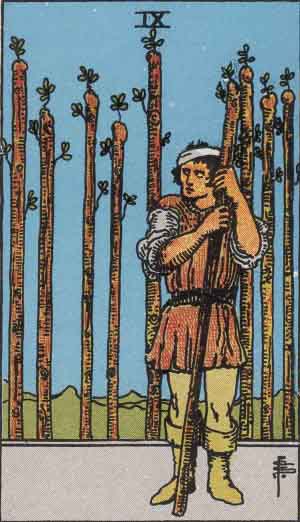
When the Nine of Wands repeats, endurance has accumulated a cost. The seeker may have good reason to remain watchful, but the live question is whether the present still requires the same guard and whether continuing, resting or leaving can become a deliberate choice.
Core Repeating Message
The Nine of Wands shows a figure leaning on a wand, bandaged at the head, turning to look behind them with an expression that holds both weariness and wariness. Eight wands are planted in a row behind the figure: the evidence of what has been carried, defended, and persisted through. The figure is not fallen. But the figure is also not advancing. They are in the posture of someone who has come through something difficult and is standing in the aftermath of it, assessing whether they have enough left to continue.
When this card appears once, it may reflect a moment in which effort has been costly and the next decision cannot be reduced to pushing harder. When it appears repeatedly, it can describe a person who keeps arriving at the same guarded threshold: still functioning, but unsure whether resilience now requires continuation, rest, renegotiation or withdrawal. The facts of the situation, including safety and material constraints, must decide which response is appropriate.
One common pattern is the seeker who has been hurt by the work of their own creative or vocational life and who has continued through the hurt in the way that the figure in the image continues: still standing, still in the field, but carrying the wound rather than tending it. The hurt might be professional disappointment, creative rejection, relational difficulty arising from creative or vocational commitment, or the exhaustion of having given significant effort to something that did not return what the effort warranted. The figure continues. The wound is real. The question the card keeps asking is whether continuing is chosen or whether the seeker has never stopped long enough to ask.
A second pattern is the seeker for whom the Nine’s posture of vigilant endurance has become a permanent identity rather than a response to a particular phase of difficulty. This seeker is recognisable by readiness for the next difficulty: they are always prepared for what is coming, always on alert for the next challenge, always positioned as someone who is managing through something rather than at rest. The original difficulties that produced this posture were real. But the posture has now extended into contexts where it is not required by the current situation: the seeker is on guard in environments that are not threatening, wary of people who are not challenging, braced for impact in periods that do not warrant it.
A third pattern belongs to the seeker who has developed a cyclical relationship to their own creative or vocational fire: who extends fully, gives wholeheartedly, pushes through difficulty, arrives at the Nine’s state of exhausted resilience, recovers enough to resume, extends again, arrives at the Nine again. The cycle is productive in many ways: things get done, work gets made, significant difficulties get navigated. What the cycle does not include is rest, care for the accumulated wound or reassessment of whether the current direction is worth the cost the cycle consistently produces.
A fourth pattern belongs to the seeker whose identity has become so thoroughly organised around being the person who endures that the relinquishment of the burden would feel like the relinquishment of themselves. This seeker does not continue because they have consciously chosen to continue; they continue because stopping, resting, asking whether this is the right path, would require them to engage with a version of themselves that is not the Nine’s figure, and that version is not yet known to them. The burden is not only a burden; it is also an identity, and identities are not set down as easily as packs.
What all these patterns share is a relationship to the wound that the Nine’s figure carries: the wound is real, the resilience is genuine, and the cost of the sustained endurance is accumulating in ways that the seeker may not yet be fully aware of because the continuing is so habitual it no longer feels chosen.
When This Card Repeats Weekly
A week of Nine of Wands repetition marks an immediate experience of weariness combined with continuing pressure: the feeling of having already given a great deal and being asked to give more, of being at the end of one’s available resources while the demands of the situation have not yet been met.
The card this week is asking the seeker to be honest about their actual state: not the state they are performing for the people around them or the state they feel they should be in, but the actual current quality of their energy, their resilience, and their relationship to the continued demands of the situation. Are they able to continue? Is the continuation chosen? Or is the figure in the image a mirror of a present experience of exhausted persistence that has not yet been given acknowledgement?
The weekly question is also: what would it actually mean to tend the wound this week, even briefly? Not abandon the field, not stop permanently, but attend to what has been injured rather than continuing to carry it as a condition of ongoing movement.
When This Card Repeats Monthly
A month of Nine of Wands repetition suggests that continuing through costly effort is becoming a visible pattern: rest is repeatedly deferred, and the costs of creative or vocational commitment are carried without being fully understood or cared for. The pattern is becoming more entrenched rather than finding resolution.
The monthly lens asks the seeker to look at what has accumulated across the past weeks: not the accomplishments, which are real, but the costs. What has the continued forward movement cost in terms of energy, in terms of the relationship to the original creative fire, in terms of the accumulation of unprocessed difficulty and unacknowledged wound? The monthly recurrence is asking whether any care has been given to the hurt or depletion that has accumulated, or whether the movement has been continuous and the wound has simply grown larger alongside it.
When This Card Repeats Seasonally
A season of Nine of Wands energy marks a sustained period of hurt and weariness alongside continuing creative or vocational demands. It asks for discernment: what is worth continuing, at what pace, and with what care for the person who has been in the field for a long time?
A central question in a Nine of Wands season concerns permission: can the seeker rest, tend the wound and assess whether the current direction is worth its cost before continuing to endure? Part of that permission may need to come from within, especially if stopping feels like weakness. Practical space for rest may also depend on support or changed conditions. The work is to recognise both rather than treat permission as either wholly personal or wholly outside the seeker’s control.
A season of this card also asks the seeker to look honestly at the accumulated cost of the cyclical pattern if it has been cycling: what specifically has been lost or diminished or deferred across multiple cycles of extend-and-endure that has not yet been acknowledged?
When This Card Repeats Across Years
The Nine of Wands returning across years names a seeker for whom the posture of vigilant endurance is a long-arc pattern: who has, across multiple phases of their life, consistently found themselves in the Nine’s position, consistently continued rather than rested, consistently carried the wound of engagement before it had healed.
One possible origin is a family or community in which endurance was the most visible and rewarded form of strength, while rest, help or reconsideration was treated as weakness. Another is repeated exposure to adult circumstances in which stopping genuinely was not affordable or safe. The card cannot establish either history. The useful inquiry is which messages and constraints are still active, and which have become assumptions that no longer match the present.
The multi-year Nine of Wands also marks the seeker who has developed resilience across a difficult creative or vocational history: who has navigated real rejection, real failure, real disappointment, and continued through each of these with creative fire. The resilience is real and it is admirable. The question across years is whether the accumulated cost of the sustained endurance has been seen and attended to, or whether the seeker is carrying the weight of multiple Nine cycles into the present without having allowed any of them to resolve.
Across years, the growth arc this card traces is towards discerning when to continue and when to rest: distinguishing resilience that is chosen from endurance that feels like the only remaining option, and finding what care, support or change could make a different response possible.
Life Area Interpretations
Love & Relationships
In love and relationships, the Nine of Wands most often marks the seeker whose relational life is shaped significantly by the accumulated wounds of previous relational investment: who has loved, committed, been hurt, and who now brings to relational life the quality of the Nine’s figure, vigilant, wary, still present but already positioned for the next impact.
Wariness after hurt may be proportionate, overgeneralised or both in different contexts. It can restrict availability, but intimacy does not require a person to lower necessary boundaries or override evidence of coercion, contempt or harm. The relevant question is whether the current person’s conduct supports gradual trust, and whether the seeker’s guard can respond to evidence rather than to pressure to appear healed.
The card may also mark a current relationship in which sincere effort has carried a real cost, and the question of continuing, pausing or seeking space to recover is live and difficult.
Career & Purpose
In career and purpose, the Nine of Wands marks the seeker who has pursued creative or vocational fire through difficulty and who is at the point of questioning whether the continued pursuit is serving that fire or whether the endurance has become its own kind of momentum separate from creative desire.
This is an important distinction. The seeker who continues pursuing a creative or vocational direction through difficulty is doing something valuable, and the fact that the pursuit has been costly does not automatically mean it should be stopped. The question the Nine is asking is whether the continued movement is driven by that fire or by an inability to stop, and whether the seeker would make the same choice to continue if they rested and asked rather than simply continuing because the alternative has not felt possible.
Money & Stability
In financial contexts, the Nine of Wands may reflect the fatigue of sustained scarcity, debt management, income instability or responsibility for other people. Vigilance may remain necessary, or it may continue after the figures have improved. The card cannot determine which is true.
Compare the felt emergency with current balances, cash flow, obligations and foreseeable risks. A written review can distinguish protective attention from constant scanning that no longer changes decisions. Where debt, contracts, benefits, tax or insolvency are involved, appropriate qualified advice belongs alongside symbolic reflection.
Spiritual Growth
In spiritual growth, the Nine of Wands marks the seeker whose spiritual life has been significantly shaped by spiritual difficulty: a period or experience in which sincere spiritual commitment led to hurt, in which the fire was real and the cost was real and the seeker continues to carry both.
The spiritual wound might be a community that failed the seeker, a practice that was pursued with dedication and produced disillusionment, a sincerely held faith shaken by experience. The continued spiritual engagement of this seeker is not performance; it is resilience. The question is whether the wound is being tended within the spiritual engagement or whether the spiritual engagement is itself being shaped by the need to manage around the wound rather than through it.
The spiritual Nine also marks the seeker who has developed a spiritual identity around endurance through spiritual difficulty, and who may be carrying that identity into spiritual life as a primary defining characteristic rather than as one phase of a longer arc.
Emotional & Mental Patterns
The Nine of Wands in emotional and mental patterns may symbolise a persistent readiness for the next difficulty: scanning, rehearsing responses or finding it hard to believe that a quieter period will last. This may be proportionate to the environment, a learned habit, or an experience with causes the card cannot identify.
Tarot cannot distinguish anxiety, trauma-related vigilance, occupational pressure or another psychological or medical explanation. A readiness learned during real difficulty may persist when conditions ease, but that possibility must be assessed alongside these other explanations. What can be examined is context: where the alertness rises, what evidence of threat is present, how much it changes behaviour and whether it interferes with sleep, relationships or daily functioning. Persistent or distressing experiences may warrant professional support.
The mental counterpart is the weary, vigilant mind: a mind that is always running a background scan of the environment for the next difficulty, always prepared with responses to challenges that may not be coming, always managing pre-emptively for the impact of being in the field.
Family & Generational Dynamics
In family dynamics, the Nine of Wands may invite inquiry into a lineage shaped by hardship and endurance. Stories, roles and remembered responses to difficulty may reveal that persistence was highly valued while rest, help or reconsideration received less recognition. The card cannot establish family history, and present endurance may also arise from current realities.
Where this history applies, the family may be admirable in their resilience. They have navigated things that required the Nine’s persistence through hurt. The inheritance they pass on is one of real toughness and real capacity to persist. What they often do not pass on is permission to rest, ways of tending the wound or examples of the forms of strength that look like stopping or asking for help.
For someone raised where sitting down was not an option, permission to pause may not feel available even when the present situation allows it. The old lesson can remain in expectations and in a felt readiness to keep going. Recognising that gap is part of learning another form of strength.
Health & Energy
In health contexts, the Nine of Wands may symbolically reflect feeling worn down, guarded or unable to recover fully between demands. Tarot cannot determine what the body has absorbed, identify the cause of fatigue or tension, or show what treatment is needed.
If tension, pain, fatigue, sleep disruption or changes in functioning are present, record their timing and seek appropriate assessment when they persist, worsen or concern you. Some people describe an older, accumulated tiredness that feels different from fatigue after one recent effort. A long history of effort may be relevant, but it should not be assumed to explain symptoms that can have many causes.
A protected pause may bring relief, unfamiliarity or no clear shift. Rest may provide useful information about the relationship between demand and energy, but the response will vary and an absence of improvement is not a personal failure. Treat any change as observation rather than proof of the card’s mechanism, and do not use rest alone as a substitute for care that symptoms require.
Advanced Interpretive Sections
The Shadow Expression
The Nine of Wands in shadow can describe an identity so organised around endurance that ordinary choices are repeatedly framed as tests of toughness. The seeker may overcommit, decline available help or remain in familiar conditions longer than necessary. Where difficulty has become central to identity, these choices may preserve a familiar sense of who they are before that purpose is consciously recognised. This does not mean they create abuse, hardship or structural constraint. Responsibility belongs with the people and systems causing harm.
The shadow can also involve continuing to use the wound as protection against the vulnerability of creative or vocational commitment after some conditions have changed. The hurt remains real. The question is whether the guard is responding to current limits and care needs, or also helping the seeker avoid an exposure that may now be manageable.
The Integrated Expression
The integrated Nine of Wands seeker has developed discernment about when to continue and when to rest. They can feel the difference between chosen resilience and endurance that is simply continuing, and can give themselves permission to stop and tend what has been hurt rather than carrying it indefinitely.
This seeker is recognisable by earned equanimity: they have been hurt, they continue with fire, and they have developed the capacity to distinguish between difficulty that requires the Nine’s posture and difficulty that does not warrant the full defensive bracing. They know when to raise the wand and they know when to set it down.
Why This Energy Has Not Released Yet
The Nine of Wands pattern may persist because rest has not felt permitted, because the demands are genuinely ongoing, or because pausing would expose a decision that endurance has postponed. Where stopping is not immediately safe or affordable, resolution may begin with smaller changes, support, documentation or an exit plan rather than an ideal period of complete rest.
The pattern can also persist when the particular hurt has not received the care it needs. Continuing around it may make that need easier to postpone, especially when endurance has become familiar. The question is what kind of attention, support or practical change would help, rather than assuming that private processing alone must resolve it.
Finally, the pattern persists when the endurance identity is so central to the seeker’s sense of themselves that rest would feel like losing their sense of self. Until the seeker has begun to develop a relationship to themselves that includes other modes of being alongside endurance, the endurance continues because it is the primary mode through which the seeker knows who they are.
What This Card Wants the Seeker to Understand
The Nine of Wands wants the seeker to understand that the figure in this image has permission to sit down. Not permanently. Not in defeat. But for long enough to tend the wound and to ask whether to continue, at what pace, toward what, and from what quality of fire.
The card is not asking the seeker to abandon their creative or vocational commitment. It is asking whether the continued pursuit is consciously chosen or whether it has become simply what happens because stopping has never felt like an option. There is a significant difference between those two forms of continuing, and the fire that continues because it is consciously chosen burns very differently from the fire that continues because the alternative has never been examined.
Signs the Pattern Is Beginning to Resolve
The Nine of Wands pattern begins to resolve when the seeker gives themselves permission to stop, even briefly, and assesses from that stopping place whether to continue and how: when the continuation becomes a conscious choice rather than a persistent default.
It also resolves when the seeker begins to tend the wound rather than continue around it: when the hurt that the sustained endurance has been carrying gets attention, care and space to be worked through rather than being managed as a condition of ongoing movement.
And it resolves when the seeker begins to develop a richer relationship to their own strength: one that includes not only the capacity to endure but the capacity to rest, to receive care, to ask for support, and to choose the form of engagement that their fire in the current situation actually warrants.
Reflective Questions
-
Think about the specific wound or weariness you are currently carrying. When did it arrive, and how much has it been tended versus carried as a condition of continued forward movement?
-
Have you given yourself permission to stop and rest from the sustained endurance this card is marking? Not tactical rest between rounds of effort, but rest that would allow an honest reassessment? What prevents that permission?
-
Is there a point in your history at which the Nine’s posture of vigilant endurance was necessary and appropriate? And has that posture been updated in response to changed conditions, or does it continue to operate as a baseline regardless?
-
What would it mean to tend the wound you are carrying? Not to explain it, justify it, or continue around it, but to give it the attention and care it is asking for?
-
Is the continuation of your current creative, vocational, or relational direction a conscious choice, or is it primarily the result of the endurance posture having become so habitual that stopping has simply not presented itself as a real option?
-
What did your family of origin communicate about the appropriate relationship to difficulty, hurt, and the need for rest? Was rest permitted and modelled, or was endurance through difficulty the primary valued form of strength?
-
Do you experience periods of rest from the sustained effort of your creative or vocational life? What does the quality of that rest feel like, and is there a meaningful difference between tactical recovery and rest that leaves room to reconsider?
-
Is the identity of someone who endures through difficulty central to your sense of yourself? What would remain of your sense of who you are if the difficulty that requires endurance were resolved?
-
Think about the people in your creative or vocational life who have permission to rest when they are tired. What is different about their relationship to their own fire and their own limits, and what would it take to develop a similar quality of permission for yourself?
-
If the Nine of Wands has been appearing for a sustained period, what specifically has it been marking as the wound that has not yet been tended? What would tending of that specific wound actually look like?
Practical Integration Actions
Give yourself genuine permission. Write a specific, direct statement addressed to yourself: permission to rest from sustained endurance, to put the wand down for a defined period and to assess the direction from a place of rest rather than within the momentum of continuing. This is not a permanent stopping. It is acknowledgement that rest and reconsideration can be legitimate, even when the old endurance pattern has made them feel unavailable.
Tend the specific wound. Identify the particular hurt or accumulated cost that the Nine symbolises for you, without assuming that every feeling has one hidden source. Write what care, acknowledgement, boundary or practical change may be needed. Choose and take one proportionate step. If the material involves trauma, abuse, severe distress or health symptoms, use appropriate professional or specialist support rather than forcing private processing.
Audit the endurance cycle. If you have a recognisable pattern of extending fully, arriving at the Nine’s state, recovering, and extending again, write specifically about the full arc of one cycle: what produced the extension, what the state at the Nine felt like, what the recovery looked like, and what the assessment of whether to continue was in the recovery period. The exercise is to see the cycle clearly enough to engage with it consciously rather than simply being carried through it.
Examine the endurance identity. Write about the specific version of yourself that the endurance produces: who you are when you are the person who continues through difficulty. What does that person feel like from the inside? What do they carry that the non-enduring version of you does not? And what do they relinquish that the non-enduring version would have access to? This is not a critique of resilience; it is an examination of whether endurance has become an identity that constrains rather than an expression of creative strength.
Design genuine rest. Identify one form of rest or reduced demand that is safe, realistic and relevant to what has been depleted. Aim for rest that permits reconsideration, rather than only enough recovery to begin the next round. Define its duration and what will be paused. If obligations prevent a full stop, design the smallest protected interval available and identify whose help could make it possible. Put the protected interval into practice, then review what changed before resuming the same level of demand.