
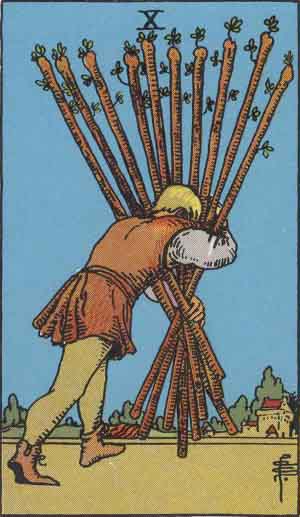
When the Ten of Wands repeats, accumulated responsibility may be obscuring both direction and choice. The live question is which burdens remain necessary, which can be renegotiated, and whether the original purpose still justifies what maintaining it now requires.
Core Repeating Message
The Ten of Wands shows a figure bent almost double under the weight of ten wands held close against them, obscuring their body and their vision. In the distance, a settlement: the destination is visible, but the figure cannot easily see it because the load is in the way. The image captures something very recognisable: the person who started a journey with fire and purpose and who arrives at the late stages of it carrying so much more than they started with that the original purpose is difficult to locate beneath the accumulated weight.
When this card appears once, it may reflect a period in which responsibilities have exceeded comfortable capacity. When it appears repeatedly, it can describe a recurring route into overload: commitments accepted separately become unsustainable in combination, unequal systems assign the seeker more than a fair share, or work once animated by desire becomes dominated by maintenance. Not every burden is freely chosen, and not every necessary obligation can be set down immediately.
One common pattern is the seeker who finds it difficult to say no. Not from lack of judgement about what is reasonable, but from the difficulty of distinguishing between commitments that arise from genuine desire and commitments that arise from the inability to decline the expectation or need of others. Each addition to the load began as something that felt possible to carry: a project agreed to because it seemed manageable, a responsibility assumed because someone needed to assume it, a creative commitment accepted because the opportunity was genuine. Each individual bundle is defensible. The sum of them is the Ten.
A second pattern is the seeker whose original creative or vocational fire has produced, over time, a structure of obligations that has grown significantly larger than the fire itself. The business was wanted and built, and the business now requires more from the seeker than the seeker wants to give it. The creative project was initiated, and the project has now grown into something that produces more obligation than creative aliveness. The fire produced the structure; the structure has outlasted the fire; and the seeker is now maintaining the structure from obligation rather than from continuing desire, while the current desire remains buried beneath the maintenance.
A third pattern belongs to the seeker who habitually carries what others could carry: who takes on the creative or vocational loads of colleagues, family members, or partners in addition to their own, either because the seeker is capable of carrying more than others around them or because the seeker has learned that taking on the loads of others is a reliable way of being needed and valued in the ways that matter to them. This pattern does not always feel like burden from the inside; sometimes it feels like generosity, or competence, or the expression of care. It becomes visible as the Ten when the seeker notices that the accumulation has produced a quality of ongoing strain that their own desires and commitments alone would not produce.
A fourth pattern involves the seeker whose identity has become so thoroughly organised around being the one who carries that the possibility of setting anything down produces uncertainty about who they would be. Not just practical concern about what will happen if things are set down, but the experience of a person who, without the load, does not know who they are. The ten wands are not only a burden; they are a self-definition, and the development of a self that can exist independently of the load is the work the card is marking.
What all these patterns share is a transformation that the Wands suit traces across its full arc: from the pure spark of the Ace to the accumulated weight of the Ten. The fire that was genuine and chosen at the beginning has become, across time and accumulation, a burden that is carried rather than a fire that is still burning. The card returns because the burden has not yet been examined, sorted or set down where possible.
When This Card Repeats Weekly
A week of Ten of Wands repetition marks an immediate experience of overload: more is being required of the seeker’s creative or vocational fire than the fire can comfortably produce, and the accumulation is producing a quality of bent-under strain that the current week’s demands are making visible.
The card this week is not asking the seeker to immediately resolve the full extent of the accumulated commitment. It is asking them to be honest about the current state of the load: what is being carried right now, how much of it was consciously chosen, and whether any single item in the current week’s burden could be set down or transferred without the catastrophe the pattern’s momentum suggests it would produce.
The weekly question is practical: what specifically is weighing the most right now, and is any of it the seeker’s responsibility?
When This Card Repeats Monthly
A month of Ten of Wands repetition suggests that the pattern of overcommitment or accumulated obligation is not a temporary spike in demands but a sustained characteristic of the seeker’s current creative or vocational life. The month is offering enough material to see not just the current load but the pattern of how loads accumulate: what the seeker consistently takes on, what they consistently decline, and what the gap between those two categories reveals about the underlying pattern.
The monthly lens asks the seeker to look honestly at the full scope of their current commitments: not just the large visible ones but the smaller accumulations that have added to the load without being fully visible as additions. A month is long enough to inventory the whole load rather than managing it in fragments.
The monthly recurrence also asks what has happened to the original fire in the context of the accumulated obligation: where creative desire currently lives, how much of the seeker’s current engagement is from fire and how much is from the maintenance of structures that the fire originally produced.
When This Card Repeats Seasonally
A season of Ten of Wands energy marks a sustained period in which the accumulated weight of commitment and obligation has become one of the defining features of the seeker’s experience of their own creative or vocational life. The season is asking for a careful sorting: not the management of the current load but the examination of what is in it, what belongs to the seeker, and what could be set down or transferred or concluded without the loss of what actually matters.
A central task in a Ten of Wands season is discerning what belongs in the load: not the efficient management of existing commitments but the honest question of which ones arise from continuing desire and which ones are being maintained primarily because setting them down has not yet felt possible.
A season is also long enough to distinguish between the weariness of the Ten and the natural cost of sustained creative effort. Not all of what is being carried is burden; some of it is the necessary weight of worthwhile work. The season is asking the seeker to know the difference.
When This Card Repeats Across Years
The Ten of Wands returning across years names a seeker for whom the pattern of accumulated commitment beyond considered choice is a long-arc dynamic: who has, across multiple phases of their life, consistently arrived at the Ten’s state of bent-under carrying, who has consistently continued under the load, and who has not yet sorted through what is in the load and what, if anything, can be set down.
One possible origin is an environment in which carrying was treated as proof of worth, while refusal, delegation or rest was associated with selfishness or failure. Another is an adult reality in which paid work, care, disability, migration, financial pressure or inadequate institutional support has concentrated responsibility without meaningful choice. The card cannot establish the cause. It can help separate internalised obligation from burdens imposed by present conditions.
The multi-year Ten of Wands also marks the seeker who has built, over time, a creative or vocational life of substance and complexity, and who has not yet developed the capacity to manage that complexity without taking it all on personally. The seeker’s fire was enough to produce what has been built; the question is whether creative authority at this scale requires the seeker to carry all of it themselves, or whether some of what has been built could carry itself if the seeker allowed it to.
Across years, the growth arc this card traces is towards creative sovereignty: the capacity to hold creative and vocational responsibility without converting it into personal burden, and to distinguish clearly between what is the seeker’s to carry and what belongs to the structures they have built or the people they work alongside.
Life Area Interpretations
Love & Relationships
In love and relationships, the Ten of Wands may reflect a disproportionate share of emotional, domestic, financial or logistical labour. This can arise through habit, differing capacity, temporary crisis, unequal expectations, neglect or control. It may also reflect a learned belief that carrying more is how the seeker remains needed or valued. The seeker should not assume that better delegation alone can repair a relationship in which the other person refuses accountability or where safety is compromised.
The relational Ten often develops through invisible accumulation: the seeker may not have made a single conscious decision to carry the relational load they are currently carrying, but the sum of many small decisions in the direction of taking on rather than setting down has produced a version of the relationship in which the distribution of effort is lopsided, and the seeker is the one who is bent.
The card may also mark the seeker who is carrying the unprocessed emotional loads of family members or a partner in addition to their own: who has become the designated holder of others’ feelings, needs, and unresolved difficulties in a way that has added significantly to the weight the figure in the card is carrying.
Career & Purpose
In career and purpose, the Ten of Wands is among the most directly recognisable patterns: the seeker whose original creative or vocational fire has been so thoroughly translated into accumulated professional responsibility that it is hard to locate beneath the maintenance, management, and obligation.
This vocational pattern involves the seeker who is good at what they do and has been given more and more of it: who said yes to the first additional commitment because it was reasonable, and yes to the second because it was possible, and yes to the third and fourth and fifth because the pattern of saying yes was established, until the current vocational load is beyond what creative desire would have authorised if the full weight had been visible at the start.
The Ten also marks the seeker whose creative work has been increasingly displaced by the administrative, managerial, or relational work that the success of that work has produced: who made something of value and now spends the majority of their creative time managing the structure around what they made rather than making things.
Money & Stability
In financial contexts, the Ten of Wands may reflect accumulated obligations whose combined cost now creates strain. Some may involve taking on the financial difficulties of family or a partner alongside one’s own, or commitments that grew beyond what the original purpose could sustain. Some were chosen, some may have changed after the agreement, and others may be legal, familial or survival responsibilities with little immediate flexibility.
The useful task is to inventory balances, interest, due dates, guarantees, dependants and contractual duties, then distinguish what can be reduced, refinanced, renegotiated or ended from what cannot. Do not stop payments or abandon obligations on the basis of a reading. Qualified debt, financial, legal or tax advice may be necessary.
The financial Ten asks where redistribution is both lawful and realistic: whether another responsible person can contribute, whether assistance or hardship provisions exist, and which new commitments need a firm limit. Relief begins with accurate scope, not with moral judgement about how the load was acquired.
Spiritual Growth
In spiritual growth, the Ten of Wands marks the seeker whose spiritual life has accumulated obligation and responsibility beyond what spiritual fire would choose: who has taken on roles, responsibilities, or commitments within their spiritual community or practice that have grown larger than the spiritual desire that originally motivated them.
This pattern is recognisable in seekers who have spiritual capacity and who find that capacity consistently recruited by communities or situations that need the kind of carrying that the seeker can provide. The spiritual Ten often develops not through selfishness but through responsiveness to real need, and arrives when the accumulated weight of spiritual service has buried the seeker’s own spiritual fire beneath the obligations it has produced.
The spiritual work the card marks is developing the capacity to say no with spiritual discernment: to distinguish between the spiritual service that is consciously chosen and the spiritual carrying that is simply what the seeker always does when need is present.
Emotional & Mental Patterns
The Ten of Wands in emotional and mental patterns marks the seeker whose characteristic inner experience is one of accumulated responsibility for more than is theirs: who carries not only their own emotional processing but the anticipated needs, potential disappointments, and unspoken expectations of the people around them, in addition to the demands of their own creative and vocational life.
The emotional Ten often involves what might be described as carrying weight in advance: the seeker who manages the anticipated difficulties before they arrive, who processes the potential emotional consequences of their choices for others before the others have experienced those consequences, who has such a developed capacity for anticipatory responsibility that their inner world is perpetually stacked with things they are managing on behalf of circumstances and people that have not yet actually presented the need.
Anticipatory carrying can consume considerable attention over time. The mind doing this work is doing a significant amount of work on behalf of a future that has not yet arrived, and that effort may leave less attention for creative engagement.
Family & Generational Dynamics
In family dynamics, the Ten of Wands may invite inquiry into whether carrying became a principal form of contribution, love or worth. Some members may have taken on more than was equitable, whether because of expectation, necessity, age, gender, illness, culture or circumstance. The card cannot establish the seeker’s childhood role, so memories and present patterns should supply the evidence.
Where this inheritance applies, the seeker who grew up carrying may not experience the accumulation of commitment as an unusual or remarkable thing. It is simply the condition of participation in the world, the baseline expectation of what engagement requires. The question of whether any of the load is theirs to carry is not a question that has been available, if the original family system left no room to ask it.
The generational work this card marks is developing the capacity to assess the load and to distinguish between what is the seeker’s creative and vocational responsibility and what is being carried from an inherited pattern of assuming all available weight.
Health & Energy
In health contexts, the Ten of Wands may symbolically reflect feeling physically burdened, depleted or compressed by sustained demand. The bent figure is an image of load, not evidence about posture, the nervous system or the cause of any symptom.
Tightness in the chest or shoulders, a sense of weight around the neck, pain, breath changes, fatigue and altered posture can have many causes. If they are present, persistent or worsening, seek appropriate assessment rather than interpreting them as confirmation of overload. Workload, ergonomics, sleep and care demands may still be useful observations to record alongside clinical advice.
A safe reduction in avoidable demand may change how the seeker feels, including a sense of unfamiliar ease as less has to be carried, but responses vary. Treat any improvement, discomfort or lack of change as personal data rather than proof of a symbolic mechanism. Rest and delegation do not replace care for symptoms that need professional attention.
Advanced Interpretive Sections
The Shadow Expression
The Ten of Wands in shadow can describe the conflict between genuine depletion and attachment to the carrier role. The seeker may continue accepting work, decline help or measure worth through sacrifice even while naming the cost. Yet a lack of visible change may also reflect poverty, care obligations, coercion, inaccessible support or other constraints. It should not automatically be read as unconscious preference for burden.
The shadow also produces the seeker who uses the visibility of the load to manage others’ expectations and responses: the ten wands carried openly are a way of communicating one’s own level of contribution and sacrifice, and the carried burden may serve social and relational functions the seeker has not yet recognised.
The Integrated Expression
The integrated Ten of Wands seeker has developed the capacity to hold creative and vocational responsibility without turning every part of it into a personal burden. They can lead, manage and carry the necessary weight of work, while setting down what is not theirs and delegating what others or the structures they have built can sustain.
This seeker’s fire is still burning rather than buried. They carry responsibility from conscious choice rather than from accumulated default, and they have developed discernment about the difference between the load that is theirs and the load that is simply present and uncarried by anyone else.
Why This Energy Has Not Released Yet
The Ten of Wands pattern can persist when the seeker has not yet sorted through the load to identify what is theirs to carry and what is being carried from other sources: inherited pattern, learned identity, inability to decline need, or the accumulated result of multiple small commitments whose sum was never directly examined. Without a full inventory and assessment, the pattern of accumulation continues because each individual addition to the load looks manageable in isolation.
The pattern may also persist because carrying provides identity, belonging or protection from disappointing others. Reducing the load can therefore produce anxiety even when it is materially possible. Where the burden is externally imposed, however, insight alone will not remove it. Structural support, negotiation, formal rights or a staged exit may matter more than further self-examination.
Finally, the pattern persists when the seeker has not yet engaged with the grief of what the accumulated burden has cost: what creative, vocational and personal fire has been buried or deferred or lost in the sustained experience of carrying more than the fire originally chose. This grief is real, and leaving it unacknowledged can make continued accumulation a way of moving past what was lost.
What This Card Wants the Seeker to Understand
The Ten of Wands draws attention to the settlement in the distance: the destination still visible beyond the load. It asks whether the current weight, pace and way of carrying are making that destination harder to reach, and what needs to change before the journey can continue sustainably.
The card’s teaching is that the fire is buried beneath the wands, rather than erased by the load. It asks the seeker to pause where possible, sort what is being carried, and distinguish what remains their responsibility from what could be shared, renegotiated or left behind. A lighter journey need not mean abandoning the destination; seeking that lighter way begins with examining the load, without assuming that every burden is removable.
Signs the Pattern Is Beginning to Resolve
The Ten of Wands pattern begins to resolve when the seeker begins to identify specific items in the current load that are not theirs to carry and takes concrete steps to set them down, transfer them, conclude them, or decline them when they appear in future. The first setting-down can be revealing, both through any practical relief and through anxiety that may arise, which is itself useful information about the function the carrying has been serving.
It also resolves when the seeker begins to practise discernment at the point of addition: to notice when a new commitment is about to be taken on and to ask whether it is theirs to carry rather than accepting it as automatically the thing that happens when need or opportunity presents itself.
And it resolves when the seeker begins to recover access to the fire beneath the accumulated load: when the original creative or vocational desire that the Ten’s obligations have been built on top of becomes accessible again, and the seeker can consciously choose what to continue and what to conclude based on whether the fire is present rather than on whether the obligation has been assumed.
Reflective Questions
-
If you were to lay out every creative, vocational, relational, and personal commitment you are currently carrying, what would the full inventory look like? Have you ever actually seen the full scope of the current load in one place?
-
Of all the things you are currently carrying, which ones arose from genuine desire and continue to be consciously chosen? Which ones arose from genuine desire but are no longer fuelled by it? And which ones were never consciously chosen but were assumed because they were present and uncarried?
-
What would it actually mean to set down one specific item in the current load? Not theoretically, but specifically: which item, and what would the practical reality of setting it down involve?
-
What does carrying provide for you beyond the completion of the carried work? What does the experience of being the carrier give you in terms of identity, worth, or relationship to the people in your life?
-
Is there a creative or vocational desire that has been buried under the accumulated obligations that grew from previous desires? Can you name it specifically?
-
What do you find difficult about saying no to additional commitment when it presents itself? Is there a specific quality of discomfort or fear that arises at the moment when no would be the honest response?
-
What did your family of origin communicate about the relationship between carrying and worth? Was carrying more than your share associated with admirable strength, with essential service, with the specific way love was expressed in your family?
-
Is there a point at which the current load was chosen and manageable? What has been added since then, and how did each addition get into the load?
-
What would your creative fire look like, specifically and concretely, if the accumulated burden were reduced to only what you consciously choose to carry? What would you make, or do, or be, if the load were lighter?
-
If the Ten of Wands has been appearing for a sustained period, what specifically is the heaviest item in the current load, and what is preventing you from setting it down?
Practical Integration Actions
Inventory the full load. Write out a comprehensive list of every current creative, vocational, relational, domestic, and personal commitment you are currently carrying: every responsibility, obligation, expectation, project, role, and ongoing duty. Do not edit or prioritise as you list; the exercise is to see the full scope of the accumulation in one place. This alone is often a significant moment for the seeker who has been managing the load in fragments without ever directly encountering its full size.
Sort what is genuinely yours. For each item, record who is formally responsible, who currently performs it, whether it is chosen and still wanted, and how much flexibility exists. Then distinguish three positions: yours and still chosen; yours but no longer wanted; or not yours, carried mainly from habit, expectation or difficulty declining. Test these descriptions against legal duties, dependency, safety and unequal bargaining power; not wanted does not mean not responsible. Use the resulting assessment to mark each item keep, renegotiate, delegate, conclude, seek advice or currently non-negotiable.
Set one thing down. From the unwanted or not-yours items identified above, choose the smallest commitment that can lawfully and safely be concluded, transferred, declined or reduced. Confirm who will be affected and what notice, consent or contingency is required. Take one concrete step this week. Do not abandon dependants, contractual duties or safety-critical work. Record the practical result and the emotional response, including any relief or anxiety; both can help show what carrying that item has meant.
Practise discernment at the point of addition. For the next month, whenever you are about to take on a new commitment, practise a pause before saying yes: ask specifically whether this is yours to carry, whether the fire is present for it, and whether it would still seem reasonable to carry if you were looking at the full current inventory. The pause does not have to produce no; it needs to produce conscious choice rather than automatic assumption.
Recover the buried fire. Set aside one period of time in the coming week that is devoted entirely to a creative or vocational desire that has been buried under obligation: not a productive use of time in the service of the current load, but time for the fire itself. Note what the fire does when it is given space independent of the obligations that grew from its previous expressions.