
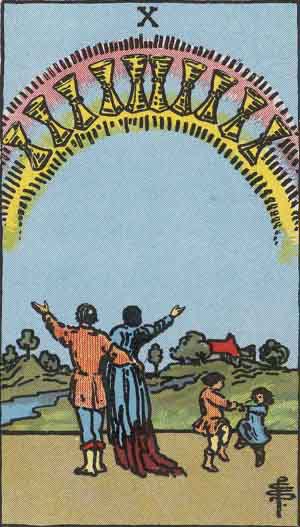
A family stands beneath a rainbow arc of ten cups, arms raised in joy and belonging. The question this card keeps returning to ask is what emotional wholeness would mean in the seeker’s life, and how they can recognise, build and participate in it.
Core Repeating Message
The Ten of Cups shows two adults and two children beneath a rainbow arc of ten cups, in a landscape of hills, water and home. The image presents one symbolic form of shared joy, not a universal prescription for partnership or family. Its emotional completion extends beyond the solitary contentment of the Nine and the mutual recognition of the Two into household, chosen family, community and intergenerational belonging. The rainbow suggests a sky spacious enough to hold what the emotional life has gathered, including difference, difficulty and change.
This is the suit’s final card, the fullness of emotional life in its communal and sustained form. It is not merely the wish for love but love genuinely built and lived in; not merely the longing for belonging but belonging genuinely found and inhabited across time. The emotional arc of the Cups suit arrives here, at the acknowledgement that genuine emotional fullness is not only personal but relational and communal.
When the Ten of Cups appears once, it can reflect communal joy, relational fulfilment or recognition of what has been built together. When it appears repeatedly, it brings the seeker’s definition of belonging into focus: what counts as family, which forms of connection are actually reciprocal, and whether an idealised picture is obscuring either real nourishment or real harm in the present.
The most common pattern is a seeker with a vivid interior picture of emotional wholeness who measures actual relationships against it. A loving partnership may have a different shape from the one imagined; family may be chosen, blended, dispersed, child-free or unconventional; community may offer belonging without perfect agreement. The card asks whether the discrepancy reflects rigid idealism or a legitimate absence of care, safety, reciprocity or shared values.
A second pattern concerns repeated attempts to build belonging on foundations that remain unclear or unequal. Affection may be real while agreements, repair, shared labour, financial stability, inclusion or respect are inconsistent. The sense of completion then arrives briefly and dissolves. Rather than blaming the seeker for failing to receive happiness, the Ten of Cups asks which conditions need practical strengthening and which relationships cannot provide the hoped-for form of home.
A third pattern is the seeker who has experienced genuine emotional wholeness at an earlier stage of life, perhaps in childhood, perhaps in a particularly abundant relational chapter, and who has not yet rebuilt what was lost when that earlier wholeness came apart. The rainbow was real once. Its dissolution was real. And the seeker is in the extended process of learning whether genuine emotional wholeness can be rebuilt after it has been lost, or whether what was broken is permanently unavailable.
A fourth pattern is ambivalence about the vulnerability of belonging. To be seen, included and affected by others is to accept dependence without surrendering autonomy. Standing at the edge may be protective where earlier groups were unreliable or exclusionary. The card invites gradual, evidence-based participation and boundaries, not unconditional openness to every family or community that claims the seeker.
When This Card Repeats Weekly
When the Ten of Cups repeats within a week, shared pleasure, household life, family expectations or community participation may be especially visible. The card asks what is actually happening between people, rather than assuming that a celebration or harmonious appearance proves emotional completion.
This might be a week of family gathering, communal celebration, or genuine connection with the people who matter most, and the card is asking whether the seeker is fully present in it: in the scene with raised arms, under the rainbow, or observing it from a slight distance as something beautiful but not quite belonging to them.
The weekly repetition may also mark a smaller moment of emotional fullness: a day when the household is warm, when belonging is felt, when what has been built together is visible and genuinely good. The card asks: did the seeker notice it and allow it to land?
When This Card Repeats Monthly
A month of Ten of Cups repetition suggests that the seeker’s relationship to emotional wholeness and belonging is the central question of this period. Emotional completion may be available but not quite inhabited, or the conditions for it may still be taking shape, with recurring interruptions that deserve attention.
The monthly framing asks the seeker to examine their closest relational world through observable qualities: consistency, mutual interest, shared responsibility, repair after conflict, consent and room for difference. If warmth is present, what helps it land? If it is absent, the card should not be used to rename isolation, coercion or performance as belonging.
When This Card Repeats Seasonally
A season of Ten of Cups appearances marks a sustained period in which the seeker is in active relationship with the question of genuine emotional completion: what it would require, what is currently in the way, what has been built and what still needs to be genuinely secured before the rainbow can fully cohere.
This might be a season of family or relational work: of building something together, of navigating difficulty in close relationships with a firm commitment to the sustained emotional honesty that genuine belonging requires. The Ten of Cups across a season is patient encouragement that the work of emotional wholeness is both demanding and worth sustaining.
When This Card Repeats Across Years
The Ten of Cups returning across years or major life phases names a seeker for whom emotional wholeness, in its communal and sustained form, is long-arc soul work. The longing for it is genuine; the conditions for it have been approached and have not yet fully arrived; the seeker is on an extended journey towards the kind of emotional fullness the card depicts.
This long-arc pattern can appear when early family life offered inconsistent warmth, limited repair or a narrow definition of who belonged. Childhood may influence the seeker’s template without determining it, and the card cannot establish what happened from symbolism alone. Adult belonging can be learned through chosen relationships, clear agreements, repeated reliability and communities that allow the seeker to remain fully themselves.
Across years, the Ten of Cups asks the seeker to be honest about both what they have built and what they have not. The rainbow does not need to be perfect; the cups do not need to be all exactly aligned. Emotional wholeness grows through sustained presence in the relationships and communities that can support it, a willingness to be held and to hold others, and the capacity to recognise the scene developing around the seeker as something they belong to.
Life Area Interpretations
Love & Relationships
In love and relationships, the Ten of Cups can describe a seeker who is close to emotional completion in partnership but cannot quite allow themselves to arrive. Where the relationship is loving, the commitment dependable and the shared history real, the raised-arms joy of the Ten of Cups may still feel slightly unavailable, as if fully inhabiting that partnership would require a vulnerability and trust the seeker has not yet been able to extend.
The card may also highlight how earlier relationships shaped expectations about closeness, intensity, conflict and repair. Familiarity can make a painful pattern feel recognisable, but it does not explain every present attraction or prove that a quieter bond is healthy. The Ten of Cups directs attention to current behaviour and mutuality rather than intensity alone.
Career & Purpose
In career and purpose, the Ten of Cups marks the seeker for whom vocational fulfilment is not only individual but communal: the work that contributes to something larger than the self, the creative or professional life that sustains and is sustained by a community, the sense of belonging within a larger shared purpose.
The seeker for whom this card repeats in career contexts is often very capable individually but has not yet found the vocational community in which their work feels genuinely connected to something beyond their own achievement. The ten cups in the sky are not arranged for one person; they are the completion of a collective emotional arc. The seeker is being asked to find or build the community within which their individual contribution becomes part of something larger.
Money & Stability
In money and stability, the Ten of Cups examines how material conditions affect shared life. Housing, income, care work, debt, inheritance and access to resources can support or strain belonging, but financial security does not guarantee a loving household and hardship does not make emotional wholeness impossible. The card asks how resources, responsibilities and decisions are shared in practice.
The seeker for whom this card repeats in financial contexts may be working on material conditions that support emotional wholeness: a secure home, financial stability that leaves more room for relational presence rather than chronic material anxiety, and practical arrangements that help shared life develop.
Spiritual Growth
In spiritual growth, the Ten of Cups marks the seeker for whom spiritual life is essentially communal: the tradition, the sangha, the circle, the gathered community whose shared spiritual presence provides a sustained relational setting in which spiritual wholeness can develop over time. This is the card of belonging not only to a practice but to a people.
The seeker may long for a spiritual community that offers shared practice and recognition. The Ten of Cups supports careful discernment rather than belonging at any cost: healthy groups allow questions, respect boundaries, make leadership accountable and do not isolate members from outside support. A solitary or informal spiritual life can also be complete if that is the seeker’s chosen form.
Emotional & Mental Patterns
In emotional and mental patterns, the Ten of Cups can describe a seeker who repeatedly approaches emotional wholeness but finds a reason why arrival is not yet quite complete.
The reasons may be substantial: something in the relationship is not yet resolved, something in the family situation is still in process, something in the seeker’s inner life is not yet integrated. The Ten of Cups pattern can persist when identifying the final insufficiency becomes a habit that keeps the seeker oriented towards improvement while avoiding the vulnerability of receiving what is already good. The question is whether the missing thing calls for attention or has become a reason never to arrive.
Emotional completion does not require all the cups to be perfectly aligned. Where care and reciprocity are present, it includes a willingness to recognise what has been built as whole, even in its imperfection, and to raise one’s arms accordingly.
Family & Generational Dynamics
In family dynamics, the Ten of Cups is centrally about the family that was not, and the family that might yet be. The seeker who draws this card repeatedly is often navigating both the family of origin and the chosen family they are building or seeking, and the central question is how the inheritance of the family of origin, both its gifts and its deficits, shapes the attempt to build what the Ten of Cups shows.
Where the family of origin did not model consistent warmth, repair or inclusive belonging, the seeker may be building relational skills without a reliable early example. That can be demanding, but the pattern is neither fixed nor solely individual. Supportive peers, chosen family, community practice and professional help can all contribute to a more workable template.
Health & Energy
In health and energy readings, the Ten of Cups may reflect the felt effects of companionship, household atmosphere and social support. Connection can influence stress, routines and access to help, but the card cannot measure a bodily mechanism or explain symptoms. Solitude is not inherently unhealthy, and belonging that requires masking or submission may be more draining than supportive.
The grounded inquiry is whether the seeker’s living conditions and relationships support rest, nourishment, safety, movement and access to care. Persistent or concerning physical or mental health changes require appropriate assessment rather than a symbolic conclusion about insufficient belonging. The card can identify a context worth examining, not a diagnosis or cure.
Advanced Interpretive Sections
The Shadow Expression
The Ten of Cups in shadow describes the seeker who performs family wholeness or communal belonging without inhabiting it. The image of the Ten of Cups, the family under the rainbow, the communal joy, can be performed with considerable conviction: the photographs look right, the family gatherings have the right shape, and something essential is being maintained as performance rather than lived.
A second shadow is the seeker who has idealised the image of the Ten of Cups to the point where any actual family or community inevitably disappoints it. Real families are complicated, real belonging is imperfect, real sustained emotional life involves difficulty alongside warmth. The seeker whose ideal is too fixed cannot recognise genuine belonging when it is present.
The Integrated Expression
The integrated Ten of Cups seeker has developed a genuine capacity for sustained emotional belonging. They are in the scene: arms raised, fully present to the people around them, nourished by community and close relationship, and able to let themselves be seen standing in genuine joy.
This seeker also has a realistic relationship to the imperfection of emotional wholeness: they know the rainbow is built across a landscape that has also known rain, and they have not required the wholeness to be perfect in order to allow it to be genuine.
Why This Energy Has Not Released Yet
The Ten of Cups pattern may persist when the seeker has not reconciled the imagined form of belonging with the life actually available. Yet acceptance is not the answer to every discrepancy. Some differences invite flexibility; others reveal unmet needs, exclusion or incompatibility. The work is to distinguish an imperfect but reciprocal bond from an arrangement that merely resembles the picture.
The pattern can also persist when the seeker’s capacity for belonging is still developing. This is not failure; it is developmental work that takes time. The ability to be held, to trust sustained closeness, to remain present within communal warmth without retreating to management, is a capacity that grows through repeated experience of safe belonging. The seeker may not yet have had enough of this experience for the capacity to be fully formed.
What This Card Wants the Seeker to Understand
The Ten of Cups wants the seeker to understand that what has been built through real care deserves recognition. A relationship that is genuinely loving, even imperfectly, is worth standing inside. A community that holds them, even imperfectly, is worth belonging to. A family that is present and caring, in whatever form family takes in this seeker’s life, is worth raising arms towards.
The card wants the seeker to know that emotional wholeness does not require the absence of imperfection. It calls for presence where care is real, a willingness to be held, and a willingness to raise their own arms rather than always being the one who ensures the arms of others are raised.
Signs the Pattern Is Beginning to Resolve
The Ten of Cups pattern begins to resolve when the seeker recognises emotional wholeness in the actual circumstances of their life, rather than measuring those circumstances against the ideal image. A loving relationship is received as loving rather than as almost-but-not-quite the ten-cup ideal; community is experienced as genuine belonging rather than as an approximation of the community the seeker imagined; the actual rainbow is seen rather than only the perfect rainbow that was expected.
It also begins to resolve when the seeker can participate in moments of communal warmth without having to perform a prescribed emotion. Presence may look like joy, quiet appreciation, grief mixed with gratitude, or a boundary that allows attendance to remain safe. The sign is honest participation, not compulsory celebration.
And it resolves when the seeker can turn to the people in their landscape and genuinely acknowledge, to them and to themselves: this is real. This belongs to me. I am standing in it.
Reflective Questions
-
What does genuine emotional wholeness look like in your interior image? Describe it specifically. Then look at your actual life: how close is what is genuinely present to what you have been imagining?
-
Is there a way in which you observe moments of genuine communal joy or genuine family warmth from a slight distance rather than being fully present inside them? What moves you to the edge of the scene?
-
What would it mean for you to stand with raised arms under the rainbow: to acknowledge and inhabit what has been built, in whatever imperfect but genuine form it has taken?
-
Is your interior image of genuine emotional wholeness shaped by something you have genuinely experienced, or by something you have hoped for without quite having lived inside it? How does this shape your ability to recognise the genuine article?
-
Have you experienced a period of genuine emotional wholeness that has since dissolved? What did it feel like from inside, and what broke its coherence?
-
In your closest relationships and communities, what is genuinely present and genuinely good? What specifically is still missing, and is the missing thing genuinely absent, or is it present in a form you have not yet recognised?
-
What would you need to genuinely allow, in yourself or in the people around you, for the ten cups to cohere into something you could stand beneath?
-
What has your family of origin shown you about what sustained genuine emotional belonging looks like? What has it shown you about what it cannot look like?
-
Is there a way in which you are building the conditions for genuine emotional wholeness but consistently interrupting the building at the point of genuine completion? What specifically is the interruption?
-
If the rainbow were genuinely present above you right now, what would prevent you from raising your arms?
Practical Integration Actions
See what is genuinely there. Write honestly about the closest relational and communal landscape of your current life: the people who are present, the relationships that are loving, the community that holds you in some form. Acknowledge what is genuinely good without immediately qualifying it with what is still missing. This is not a denial of the missing; it is an honest accounting of the present. The ten cups do not all need to be perfect for the rainbow to be real.
Practise genuine belonging in a current context. Choose one relationship or community in which genuine belonging is possible and welcomed, and commit to one month of increased presence: less observation, less management, less being-at-the-edge-of-the-scene. More showing up, availability and willingness to be known rather than only to know. Notice what this requires and what it produces.
Examine the interior image. Write about the Ten of Cups image you carry: the form emotional wholeness takes in your imagination. Then examine it: where did this image come from? How flexible is it? What would it mean to allow your actual life to be recognised as close to what this image describes, even if it is not an exact match?
Acknowledge what has been genuinely built. If there are relationships, communities, or family connections in your life that you have invested in and that have developed over time, take time to explicitly acknowledge this to yourself and to the people involved. The Ten of Cups is partly a card of recognition and gratitude for what has been built together. This acknowledgement, when it is genuine rather than performed, is itself a building act.
Build toward one missing condition. If one specific element is absent from the emotional wholeness you are trying to build, identify it clearly and take one concrete action towards it: a step towards the community that is not yet present, a conversation with a partner about what is not yet fully built, or a deliberate act of participation where belonging is possible and welcomed. One step towards the rainbow can begin with strengthening the conditions that would allow it to form.