
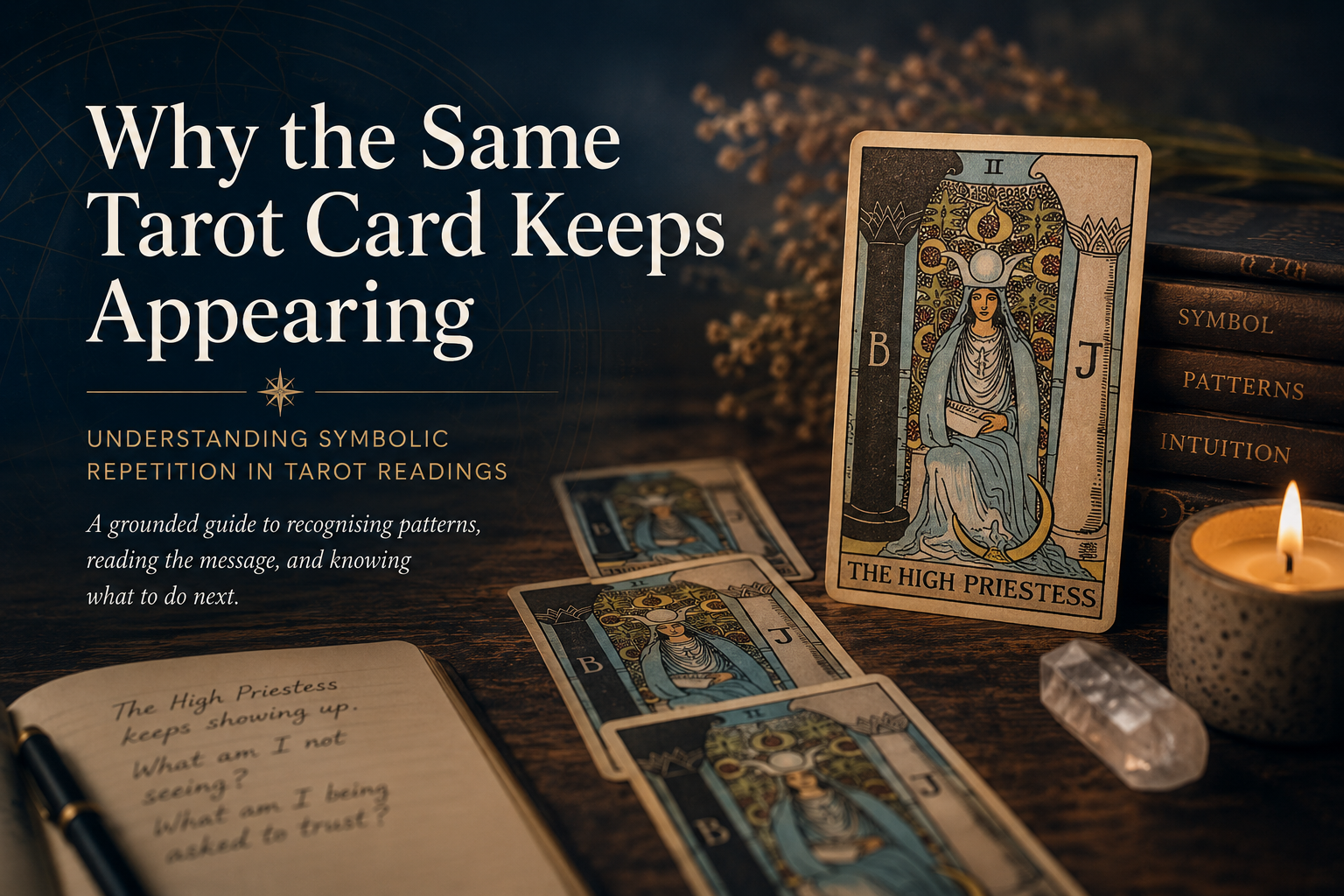
When a tarot card returns again and again to your readings, it has stopped delivering a situational message. It is now marking a pattern. The question is no longer what the card means. The question is what is still active in your life that this card keeps pointing toward.
When the same tarot card appears in reading after reading, the experience tends to generate one of two responses: alarm or confusion. Neither is particularly useful. A card that repeats is not delivering an escalating warning, and it is not broken behaviour in the deck. It is pointing at something in the reader’s life that has not yet been fully acknowledged, worked with, or released. The card’s persistence is proportional to the persistence of what it is pointing toward. Understand what that is, and the repetition becomes readable. Treat the repetition as dramatic emphasis, and the interpretation starts to distort in the direction of whatever fear the reader brought to the deck.
Why This Matters
Tarot readers, especially those who read frequently or in emotionally charged seasons, will encounter a repeating card at some point. The instinct, when a card returns, is often to treat the repetition itself as amplification: the card appears twice so it must mean the situation is doubly serious; it appears five times so something grave is being communicated. This instinct is understandable and almost always misleading.
Repetition is not escalation. It is persistence. The difference is important.
A card that escalates in meaning would grow more extreme with each appearance, driving the reader toward a conclusion. A card that persists does something quieter and more honest: it stays in the field until what it is pointing to has been genuinely seen and worked with. The repetition is not a measure of urgency. It is a measure of how long the underlying pattern has remained unaddressed.
Understanding this distinction matters because it directly affects how you read. If you treat repetition as escalation, you will eventually arrive at an interpretation that is more dramatic than the situation warrants, or more frightening than is useful. If you treat repetition as persistence, you can stay curious, remain observant, and follow the pattern toward its actual source without spiralling.
There is also a practical reason this matters for the quality of your readings. A reader who treats every repeated card as a heightened warning will, over time, create anxiety rather than clarity in their practice. The readings become self-reinforcing loops of concern. The tool stops functioning as a lens and starts functioning as a mirror for whatever emotional state the reader brought to the deck.
How to Interpret the Pattern
Timescale is one of the most useful lenses for reading what a repeating card is actually doing.
A card that shows up several times within a single week is speaking to something current and unresolved: a conversation that has not happened, a decision being avoided, an emotional pressure that has not yet been named. The territory is usually close to the surface and often corresponds directly to something the reader is actively navigating.
A card that returns across several weeks has moved from acute into recurring. Something has begun to stabilise as a pattern rather than a moment. The reader is no longer passing through a weather system. They are starting to live inside one.
A card that persists across three to four months tends to mark a deeper current of change. Identity or vocation or significant relational structure is in the process of rebuilding. This is not a situation to be managed but a phase to be inhabited.
When a card returns across a year, or resurfaces at a different life stage after a long absence, it is naming something that belongs to the reader’s longer arc: an inherited disposition, a foundational pattern, an archetypal curriculum that the current chapter of the reader’s life is engaging with in a new form.
Identifying which timescale applies changes the scale at which the card is read, and often clarifies what is actually being asked of the reader.
Beyond timescale, four factors shape how to read a repeated card: the card’s own meaning and symbolic territory; the spread position in which it keeps appearing; the context of the questions being asked; and the emotional state of the reader in the sessions where it arrives.
A card appearing repeatedly in the position of what is blocking you is pointing at something different from the same card appearing repeatedly in the position of outcome. A card appearing in response to questions about a relationship is being asked to speak to different territory than the same card appearing in response to questions about career. The card’s symbolic range is wide. Spread position, question context, and reader state all function as a focusing lens that narrows the range to what is most relevant for this particular pattern.
What Not to Assume
Three common misreadings of repetition are worth naming directly.
The first is confirmation bias. A card that appears once, in a reading the reader found meaningful, tends to become more noticeable in subsequent readings whether or not it is actually appearing more frequently. Readers who have recently had a significant encounter with The Tower, for example, will notice The Tower in subsequent readings in a way they would not have before. This is not the same as The Tower genuinely recurring. Genuine recurrence is measurable: the card is appearing in multiple distinct readings with meaningfully higher frequency than chance would suggest. Attentional bias is a different thing entirely, and conflating the two leads to a false sense of pattern where none exists.
The second is projection. When a reader is deeply anxious about a situation, they will sometimes pull the card that best represents that anxiety repeatedly, not because the card is being drawn by some external intelligence but because the deck is a tool that responds to what the reader brings to it. The repetition, in this case, is accurately reflecting the reader’s preoccupation. It is not independently confirming that the feared outcome is real.
The third is fixation. Some readers, particularly during emotionally demanding periods, will pull additional cards after every reading in search of a better answer, a more reassuring message, a different card. This practice guarantees repetition because the same question is being asked, in the same emotional state, drawing from the same symbolic field. The repeated card in this context is not a cosmic signal. It is the natural result of asking the same question repeatedly until you get the answer you were avoiding.
Genuine pattern repetition has a different quality to all three of these. It arrives in different emotional states. It appears across different questions. It comes up when the reader is not specifically looking for it. It has the quality of something returning unbidden rather than something being summoned by fixation.
Examples by Card
The Tower
The Tower is one of the cards most often interpreted with alarm when it repeats. Readers who keep drawing it are typically not facing a series of disasters. They are in a period where the psyche keeps pointing toward something that has been built on a false foundation. The question The Tower is asking is not “when will the next disruption arrive?” It is “what structure in your life is being held together by something that is not, in fact, solid ground?” The repetition is asking the reader to look honestly at what is being maintained through pretence, loyalty to an outgrown arrangement, or unexamined assumption.
Death
Death repeating is rarely about literal endings and almost always about the persistence of an ending that has not yet been genuinely inhabited. Something is over, or needs to be over, and the reader is still standing at the threshold. The card returns because the transition has not yet been completed inwardly, even if it has already begun externally.
The High Priestess
The High Priestess returning repeatedly is pointing at something already known that is not being listened to. The reader is seeking answers externally, through more cards, more readings, more consultations, while an interior signal that already holds the relevant information continues to wait, patient and quiet, for the conditions of stillness it needs to be heard.
The Fool
The Fool appearing again and again tends to mark a reader standing at a threshold they have not yet been willing to cross. The beginning is available. The readiness is present, or nearly so. What remains is the willingness to commit to not knowing what comes next.
Ace of Cups
Ace of Cups repeating often marks a reader in a season of significant emotional opening: grief that has cracked something open, love that is asking to be received, a creative and emotional vitality that is available but not yet being engaged with fully.
Three of Swords
Three of Swords returning across multiple readings is typically pointing at grief or heartache that has not been fully expressed or integrated. The card returns because the emotional material it represents is still active in the body and the psyche, still asking to be acknowledged rather than managed.
How to Work With the Pattern
The most useful first move when you notice a card repeating is to stop pulling additional cards about it. More cards do not clarify a repeating pattern; they add noise to it.
Instead, note the repetition and sit with the card’s meaning in relationship to what is actually happening in your life at this time. Not the general keyword meaning of the card but the specific, lived terrain it might be pointing toward: which relationship, which decision, which unresolved situation, which emotional pattern is this card’s symbolic range touching?
Read the card’s full interpretive range rather than its headline meaning. Most tarot cards have a wide field of possible correspondences. A repeating card is usually asking the reader to explore its less obvious territory, the aspects of the card’s meaning that do not immediately surface when you look it up.
Track the repetition across at least three distinct reading sessions before treating it as a genuine pattern. Note what question was being asked, what emotional state you were in, and which spread position the card appeared in. This tracking will usually reveal something specific about the nature of the pattern that simply noticing the card’s return will not.
When the pattern is genuine, the work is not to resolve it but to understand what it is pointing at and to begin engaging honestly with that territory.
The Repeating Card Meanings Library
Tides of Knowing has built a dedicated interpretive resource for exactly this work. The Repeating Card Meanings library covers all 78 cards with in-depth entries focused specifically on what each card is pointing toward when it returns repeatedly. Each entry explores why the energy persists, what timescale the repetition is marking, which life areas are most affected, and what would allow the pattern to shift.
The interactive repeating card tool allows you to search by card and access its full repeating-card entry directly.
A Note on The COMPASS Method™
The COMPASS Method™ is Tides of Knowing’s framework for stabilising interpretation when emotional charge, confusion, or urgency is affecting the quality of a reading. It is particularly useful when a repeating card has begun to generate anxiety rather than clarity, or when the reader is no longer sure whether they are reading the card or reading their own fears.
Working with a repeating card through The COMPASS Method™ provides a structured way to separate what the card is actually saying from what the reader’s emotional state is projecting onto it, and to arrive at an interpretation that is both honest and genuinely useful.
For majors specifically, see Repeating Major Arcana Cards. To distinguish genuine recurrence from fixation language, see Repeating Cards vs Stalker Cards.