
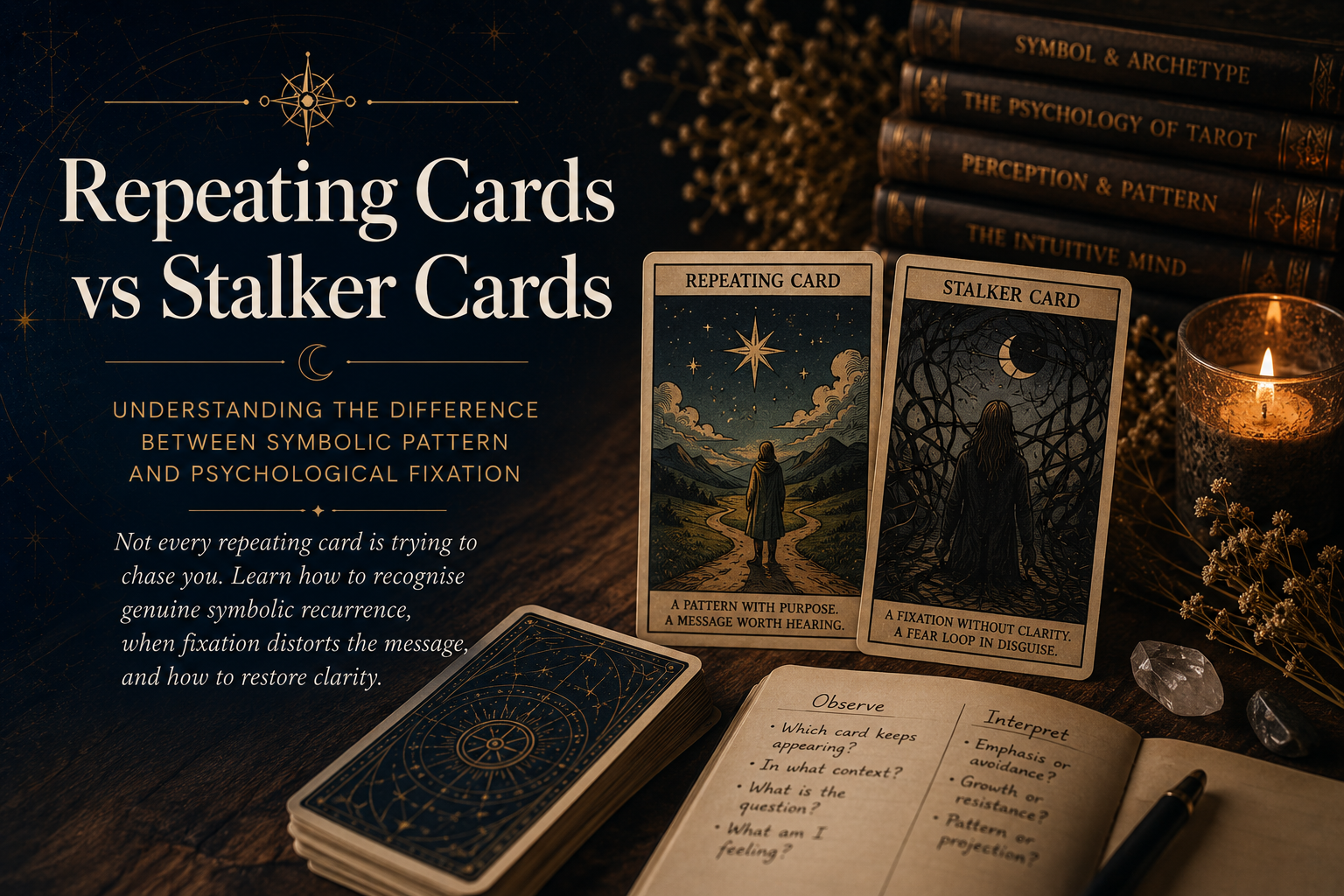
A card that follows you is worth taking seriously. The first question is whether it is following you or whether you are following it.
A tarot stalker card is a card that appears with unusual frequency across multiple readings, sometimes across different decks and different questions. The experience is common and does not require special explanation to justify: some cards do return repeatedly, and the repetition is usually pointing at something in the reader’s life that has not yet been fully acknowledged or worked with. An emotional pattern, a recurring relational dynamic, a transition that has not been completed, or an aspect of the reader’s own inner state that keeps surfacing because it has not been integrated. The card is not pursuing the reader. It is pointing at what the reader is still carrying.
The term “stalker card” names the experience accurately enough: the card’s persistence can feel uninvited, relentless, and slightly uncanny. Tides of Knowing uses “repeating card” as the preferred term, and the distinction is not merely stylistic. The language of stalking positions the card as an external force with an agenda toward the reader. The language of repetition points more accurately at what is actually happening: a pattern that is returning, a symbol that is persisting, because something in the reader’s life has not yet resolved the territory the card represents.
That distinction matters practically, because it determines whether the reader approaches the pattern with agency or with dread.
Why This Matters
Language is not neutral in interpretation. When a reader understands a card as a stalker, something with an agenda toward them, their stance becomes reactive: how do I deal with this? What does it want from me? How do I make it stop? This stance positions the reader as the object of the card’s attention rather than as the person with agency in the situation.
When a reader understands the same card as repeating, the stance shifts: what is this pattern pointing toward? Why is this energy still active? What in my life or my inner world is this card’s symbolic range touching, and why has it not shifted? This stance is investigative rather than reactive. It returns agency to the reader and keeps the interpretation honest.
The stalker card framing also tends to generate a particular kind of reading anxiety: the sense that something is pursuing the reader with intent, that the card is a force rather than a symbol, that the repetition is being done to the reader rather than arising from within the reader’s field. This anxiety rarely improves the quality of the reading. It tends to amplify exactly the kind of emotional charge that distorts interpretation.
None of this means that the experience of a persistently recurring card should be minimised. The experience is real. The persistence is worth taking seriously. The point is to take it seriously in a way that leads toward genuine understanding rather than toward escalation.
How to Interpret the Pattern
Genuine symbolic recurrence is different from the several other things that can produce the experience of a card that keeps appearing.
Pattern is genuine recurrence: the card appears with meaningfully higher frequency than chance would suggest, across different emotional states, different questions, and different reading contexts. It has the quality of something that keeps arriving rather than something being summoned. It is present in readings where the reader was not specifically thinking about it. When this is happening, the card is worth investigating in depth, because something in the reader’s life or inner world is genuinely sustaining the pattern.
Pressure is a different phenomenon. A card that appears frequently during a specific emotionally charged period may be accurately reflecting the intensity of that period rather than pointing at a long-standing pattern. A reader going through a significant loss may draw grief and ending cards with high frequency for several months. This is not the same as those cards being genuine long-term repeating cards. It is the deck accurately reflecting the current emotional climate. The distinction matters because the appropriate response to pressure-based recurrence is different from the appropriate response to genuine pattern recurrence.
Obsession is the phenomenon in which the reader is actively, if sometimes unconsciously, creating the repetition by pulling additional cards in search of a particular answer. If a reader is frightened by a situation and keeps asking the deck about it, the cards that most directly address that fear will appear with high frequency because the question keeps bringing them into the field. The Moon appearing six times in a week is not necessarily the universe sending an urgent message about illusion and hidden truth. It may be an accurate reflection of a reader who is in a state of significant anxiety and keeps pulling cards about a situation that is genuinely frightening them.
Projection is what happens when the reader’s emotional state is being read rather than the situation. The Devil appearing repeatedly for a reader who is in a relationship they are ambivalent about may be accurately naming the reader’s own emotional entanglement rather than making an independent claim about the relationship. Eight of Swords appearing again and again may be pointing at the reader’s own cognitive patterns of self-entrapment rather than at external constraints.
Distinguishing between these four phenomena, pattern, pressure, obsession, and projection, is the first and most important work when a card starts appearing with unusual frequency.
What Not to Assume
Do not assume that frequency means urgency. A card that appears three times in a week is not necessarily more urgent than a card that appeared once six months ago and once again last week. Frequency is not a measure of intensity. It is a measure of how sustained the underlying pattern is, and how consistently the symbol is being recruited into the field of the reader’s attention.
Do not assume that the card is independently commenting on a specific outcome. A repeating card points at a quality of experience, a pattern of behaviour, an emotional or relational dynamic, a theme in the reader’s inner life. Read it as symbolic pattern: context, timing, relationship, and what keeps returning to attention.
Do not assume that you need more cards to interpret the pattern. When a card keeps appearing, the instinct is often to pull more cards around it, to build a more complex reading that might reveal what the repeated card is really trying to say. This instinct is usually counterproductive. The card that keeps appearing has already delivered its message. The work is not to decode it further but to engage honestly with the territory it is naming.
Do not assume that switching decks will stop the pattern. Readers who are disturbed by a repeating card will sometimes switch to a different deck in the hope that the repetition will not follow them. When the pattern is genuine, it typically does follow, because the pattern is arising from the reader’s life and inner world, not from the specific physical deck. The card in the new deck may look different but will be pointing at the same territory.
Examples
The Moon is one of the most commonly reported cards in stalker-card conversations. Its atmospheric imagery and associations with the unconscious, with illusion, with what is hidden, make it feel particularly significant when it keeps appearing. When The Moon repeats genuinely, it is almost always pointing at a sustained relationship with uncertainty or anxiety: a prolonged period of not knowing, a pattern of seeing through the lens of fear rather than clarity, or a deep unconscious material that keeps surfacing without being integrated. When The Moon appears to be stalking a reader, it is worth asking honestly whether the card is naming an external mystery or accurately reflecting an internal one.
The Devil appearing repeatedly is one of the most anxiety-provoking experiences for readers unfamiliar with the card’s range. The card does not mean that something demonic is at work. When it repeats, it is typically naming a pattern of attachment, habit, or dependency that has become self-sustaining: something the reader keeps choosing, or keeps returning to, because it offers a form of comfort, intensity, or familiar structure even when its costs are clear. The card returns because the attachment pattern has not yet been genuinely examined or changed.
Eight of Swords recurring frequently tends to mark a reader who is experiencing significant cognitive self-restriction: a pattern of believing themselves to be more constrained than they are, of seeing the situation through a lens that emphasises limitation and minimises possibility. The card is accurate in its repetition. It is pointing at a genuine cognitive pattern. The work is not to argue with it but to investigate what is generating the sense of entrapment.
Four of Cups returning again and again is usually pointing at a reader in a sustained state of emotional withdrawal or disengagement. Something is being offered, emotionally, relationally, or creatively, that is not being received. The reader has turned inward in a way that is no longer the healthy inwardness of genuine rest or deliberate discernment but has become a habitual closing-off that is preventing genuine engagement with what is available.
The Hermit repeating is one of the patterns most worth distinguishing carefully. The Hermit can represent genuine solitude as practice, the deliberate withdrawal that allows genuine inner work. But when The Hermit keeps appearing in a reading context, the question worth asking is whether the solitude being named is chosen and purposive or whether it has become a way of avoiding the reconnection and engagement that is actually needed.
When to Pause Readings
There are circumstances in which the right response to a card that keeps appearing is to stop pulling cards entirely, at least for a period.
When the repeated card is generating more anxiety than clarity, pausing is appropriate. When the reader is pulling additional cards specifically to counteract or modify what the repeated card is saying, pausing is appropriate. When the readings have begun to feel compulsive rather than clarifying, pausing is appropriate. When the emotional state in which readings are being conducted has become consistently distressed rather than occasionally concerned, pausing is appropriate.
A pause does not mean the pattern has disappeared. It means the reader is creating conditions in which they can engage with what the pattern is pointing toward through means other than more cards: through reflection, conversation, journalling, attention to daily life, or simply by allowing the situation itself to develop without asking the deck about it every few days.
How to Document Recurrence Responsibly
If you want to track a card’s recurrence accurately rather than relying on memory, keep a simple reading log: the date, the question or context, the card drawn, and the spread position. After several weeks, review the log to see whether the frequency of the card’s appearance is genuinely elevated or whether it reflects the normal distribution of a 78-card deck across a series of readings.
This kind of documentation prevents the retrospective inflation of a card’s frequency, the common experience of becoming convinced that a card has appeared far more than it actually has once attention has been drawn to it.
The Repeating Card Meanings Library
For majors specifically, see Repeating Major Arcana Cards. Every card in the tarot has a dedicated entry in the Repeating Card Meanings library at Tides of Knowing. These entries are built specifically around what a card is pointing toward when it recurs, not its general meaning in any single reading. Each entry explores why the energy persists, which life areas are most affected, what is sustaining the pattern, and how to work with what the card is genuinely asking.
The interactive repeating card tool allows you to go directly to any card’s entry to begin the work of understanding what its recurrence is actually pointing toward.
For a broader understanding of why the same card keeps appearing across your readings, the foundational article Why the Same Tarot Card Keeps Appearing covers the full interpretive framework in depth.
A Note on The COMPASS Method™
When a repeating card has generated significant anxiety, or when the reader is no longer sure whether they are interpreting the card or interpreting their own fear about the situation, The COMPASS Method™ provides a structured framework for returning to clear, grounded interpretation. It is designed precisely for the moments when emotional charge has begun to distort the quality of the reading, and it offers a reliable way to separate what the card is actually saying from what the reader’s current emotional state is projecting onto it.