
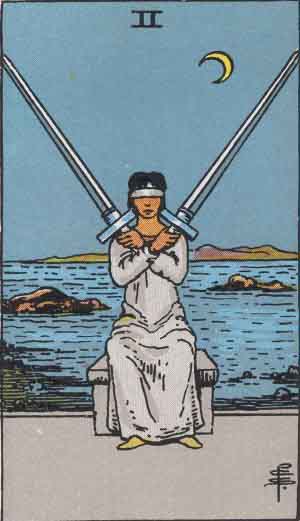
Two swords are held in balance before a blindfolded figure. The question this card keeps returning to ask is whether the pause protects necessary discernment or has become a way of postponing what can now be faced.
Core Repeating Message
The Two of Swords shows a figure seated with a blindfold, holding two crossed swords before her in what appears to be deliberate balance. The sea stretches behind her, with small outcroppings of rock visible. The crescent moon sits in a blue sky. Everything in the image is held in suspension: the swords are balanced, the figure is still, the water is at her back rather than in her field of vision. She could turn and look. She has chosen, for now, not to.
This image can describe more than one kind of uncertainty. Sometimes information is genuinely missing, circumstances are unsafe, or a pause is the most responsible choice. At other times, not-knowing feels safer than the knowledge that would require a decision. The blindfold can then symbolise a protective strategy: maintaining balance by limiting what is considered, because fuller perception might disturb the present arrangement.
When this card appears once, it can mark a specific stalemate between competing considerations, relationships, paths or pieces of information that cannot yet be responsibly weighted. When it appears repeatedly, it asks whether the not-yet-decided position still serves discernment or has continued beyond the point at which a workable choice could be made. The repetition is an invitation to investigate the difference, not proof that the seeker already knows the answer.
One common pattern is the seeker who suspects what they would choose if they looked directly at the situation, and who limits their own examination because the likely choice carries a cost they do not yet feel ready to meet. The balance of the two swords may be held less by equal weight than by avoidance of testing that weight. Yet suspicion is not certainty. The card asks for careful looking, including attention to evidence, consequences, power and safety, before any choice is treated as clear.
A second pattern is the seeker who is caught between two things that are both true, and who has made the experience of being caught into a sustained dwelling place rather than a temporary transitional state. Both considerations are real. Both carry genuine weight. And the seeker has organised their thinking around the experience of holding both rather than around the question of which one deserves priority in this situation at this moment.
A third pattern belongs to the seeker whose stalemate is sustained not by their own uncertainty but by their sensitivity to the needs and expectations of others. They know what they want. The blindfold is less about their own uncertainty than about knowing that naming what they want may disappoint, inconvenience, or genuinely harm someone else. The crossed swords hold in equilibrium not two equally weighted truths but the seeker’s own perception against the perceived cost of expressing it.
A fourth pattern is the seeker who has begun to treat impasse as identity: someone who experiences weighty decisions as reliably inaccessible and reads each stalemate as confirmation of personal incapacity. This story may conceal a strategy that can be examined and revised, but it may also coexist with exhaustion, disability, limited options or a history of decisions being punished. The card invites curiosity about the conditions of choice rather than shame about hesitation.
Whatever the specific form, the card is asking the same question: what would become visible if the blindfold were removed? And what specifically is the seeker protecting themselves from seeing?
When This Card Repeats Weekly
A week of Two of Swords repetition can mark an immediate stalemate in which the seeker is holding something in suspension that may now be ready to be resolved. Something in the week’s landscape is presenting as an impasse: a decision that needs to be made, a perception that needs to be allowed to land, a conversation that needs to move forward, and the seeker is maintaining the crossed-sword balance rather than allowing the scales to settle.
The card this week is not asking for premature decision. It is asking for honesty about whether the impasse is still genuinely unresolvable or whether it has shifted into the maintenance of stalemate for other reasons. What specifically is the seeker not looking at? What is directly behind them that they have positioned themselves to avoid seeing?
The weekly repetition may also symbolise a relational dynamic in which the seeker and another person are both avoiding a subject that appears important. The card cannot establish the other person’s motives or confirm an unspoken truth. It asks what the seeker has observed, what they are assuming, and whether a safe, bounded conversation could replace mutual ambiguity.
When This Card Repeats Monthly
A month of Two of Swords repetition suggests that sustained not-knowing has become the dominant cognitive weather of this period. The seeker is living inside the crossed-sword posture across multiple areas of their life, and the maintenance of the equilibrium is requiring significant ongoing effort that may not be fully visible to them as effort.
The monthly framing asks the seeker to look honestly at what they have been deliberately not looking at across the month. Not as accusation, but as an honest inquiry: in how many domains is something being held in artificial balance? What is the recurring theme of the stalemate? And what would change, in practical terms, if even one of the crossed swords were grounded?
A month of this card frequently accompanies a seeker who is in conflict between values that genuinely matter to them, and who needs support in thinking through how to prioritise them rather than in generating more reasons why the choice cannot be made. The monthly repetition is often less a call for faster decision than a call for more honest engagement with what options are actually available.
When This Card Repeats Seasonally
A season of Two of Swords appearances marks a sustained period in which the seeker is working on their relationship to decisions and perception, including the act of allowing information to lead to conclusions. This is not a comfortable season. It is the season of living with genuinely unresolvable tension long enough to understand its particular shape.
The seasonal frame often accompanies difficult circumstances where the right path is unclear, necessary information has not arrived, available options are constrained, or every choice carries significant consequences. In this case, the Two of Swords may represent responsible patience rather than avoidance. A legitimate pause can include gathering evidence, consulting qualified support, improving safety or waiting for conditions in which consent and capacity are less compromised.
The question the seasonal repetition asks is whether the seeker can tell the difference between genuine patience and the maintenance of the blindfold as a permanent strategy. How will they know when the stalemate has been held long enough? What would readiness for resolution look like, and how will they recognise it?
When This Card Repeats Across Years
The Two of Swords returning across years or major life phases names a seeker for whom the management of genuine perception through deliberate not-knowing is a deep structural pattern. Year after year, the swords remain crossed. Year after year, the figure remains seated at the water’s edge with the blindfold in place.
This long-arc pattern can belong to seekers who learned early that seeing clearly, and saying what they saw, produced consequences that were more difficult to manage than maintaining strategic unknowing. The child in a family where certain truths were actively not seen, where the maintenance of collective blindness was required for family cohesion, learns a specific skill: the capacity to hold the blindfold in place through an act of will so practised it no longer feels like effort. It simply feels like how perception works.
Across years, what the Two of Swords asks of this seeker is not sudden dramatic vision but the gradual development of tolerance for what seeing clearly actually produces. Not every truth seen requires immediate action. The first step is often simply the removal of the blindfold, the willingness to look at what is genuinely there, without requiring that looking to generate either speech or decision immediately.
Life Area Interpretations
Love & Relationships
In love and relationships, the Two of Swords can mark the seeker who is maintaining a form of relational not-knowing: an understanding of the relationship, their own needs within it, or what they want the relationship to be, held at arm’s length because allowing it to fully arrive would require either a difficult conversation or a difficult decision.
This might be the seeker who has important concerns about whether the relationship is working and keeps them unresolved because the costs of either conclusion feel high. Concern is not proof, and the card should not be used to infer betrayal, hidden intent or an inevitable ending. The useful work is to identify observable patterns, personal needs and the conditions for a safe conversation or decision.
The card may also symbolise two people in a mutual relational stalemate, both blindfolded, both holding their respective swords, neither willing to name what is true between them first. Where this pattern fits what has been observed, the seeker drawing the card is being asked about their own contribution to it rather than the other person’s.
Career & Purpose
In career and purpose, the Two of Swords marks the seeker who is holding a vocational impasse in suspension: an unresolved question about whether the current work is right for them, what direction a vocational transition should take, or what decision about a professional situation they know needs to be made but have not yet made.
The vocational stalemate of the Two of Swords often looks, from the outside, like careful deliberation. The seeker is thinking about it. They are gathering information. They are considering all angles. What is sometimes happening underneath this presentation is a sustained avoidance of the commitment a vocational choice requires: naming what matters most, ordering values, and accepting that one chosen direction forecloses alternatives.
Money & Stability
The Two of Swords in financial contexts can mark avoidance of available information, but it can also reflect genuinely incomplete figures, constrained choices or fear created by material insecurity. The practical distinction matters. The card invites a clear inventory of what is known, what remains uncertain and which decisions require qualified financial or legal advice rather than symbolic interpretation.
This might also manifest as the stalemate between two financial options, neither of which the seeker is willing to fully choose, because each genuine choice would foreclose something the seeker is not yet ready to release. The maintenance of the stalemate has its own financial cost that is not always included in the analysis of why neither option is yet right.
Spiritual Growth
In spiritual growth, the Two of Swords marks the seeker who is suspended between two spiritual frameworks, two understandings of the sacred, two different orientations toward meaning, that cannot both be fully inhabited at the same time. The seeker may be in genuine transition: leaving one framework that no longer fully serves without yet having found the one that would serve better. This transitional uncertainty is real and deserves genuine patience.
But the card repeating asks whether the suspension has lasted longer than genuine transition requires: whether the seeker has made a home in the between-place, choosing neither framework because choosing would require commitment, and commitment would require examining what they actually believe rather than what they are comfortable not yet having decided.
Emotional & Mental Patterns
In emotional and mental patterns, the Two of Swords most often marks a characteristic relationship to conflicting information in which the mind holds opposing considerations in careful equilibrium rather than allowing the equilibrium to be disturbed by preference or a decision about which consideration carries more weight. The seeker can hold the complexity; they have the intellectual capacity for nuance. What they sometimes cannot do is allow that complexity to resolve towards a conclusion.
The mental experience of this pattern has a distinctive quality: the seeker can articulate both sides of any question with intelligence and genuine fairness to each side, and articulating both sides consistently produces the sense that the question remains open, because the capacity for fair articulation is also the mechanism that prevents either side from becoming decisive. Fairness and indefinite suspension can, in this pattern, become structurally identical.
Family & Generational Dynamics
In family dynamics, the Two of Swords can describe the seeker who grew up in a family system that maintained its coherence partly through collective agreement not to see certain things. The family blindfold was worn by everyone; the swords were crossed by consensus; certain truths were simply not available for direct examination. The child who grew up within this system learned the skill of maintaining strategic not-knowing as an accurate adaptation to those circumstances.
The seeker who draws this card repeatedly may have developed a sophisticated capacity for holding competing realities when contradiction was difficult or unsafe to acknowledge in the family environment. This is one possible symbolic reading, not a conclusion about family history. The present work may involve tolerating some discomfort while allowing one consideration to carry more weight, without assuming that every conflict must be resolved quickly or alone.
Health & Energy
The Two of Swords in health contexts can symbolise the strain of sustained decision-making or prolonged uncertainty. Some people notice fatigue, tension, numbness or difficulty concentrating during such periods, while others do not. These experiences have many possible causes, and the card cannot determine whether a health condition, medication, stress, sleep or another factor is involved.
A seeker in sustained Two of Swords territory may experience mental flatness or low-grade tension, yet relief is not guaranteed simply because a decision is made. The useful invitation is to reduce unnecessary decision load, seek relevant information and notice how the body responds without treating that response as diagnostic proof. Persistent numbness, fatigue, cognitive change or other concerning symptoms deserve appropriate professional assessment.
Advanced Interpretive Sections
The Shadow Expression
The Two of Swords in shadow produces the seeker who has elevated deliberate not-knowing into a principled stance: who considers the maintenance of balance and the refusal to make final judgements as marks of sophistication and intellectual humility, while the underlying function is the avoidance of genuine commitment and its consequences. The blindfold is worn with pride. The stalemate is reframed as wisdom.
A second shadow is the seeker whose not-knowing is deployed relationally as a form of control: who maintains strategic ambiguity about their own intentions, needs, or positions because ambiguity keeps others in a particular orientation toward them. The swords are crossed not out of genuine uncertainty but as a means of maintaining a specific relational dynamic that genuine clarity would disrupt.
The Integrated Expression
The integrated Two of Swords seeker has developed the capacity to hold complexity with genuine patience and to distinguish that patience from avoiding a decision. They can sit with real impasse when the situation requires it, and they can recognise the moment when the impasse has been held long enough and resolution is now both available and appropriate.
This seeker can also remove the blindfold without requiring the removal to produce immediate action. They can look at what is genuinely there, feel the weight of that perception, and experience clarity without requiring that clarity to generate speech or decision immediately. Seeing and deciding are sequential. Seeing first is enough.
Why This Energy Has Not Released Yet
The Two of Swords pattern may persist when the seeker has not examined what the pause is protecting, or what information and conditions are still genuinely needed. The blindfold is symbolic, not evidence that a hidden truth must exist. Naming what the seeker fears they might see, alongside what they actually know and do not know, turns a general state of suspension into a more specific and workable inquiry.
The pattern also persists when the seeker’s experience of family or early-life decision-making was consistently so costly that choice itself has become something to avoid as a rule rather than assess in each situation. Until the specific historical teaching is examined and the present context distinguished from it, the pattern tends to apply itself indiscriminately.
What This Card Wants the Seeker to Understand
The Two of Swords asks the seeker to determine whether enough information is already present for a provisional choice. Sometimes the impasse is maintained by deferred weighting; sometimes essential evidence, safety or consent is genuinely absent. More information is useful when it answers a defined question. Indefinite gathering that never changes the decision may be another way of preserving equilibrium.
The card wants them to know that removing the blindfold is a separate act from deciding. Looking at what is genuinely there does not automatically commit the seeker to any course of action. It simply allows what has been seen to inform whatever follows. This distinction, small as it may seem, is often the distinction the seeker needs to make the first movement.
Signs the Pattern Is Beginning to Resolve
The Two of Swords pattern begins to resolve when the seeker notices that they have been looking directly at something they had been managing not to see, and that the looking, while uncomfortable, has produced a clarity that keeping the blindfold in place was preventing. Even one such act of perception, however small, signals movement.
It also resolves when the seeker can name, with specificity, what the impasse is actually about: not only “I cannot decide between X and Y”, but which fact, value, fear, constraint or missing condition keeps the decision open. A further sign is the capacity to make a bounded or provisional choice where appropriate, then review its effects rather than demanding certainty in advance.
Reflective Questions
-
Think of the most significant current impasse in your life. Is it unresolved because crucial information, safety or capacity is missing, or because available information has not yet been weighted? What evidence supports your answer?
-
What might the landscape behind the figure symbolise for you: a fact, feeling, consequence or uncertainty you have been reluctant to examine? What do you actually know about it, and what are you imagining?
-
Is there a decision in your life that has been technically open and practically clear for more than six months? What does keeping the decision technically open protect you from?
-
Did your family of origin require you not to see certain things? If so, what truths were held in collective blindness, and how has this shaped your current relationship to your own perception of genuinely difficult things?
-
In your most significant current stalemate, does one consideration carry more weight once values, evidence and consequences are named? If not, what specific condition would make a responsible decision possible?
-
Is there a relational dynamic in your life that is sustained by mutual not-naming: a situation where both you and another person are maintaining the blindfold together? What would be required for one of you to look first?
-
What is the specific fear that sits underneath the not-seeing in your most sustained current impasse? Can you name it precisely: is it the fear of loss, of conflict, of being wrong, of the irrevocability of genuine choice, or something else?
-
Have you ever resolved a stalemate that you had been maintaining for a long time? What prompted the resolution? What was it like to finally look, and what followed?
-
What would you need to believe about your own capacity to manage the consequences of genuine clarity before the blindfold could feel safe to remove?
-
If you imagine yourself a year from now, still in the same stalemate: what specifically would have been the cost of the year of continued not-looking? Is that cost genuinely smaller than the cost of looking now?
Practical Integration Actions
Name what is behind you. Spend twenty minutes writing about what you believe you would see if you looked directly at your most significant current impasse without managing what you allowed yourself to see. Not the diplomatic version, not the balanced version, but what you genuinely believe is there. Write without editing. The act of naming it privately does not commit you to any external action; it is simply the practice of giving your perception a clear private form.
Separate looking from deciding. For one significant area of current stalemate, practise looking directly without requiring it to produce an immediate decision. Look at the information you have. Weight it honestly. Notice what that weighting suggests. Then let yourself sit with that suggestion for a week before requiring it to become a decision or a conversation. The blindfold and the swords are separate things; removing the blindfold is the first act, not the final one.
Identify one sword to ground. In a situation with competing considerations, practise deliberately choosing one as less weighty in this particular situation than the other, not because it is unimportant in the abstract, but because a priority must be established somewhere for movement to become possible. The act of consciously prioritising one value above another in a specific situation is not the same as permanently dismissing the second. It is the exercise of decision that the Two of Swords is asking for.
Examine the family blindfold. Write about what was not directly examined in your family of origin: the truths that were held collectively without being named, the realities that were maintained in polite or protective not-seeing. Identify one specific way this collective practice has shaped your current relationship to genuine perception of difficult things. This examination is not about assigning blame to the family; it is about understanding the specific origin of the pattern so that it can be related to as a pattern rather than as a fundamental feature of how perception works.
Create a genuine resolution deadline. For one pending decision, choose a date by which you will either decide, seek specific missing information, or extend the consideration period for a stated reason. A review date adds structure without forcing a choice before safety, consent or evidence is adequate. At the review, record what changed, what did not and whether further delay serves discernment or simply repeats the stalemate.