
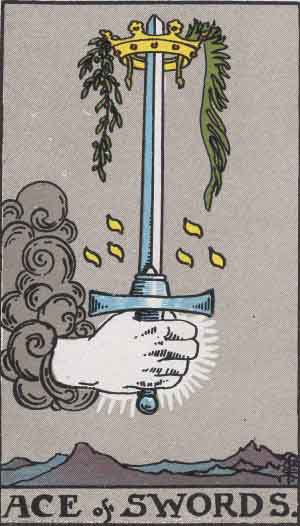
A clear thought is not yet a settled truth. The question this card keeps returning to ask is what deserves to be tested, spoken or decided, and what still needs evidence.
Core Repeating Message
The Ace of Swords shows a hand emerging from a cloud, grasping an upright sword whose tip is crowned. From the crown hang branches of olive and palm: peace and victory, the twin consequences of genuine truth applied at the right moment in the right direction. The sword is double-edged, always. What cuts through also carries risk; what clarifies also changes the shape of what follows. The image is entirely directional, entirely committed. Nothing in the hand’s posture is uncertain. The sword is held, and it is held upright.
When this card appears once, it can mark the arrival of clarity: a thought formed with precision, a truth that feels newly visible, a decision that has become available, or an insight that could cut through what has been clouded. Clarity is not infallibility, and the sword still asks for evidence, context and proportion. When it appears repeatedly, it may be marking a seeker whose characteristic relationship to insight is not the act of testing or using it but the act of holding it suspended.
The sword is there. The question the card keeps returning with is: what is happening between the forming of the clarity and its expression?
The most common pattern is the seeker who reaches a considered view and consistently does not speak it. This is not always the simple cowardice it is sometimes described as. The unsaid conclusion often reflects something more specific: an awareness that speaking may alter the situation, combined with reluctance to become the agent of that alteration. The seeker may know what they think while still needing to distinguish perception from assumption. Something keeps the sword raised because speaking would make a private interpretation consequential in the shared world, where it can be questioned, answered and no longer privately revised.
A second pattern is the seeker whose mental engagement with clarity never quite completes into action. The thinking is extensive, genuinely so: the problem has been turned over from every angle, the decision has been rehearsed repeatedly, the implications have been assessed with considerable intelligence, the same core insight has emerged from the analysis dozens of times. And at the point where this processing would produce either speech or decision or some concrete form of integration, the mind returns to the beginning of the loop. The sword keeps forming; the hand keeps adjusting its grip without delivering the cut. This is not stupidity. It is a specific pattern in which mental activity has become a substitute for the thing mental activity is supposed to produce.
A third pattern belongs to the seeker whose emerging clarity is repeatedly undermined by anxiety before it can be examined properly. The Ace of Swords in this pattern does not necessarily show avoidance of truth; it shows the seeker reaching a plausible conclusion and meeting the questions: what if I am wrong, what evidence would change my mind, and can I manage the consequences of speaking? Analysis that was meant to support a responsible decision can then produce more analysis, with each new layer doing less to test the original question and more to postpone the uncertainty that any real decision contains.
A fourth pattern is the seeker standing at a genuine decision point, sword in hand, who cannot make the cut. The decision is available; the seeker has thought it through; they know what they would decide if they decided. The Ace keeps appearing because the decision remains technically open while being practically clear, and keeping it technically open protects the seeker from the weight of irreversible commitment. To name what is true is to make it so. The sword, once swung, cannot be unswung.
What all these patterns share is a relationship to the consequences of clarity: an understanding, usually accurate, that speaking the truth or making a decision will change the landscape in ways that cannot be undone, and a preference, usually below the level of explicit choice, for the safety of holding the sword upright without using it. The seeker is not confused. They are protecting something, and the card keeps returning to ask whether what they are protecting is worth what the protection is costing.
When This Card Repeats Weekly
A week of Ace of Swords repetition marks an immediate situation in which something clear needs to be said or decided but remains unspoken or undecided, and the gap between clarity and expression is generating internal pressure.
This might be a specific unsaid sentence: a conversation that needs to happen, a boundary that needs to be named, a truth about a situation that the seeker is carrying without yet giving it external form. The mental weight of the unsaid thing is often exactly what the week of this card marks: the specific heaviness of clarity held in suspension rather than in use.
The weekly repetition may also be marking an acute decision that is consuming more cognitive energy than the decision warrants because the seeker is processing it rather than making it. The mind can only spin the same material for so long before the spinning becomes its own significant cost. The card this week is asking: what would it take to simply decide?
When This Card Repeats Monthly
A month of Ace of Swords repetition suggests that the seeker’s characteristic relationship to their own clarity, truth and capacity for incisive perception is stabilising as a pattern visible across multiple contexts rather than a single situation.
The monthly framing asks the seeker to look at what they have been thinking, repeatedly, across the month. What is the insight that keeps forming? What is the conversation they have rehearsed mentally more than twice without having it? What truth has presented itself in multiple domains, multiple relationships, multiple moments of genuine interior quiet, and has not yet been spoken or acted on?
A month of this card also frequently marks the seeker in a sustained period of mental over-activity that has begun to feel exhausting. The mind that cannot complete its processing loop does not rest between attempts; it returns, again and again, to the same territory. The specific tiredness of a month of Ace of Swords energy is the tiredness of someone whose thinking has been very busy without being genuinely useful.
When This Card Repeats Seasonally
A season of Ace of Swords appearances marks a sustained period of engagement with truth in one of its more demanding forms: a truth that requires not just being understood but being spoken, or a decision that requires not just being analysed but being made, or an insight that requires not just being held mentally but being allowed to reorganise something in the seeker’s life.
The seasonal frame often accompanies the seeker who is doing significant reflective work, with professional support or through careful solitary inquiry, and who keeps arriving at the same core recognition from different angles. Repetition strengthens the case for examining that recognition, but does not make it automatically correct. The season of the card marks a period in which an insight is being understood without yet being translated into change. This is not dishonesty; sometimes understanding needs time, corroboration and safe conditions before it can be acted on. But a full season of the same conclusion without any test or movement in the direction it points is information worth examining.
When This Card Repeats Across Years
The Ace of Swords returning across years or major life phases names a seeker for whom the specific challenge of acting from genuine clarity, rather than only thinking from it, is long-arc work. Year after year, the sword forms. Year after year, what the sword points at is clearly perceived. Year after year, the cut is deferred.
This long-arc pattern most often belongs to seekers for whom speaking truth has carried a real historical cost. The child who spoke clearly and was penalised for it, through dismissal, anger, punishment, or the particular loneliness of being right in a context that could not receive that rightness, learns, as an intelligent adaptation, to manage how far clarity is allowed to travel before being called back. They can think it. They may even write it privately. But the act of articulation, of allowing truth to become interpersonally real, carries a charge that remains from earlier experience.
Across years, what the Ace of Swords asks of this seeker is not bravery as performance but the gradual development of trust in their own perception: the experience, repeated in safe contexts, of speaking clearly and discovering that clarity spoken is not always the danger that the early experience established it to be. This trust is built slowly and from lived experience, not from instruction.
Life Area Interpretations
Love & Relationships
In love and relationships, the Ace of Swords often marks the seeker who is carrying a considered understanding about a significant relationship and has not yet spoken it. This may concern a repeated dynamic, the seeker’s own needs, observable behaviour, or the relationship’s present condition. The card does not verify suspicions about another person. It asks the seeker to separate fact, interpretation and feeling before turning private clarity into relational speech.
The unsaid thing in a relationship has a specific quality of weight that grows over time. What is true and unspoken does not simply wait; it shapes the texture of the connection from underneath. The seeker’s interactions are partly organised around managing what has not been said, creating a relational distance that neither person may be able to name clearly but that both, at some level, feel.
The card may also mark the seeker at a genuine relationship decision point: where they know what they want to do, or know what would be honest, and cannot yet bring themselves to the act of articulating the decision to the person it concerns. The sword is held; the other person is in the room; and what keeps the sword from its necessary movement is something the seeker is often not fully conscious of.
Career & Purpose
In career and purpose, the Ace of Swords most often marks the seeker who has a clear perception about their current work, vocational direction, or professional situation that is not being spoken or acted on. This might be the understanding that the current work is not aligned with the seeker’s actual capacity or values. It might be the recognition that a decision about a project, a role, a professional relationship, or a vocational direction has been available for some time and has not been made.
The card also marks the seeker whose professional voice is not yet fully developed: who thinks incisively, perceives with analytical clarity and has original contributions to make, but has not yet found the confidence or the form that would allow this thinking to enter professional contexts with its full weight. The clarity is present; the professional expression of it is consistently more tentative or more managed than the actual thinking warrants.
Money & Stability
The Ace of Swords in financial contexts often marks the seeker who has enough information to examine their position and is not yet acting on it. Figures may be exact while their meaning still depends on timing, obligations, access and professional context. The useful cut is therefore not a dramatic conclusion but a clear separation of known facts, uncertain assumptions and the next decision that belongs to the seeker. Complex or high-stakes choices may warrant qualified financial advice rather than interpretation alone.
The card may also mark the seeker who needs to have a specific financial conversation, with a partner, a family member, an employer, a lender, that they are carrying as mental weight without yet having. The specific relief of financial truth spoken is something this seeker has not yet given themselves.
Spiritual Growth
In spiritual growth, the Ace of Swords marks the seeker whose spiritual practice is significantly shaped by the mind’s relationship to its own perceptions: the seeker for whom thinking about spiritual experience is more immediately available than genuine spiritual presence. The sword of discernment, the capacity to perceive clearly and without distortion, is a genuine spiritual tool. The question the card asks in spiritual contexts is whether the seeker is using discernment in the service of spiritual development or as a sophisticated form of distance from spiritual experience.
The card also marks the seeker at a genuine threshold of spiritual clarity: a perception about the nature of their practice, their tradition, their relationship to belief or to the sacred, that has formed with precision and has not yet been integrated into how they practise, what they say about their beliefs, or how they live the spiritual dimension of their life.
Emotional & Mental Patterns
In emotional and mental patterns, the Ace of Swords most often marks a characteristic relationship to insight in which the mind produces genuine clarity and then generates enough additional mental activity around the clarity to prevent it from becoming a basis for decision. The insight forms; the mind immediately begins assessing its completeness, its risks, its possible errors, its alternative readings. By the time the assessment is complete, the clarity has been so thoroughly processed that it has lost the specific directional force it originally carried.
This is the over-processing pattern specific to Swords: the intelligence that is so comprehensive in its analytical capacity that it turns its analysis on its own conclusions, producing a recursive loop in which every insight generates the need for further insight before the original one can be trusted enough to use. The seeker in this pattern is not unclear. They are very, very thorough, and the thoroughness is partly a way of not having to commit to the single clean cut that genuine clarity calls for.
The embodied dimension of this pattern is worth noticing without treating it as a diagnosis. Ongoing unresolved processing may be experienced as tension, restlessness, fatigue or difficulty settling, although these experiences can have many causes. The card can invite the seeker to notice correlations between recurring thought loops and bodily strain, while seeking appropriate support for persistent or concerning symptoms.
Family & Generational Dynamics
In family dynamics, the Ace of Swords most often marks the seeker who grew up in a family system where clear perception and clear articulation of what was genuinely true were either not modelled, not welcomed, or actively penalised. Families that operated by implicit agreement around certain truths not being named, where the emotional weather was managed rather than clearly described, where genuine honesty was experienced as disruptive rather than as a form of care, tend to produce adults who have a complicated relationship with their own clarity.
The seeker who draws this card repeatedly often knows, from family experience, the specific cost of speaking clearly in a context that was not prepared to hear it. The sword was drawn at some earlier point, perhaps in childhood, perhaps in adolescence, and what followed taught the seeker what truth-telling can cost in that context. The pattern of holding the sword upright without using it is, in many cases, precisely as old as that lesson.
The generational work this card can symbolise is the gradual discovery that present contexts may not carry the same risks as earlier ones. Clear speech in an adult relationship with consent, timing and boundaries is not identical to speaking within the family system that may have established the pattern. Some present contexts remain unsafe or unequal, so discernment includes deciding where, when and with whom directness is appropriate.
Health & Energy
The Ace of Swords in health contexts symbolically points to the embodied cost that can accompany sustained mental effort. A person may notice tension, restlessness or tiredness while repeatedly circling an unresolved concern, but the card cannot establish the cause of those sensations or distinguish everyday stress from a health condition.
Some seekers may experience jaw, neck or shoulder tension, persistent mental alertness, or sleep disturbed by recurring thoughts. These experiences are not proof that speech is being held, and they can arise for many physical, psychological or situational reasons. Persistent pain, marked sleep change, sudden confusion or other concerning symptoms deserve assessment by an appropriate health professional rather than a tarot explanation.
Clearer decisions or appropriately timed conversations may reduce some subjective strain, but they are not guaranteed to produce physical relief and are not a substitute for care. The useful invitation is to notice what changes after a thought is written, checked, spoken safely or converted into a proportionate action, while treating the body’s signals as information rather than confirmation of the card’s interpretation.
Advanced Interpretive Sections
The Shadow Expression
The Ace of Swords in shadow produces two distinct patterns. The first is the seeker who uses the language of clarity and truth as a form of aggression: who delivers genuine perception as a weapon, who values being right more than being in genuine relationship, whose sword is never suspended but is instead used indiscriminately, cutting through things that were not in need of cutting and people who were not prepared for the blade. This shadow is recognisable by the absence of any consideration for when or how or to whom the truth should be spoken: the honest statement that is also a form of violence.
The second shadow is the seeker who has intellectualised their way entirely out of genuine emotional presence: who can describe, analyse, and articulate the structure of any experience with considerable precision while remaining emotionally absent from the experience itself. The sword is very sharp; the seeker is very far from the sea.
The Integrated Expression
The integrated Ace of Swords seeker has developed the capacity to think clearly and express that clarity at the right moment, in the right form, with precision and appropriate consideration of consequence. The sword is used, and it is used well.
This seeker can perceive accurately and speak from that perception with directness and care for the person or situation the words are directed at. They are not performing honesty as virtue; they are oriented toward truth as a form of service, toward themselves and toward others. They have also developed the capacity to tolerate the discomfort that follows the expression of clarity: the altered landscape, the reaction of others, the irreversibility of what has been said.
Why This Energy Has Not Released Yet
The Ace of Swords pattern may persist when the seeker has not found a workable balance between trusting perception and testing it. Repeatedly asking whether an insight is true, complete or responsible to express can function as deferral, but questioning can also prevent error. The task is to establish what evidence is sufficient, what remains uncertain and what proportionate step can be taken without pretending to absolute certainty.
The pattern also persists when the seeker has not yet examined the original experience that taught them what genuine clarity costs. The lesson from that experience operates as a general prohibition on speaking clearly, applied indiscriminately to all contexts regardless of whether those contexts share the conditions that made the original expression risky. Until the original teaching is examined with adult eyes in the present context, the prohibition tends to persist well past the situations that genuinely warranted it.
Finally, the pattern persists in seekers who have not yet experienced enough examples of clarity spoken and well-received: of truth offered and met with genuine engagement rather than with the consequences the seeker’s history has led them to anticipate. New experience in relatively safe contexts is often what allows the pattern to begin changing.
What This Card Wants the Seeker to Understand
The Ace of Swords wants the seeker to take their clarity seriously enough to act from it. The pattern described here is not the confusion of someone who does not yet see clearly. It is the particular situation of someone who sees clearly and who has not yet allowed that seeing to become fully active: fully articulated, fully decided, fully integrated into the way they speak and act and navigate the specific situations the sword keeps pointing at.
The card wants the seeker to know that held clarity has a cost that is not always smaller than the cost of expressing it. The ongoing maintenance of the suspended sword, the perpetual processing of the same material, the chronic low-grade tension of truth carried without being spoken, is itself a form of expenditure. The specific safety of not-yet-having-said is not free.
Signs the Pattern Is Beginning to Resolve
The Ace of Swords pattern begins to resolve when the seeker notices that they have said something true and clear, perhaps for the first time in a context where they would previously have managed it, and that what followed was not the feared consequence but something more ordinary and more workable. This experience, repeated, builds genuine trust in the seeker’s own clarity and in the act of expressing it.
It also resolves when the characteristic thought loop begins to complete rather than returning automatically to its starting point: when an insight is tested and produces a decision, an articulated sentence or a deliberate choice to wait for more evidence. The seeker may also notice changes in bodily tension after a conversation or decision, without treating relaxation as proof that the conclusion was correct. The deeper sign is increased capacity to think, revise and speak without either compulsive certainty or endless deferral.
Reflective Questions
-
What is the thought you have thought most often in the last month that you have not yet translated into a sentence spoken aloud to another person? What specifically is preventing the translation?
-
Think of the last time you knew something clearly and did not say it. What did you do with the knowing instead? How long did you carry it before the clarity dissipated or the situation resolved without you?
-
What do you honestly believe will happen if you speak the true thing in the context where it most needs to be spoken? Is this understanding based on genuine evidence from the present context, or on something learned in an earlier one?
-
Is there a decision that has been technically pending in your life for more than three months? If you examine it honestly, do you actually know what you would decide if you decided? What is keeping it technically open?
-
What does sustained mental processing without conclusion feel like in your body, if you notice a connection at all? What other explanations or needs should remain in view? When did you last experience a piece of mental work reaching a workable stopping point?
-
What did your family of origin teach you about the consequences of clear articulation, of naming what was actually true, of saying directly what you perceived? How has this teaching shaped your current relationship to your own clarity?
-
In what domain of your life is your thinking much more incisive than what you are willing to express? What is the gap between the clarity in your mind and the words that come out?
-
Have you ever spoken a truth that you had been withholding for a long time and discovered that the consequence was not what you had anticipated? What was that experience like, and what did it change about your understanding of what genuine clarity costs?
-
What is the specific quality of your anxiety around speaking clearly: is it the fear of being wrong, the fear of causing harm, the fear of conflict, the fear of the specific consequences of being right, or something else? Can you name it precisely?
-
If the sword in your hand were already swung, if the clarity you are carrying had already been spoken or decided, what specifically would be different? What would have been released, and what would need to be managed, and is the management genuinely more difficult than the carrying?
Practical Integration Actions
Write it first. If there is a truth you have been carrying without speaking, write it first: not the managed version, not the diplomatic version, but the clear version, the actual thing as the mind has understood it. Write it in private, without the constraint of how it will land. This is not the same as saying it; it is the practice of allowing the clarity to have genuine form, even in private, which often reveals both how clear the thing actually is and how much the management of it has been costing. Many seekers find that writing the unsaid thing begins to shift the pattern before the speaking occurs.
Complete one pending decision. Identify one decision that has been technically open and practically clear for more than four weeks. Write down, in one sentence, what you would decide if you decided. Then examine what that sentence requires of you next. Not every decision requires immediate action; some require a conversation, some require a concrete step, some require only honest internal acknowledgement of what has already been decided in practice. Give the decision a clear form, and notice how you feel when the loop is allowed to close.
Track the processing loop. For one week, notice whenever your mind returns to the same piece of unresolved clarity: the same topic, the same question, the same unsaid thing. Each time it returns, note it briefly. By the end of the week, you will have a record of the pattern’s territory, both what the mind keeps returning to and how much energy the returning seems to consume. This is not an exercise in self-criticism; it is the practice of making the invisible visible so that what has been automated can become chosen.
Choose one safe context for genuine articulation. The seeker who has learned that clarity is dangerous may have little recent evidence to the contrary, because the management habit prevents new evidence from accumulating. Choose one relationship or context in which speaking clearly is relatively safe, where the other person is likely to receive direct speech with openness, and practise one genuine articulation: one thing said clearly and directly that you would usually manage or qualify. Note what happens. This begins to build evidence that clarity in the right context need not produce the consequences the pattern treats as inevitable.
Develop a practice of physical release. If recurring thought is accompanied by physical tension, choose a gentle practice that helps you notice and reduce strain, such as speaking aloud in private, walking, singing, stretching within your comfort, or allowing the breath to settle without forcing it. Treat this as support for reflection, not as treatment or proof that a particular truth is being held in the body. Stop if a practice causes discomfort, and seek appropriate care for persistent or concerning symptoms.