
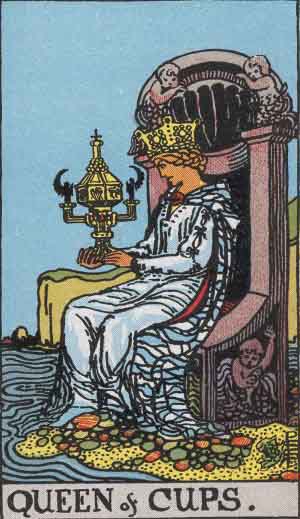
The Queen sits at the water’s edge, holding a closed cup of unusual beauty in both hands. She does not perform feeling; she contains it. The question this card keeps returning to ask is not whether the seeker has emotional depth, but whether they have yet claimed the authority to know what they know.
Core Repeating Message
The Queen of Cups sits at the edge of the sea, enthroned at the boundary between the conscious world and the depths of emotional and unconscious life. She holds a closed cup, more elaborate than any other in the suit, with handles, a domed lid and a sense of ceremonial containment. This is not a cup that pours indiscriminately; it holds its contents with intention. As the Queen studies it and the sea remains still at her feet, she appears deeply connected to the emotional realm without being overwhelmed by it.
The Queen of Cups represents emotional maturity expressed through attentive presence, compassion, reflective intuition and appropriate boundaries. Her authority does not come from infallibly knowing what others feel. It comes from staying receptive while distinguishing perception from projection, asking rather than assuming, and remaining connected to her own ground in emotionally complex situations.
When this card appears once, it marks the presence of this quality, either in the seeker or in a person in their life who embodies it, or the invitation to develop it. When it appears repeatedly, it marks a persistent pattern in the seeker’s relationship with their own emotional authority, their capacity for genuine empathic presence, and the specific challenge of claiming the Queen’s ground rather than perpetually approaching it.
The most common pattern is a seeker with emotional depth and strong sensitivity who does not trust their own experience unless someone else validates it. They may notice tone, pattern and atmosphere accurately, yet those observations remain interpretations until checked through communication and behaviour. Claiming the Queen’s authority means speaking from one’s own experience clearly, not claiming privileged access to another person’s interior.
A second pattern is sustained attention to other people’s needs at the expense of the seeker’s own. They may be highly practised at anticipating, listening and responding while having less language for what they want or can sustain. This can arise from care, role expectations, work or habit. The closed cup asks for private self-knowledge and reciprocity, not withdrawal from compassion.
A third pattern is compassionate attention without workable limits. The seeker may ruminate after conversations, assume responsibility for another adult’s mood, or remain available beyond their capacity. Rather than describing this as literally absorbing someone else’s feelings, the Queen asks which cues trigger over-responsibility, which commitments were actually made and what boundary would return choice to the seeker.
A fourth pattern belongs to the seeker who has intellectual or analytical understanding of emotional dynamics without yet having the Queen’s embodied, felt, intimate relationship to the emotional interior. They can describe feeling, analyse feeling, contextualise feeling, and are not quite in full contact with the feeling itself. The Queen’s cup holds something interior, intimate, not fully externalised: feeling as it is experienced, before it is explained.
When This Card Repeats Weekly
A week of Queen of Cups repetition marks an immediate encounter with the emotional wisdom and empathic capacity that the Queen embodies, either calling the seeker to inhabit it more fully or showing how it is being stretched or strained by the demands of the week.
For caregivers, counsellors, therapists and others in emotionally demanding roles, the week may expose tension between compassionate presence and sustainable practice. The practical questions concern workload, supervision, confidentiality, recovery time, role boundaries and whether support is available to the seeker. The card does not assess professional competence or replace workplace safeguards.
When This Card Repeats Monthly
A month of Queen of Cups repetition suggests that emotional authority, empathic maturity, and the relationship between compassionate presence and self-care are the central concerns of this period.
The monthly framing asks the seeker to look at the balance of emotional giving and receiving across the month. Where has the Queen’s energy been expressed with depth and appropriate boundaries? Where has it been collapsed into excessive giving? Where has it been withheld from appropriate expression because the seeker does not yet fully claim the authority that would allow it to carry weight?
When This Card Repeats Seasonally
A season of Queen of Cups appearances marks a sustained period in which emotional maturity is the developmental territory being navigated. The seeker is developing, deepening, or more fully inhabiting the qualities the Queen embodies: sustained empathic presence, emotional authority, and the relationship between compassion and appropriate limits.
This might be a season of significant deepening in therapeutic or counselling work, in which the seeker is developing capacity for emotionally present professional service. It might be a season of sustained relational depth, in which close partnership or family relationship is requiring the full scope of the Queen’s particular gifts. Or it might be a season of self-examination, in which the seeker is developing for the first time a clearer and more authoritative relationship to their own emotional interior.
When This Card Repeats Across Years
The Queen of Cups returning across years or major life phases names a seeker for whom the development of genuine emotional authority, the capacity to claim what they know from the depth of their own emotional and intuitive experience, is long-arc soul work.
The seeker may have sensitivity, depth and strong pattern recognition without yet having stable confidence or boundaries. The Queen’s mature expression develops when impressions are tested, needs are named, uncertainty is tolerated and care is offered by choice rather than compulsion. The throne represents accountable self-possession, not unquestioned intuitive status.
Across years, the growth arc this card traces is from sensitivity to emotional authority: from knowing what they feel and reading others’ feelings, to standing in their own experience with confidence, appropriate boundaries, and the capacity to be present with emotional complexity without losing their ground. This is significant developmental work, and the card’s return across years both acknowledges its depth and encourages the seeker to take their place on the throne.
Life Area Interpretations
Love & Relationships
In love and relationships, the Queen of Cups highlights careful attention to emotional nuance and the risks of inferring too much from it. A seeker may notice changes in tone or behaviour before they are discussed, but only the other person can confirm what those changes mean. Healthy attunement combines observation with direct questions, consent, mutual care and respect for separate inner lives.
The seeker may be the emotional manager of the relationship, the one whose empathic attunement means they are consistently responding to what the partner needs before their own needs have been clearly expressed in the relationship. The Queen’s cup is regularly extended; the question of what is being poured into the Queen’s own cup is less consistently asked.
The card may also mark the seeker who is in a relationship in which their emotional depth is not adequately met: whose interior richness is not fully encountered by the partner, and who is experiencing the longing of someone whose emotional world is very large and whose relational container does not yet fully match it.
Career & Purpose
In career and purpose, the Queen of Cups can describe work requiring relational attention, including counselling, teaching, care, mediation, leadership and art. Sensitivity alone does not confer professional authority. Training, ethics, supervision, scope of practice and clear boundaries are what allow emotional presence to become responsible service.
The card may also mark the seeker who has not yet found the vocational form that requires and honours their particular emotional and intuitive capacities. They are working in ways that use a fraction of what they have to offer, and the Queen of Cups keeps appearing as acknowledgement of the gap between what is being offered and what they are capable of offering.
Money & Stability
The Queen of Cups in financial contexts most often marks the seeker whose relationship to money is shaped by empathic responsiveness in ways that are not always in service of their own wellbeing. The capacity to sense what others need, the compassion that characterises the Queen’s energy, can produce patterns of financial generosity that are not sustainable: giving to others from a cup that has not been adequately replenished, prioritising the financial needs of those they care about over their own material requirements.
The card returning in financial contexts asks the seeker to examine whether the Queen’s gifts are being adequately compensated in material terms, and whether the seeker has developed the capacity to receive appropriate material care as well as to give it.
Spiritual Growth
In spiritual growth, the Queen of Cups marks the seeker whose spiritual life is most essentially interior, contemplative, and feeling-based: the one whose relationship to the sacred is most alive in prayer, in contemplative practice, in interior dialogue with the deep. This is the Queen’s natural spiritual territory, and the card repeating in this domain is asking whether the seeker has yet claimed their own spiritual authority: the authority of someone who knows their inner experience and no longer needs external permission to take it seriously.
The card may also appear for a spiritual or intuitive practitioner who is deciding how much authority to give subjective perception. The Queen’s maturity lies in humility, consent and transparent limits: describe an impression as an impression, avoid claims that override another person’s knowledge, and revise interpretations when evidence changes.
Emotional & Mental Patterns
In emotional and mental patterns, the Queen of Cups can describe difficulty separating personal feeling, inference and reaction to another person’s behaviour. The seeker knows their own experience directly; they know another’s only through what is communicated and observed. Labelling each layer clearly can reduce confusion without denying sensitivity.
This pattern is not a diagnosis and should not be romanticised as mind-reading. Discernment asks: what am I feeling, what did I observe, what am I inferring, what has the other person actually said and what responsibility is mine? This preserves empathy while returning ownership of each person’s emotional life to them.
Family & Generational Dynamics
In family dynamics, the Queen of Cups most often marks the seeker who has been the emotional attunement point of the family system: the one who attended closely to how everyone was feeling, who managed the family’s emotional climate, who could read the room before anyone else. This role is sometimes honoured and sometimes invisible, but it is consistently demanding, and the adult who grew up in this position has often developed enormous capacity for reading others alongside a significant underdevelopment of their own clear emotional self-knowledge.
The generational work this card marks is the gradual development of a clear distinction between the family’s emotional life, which the seeker knows very well from long intimate practice, and the seeker’s own interior, which has sometimes been peripheral to the family’s emotional organisation. Developing knowledge of and authority over the seeker’s own emotional life, distinct from their practised attention to others’, is often the most significant developmental task the Queen of Cups marks.
Health & Energy
In health and energy readings, the Queen of Cups may reflect tiredness associated with caregiving, emotional labour, vigilance or limited recovery time. The card cannot determine that empathy is causing symptoms, and fatigue, pain, sleep changes or low mood have many possible contributors. Persistent or concerning changes warrant appropriate health assessment.
The grounded response is to review workload, rest, practical support, boundaries and opportunities to process demanding experiences through appropriate supervision, conversation or reflection. The closed cup symbolises containment, not a claim that another person’s emotion has entered the seeker’s body. Care for the Queen must be concrete enough to protect time and capacity.
Advanced Interpretive Sections
The Shadow Expression
The Queen of Cups in shadow describes two primary patterns. The first is the seeker whose empathic sensitivity has collapsed into emotional absorption and chronic over-functioning in others’ emotional lives: who takes responsibility for what belongs to others, who organises their life around others’ feeling without adequate attention to their own, and who has so thoroughly erased the boundary between compassion and self-loss that the distinction has become unclear.
The second shadow is the seeker who uses the language of emotional sensitivity as a form of control: whose empathic attunement to others is used to manage the relational environment rather than to offer compassionate presence. This shadow Queen reads the room to manage the room, not to meet it.
The Integrated Expression
The integrated Queen of Cups seeker holds the closed cup with authority: they know their own emotional and intuitive experience, and they claim that knowledge with appropriate confidence. They are present with others’ emotional reality without losing their own ground; their compassion has appropriate limits that protect their interior without reducing the quality of their empathic presence.
This seeker knows their own emotional life with the same clarity and care that they bring to understanding others: they have developed self-knowledge alongside empathy, and they no longer need to choose between the two. The cup is their own, and it is full.
Why This Energy Has Not Released Yet
The Queen of Cups pattern may persist while the seeker is learning to distinguish direct experience from inference. Authority grows through precise language: this is what I feel, this is what I observed, this is what I suspect, and this is what I do not know. That distinction allows compassion without projection and boundaries without emotional withdrawal.
The pattern also persists when the seeker has not had enough experience of receiving appropriate care from others: of their own cup being filled and their emotional reality being met with compassionate presence, enough to know what reciprocal emotional care feels like. The seeker who has always been the one providing the cup may not yet know what it is to be fully on the receiving end of it.
What This Card Wants the Seeker to Understand
The Queen of Cups wants the seeker to understand that their emotional experience carries authority about their own needs, limits and values. They do not require permission to name that experience. Intuitive impressions about other people or external events deserve a different standard: they remain provisional and should be checked against consent, evidence and direct communication.
The card also wants them to know that compassion includes appropriate limits, and that the limits are not a reduction of the compassion but what allows it to remain sustainable. The Queen’s closed cup does not pour constantly; it opens with intention, and this is what allows it to keep offering care.
Signs the Pattern Is Beginning to Resolve
The Queen of Cups pattern begins to resolve when the seeker speaks about their own feelings and boundaries with clarity while holding interpretations lightly. They can act on a personal limit without proving another person’s motive, and they can investigate an intuition without treating it as verified fact. Confidence and humility become compatible.
It also resolves when the seeker begins to attend to their own emotional interior with the same quality of care and attentiveness that they bring to others: when self-care is not a residual activity but a priority, when the Queen’s own cup is being regularly filled.
And it resolves when the seeker develops and maintains appropriate limits around their empathic presence: when they know the difference between compassionate presence and empathic absorption, and when that distinction is available in real time, before rather than after they have become overwhelmed.
Reflective Questions
-
In your closest relationships and most significant roles, where does your emotional energy go most consistently? Who receives the most of what the Queen’s cup offers, and who is replenishing it?
-
What do you know from the depth of your own emotional and intuitive experience that you have not yet claimed with authority? What prevents you from speaking or acting from this knowing?
-
Where in your life do you have difficulty distinguishing your own feeling from what you infer another person may be feeling? What observations, assumptions and responsibilities become mixed together?
-
Is there a pattern of emotional caretaking in your life that is not adequately reciprocal: a relationship or role in which you consistently give empathic presence and do not consistently receive it? What is the cost of this pattern?
-
What specific conditions allow you to be genuinely replenished: to fill the Queen’s cup rather than to pour from it? Are these conditions present in your current life, and how regularly?
-
What did your family of origin require of your emotional attunement? Were you the family’s emotional manager, its mood reader, its caretaker? How has this role shaped who you are now?
-
Where does compassionate presence end and over-responsibility begin for you? What observable signs tell you that attention to another person is exceeding your role or capacity?
-
Is there a dimension of your own emotional interior that you know less clearly than you know others’? If so, what would attention to this less-known territory reveal?
-
What would it feel like to claim the authority of the Queen’s throne: to trust the depth of your own emotional experience without requiring external validation?
-
Who in your life genuinely meets you with the quality of empathic presence you most often provide to others? And what happens when you allow yourself to receive it?
Practical Integration Actions
Claim one knowing this week. Choose one feeling, need, value or limit you know from your own experience and express it clearly in first-person language. Do not attach an unverified claim about another person’s motive. Notice how authority changes when it rests on what is genuinely yours to know.
Map your emotional giving and receiving. Over one week, keep a simple record of the emotional energy you give in service of others and the emotional nourishment you receive. Not quantitatively, but qualitatively: where are you most consistently pouring from the cup, and where is the cup being filled? The honest picture often clarifies what needs to change before the seeker can address it.
Develop a genuine boundary in one context. Identify one relationship or role where the absence of appropriate limit is costing you wellbeing, and practise one specific limit: something you will not do or take responsibility for. This is not withdrawal of compassion; it is the development of the containment the Queen’s closed cup represents. Notice how it feels to hold the limit and what it provides.
Spend genuine time in your own interior. The seeker whose attention is predominantly directed outward towards others’ emotional reality often has less access to their own interior than they realise. Develop a regular practice, however brief, of inward attention: journalling about your own feeling, not others’, meditating without the service orientation that characterises much of your emotional work, simply attending to what is present in your own interior right now. This develops self-knowledge alongside your understanding of others.
Receive care deliberately. Identify one relationship in which emotional reciprocity is possible and practise receiving care: allowing empathic attention to land, allowing concern for your wellbeing to be expressed and met rather than immediately redirected towards the other person. The Queen’s cup, to continue offering care, requires consistent replenishment. Deliberately receiving care provides that replenishment.