
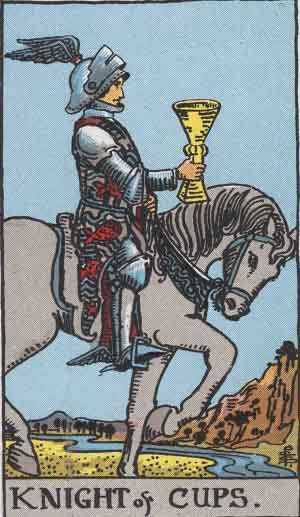
The Knight rides at a gentle canter, holding the cup before him with deliberate care. He is always arriving, perpetually en route to something, the feeling ahead of him leading the way. The question this card keeps returning to ask is not whether the quest is genuine, but whether the seeker is yet willing to arrive.
Core Repeating Message
The Knight of Cups shows a mounted figure moving at an unhurried pace, carrying a cup as an offering towards a destination not yet fully visible; this is not the charge of the Knight of Wands. Water and fish imagery associate the journey with feeling, imagination and desire. Emotion supplies direction, but it is not automatically reliable evidence. The Knight’s task is to place inspiration beside observation, consent, consequence and the practical demands of arrival.
The Knight of Cups is the card of romantic pursuit, of the heart-led quest, of the emotional life at its most active and most directional. Where the Page receives interior messages with open curiosity, the Knight has turned those messages into movement: toward a person, a creative project, a spiritual ideal, a version of life that seems to hold the feeling he is seeking. He is animated by genuine yearning, and his movement is genuine. What the card does not show is the arrival.
When the Knight of Cups appears once, it can reflect romantic, creative or values-led movement towards something compelling. When it appears repeatedly, it brings the seeker’s pattern of pursuit into focus: how beginnings are chosen, what happens when fantasy meets information, and whether feeling develops into sustained engagement or repeatedly seeks a new destination.
The most common pattern is the seeker who is perpetually at the beginning of something emotionally significant. Each beginning carries genuine feeling; the pursuit is often compelling; and something in the seeker’s way of moving through the emotional landscape reliably recreates the conditions of the beginning without allowing the fullness of arrival. New relationships begin with great feeling and stall before depth develops. Creative projects are pursued with aliveness and gradually lose their momentum before completion. Spiritual quests are undertaken with genuine conviction and then replaced by the next quest when the first one demands the unglamorous work of sustained practice.
A second pattern is romantic or creative idealism that makes ordinary reality seem like failure. A person may be invested with qualities not yet demonstrated; a project may be loved most before its constraints are known. The issue is not that ideals are false, but that they need contact with the actual person, work or practice. Disappointment can then become information rather than an automatic signal to abandon the destination.
A third pattern is reliance on feeling without enough discrimination between attraction, urgency, familiarity, values and evidence. Not every strong emotion is wisdom, and not every quiet response is avoidance. The card asks what generated the feeling, how it changes over time, what facts support it and who else bears the consequences of acting on it.
A fourth pattern belongs to the seeker who has the Knight’s genuine romantic and creative sensitivity but has learned, through disappointment or by the requirements of a practical life, to suppress the outward movement while the interior continues to generate it. The quest is alive; the Knight is still mounted; but the horse has not been allowed to move for some time, and the cup is held in a kind of suspended readiness that is not quite the Page’s gentle receptivity and not quite the Knight’s outward motion.
When This Card Repeats Weekly
A week of Knight of Cups repetition marks an immediate experience of emotional movement: feeling is drawing the seeker towards someone or something, and the card asks them to be conscious of what they do with that movement.
The feeling is real as an experience; its interpretation and destination remain open. The seeker can distinguish responsiveness from reactivity by slowing the timetable, checking assumptions, observing consistency and considering whether the action respects boundaries and consent. Reflection does not invalidate the cup. It gives the horse a road.
When This Card Repeats Monthly
A month of Knight of Cups repetition suggests that a pattern of heart-led movement, emotional pursuit, or romantic and creative quest is operating as the month’s dominant emotional experience. The seeker is in genuine motion.
The monthly framing asks where the movement is going and what is happening at the point where arrival becomes possible. Is the pursuit developing into sustained engagement, or is something happening at the threshold of depth that redirects the seeker back to the earlier, more comfortable territory of beginning? The Knight is always most vivid in his beginning; the monthly repetition asks whether this particular month will be the one in which the beginning becomes something more sustained.
When This Card Repeats Seasonally
A season of Knight of Cups appearances marks a sustained period of emotional quest: the seeker is actively pursuing something that the feeling-life is pointing towards, and the season is the time in which the quest will either develop into sustained engagement or cycle back to a new beginning. The card appearing across a season asks the seeker to be honest about which of these is happening and what kind of commitment would allow the movement to arrive.
For the seeker whose creative work is animated by romantic or emotional inspiration, a season of the Knight may mark a period of productive emotional aliveness that is fuelling sustained creative work. This is the Knight at his best: feeling sustaining the work. The question is whether the work will be completed or whether the feeling, once the initial aliveness wanes, will need to be renewed by the next beginning.
When This Card Repeats Across Years
The Knight of Cups returning across years or major life phases names a seeker for whom the quest, the romantic or creative or spiritual beginning and its compelling feeling, is an enduring feature of their emotional life. Year after year, the Knight rides. Year after year, the arrival is deferred.
This long-arc pattern most often belongs to seekers for whom arrival carries real risk: to arrive is to be judged, to commit is to become accountable, to inhabit the destination is to risk finding that what was pursued disappoints when it is lived rather than pursued. The Knight in perpetual motion avoids this reckoning by never quite reaching it.
Across years, what the Knight of Cups asks of this seeker is the courage of arrival: the willingness to step from the horse, to set the cup down, to inhabit the destination rather than the journey toward it, and to discover what sustained emotional presence in one place actually provides that the perpetual motion of the quest cannot.
Life Area Interpretations
Love & Relationships
In love and relationships, the Knight of Cups highlights the difference between compelling pursuit and established intimacy. Early attraction can be intense partly because much remains unknown. As information accumulates, the feeling may deepen, change or appropriately diminish. The card asks whether the seeker is responding to the actual person, honouring their pace and consent, and evaluating compatibility rather than chasing recognition as proof of destiny.
This is not evidence that the seeker is incapable of love. They may simply associate aliveness with novelty and misread quieter connection as absence. Yet staying is not inherently mature if the relationship is unsafe, incompatible or one-sided. The Knight integrates when pursuit gives way to mutual knowledge and when both staying and leaving are based on present reality.
Career & Purpose
In career and purpose, the Knight of Cups marks the seeker whose creative or vocational life is driven by passionate engagement with beginnings and difficulty sustaining that engagement through the long middle of creative work. The inspired beginning is vivid; the first chapters, the initial concept, the early creative excitement are alive. And the work of bringing a complex project to completion, through the unglamorous middle where the initial feeling is not reliably present, is where the Knight’s energy tends to wane.
The creative seeker for whom this card repeats often has a collection of compelling beginnings and a dearth of completed work. The feeling has been followed faithfully; the completion is not where the feeling reliably leads.
Money & Stability
In money and stability, the Knight of Cups warns against letting an emotionally compelling story substitute for financial evidence. Spending on romance, beauty, creativity or a hoped-for new chapter may be meaningful, but investments, offers and commitments still require verified terms, fees, affordability and independent comparison. Urgency and charm are reasons to slow down, not proof of value.
The issue is not pleasure or generosity but whether repeated decisions undermine essentials, debt obligations, savings or other people’s security. Structural hardship should not be reduced to impulsiveness. Where resources are limited, the Knight’s integration may be a small protected creative budget and a plan that preserves both feeling and material reality.
Spiritual Growth
In spiritual growth, the Knight of Cups marks the seeker who pursues spiritual experience with romantic intensity and who has difficulty with the unglamorous practice of sustained spiritual development. The retreat is alive; the ceremony is alive; the new teacher, the new tradition, the new practice is alive with the quality of feeling that the Knight follows. And the daily practice, the small incremental work of spiritual development, is less reliably animated by that feeling.
Genuine spiritual development requires what the Knight does not naturally provide: sustained practice through the periods when the feeling is not compelling, fidelity to one vessel long enough for depth to develop, willingness to stay when the initial aliveness fades rather than orienting toward the next beginning where it will be available again.
Emotional & Mental Patterns
In emotional and mental patterns, the Knight of Cups most often marks a characteristic relationship to feeling in which emotional aliveness is most readily accessible in its generative, directional form: the feeling that creates movement toward something. Feeling as sustainer, as the quality that maintains genuine presence in the middle of a sustained commitment when the initial directional pull has stabilised, is somewhat less reliable.
This produces a characteristic emotional life: intense and genuine at the beginning and in moments of emotional charge, and somewhat less available for the sustained presence that the middle and the long-term of commitment require.
Family & Generational Dynamics
In family dynamics, the Knight of Cups can suggest a learned association between emotional connection and high-intensity moments such as crisis, reunion or celebration. This is a possibility to investigate, not a fact the card can recover about childhood. The seeker can compare family stories with actual patterns and notice whether ordinary, low-drama contact is currently difficult to recognise or sustain.
Where this learning has occurred, it can shape the adult’s emotional compass: oriented towards the feeling that marks beginning and intensity, less reliably oriented towards the sustained presence that long-term relationship requires.
Health & Energy
In health and energy readings, the Knight of Cups may mirror the temporary activation that accompanies novelty, attraction or creative momentum. The card cannot establish why energy is high or low, and apparent intensity may coexist with exhaustion, sleep disruption or health concerns. It should not be used to dismiss depletion or to interpret activation as inherently beneficial.
The useful inquiry is sustainability: what routines, rest, nourishment, treatment, pacing and support allow a project or relationship to continue after novelty fades? Marked or persistent changes in sleep, mood, energy or judgement warrant appropriate professional assessment rather than a symbolic explanation about the Knight’s temperament.
Advanced Interpretive Sections
The Shadow Expression
The Knight of Cups in shadow describes the seeker whose romantic or creative idealism has become a practised mechanism for avoiding engagement with imperfect reality. Every real person disappoints the ideal; every project loses its initial feeling; every practice becomes unglamorous. The shadow Knight is perpetually en route to a destination that does not need to be reached because the route itself is the primary value.
A second shadow is the seeker who has mistaken emotional intensity for emotional depth. The most charged feeling is not always the most genuine feeling, and the pursuit of intensity, whether in romance, creative work, or spiritual experience, can become a way of avoiding the sustained depth that intensity obscures.
The Integrated Expression
The integrated Knight of Cups seeker has developed a relationship with both the beginning and the middle: they can follow feeling with responsiveness and discernment, and they can remain present when the initial charge has stabilised into something quieter and more sustained. They have arrived enough times to know what arrival provides that the perpetual quest cannot.
This seeker brings romantic and creative aliveness to their commitments, and they sustain that aliveness across time through practice, continued attention, and willingness to find the feeling that sustains rather than the feeling that initiates.
Why This Energy Has Not Released Yet
The Knight of Cups pattern persists when the seeker has not yet experienced enough of what arrival provides to make it compelling. The pattern of the beginning is so vivid and so consistent that arrival feels, from inside the pattern, like a reduction rather than a completion. Until the seeker has experienced what sustained emotional presence in one place actually provides, the quest remains more compelling than the destination.
The pattern also persists when the seeker has not yet examined what specifically produces the diminishment of feeling at the threshold of depth. Is it the actual relationship or project that loses its feeling? Or is it the seeker’s characteristic way of responding to depth, with its requirements of vulnerability, sustained presence, and accountability, that produces the felt diminishment?
What This Card Wants the Seeker to Understand
The Knight of Cups wants the seeker to understand that feeling can begin a journey without guaranteeing its destination. Sustained love, completed creative work or enduring practice may become possible when inspiration is joined by skill, mutuality and repetition. The value lies in testing whether this particular cup can be carried into life, not assuming that every quest is meant to arrive.
The card wants them to know that arriving does not end the feeling. It changes it. The feeling in the middle of a sustained commitment is not the absence of feeling; it is a different and more sustaining form of it.
Signs the Pattern Is Beginning to Resolve
The Knight of Cups pattern begins to resolve when the seeker remains present in a relationship, project, or practice through the first difficulty, the first loss of the initial feeling, and discovers that something more nourishing is available on the other side of that threshold than the next beginning would have provided.
It also resolves when the seeker begins to develop discernment about the quality of the feelings they follow: when they can distinguish between the genuine emotional call that leads towards development and the reactive or habitual pull that leads towards the familiar beginning without arrival.
And it resolves when the seeker can remain in the middle of something significant with presence, even without the Knight’s characteristic aliveness, and find within that sustained presence its own quality of emotional richness.
Reflective Questions
-
Think about your relational or creative history. What is the pattern of your beginnings versus your sustained middles? Where does the feeling reliably generate movement, and where does it reliably reduce?
-
When a relationship or creative project reaches depth, encounters difficulty, or calls for sustained commitment, what happens to the feeling that was animating the pursuit? Does it stabilise, or does it consistently diminish?
-
What specifically would need to be different about a relationship, project, or commitment for you to remain present through the loss of the initial feeling and into sustained depth?
-
Have you ever experienced genuine arrival: inhabiting a relationship, creative project, or spiritual practice through its full complexity across time? What was it like? What did it provide that the beginning could not?
-
Is there something you have been pursuing with genuine feeling that has reached a threshold that requires commitment and that your feeling has consistently pulled back from? What specifically is the threshold?
-
What is your relationship to romantic or creative idealism: to the sense of a perfect beloved, a perfect project, a perfect practice, that reality consistently fails to match? How much of your pursuit is toward something genuinely possible?
-
What did your family of origin teach you about sustained emotional presence: was it modelled, or was the family most alive at intensity and less available in the ordinary middle?
-
What would you discover about yourself if you stayed with one significant commitment long enough to move through its full complexity into genuine sustained depth?
-
Is there a way in which the feeling you are following is leading you toward genuine growth, and a way in which it is leading you toward the familiar feeling of beginning rather than toward something genuinely new?
-
When you imagine sustained presence in one relationship, creative project, or spiritual practice across years, what is the first feeling that arises? What does this feeling tell you about what you believe genuine arrival involves?
Practical Integration Actions
Stay with the diminishment. The next time you notice the initial feeling of a significant pursuit beginning to stabilise or quiet, practise remaining present rather than orienting toward the next beginning. Write about what you discover in the quiet after the initial aliveness: what is genuinely present, what the connection or project or practice actually is when it is not held in the intensity of the beginning. This is often the first meeting with the actual thing rather than with the feeling about it.
Complete one thing. Choose one creative project, relational commitment, or practice that is in its unglamorous middle and commit to completing it: the manuscript finished, the difficult conversation had, the practice sustained through the period when it does not feel alive. The experience of completion is one of the most direct revisions of the Knight’s perpetual-motion pattern.
Examine what you are actually following. Write about the feeling that is currently guiding your significant choices. What is its quality: is it orientation towards something nourishing, creative inspiration, genuine love? Or is it compulsion, familiar emotional pattern, the specific pull of the beginning that has been experienced many times before? This examination does not require abandoning the pursuit; it requires knowing what you are actually pursuing.
Practise staying when staying is hard. In one relationship, project or practice, identify the point where novelty usually fades and choose a bounded period of continued attention. Set criteria for what would count as useful development and what would justify stopping. Do not use this exercise to remain in harm, override another person’s boundary or persist with an unaffordable commitment.
Develop a practice of genuine sustained attention. Choose one low-risk creative, relational or reflective practice and set a realistic review period rather than an arbitrary test of endurance. Track attendance, value and cost, then revise the commitment from evidence. Consistency is useful when it serves the chosen purpose; it is not a virtue that overrides safety, capacity or changing information.