
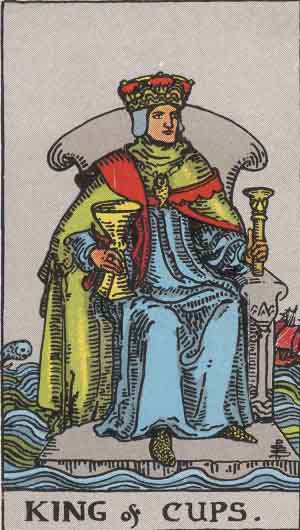
The King sits enthroned on a stone platform in the midst of a turbulent sea, holding his cup and his sceptre with steady equanimity. He is not above the water; he is in it, and he is not moved from his ground. The question this card keeps returning to ask is not whether the seeker can feel, but whether they can feel and remain.
Core Repeating Message
The King of Cups shows a figure enthroned in the midst of the sea, not above it, not beside it, but on a platform within it. The water moves around him; a fish leaps in the distance; a ship rides the waves somewhere behind. He holds a cup in his right hand and a sceptre in his left: the symbols of emotional authority and of the capacity to act from that authority. He does not look at the sea; he is not preoccupied with managing or analysing it. He is simply present, stable, neither overwhelmed by what is happening around him nor detached from it.
This is the suit’s king, and what he embodies is the most mature expression of the Cups capacity: the ability to be genuinely present with emotional complexity, in oneself and in others, without losing one’s own ground. He holds the cup without being ruled by what it contains. He is immersed in the feeling environment without being submerged by it. The sea represents the full range of emotional and unconscious life, and the King’s mastery lies in inhabiting it from a position of stability rather than controlling it.
When this card appears once, it marks the presence of this quality: in the seeker, in a person in their life, or as an invitation to develop the kind of emotional groundedness the King embodies. When it appears repeatedly, it marks a persistent pattern in the seeker’s relationship to emotional authority and containment: the challenge of remaining oneself while being fully present with the emotional reality of others.
The most common pattern is a seeker who is highly competent during other people’s difficulty but gives less deliberate attention to their own emotional life. They may be the trusted friend, adviser or family stabiliser because they listen, organise and remain calm. The capacity is valuable, yet it can conceal an imbalance if their own needs are unnamed, deferred or met only after everyone else is settled.
A second pattern is the difference between emotional regulation and rigid control. Calm behaviour may reflect genuine steadiness, temporary containment, role requirements or suppression; the card cannot know which from appearance alone. Groundedness allows feeling, choice and later processing. Control becomes costly when only composure is permitted and the seeker’s own experience has no safe place to be acknowledged.
A third pattern concerns emotional leadership in family, community or work. The seeker may have demonstrated calm judgement without deciding whether a sustained leadership role is wanted, ethical or properly supported. The King asks about responsibility, scope, accountability and succession as well as capacity. Being able to hold a difficult moment does not create an obligation to become everyone else’s permanent container.
A fourth pattern is the seeker who is emotionally wise and genuinely unaccompanied by people who can meet them at their own level. The King’s court is somewhat empty in many seekers’ lives: they provide counsel, steadiness, and emotional presence to many, and they have very few people in their landscape who offer the equivalent quality of presence in return. The King on his throne is not alone; he is surrounded by the sea. But peers who can meet the King’s emotional depth with equivalent depth of their own may be scarce.
When This Card Repeats Weekly
A week of King of Cups repetition marks an immediate encounter with the qualities this card represents: either the seeker is being called to embody genuine emotional steadiness in a situation that requires it, or the steadiness they have been maintaining is being tested by the conditions of the week.
If the week involves significant demands from others, the card asks what steadiness is costing and whether the role is freely chosen. Signs worth noticing include unavailable recovery time, difficulty declining responsibility, irritability after maintaining calm or the absence of anyone with whom the seeker can be less composed. These are observations to explore, not proof of hidden dysfunction.
When This Card Repeats Monthly
A month of King of Cups repetition suggests that the seeker’s relationship to emotional authority and emotional groundedness is a recurring theme across this period. Either the capacity is being exercised in significant and demanding contexts, or its absence, or the difference between genuine groundedness and emotional management, is making itself felt.
The monthly framing asks the seeker to look at where the King’s qualities have been fully present and where they have been approximate: performed rather than inhabited, held in place by effort rather than by stability. This examination is not self-criticism; it is useful self-knowledge that allows the development of what is still developing.
When This Card Repeats Seasonally
A season of King of Cups appearances marks a sustained period in which emotional authority, mature containment, and the relationship between emotional presence and personal ground are the central developmental territory. The seeker is doing significant work in this domain, whether or not they have named it as such.
This may be a season of counselling work, family care or community leadership that repeatedly calls for calm presence. The Ten of Cups asks about belonging; the Queen about receptive attunement; the King specifically asks how responsibility is carried. Supervision, workload, authority, compensation, respite and reciprocal support determine whether that responsibility is sustainable.
When This Card Repeats Across Years
The King of Cups returning across years or major life phases names a seeker for whom the development of emotional authority, the quality of being fully present in the emotional sea without being moved from one’s own ground, is long-arc work of depth and significance.
The qualities the King embodies do not arrive fully formed; they develop through sustained experience of being with emotional complexity, including one’s own, across time. The seeker for whom this card returns across years is developing something that takes years to develop: the emotional wisdom, groundedness, and maturity that allow the cup to be held steadily in turbulent water.
Across years, what the King of Cups asks is not faster development but more authentic development: the willingness to let emotional wisdom be hard-won rather than performed, to attend to one’s own interior with the same quality of sustained presence that the King offers to others, and to gradually develop the groundedness from which authoritative emotional presence can emerge.
Life Area Interpretations
Love & Relationships
In love and relationships, the King of Cups most often marks the seeker who brings emotional steadiness and depth to their closest connections, and who is navigating the challenges this brings. Partners, family members, and close friends may rely on the King’s stability in ways that are both important and sometimes subtly depleting.
The seeker may also be noticing, across years, the longing that belongs to the King who has given generously of his presence and his steadiness: the longing for someone who can genuinely meet them at their own depth, who can be the stable presence in the sea when the King’s own weather is turbulent. Reciprocity of emotional depth and stability is something many King-energy seekers have not yet found in close partnership, and the card repeating marks this longing alongside the gifts the seeker provides.
Career & Purpose
In career and purpose, the King of Cups can describe roles in counselling, teaching, care, mediation or leadership where emotional steadiness supports sound decisions. Personal depth is not a substitute for training, ethics, supervision or structural accountability. The mature King uses formal power transparently and does not treat calmness as permission to exceed professional scope.
The card returning in career contexts often marks the seeker who is providing this quality of service without adequate support, supervision, or reciprocal emotional care: the professional who is consistently the one who holds the difficult material, who maintains the steady presence in turbulent institutional water, and who has not ensured that they are adequately resourced for the consistent demands of this work.
Money & Stability
In money and stability, the King of Cups highlights decisions where care, loyalty or relational responsibility interacts with material reality. The seeker may undercharge, lend, support others or avoid financial conversations in order to preserve calm. This is a pattern to examine, not an inherent trait of emotional maturity. Human value and financial competence can be held together.
The seeker for whom this card repeats in financial contexts is often being asked to develop the King’s capacity in the material domain as well as the emotional: the same quality of stable, grounded, authoritative presence that characterises the King’s emotional life, applied to the practical management of material resources. Emotional wisdom and practical wisdom are not incompatible; the King’s full development includes both.
Spiritual Growth
In spiritual growth, the King of Cups marks the seeker whose spiritual life is most essentially that of sustained interior work: the contemplative who maintains spiritual depth across the full complexity of life, without needing the sea to be calm before the throne can be occupied. This is the mature spiritual practitioner, the one who has discovered that spiritual life is not a refuge from difficulty but the quality of groundedness that allows full presence within it.
The seeker for whom this card repeats spiritually is often being called to a more authoritative expression of what they have developed inwardly: to bring what the sustained interior work has produced into service, teaching, or leadership in which the King’s quality of steady presence in the turbulent sea is available to others who need it.
Emotional & Mental Patterns
In emotional and mental patterns, the King of Cups highlights the possible gap between outward steadiness and inward experience. Calm presentation alone cannot distinguish regulation, privacy, numbness, suppression or simple temperament. The seeker can examine whether feelings are accessible, whether they can be expressed safely and whether composure is flexible enough to include help-seeking.
The practical distinction is whether the strategy remains workable. Temporary containment can be necessary in a crisis or professional role, while permanent suppression may reduce self-knowledge or strain relationships. The card cannot establish that emotion accumulates in the body or unconscious. It asks whether there is time, language and appropriate support for later processing.
Family & Generational Dynamics
In family dynamics, the King of Cups most often marks the seeker who has been, or has become, the stable emotional ground of their family system: the one to whom the family turns in difficulty, the one whose steadiness is relied upon, the one whose emotional presence maintains the family’s coherence in turbulent times. This is a significant role and often a genuine vocation. It is also a role that can, without adequate attention, produce a seeker who gives consistently and receives minimally, whose own needs for emotional support are either not seen or not adequately met within the family structure.
The generational dimension of the King of Cups often marks the seeker who has inherited a role of emotional containment from the family system without having had adequate modelling of what emotional authority looks like from the inside: how a grounded emotional presence maintains itself, what the King does when the sea is turbulent in their own interior, how emotional leadership includes self-care rather than being incompatible with it.
Health & Energy
In health and energy readings, the King of Cups may reflect fatigue associated with caregiving, responsibility, vigilance or sustained emotionally demanding work. The card cannot identify the cause of fatigue, flatness, pain, sleep change or other symptoms. Persistent or concerning changes warrant appropriate health assessment, regardless of how well the symbolism fits.
The grounded response is to review workload, role boundaries, sleep, leave, supervision, peer support and access to confidential care. Reflection or therapy may help where appropriate, but no single practice guarantees recovery. The cup symbolises limited capacity: what is taken on, what belongs within the role and where responsibility must be shared.
Advanced Interpretive Sections
The Shadow Expression
The King of Cups in shadow describes two primary patterns. The first is the seeker who uses emotional control as a substitute for genuine emotional authority: whose characteristic steadiness is the steadiness of someone who has learned not to feel rather than someone who has learned to feel without losing their ground. This shadow can look very like the integrated King from the outside; the difference is interior, and it is significant.
The second shadow is the seeker who provides emotional authority and leadership in ways that become subtly controlling: whose steadiness in the turbulent sea becomes an implicit demand that others also remain calm, whose emotional containment becomes a standard that is imposed rather than offered, whose capacity for presence has been organised into a structure of emotional power over those who rely on it.
The Integrated Expression
The integrated King of Cups seeker holds the cup and the sceptre with authority and ease. They are in the emotional sea, not above it or beside it, and they are stable within it: not because the sea is always calm, but because emotional mastery is the capacity to remain oneself in whatever conditions the sea is currently producing.
This seeker gives the King’s gifts generously and receives in return: they have people in their landscape who can genuinely meet their depth, who are capable of offering the King sustained emotional presence in return for what the King so consistently provides. They attend to their own interior with the same care they bring to others’, and their groundedness is not maintained at the cost of feeling but is the quality of stability that sustained engagement with feeling across a lifetime develops.
Why This Energy Has Not Released Yet
The King of Cups pattern may persist when the emotional presence the seeker provides is not matched by adequate support, recognition or rest. Imbalance can contribute to depletion, but the card cannot diagnose burnout or predict an inevitable collapse. The useful question is which responsibilities can be shared, which supports are missing and what evidence shows that current arrangements are unsustainable.
The pattern also persists when the seeker has not yet attended to the distinction between genuine groundedness and emotional management. Until this distinction is examined, the effort of maintaining the King’s outward steadiness can be mistaken for the development of the capacity itself, even when that effort is depleting.
What This Card Wants the Seeker to Understand
The King of Cups wants the seeker to understand that emotional authority includes self-knowledge, limits and accountability. Stability does not require constant insight into every feeling, but it does require enough access to notice when judgement, capacity or behaviour is changing. The throne is sustainable when the person occupying it can share responsibility and seek support before steadiness becomes performance.
The card wants the seeker to know that emotional leadership includes being led, sometimes: the ability to receive the quality of emotional presence they so consistently provide. This is not weakness; it is what sustainability requires. The King’s cup, like any cup, needs to receive in order to continue to offer.
Signs the Pattern Is Beginning to Resolve
The King of Cups pattern begins to resolve when the seeker gives their own emotional life scheduled attention rather than residual attention. They can name what is known, acknowledge what is unclear, receive care and recognise when calm behaviour is serving the situation versus concealing a need for support. Authority becomes more flexible and therefore more reliable.
It also resolves when reciprocal emotional presence enters the seeker’s relational landscape: when they find or develop relationships in which the quality of emotional depth they offer is returned, in which they can receive what they so consistently provide. And it resolves when the seeker can be in their own turbulent sea, in the difficulty and complexity of their own interior weather, with the same quality of steady presence they bring to the sea of others.
Reflective Questions
-
In your closest relationships and significant roles, how much of your emotional energy goes toward being genuinely present for others, and how much goes toward attending to your own interior? Is this balance sustainable?
-
What happens when your own sea is turbulent: when your own emotional weather is difficult or complex? Do you attend to it with the same quality of presence you bring to others’, or does it receive a different quality of attention?
-
Is there a distinction in your experience between feeling fully and remaining stable, and managing feeling to maintain apparent stability? What does each feel like from the inside?
-
Who in your life can genuinely meet your emotional depth with equivalent depth of their own? If this number is very small, what has been the cost of this absence over time?
-
In what contexts have you provided emotional steadiness and leadership that was needed and valuable? What did this require of you, and what did it give you in return?
-
What is your own emotional weather doing right now, underneath the steadiness that you characteristically maintain for others? What would honest attention to it reveal?
-
What specific forms of renewal and replenishment restore your capacity for the King’s kind of presence: the specific practices, relationships, and conditions that fill rather than drain the cup?
-
Is there a way in which the authority the King’s ground represents has not yet been fully claimed by you: a form of genuine emotional leadership that you are capable of and that you have not yet stepped into?
-
What did you learn, in the family of origin, about what genuine emotional authority looks like? Was the King’s ground modelled? What was the cost, in the family system, of genuine emotional steadiness?
-
If you were to receive the same quality of sustained empathic presence that you most consistently offer to others, what would it feel like, and what would it change?
Practical Integration Actions
Attend to your own interior first today. Before responding to the emotional needs of others this week, practise spending ten minutes attending to your own interior: not analysing or contextualising, but being present with what you are actually feeling right now, in this day, in this body, in this season of your life. This is the King’s practice of self-knowledge alongside understanding of others, and it helps sustain the groundedness of the throne.
Name the cost honestly. Write about what the consistent provision of the King’s quality of presence has cost you over time: in energy, in self-knowledge, in the reciprocal emotional care that has not been consistently available. Not as grievance, but as honest accounting. What you can honestly name you can honestly address.
Identify what genuinely renews you. Write a list of the specific practices, relationships, and conditions that genuinely restore your capacity for sustained emotional presence: not what you think should renew you, not what you perform as self-care, but what, in your own experience, fills rather than drains the cup. Then examine whether these specific conditions are actually present in your current life, and with what regularity.
Seek genuine reciprocal presence. Identify one relationship in which emotional reciprocity is either present or possible, and practise openness to receiving: allowing concern for your wellbeing, deep attention to your interior, and sustained empathic presence to reach you rather than being immediately returned to the other person. The King who can receive genuine presence is the King whose capacity for providing it is sustainable.
Examine the management versus groundedness distinction. When a difficult feeling arises, note what the situation requires now and what will need attention later. Ask whether you can name the feeling, whether your behaviour remains chosen and whether there is a safe context for follow-up. The aim is not maximum expression in every moment, but flexible regulation that includes privacy, responsibility and timely support.