
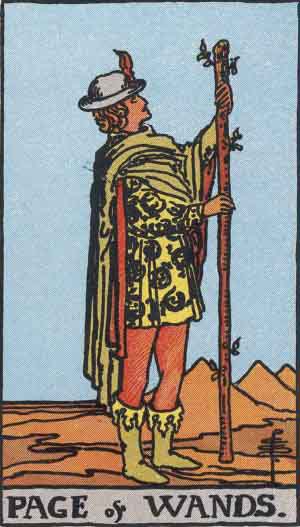
When the Page of Wands repeats, curiosity is active but its purpose is still being tested. The live question is whether exploration is gathering the evidence needed for a beginning, sustaining a valid many-sided practice, or postponing the exposure that comes with choosing one direction.
Core Repeating Message
The Page of Wands shows a young figure standing in an open, spare landscape, holding a wand upright and studying it with focused attention. The wand itself is budding, small green shoots emerging from what was a staff, a sign that the fire it represents is alive and developing. The figure is not yet moving. They are in a mode of attentive looking, the early engagement with a creative or vocational impulse that is not yet committed to a specific direction but is attentively present to what the impulse might become.
When this card appears once, it may mark a beginning that benefits from patient investigation before commitment. When it appears repeatedly, it can describe a creative life organised around exploration, but that is not automatically a deficit. The seeker may be developing a portfolio practice, responding to changing opportunities or learning what genuinely fits. The question is whether exploration produces knowledge, prototypes or decisions, or repeatedly resets before anything can be evaluated.
One common pattern is the seeker who is creative, curious and responsive to a wide range of creative, intellectual and spiritual impulses, and who finds that commitment to any single direction is consistently more difficult than the exploration of multiple possible ones. This seeker’s life has rich possibility: there are always interesting things in the vicinity, always fascinating directions to investigate, always new ideas that warrant the Page’s attentive engagement. What the seeker’s life consistently lacks is the developed manifestation of any of those possibilities: the thing that has been committed to and developed past the stage of initial investigation into something real and substantial and fully inhabitable.
A second pattern is the seeker who has not yet developed trust in their own creative impulses: who keeps investigating them, testing them, examining them from multiple angles, looking for the confirmation that would justify commitment, and who finds that the investigation continues rather than producing the confirmation, because the confirmation being sought is not something investigation can produce. The trust the seeker is waiting for requires commitment to develop, not investigation. The Page keeps appearing because the seeker keeps returning to the investigation rather than making the move that the investigation was supposed to prepare them for.
A third pattern belongs to the seeker entering a new creative beginning, an area of exploration or a vocational direction they have not inhabited before. For this seeker, the Page is not a problem to be solved but a fitting description of the moment: the fire is new, and openness and curiosity are what it needs. The pattern to examine is their relationship to beginning itself: can they inhabit the early stage without rushing it or requiring themselves to know already where it is going?
A fourth pattern is the seeker who returns to the Page’s mode as a form of creative retreat: who, when the demands of sustained creative commitment become particularly heavy, finds a new area to explore with the Page’s freshness and enthusiasm, not as a new beginning but as the renewal that starting over provides. The pattern of returning to the Page is not always avoidance; sometimes it is creative regeneration. The question is whether it consistently produces a return to sustained development of a specific creative direction, or whether it has become the seeker’s characteristic response to the difficulty of the committed middle.
What these patterns share is a relationship to the transition from exploration to development. The Page’s curious beginning is valuable; the question is whether it helps the fire find a form in which it can grow, or repeatedly replaces the sustained engagement that a particular piece of work now needs.
When This Card Repeats Weekly
A week of Page of Wands repetition marks an immediate experience of creative or vocational freshness: something new has arrived in the seeker’s creative landscape, a new idea, a new impulse, a new area of interest, and the seeker is in a mode of curious engagement with it.
The card this week may be appropriate: if the possibility is new and curiosity is helping a direction develop, the Page’s mode is exactly right. The weekly question is not whether to be curious but whether the curiosity this week is the beginning of development or whether it is the latest in a pattern of beginnings that have not yet sustained themselves past the Page’s stage.
The practical question is also: what is happening with previous creative impulses that were investigated with the Page’s curiosity? Are any of them being developed, or have they all remained in the exploratory phase?
When This Card Repeats Monthly
A month of Page of Wands repetition suggests that the seeker’s creative life is characterised across multiple contexts by the quality of curiosity and exploration without sustained development in any specific direction. Multiple things are being investigated; multiple creative impulses are being attended to; the seeker is engaged with a wide range of possible creative directions. The question is whether any of them are moving past the Page’s mode into the committed engagement that development requires.
The monthly lens asks the seeker to look at the creative and vocational impulses they have engaged with over the past several weeks: which ones have received sustained development beyond the initial exploratory phase, and which have remained interesting possibilities that have not yet been committed to? The ratio between these two categories is meaningful data about the seeker’s current relationship to the transition from exploration to development.
When This Card Repeats Seasonally
A season of Page of Wands energy marks a sustained period in which the seeker is either in a new creative beginning that requires patient, open exploration, or in a sustained pattern of exploratory engagement that has not yet produced a commitment to direction that allows creative work to develop.
A central question in a Page of Wands season concerns discernment: is the current exploratory mode serving development that is slowly clarifying, or has it been active for long enough that a different quality of engagement is actually what the creative fire is asking for?
A season is long enough to examine the quality of the seeker’s relationship to beginning. Do they find creative aliveness in the exploratory phase and difficulty in the committed development phase? Is the preference for the Page’s mode a creative characteristic that has produced substantial work when it has been given room, or is it a characteristic resistance to the vulnerability of creative commitment?
When This Card Repeats Across Years
The Page of Wands returning across years names a seeker whose relationship to their own creative fire has been consistently characterised by the exploratory mode: who has, across multiple phases of their life, found creative curiosity and openness to be more available to them than sustained creative development, and whose creative life has been significantly shaped by this pattern.
One possible long-arc pattern is a strong response to novelty followed by declining engagement as repetition, administration or external evaluation increases. Where this pattern fits, returning to the Page can preserve the excitement of beginning while postponing the transition towards the Knight or Queen. Other explanations include limited resources, changing health or care demands, neurodivergent attention patterns, unsuitable environments or a genuinely multidisciplinary vocation. The card cannot determine the cause. The useful evidence is what kinds of structure have previously allowed curiosity to become durable work without extinguishing it.
The multi-year Page also marks the seeker who has creative breadth and responsiveness to a wide range of impulses and who is in the process of discovering, over a long arc, what specific creative direction their fire most wants to commit to. This discovery process is real and it takes time; the question is whether the exploration is actively moving toward clarity and commitment or whether it has become its own established mode.
Across years, the growth arc this card traces is towards creative depth alongside breadth: the capacity to commit to a specific direction without losing the openness and curiosity of the Page, and to discover from that commitment the substantial creative development that the Page’s exploration was always preparing for.
Life Area Interpretations
Love & Relationships
In love and relationships, the Page of Wands most often marks the seeker whose relational engagement has the quality of exploration without yet arriving at sustained commitment: who finds the early stages of relational connection alive and interesting, and who finds the transition from exploration to depth and commitment challenging.
This pattern may appear in a relational history of vivid beginnings followed by reduced interest or difficulty with the ordinary work of intimacy. It may also reveal incompatibility that becomes visible only with time. Commitment is not automatically the more mature answer, and exploration should not be used to imply consent to exclusivity. The evidence is whether interest declines whenever novelty fades or specifically when values, safety or needs do not align.
The card may also mark the seeker who is at the beginning of a new relational possibility and is being asked to inhabit the exploratory beginning with openness rather than rushing it into a commitment that the exploration has not yet earned.
Career & Purpose
In career and purpose, the Page of Wands marks the seeker whose vocational life is characterised by enthusiasm for new directions and difficulty sustaining development in any specific direction past the initial exciting phase. This seeker may have explored multiple vocational possibilities with interest and initial investment, and may find that each successive exploration produces early aliveness that gradually diminishes as the ordinary demands of sustained vocational development become the primary texture of the engagement.
The vocational Page also marks the seeker who is early in a new creative or vocational direction: who has found a new area of engagement, who does not yet fully know what it will become, and who is being asked to bring patient curiosity to the development of this direction rather than requiring it to immediately produce the clarity and certainty of a more advanced stage.
The vocational challenge this card marks is developing the capacity to sustain creative fire through the ordinary sustained work that vocational development eventually requires.
Money & Stability
In financial contexts, the Page of Wands may reflect research into several earning, saving, study or business possibilities before a decision has been made. Exploration can be prudent when information is incomplete, but it can also become a sequence of attractive ideas with no comparison method or stopping rule.
Use current figures to compare setup cost, recurring cost, risk, liquidity, time requirement and exit conditions. Small reversible trials may be more informative than immediate commitment. High-stakes choices require appropriate qualified financial, legal or tax advice, and the card should not be treated as evidence that an opportunity is sound.
The question in financial contexts is the same as in all Page contexts: is the exploration helping to clarify the right financial direction, or has the exploration become a way of remaining in the interesting early stage rather than making the commitments that financial development requires?
Spiritual Growth
In spiritual growth, the Page of Wands marks the seeker whose spiritual life is characterised by curiosity and openness to a wide range of spiritual possibilities: who investigates practices, traditions, and paths with interest and responsiveness, and who finds commitment to a sustained and deepening practice in any single direction challenging.
The spiritual Page is a recognisable pattern, and it is not simply avoidance. Broad exploration can produce understanding and development. The question is whether it supports sustained depth in any practice, or whether moving from one interest to the next keeps replacing the commitment that a developing practice now requires.
For some seekers, the repeated Page of Wands in spiritual contexts marks the early stage of a spiritual beginning: a new relationship to the sacred that is authentically beginning and that requires patient openness before it fully declares itself.
Emotional & Mental Patterns
The Page of Wands in emotional and mental patterns marks the seeker whose characteristic intellectual and creative engagement has the quality of enthusiastic beginnings: who engages with new ideas, new interests, new areas of creative or intellectual exploration with aliveness, and whose engagement gradually diminishes as the initial freshness gives way to the sustained effort that depth of development requires.
This is not a quality of superficiality; the seeker’s intelligence and curiosity are real. The pattern is the relationship between aliveness and novelty: the seeker whose creative and intellectual fire is most consistently present at the beginning of a new engagement, and whose characteristic response to the fading of initial aliveness is a new beginning rather than a deepening of the existing engagement.
The emotional quality the Page marks is a longing for creative depth alongside difficulty reaching it: the seeker who knows that the sustained development of a specific creative direction produces something the multiple beginnings do not, but who finds the ordinary sustained effort of that development consistently less alive than the initial exploratory engagement.
Family & Generational Dynamics
In family dynamics, the Page of Wands may invite inquiry into how beginning and exploration were treated. Multiple interests may have been welcomed while sustained development received less support, or beginnings may have been interrupted by instability, criticism or changing circumstances. These are possibilities, not a family history the card can establish. The seeker should look for remembered examples and present-day repetitions.
One possible inherited influence is how being a beginner was received: as a promising, valued state or as an embarrassing inadequacy to move beyond quickly. Where the seeker recognises either message, they can examine how it affects their present relationship to early creative work.
Health & Energy
In health contexts, the Page of Wands may symbolically reflect the felt lift that can accompany curiosity, novelty or manageable experimentation. Tarot cannot determine why energy changes, whether an activity is restorative or what the body can safely sustain.
If new beginnings feel energising after sustained work, compare that response across time and contexts. It may indicate useful renewal, reduced demand, novelty or another factor. Notice whether that renewal helps the seeker return to sustained work or increasingly takes its place. Persistent fatigue, marked changes in energy or difficulty functioning deserve appropriate assessment rather than a symbolic explanation.
The symbolic invitation is to keep curiosity and beginner’s openness available alongside sustained work, using them as a low-stakes experiment within safe limits and noticing the result. Treat that result as personal feedback, not medical proof, and allow exploration to coexist with rest, treatment or accessibility needs where relevant.
Advanced Interpretive Sections
The Shadow Expression
The Page of Wands in shadow produces the seeker who has developed such a sophisticated relationship to the exploratory beginning that they have effectively become permanent beginners: who can sustain enthusiasm for virtually any new creative or intellectual direction for the period of initial engagement, and who has developed expertise in the Page’s stage that never produces the creative development the Page is supposed to serve.
The shadow also produces the seeker who uses the freshness and openness of the Page’s mode as protection against the vulnerability of creative commitment: who remains in the exploration phase not because the direction has not yet clarified but because clarity would require commitment, and commitment produces a quality of exposure that the exploration perpetually defers.
The Integrated Expression
The integrated Page of Wands seeker has developed the capacity to inhabit both exploratory and committed modes of creative engagement. They can bring curiosity and openness to new possibilities and make the transition to sustained development when a direction has clarified.
This seeker’s creative life is characterised by breadth and depth: they explore widely and they develop specifically, and the exploration consistently serves the development rather than replacing it. They have tolerance for the ordinary sustained effort that creative development requires, and they have discovered through experience that the creative fire in the sustained development phase is different from the fire in the exploratory phase but just as alive in its own way.
Why This Energy Has Not Released Yet
The Page of Wands pattern may persist because the beginning supplies novelty, possibility and low exposure, while sustained development introduces repetition, judgement and constraint. It may also persist because the seeker has not yet found conditions that support continuity. Without experience of aliveness in sustained work, returning to a beginning may feel like moving towards fire rather than away from development. The aim is not to prove that one mode is superior, but to test whether a chosen direction can remain alive when structure is designed around actual capacity.
The pattern can also persist when the seeker has not yet examined the difficulty in the transition from Page to Knight or Queen: what specifically becomes harder, less alive, more exposed, more ordinary, at the point where commitment is required and the initial freshness of the beginning has passed. Exploration may be protecting against that particular difficulty; naming it can make a more deliberate response possible.
What This Card Wants the Seeker to Understand
The Page of Wands wants the seeker to understand that the wand in this image is budding. The green shoots are emerging from the staff. The fire that the Page is holding is alive and developing toward something. What the card is asking is whether the seeker will stay curious and open enough to follow that development past the initial stage of fascination into the sustained development that turns a budding branch into a flourishing living thing.
The curiosity is real. The fire is real. What the Page is preparing for is not another beginning. It is the direction that the beginning is trying to clarify, and patience with the exploration in service of that direction is exactly what the card is asking for.
Signs the Pattern Is Beginning to Resolve
The Page of Wands pattern begins to resolve when the seeker begins to make commitments to specific creative directions rather than continuing to hold all directions in the exploratory mode: when a particular impulse is given the sustained development it has been asking for, rather than being kept in the investigative stage indefinitely.
It also resolves when the seeker begins to develop experiential knowledge of the quality of creative aliveness available in the sustained development phase: when they discover, from experience of staying with a specific direction through the Page’s stage into something more developed, that the fire does not go out when commitment arrives. It changes its quality. And the new quality is alive in its own way.
And it resolves when the seeker develops the capacity to bring the Page’s curiosity and openness into the sustained development phase rather than leaving those qualities behind at the transition: when the beginner’s mind becomes a practice within committed creative development rather than a stage that precedes it.
Reflective Questions
-
Think about the creative, vocational, or intellectual impulses you have explored over the past year or two. Which of them have received sustained committed development past the initial exploratory phase, and which have remained interesting possibilities that you have not yet committed to?
-
What specifically happens for you at the transition point where a creative exploration asks to become a commitment? What is the quality of what you feel at that moment, and what does it tell you about your relationship to creative commitment?
-
Is there a specific creative direction that the Page energy has been preparing you for, that the exploration has been pointing toward with increasing clarity? Can you name it specifically?
-
What does the initial exploratory phase of a new creative or vocational engagement provide that the sustained development phase does not? Be honest about the specific quality of the beginning that is most alive for you.
-
Have you experienced the quality of creative aliveness available in sustained development of a particular direction? What was that experience like, and what did it produce that the multiple beginnings did not?
-
Is there a pattern across multiple creative or vocational engagements in which your investment was highest at the beginning and gradually diminished as the ordinary demands of sustained development became the primary texture of the work? What specifically triggers the diminishment?
-
What does your relationship to creative commitment feel like from the inside? Is there a specific quality of exposure, of foreclosing other possibilities, or of becoming visible in a specific direction, that makes commitment difficult?
-
What did your early environment communicate about the appropriate pace and depth of creative engagement? Were multiple simultaneous interests encouraged, or was deep commitment to a single direction modelled and valued?
-
Is there a genuine new beginning in your current life that authentically deserves the Page’s patient, curious, exploratory engagement rather than being rushed into commitment? What would patient openness look like for that specific beginning?
-
If the Page of Wands has been appearing for a sustained period, what specifically has it been marking as the beginning that has not yet been allowed to develop into sustained creative engagement? What would allowing that development actually require?
Practical Integration Actions
Inventory your current explorations. Write out the specific creative, vocational, and intellectual directions you are currently investigating with the Page’s mode of curious engagement. For each one, note honestly how long the investigation has been active and whether it has moved at all toward committed development or remains primarily in the exploratory phase. The exercise is to see the full scope of the current exploration clearly.
Choose one to develop. From the list, identify the direction that exploration has most consistently shown to be significant, feasible and specific enough to evaluate. Commit to developing it for a defined period, with an output, time boundary and review criteria. This might be a daily practice, a structured project or an investment of time over several months where that is workable; use a daily, weekly or project-based rhythm suited to actual capacity. At the review point, decide to deepen, adapt, pause or conclude on evidence, rather than treating continuation as the only successful result.
Examine the transition difficulty. Write specifically about what happens at the point where a creative exploration asks to become a commitment. What is the quality of resistance or difficulty that arises? Is it the foreclosing of other possibilities, the exposure of creative output to assessment, the loss of the aliveness of the beginning? Naming the specific quality of the difficulty is the first step toward engaging with it rather than simply returning to another exploration.
Practise staying. For one engagement you might leave when novelty fades or another possibility starts to look more interesting, continue until the review point set in the previous exercise unless cost, safety or material facts justify an earlier change. Record what sustained engagement and repetition produce that multiple beginnings do not, what support improves continuity and what remains unsuitable. Use that experience as a reference point. Staying is an experiment in depth, not a requirement to persist with a harmful or unworkable direction.
Bring the Page’s curiosity forward. Once you have committed to a specific direction, practise bringing the Page’s curiosity and openness into the sustained development phase: approaching each session of the sustained work with questions, openness to what the work will reveal and attention to what is actually emerging rather than a fixed agenda of what needs to be produced. The beginner’s mind is not only appropriate at the beginning; it is a practice that sustained creative development benefits from throughout its full arc.